



Cloud Enterprise Content Management Market Trends, Companies, Revenue / Sales Performance, Subscriber Growth, Pricing Strategies, Cloud Adoption, Infrastructure Expansion, Competitive Landscape, and Industry Outlook
Cloud Enterprise Content Management Market (By Solution: Content Management, Case Management, Workflow Management, Record Management, Digital Asset Management, Other Solutions; By Deployment Model: Public Cloud, Private Cloud, Hybrid Cloud; By Service: Professional, Managed; By Organization Size: Small and Medium Enterprises, Large Enterprises; By End-User Industry: Banking, Financial Services, and Insurance (BFSI), Energy and Power, Medical and Healthcare, Manufacturing, Retail, Information Technology and Telecom, Other End-User Industries) - Global Industry Analysis, Size, Trends, Leading Companies, Regional Outlook, and Forecast 2026 to 2035
Source: https://www.precedenceresearch.com/cloud-enterprise-content-management-market
 Get a Sample
 Table Of Content


What is the Cloud Enterprise Content Management Market Size?
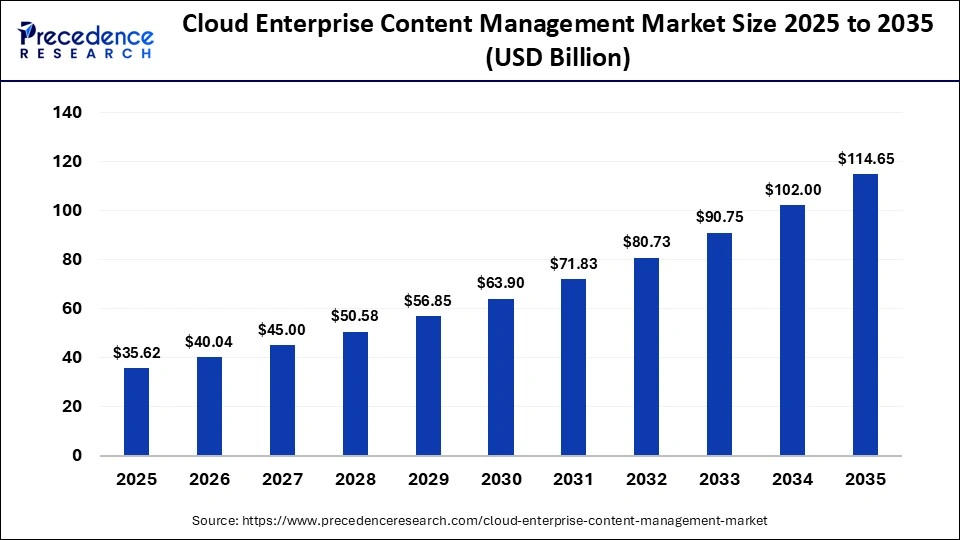
The global cloud enterprise content management market size was calculated at USD 35.62 billion in 2025 and is predicted to increase from USD 40.04 billion in 2026 to approximately USD 114.65 billion by 2035, expanding at a CAGR of 12.40% from 2026 to 2035. The market is rapidly growing due to the integration of artificial intelligence and machine learning, which allows for automated content categorization, intelligent analytics, and expansion of data generation. Organizations are transitioning from paper-based processes to digital workflows to support remote, distributed teams that require secure, anywhere access to documents.
Key Takeaways
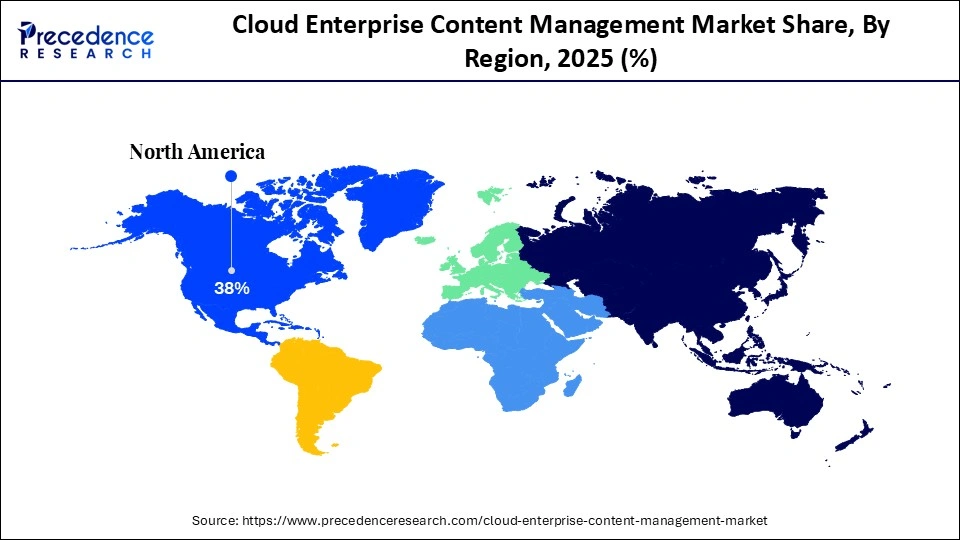
- North America held the largest market share of 38% in 2025.
- Asia-Pacific is expected to grow at the fastest CAGR during the foreseeable period.
- By solution, the content management segment held the largest cloud enterprise content management market share in 2025.
- By solution, the digital asset management segment is expected to grow at the fastest CAGR during the forecast period.
- By deployment model, the public cloud segment held the largest market share in 2025.
- By deployment model, the hybrid cloud segment is expected to grow at the fastest CAGR between 2026 and 2035.
- By service, the professional services segment held the major market share of 57% in 2025.
- By service, the yet managed services segment is expected to grow at the fastest CAGR during the foreseeable period.
- By organization size, the large enterprises segment contributed the highest market share of 65% in 2025.
- By organization size, the small and medium enterprises segment is expected to grow at the fastest CAGR during the foreseeable period.
- By end-user industry, the banking, financial services, and insurance segment held the largest market share in 2025.
- By end-user industry, the healthcare segment is expected to grow at the fastest CAGR during the foreseeable period.
What is Cloud Enterprise Content Management?
The global cloud enterprise content management market comprises functions that serve as a single source of truth, streamlining the lifecycle of unstructured data, such as media and correspondence, and formal records. By leveraging a SaaS model, it eliminates data silos and integrates directly into existing workflows to drive operational efficiency and digital agility. Key benefits include improved remote collaboration, enhanced data security, reduced operational costs, and seamless integration with existing tools, such as ERP or CRM.
Market growth is driven by the rise of AI-powered automation for document classification, increased demand for regulatory compliance, and the necessity for digital workplace solutions to support hybrid work models. The SME adoption is scaling rapidly, making these advanced capabilities accessible across various industry verticals.
How is AI Influencing the Cloud Enterprise Content Management Market?
The integration of Artificial Intelligence, specifically machine learning (ML), is transforming the cloud enterprise content management industry by turning static document repositories into intelligent, active data ecosystems. Generative AI is enhancing content retrieval through semantic, context-aware search, allowing users to find specific information across vast, unstructured datasets rather than just searching by file name. The integration of AI/ML also strengthens governance by automatically enforcing compliance policies and identifying sensitive information for reduction. Cloud-based ECM solutions are evolving into proactive, automated systems that provide actionable insights and streamlined workflows, enabling organizations to maximize the value of their digital assets.
Cloud Enterprise Content Management Market Trends
- Adoption of Hybrid and Multi-Cloud Models: Organizations balance data sovereignty with the scalability of the cloud; hybrid and multi-cloud approaches are becoming dominant, particularly in regulated industries, such as banking and healthcare. This allows companies to keep sensitive data on-premise or in private clouds while leveraging the public cloud for collaboration and content management.
- Rise of Low-code Content Applications: To speed up digital transformation and reduce reliance on specialized IT teams, businesses are increasingly adopting low-code ECM platforms to create custom applications.
- Stringent Regulations: The rise in data breaches and stricter regulations (such as GDPR) means that cloud ECM solutions are integrating advanced, automated security features like zero-trust, data tokenization, and encryption.
- Rising Focus on Sustainability: Enterprises are prioritizing cloud providers that can help reduce their carbon footprint, with major vendors aiming for 100% renewable energy usage for their data centers. The increasing utilization of energy-efficient cloud operations and digital workflows to replace paper-based processes enhances the company's overall environmental, social, and governance goals.
Market Scope
| Report Coverage | Details |
| Market Size in 2025 | USD 35.62 Billion |
| Market Size in 2026 | USD 40.04 Billion |
| Market Size by 2035 | USD 114.65 Billion |
| Market Growth Rate from 2026 to 2035 | CAGR of 12.40% |
| Dominating Region | North America |
| Fastest Growing Region | Asia Pacific |
| Base Year | 2025 |
| Forecast Period | 2026 to 2035 |
| Segments Covered | Solution, Deployment Model, Service, Organization Size, End-User Industry, and region |
| Regions Covered | North America, Europe, Asia-Pacific, Latin America, and Middle East & Africa |
Segmental Insights
Solution Insights
Which Solution Segment Led the Cloud Enterprise Content Management Market?
The content management segment led the market in 2025. This is because the convergence of elastic scalability, remote accessibility, and cost-efficient SaaS models is fundamentally reshaping how enterprises manage their digital assets. By integrating AI-driven automation and robust compliance frameworks, cloud ECM solutions empower organizations to optimize workflows while mitigating regulatory risks. The market is shifting towards agile, integrated platforms that prioritize both operational efficiency and data security.
The digital asset management segment is expected to show the fastest growth over the forecast period, due to the expansion of digital content across marketing and e-commerce, which is forcing a shift toward specialized, cloud-native management. By leveraging AI-driven automation and centralized security, these platforms eliminate operational silos and reduce redundant overhead. The transition to cloud DAM empowers distributed teams to scale content lifecycles with greater speed, consistency, and cost-efficiency.
Deployment Model Insights
Why Did the Public Cloud Segment Dominate the Cloud Enterprise Content Management Market?
The public cloud segment held the largest market share in 2025. This is because of a strategic shift from high-capital infrastructure to an agile, opex-driven model that aligns IT spending with real-time business needs. By centralizing content on hyperscale platforms, organizations gain immediate access to enterprise-grade security and AI-powered automation that would be cost-prohibitive to develop in-house. This environment not only supports the distributed workforce through seamless worldwide accessibility but also ensures continuous modernization through automatic background updates.
The hybrid cloud segment is expected to gain the highest market share between 2026 and 2035, due to its ability to enable organizations to modernize through AI and IoT while maintaining sovereign control over legacy assets. By tiering workloads, businesses achieve a balance of elastic scalability and cost optimization without compromising on stringent regulatory mandates. This model provides the operational resilience needed to support a distributed workforce while safeguarding mission-critical data.
Service Insights
How the Professional Services Segment Dominated the Cloud Enterprise Content Management Market?
The professional services segment contributed the biggest market share in 2025, as professional services are an essential bridge for enterprises transitioning to a cloud-first strategy, ensuring seamless integration between modern ECM platforms and legacy environments. By providing bespoke customization for complex regulatory landscapes, these experts transform generic tools into high-governance assets. Their ongoing advisory role ensures long-term scalability and security, allowing organizations to maintain peak operational agility.
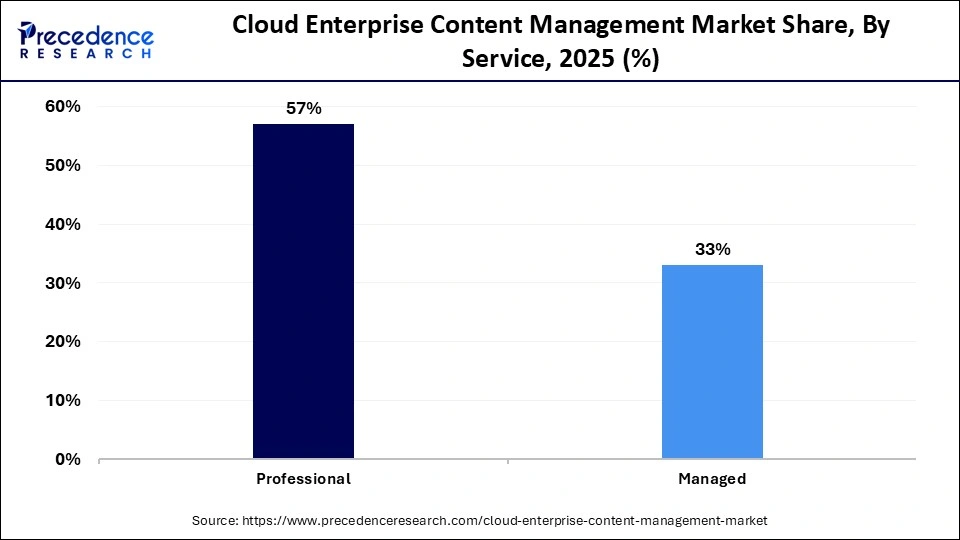
The yet managed services segment is expected to witness the fastest growth in the market over the forecast period, due to offloading maintenance and security to specialized providers, and organizations achieve a cloud-native posture that ensures both regulatory resilience and 24/7 accessibility. This shift allows leadership to redirect internal resources towards core business innovation while maintaining a high-velocity, collaborative environment.
Organization Size Insights
Why Did the Large Enterprises Segment Lead the Cloud Enterprise Content Management Market?
The large enterprises segment accounted for the highest market share in 2025. This is because critical requirements for managing the massive volume and complexity of unstructured data, these platforms provide the interoperability needed to link siloed systems, such as CRM and ERP, creating a unified digital ecosystem that drives operational agility. By combining automated compliance with elastic scalability, large organizations can sustain worldwide growth and a distributed workforce without the friction of legacy infrastructure.
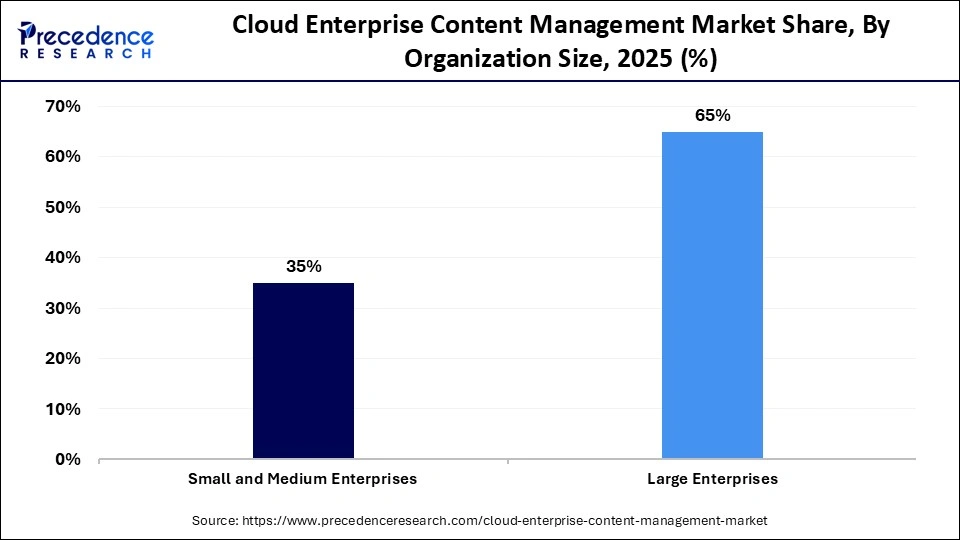
The small and medium enterprises segment is expected to expand rapidly in the market in the coming years, due to their ability to provide enterprise-grade functionality and AI-driven automation without the prohibitive costs of traditional infrastructure. This SaaS-based agility allows smaller firms to scale their operations instantly and support a distributed workforce with minimal IT overhead. These platforms enable SMEs to maintain competitive parity and operational resilience in an increasingly digital-first economy.
End-User Industry Insights
Which End-User Industry Insights Segment Dominated the Cloud Enterprise Content Management Market?
The banking, financial services, and insurance segment registered its dominance in the market in 2025. This is because, by shifting to an opex-centric model, institutions achieve significant cost optimization while replacing rigid legacy systems with high-velocity, AI-powered workflows. This infrastructure not only secures massive volumes of sensitive data but also enables the omnichannel agility necessary to deliver superior customer experiences in a digital-first market.
The healthcare segment is expected to grow with the highest CAGR in the market during the studied years, due to modern patient care, enabling the secure, real-time exchange of medical records and high-resolution diagnostic images across distributed networks. By automating HIPAA and GDPR compliance, these platforms mitigate the risk of data breaches while providing the elastic infrastructure necessary to support the surge in telehealth adoption. This shift from legacy hardware to integrated cloud solutions drives clinical efficiency, allowing providers to focus on improving patient outcomes.
Regional Analysis
What is the North America Cloud Enterprise Content Management Market Size?
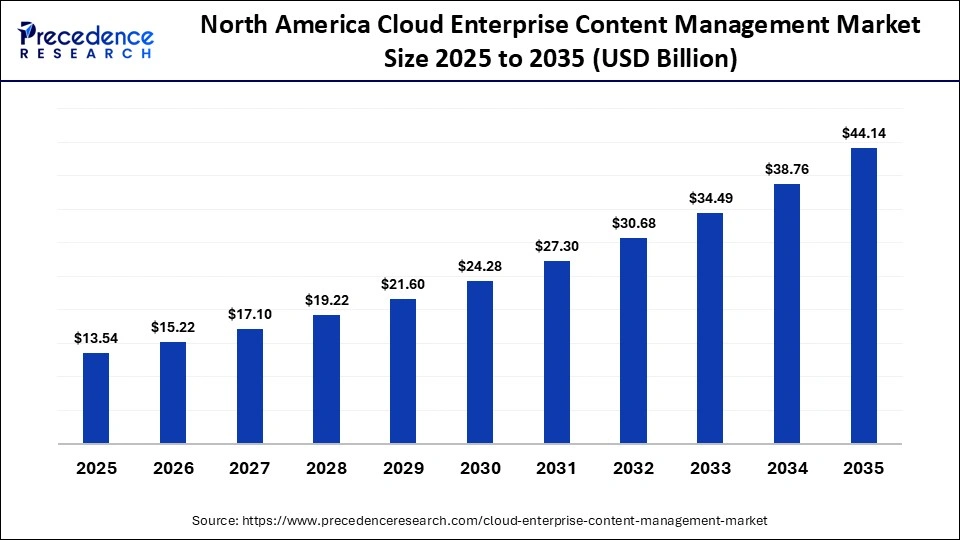
The North America cloud enterprise content management market size is estimated at USD 13.54 billion in 2025 and is projected to reach approximately USD 44.14 billion by 2035, with a 12.54% CAGR from 2026 to 2035.
What Made North America the Dominant Region in the Cloud Enterprise Content Management Market?
North America registered its dominance in the market in 2025. This is mainly due to high digital maturity and the presence of industry-leading vendors driving continuous AI innovation. These regions' strict regulatory landscape necessitates the high-governance, secure infrastructure that only advanced cloud platforms can provide at scale. By integrating these tools into regulated sectors and hybrid work models, organizations achieve the operational agility and compliance resilience required for global leadership. There is a shift towards hybrid work models that has driven demand for scalable, flexible, and accessible cloud solutions that facilitate remote collaboration and data security.
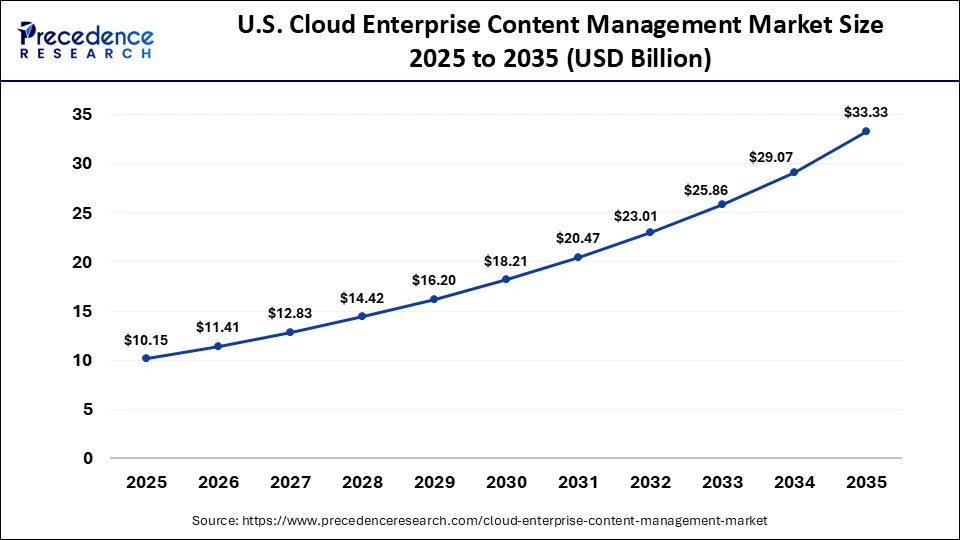
U.S. Cloud Enterprise Content Management Market Size and Growth 2026 to 2035
The U.S. cloud enterprise content management market size is calculated at USD 10.15 billion in 2025 and is expected to reach nearly USD 33.33 billion in 2035, accelerating at a strong CAGR of 12.63% between 2026 to 2035
U.S. Market Analysis
The market in the U.S. is growing due to the prioritization of AI-driven automation and high-governance security to meet escalating regulatory demands. By adopting no-code tools and hybrid infrastructures, organizations are democratizing process automation and achieving unprecedented operational velocity across the region. The shift towards hyperscale platforms ensures that enterprises remain scalable, compliant, and ready for a digital-first future.
How is Asia-Pacific Growing in the Cloud Enterprise Content Management Market?
Asia-Pacific is expected to experience the fastest growth during the predicted timeframe, due to the massive infrastructure initiatives and a rapid shift toward digital public services across emerging economies. The region's booming BFSI and e-commerce sectors are leveraging these platforms to manage high-velocity data while transitioning from rigid CAPEX models to agile, OPEX-driven cloud environments. By prioritizing mobile-first accessibility and 5G integration, organizations are building a resilient digital foundation to support a highly mobile and distributed workforce.
China Market Analysis
In China, the market is evolving due to the shift toward public and hybrid cloud environments, with SMEs emerging as a high-growth segment due to flexible, subscription-based models. Industry demand is anchored by the BFSI and government sectors, where the need for automated compliance and AI-driven workflow optimization is paramount. By prioritizing mobile-first accessibility and robust data sovereignty, organizations are building resilient, high-velocity digital infrastructures.
Will Europe Grow in the Cloud Enterprise Content Management Market?
Europe is expected to grow at a notable CAGR in the foreseeable future. Cloud ECM growth is anchored in a compliance-first strategy, where stringent GDPR mandates drive the adoption of high-governance, secure digital repositories. By integrating AI-powered automation into legacy manufacturing and financial workflows, organizations are replacing rigid infrastructure with elastic, cost-effective SaaS models. This transition not only secures sensitive data but also provides the collaborative agility necessary to sustain a robust hybrid workforce across the continent.
UK Cloud Enterprise Content Management Market Trends
The surging demand for AI-enabled content management solutions from the retail sector, along with the rapid deployment of cloud-based record management software in small and medium enterprises, fosters the industrial expansion.
Germany Market Trends
The German market is driven by the growing demand for scalable digital workflows and favourable government initiatives. German enterprises increasingly incorporate GenAI for automated metadata tagging, contract analysis, and intelligent document capture. The presence of key players, such as SAP, Newgen, and OpenText, also contributes to market growth.
What is Driving the Cloud Enterprise Content Management Market in Latin America?
The increasing emphasis of the BFSI companies in Brazil and Argentina to store information in the cloud platforms has driven the industrial growth. Additionally, the rapid investments by the government for digitalizing the healthcare sector are playing a crucial role in driving the market expansion.
Brazil Cloud Enterprise Content Management Market Analysis
The growing adoption of hybrid cloud storage solutions by the energy and power companies, coupled with the increasing deployment of agentic AI in the telecom sector, has contributed to the industrial growth.
What is the Trend of the Cloud Enterprise Content Management Market in Middle and East Africa?
The surging emphasis of the investment firms on deploying digital asset management solutions to improve their investing capabilities has accelerated the industrial growth. Moreover, the increasing focus of the government on integrating advanced technologies such as Big Data Analytics and AI in the manufacturing sector is adding to the market expansion.
South Africa Cloud Enterprise Content Management Market Trends
The rising investment by the IT companies to integrate advanced cloud management platforms to enhance their working efficiency, as well as technological advancements in the medical sector, has boosted the market growth.
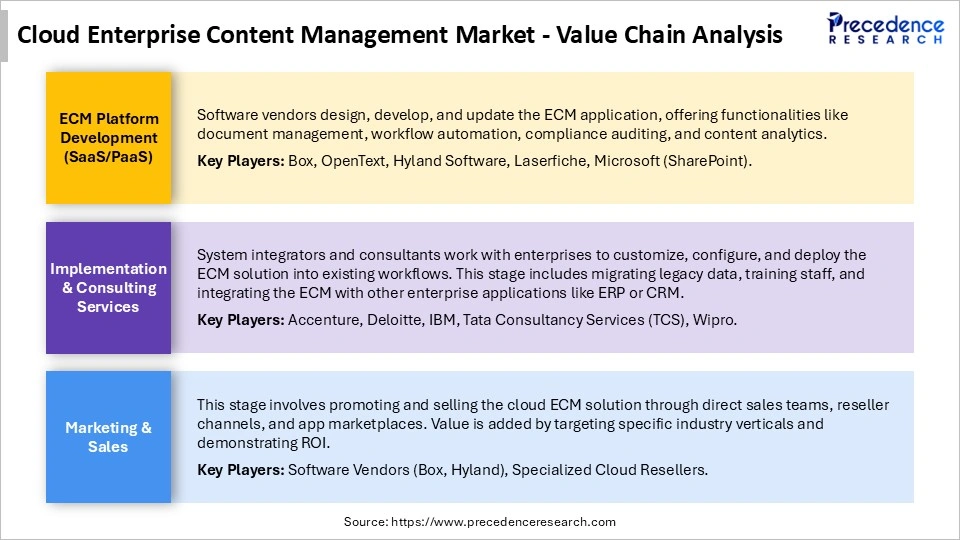
Cloud Enterprise Content Management Market Value Chain Analysis
Top Companies in the Cloud Enterprise Content Management Market
- Adobe Inc.
- Box Inc.
- Alfresco Software Inc.
- Hyland Software Inc.
- Microsoft Corporation
- IBM Corporation
- OpenText Corporation
- Xerox Holdings Corporation
- Oracle Corporation
- Newgen Software Technologies Limited
- Laserfiche
- DocuWare GmbH
- M-Files Corporation
- KnowledgeLake Inc.
- Fabasoft
Recent Developments
- In May 2026, Synergis Software launched the Adept Cloud. Adept Cloud is a Cloud-Native document management platform designed for the asset-Intensive Industries.
- (Source: https://finance.yahoo.com)
- In May 2026, Broadcom unveiled the VMware Cloud Foundation 9.1 platform. This cloud-based platform enables businesses to deploy inference and agentic AI applications with lower costs, enhanced security, and delivers freedom to choose among GPU and CPU hardware.
- (Source: https://news.broadcom.com)
- In April 2026, Google Cloud partnered with Accenture. This partnership was done to transform agentic transformation for global enterprises by using Gemini Enterprise. (Source: https://newsroom.accenture.com)
- In April 2026, Hyland launched an AI-based content management solution. This solution was designed to help organizations work more intelligently with content, modernize core systems, and enhance AI‑driven automation in cloud enterprises. (Source: https://www.hyland.com)
- In March 2025, Satcom Infotech announced a strategic distribution partnership with GoTo to distribute IT and cloud management solutions across India, targeting SMEs and large corporations. The collaboration focuses on providing AI-powered tools, including LogMeIn Rescue and GoTo Meeting, while leveraging a new INR billing structure to support local partner margins.
(Source: https://www.htsyndication.com) - In April 2024, Hyland launched Hyland Experience Automate (Hx Automate), a cloud-native service designed to drive intelligent content automation, incorporate LLMs, and streamline enterprise workflows through low-code tools. As part of the Hyland Experience platform, it enables organizations in industries like insurance and education to modernize content management and integrate with existing systems.
(Source: https://www.hyland.com)
Segments Covered in the Report
By Solution
- Content Management
- Case Management
- Workflow Management
- Record Management
- Digital Asset Management
- Other Solutions
By Deployment Model
- Public Cloud
- Private Cloud
- Hybrid Cloud
By Service
- Professional
- Managed
By Organization Size
- Small and Medium Enterprises
- Large Enterprises
By End-User Industry
- Banking, Financial Services, and Insurance (BFSI)
- Energy and Power
- Medical and Healthcare
- Manufacturing
- Retail
- Information Technology and Telecom
- Other End-User Industries
By Region
- North America
- Latin America
- Europe
- Asia-pacific
- Middle and East Africa
For inquiries regarding discounts, bulk purchases, or customization requests, please contact us at sales@precedenceresearch.com
Frequently Asked Questions





Ask For Sample
No cookie-cutter, only authentic analysis – take the 1st step to become a Precedence Research client
 Get a Sample




 sales@precedenceresearch.com
 Schedule a Meeting
