



Collation Shrink Film Market Size, Share and Trends 2026 to 2035
Collation Shrink Film Market (By Material: LCPE, LLDPE, MDPE, HDPE, PP, Others; By Application: Bottles, Cans, Books and magazines, Cartons, Others; By End-Use: Food and beverages, Cosmetics, Personal Care and home Care, Transport and logistics, Pharmaceuticals, Printing and publications, Others) - Global Industry Analysis, Size, Trends, Leading Companies, Regional Outlook, and Forecast 2026 to 2035
 Get a Sample
 Table Of Content


What is Collation Shrink Film Market Size in 2026?
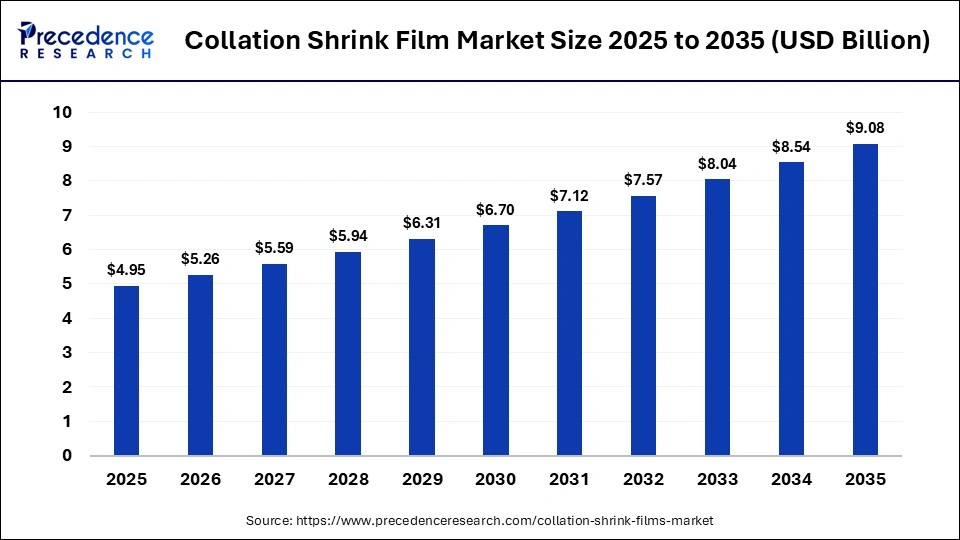
The global collation shrink film market size was calculated at USD 4.95 billion in 2025 and is predicted to increase from USD 5.26 billion in 2026 to approximately USD 9.08 billion by 2035, expanding at a CAGR of 6.25% from 2026 to 2035. The market is driven by increasing demand for sustainable, high-performance, and cost-effective packaging solutions across various consumer goods sectors.
Key Takeaways
- North America dominated the market with a major share in 2025.
- Asia Pacific is expected to grow at the fastest CAGR between 2026 and 2035.
- By material, the LLDPE segment contributed the highest market share in 2025.
- By material, the LDPE segment is expected to grow at a strong CAGR between 2026 and 2035.
- By application, the bottles segment held a major market share in 2025.
- By application, the cans segment is expected to expand at the fastest CAGR from 2026 to 2035.
- By end-use, the food and beverage segment captured the highest market share in 2025.
- By end-use, the pharmaceuticals segment is poised to grow at a healthy CAGR between 2026 and 2035.
Market Overview
Collation shrink film is a flexible, heat-shrinkable packaging material used to bundle multiple individual products, such as bottles, cans, or cartons, into a single, secure unit for secondary packaging. It provides high tensile strength for transport and clarity for retail display, with market growth driven by automation, e-commerce, and sustainable, recyclable, or downgauged formulations. The shift toward sustainable, recyclable, and biodegradable materials is crucial, with manufacturers focusing on reducing plastic waste and improving.
How is AI Transforming the Collation Shrink Film Market?
Artificial intelligence (AI) is transforming the collation shrink film market by optimizing manufacturing through real-time defect detection with computer vision, predictive maintenance, and reducing material waste, with an emphasis on smart, eco-friendly films. AI-powered machine vision inspects films in real-time, significantly reducing waste. IoT-enabled systems forecast machine failures before they occur, lowering downtime. AI analyzes data to optimize inventory and forecasting, especially for e-commerce. AI assistants also reduce setup time for advanced, multi-layer, or seven-layer film production lines.
Major Trends in the Collation Shrink Film Market
- Growing Sustainability and Circular Economy Adoption: Stringent environmental regulations and consumer preferences are pushing the market toward recyclable, bio-based, and thinner films for better recyclability.
- Rapid Down Gauging and High-Performance Films: Manufacturers are emphasizing the reduction of film thickness while maintaining or even increasing tensile strength and stiffness, decreasing material usage and transportation costs.
- E-commerce Driven Demand for Secure Packaging: The increase in online retail and doorstep delivery has escalated the need for secure, durable, and tamper-evident packaging, with high-clarity, retail-ready presentation.
- Technological Advancements in Multi-Layer Films: Innovations in 5-layer and 7-layer structures are improving performance, such as better puncture resistance, enhanced printing, and improved seal integrity.
- Improved Machine Compatibility and Process Efficiency: Shrink films are increasingly designed for compatibility with high speed packaging lines and automated equipment, supporting faster production cycles and reduced downtime.
- Customization and Branding Opportunities: Brands are using printable and high clarity shrink films for enhanced aesthetics and promotional appeal, allowing custom designs for retail shelving and seasonal campaigns.
- Rising Demand in Pharmaceutical and Healthcare Packaging: Stringent safety and tamper evidence requirements in the pharmaceutical sector are increasing the adoption of shrink films for secure packaging of medicines and medical devices.
Market Scope
| Report Coverage | Details |
| Market Size in 2025 | USD 4.95 Billion |
| Market Size in 2026 | USD 5.26 Billion |
| Market Size by 2035 | USD 9.08 Billion |
| Market Growth Rate from 2026 to 2035 | CAGR of 6.25% |
| Dominating Region | North America |
| Fastest Growing Region | Asia Pacific |
| Base Year | 2025 |
| Forecast Period | 2026 to 2035 |
| Segments Covered | Material, Application, End Use, and region |
| Regions Covered | North America, Europe, Asia-Pacific, Latin America, and Middle East & Africa |
Segment Insights
Material Insights
What Made LLDPE the Leading Segment in the Collation Shrink Film Market?
The LLDPE segment led the market with the largest share in 2025, primarily due to its superior puncture resistance, high tensile strength, and excellent sealing properties, which are essential for securing heavy and irregular items during transit. LLDPE offers greater tear and puncture resistance compared to conventional films, enabling reduced material usage while maintaining or even enhancing protection for bundled products. Additionally, LLDPE provides high clarity, gloss, and sealing efficiency, improving the aesthetic appeal of retail-ready bundled items.
The LDPE segment is expected to grow at the fastest CAGR during the forecast period. This growth is driven by its cost-effectiveness, exceptional versatility, and increased usage in high-demand industries. LDPE is highly compatible with automated high-speed packaging lines, leading to reduced labor costs and improved efficiency in manufacturing and logistics. It offers an optimal balance of strength, flexibility, and transparency for product display, along with superior sealing properties. There is a shift toward recyclable mono-material polyethylene, featuring improved and more sustainable LDPE formulations.
Application Insights
How Did the Bottles Segment Dominate the Collation Shrink Film Market?
The bottles segment dominated the market in 2025, mainly due to significant demand for bundling, tamper-evident protection, and cost-effective packaging in the beverage, bottled water, and carbonated soft drink industries. Collation shrink films provide essential structural integrity and protection against moisture and dust for bottled products. The trend toward thinner, recyclable, and biodegradable films allows brand owners to meet corporate sustainability goals, thus maintaining bottles as the leading application.
The cans segment is projected to expand at the fastest CAGR during the forecast period, mainly due to the rising demand for multi-pack bundling of beverages and food products, as the food and beverage industry focuses on efficiency. The growing consumption of canned beverages drives the need for efficient, cost-effective bundling solutions. Innovations in multi-layer technology increase tensile strength and improve transparency, enhancing product shelf appeal and protection. The increased use of automated packaging lines is driving demand for consistent, high-performance films.
End-Use Insights
Why Did the Food and Beverage Segment Lead the Collation Shrink Film Market?
The food and beverage segment led the market in 2025, primarily due to a strong demand for cost-effective, lightweight bundling of beverages, canned goods, and packaged foods. The transparency of the film enhances product presentation on store shelves, while the ability to print branding directly on the film boosts consumer appeal. The shift toward recyclable LDPE and LLDPE enables manufacturers to meet sustainability goals, particularly benefiting the food sector, which requires high-performance, thin-gauge films that enhance demand for durable, shrink-wrapped, shelf-ready units.
The pharmaceuticals segment is expected to grow at the fastest CAGR during the forecast period, primarily due to the increasing demand for tamper-evident and moisture-resistant packaging. The pharmaceutical industry relies heavily on collation shrink films to protect products from moisture, contamination, and oxygen exposure. High-performance, durable, and puncture-resistant films are crucial for maintaining the integrity of pharmaceutical products during transit, reducing the risk of contamination. The market is shifting towards sustainable materials to comply with regulatory requirements.
Regional Insights
How Did North America Dominate the Collation Shrink Film Market?
North America dominated the global market while holding the largest share in 2025, owing to its mature automated packaging industry, strong demand from the food, beverage, and e-commerce sectors, and stringent sustainability regulations that drive innovation in recyclable films. High demand for secure, tamper-evident, and stable packaging during shipping especially boosts the market for multi-packing bottled water, beverages, and consumer goods. Strict regulatory pressures in the U.S. and Canada regarding plastic waste encourage the adoption of recyclable mono-materials and, increasingly, post-consumer recycled content.
U.S. Collation Shrink Film Market Trends
Within the North American market, the U.S. plays a dominant role due to high demand from the food and beverage industry, rapid growth in e-commerce requiring robust bundling solutions, and a strong focus on sustainable packaging. Many prominent players, such as Berry Global and Sealed Air, are concentrating on advanced, thin, high-strength collation films as well as increasing post-consumer recycled content, further driving market adoption.
How is Asia Pacific Considered the Fastest-Growing Region in the Collation Shrink Film Market?
Asia Pacific is expected to experience the fastest growth during the forecast period due to rapid industrialization, increasing e-commerce demand, and growing consumer preference for packaged foods and beverages. The rapid expansion of online shopping, especially in China and India, necessitates robust, lightweight, and cost-effective secondary packaging to protect products during transit. Increased investment in manufacturing facilities, notably in China, Japan, and India, along with a shift toward high-speed automated packaging, boosts the demand for high-performance shrink films.
India Collation Shrink Film Market Trends
India is emerging as a major market player because of growing retail modernization and manufacturing, rapid urbanization, retail network expansion, and rising demand for packaged food and beverages. The market is shifting towards flexible, lightweight, and sustainable options, aiming for circularity in flexible packaging. Major Indian companies like Uflex and Cosmo Films, alongside growing domestic demand, are expanding their manufacturing capacities.
How is the Opportunistic Rise of Europe in the Collation Shrink Film Market?
Europe is expected to expand at a notable rate in the global market. This is mainly due to strict sustainability regulations, high industrial automation, and rapid e-commerce growth. Advanced manufacturing sectors in Germany, France, and the UK drive demand for high-performance films compatible with automated, high-speed packing lines. A strong focus on circular economy initiatives has accelerated the development of bio-based polymers and films with post-consumer recycled content, ensuring high demand for secure, transport-stable bundling solutions.
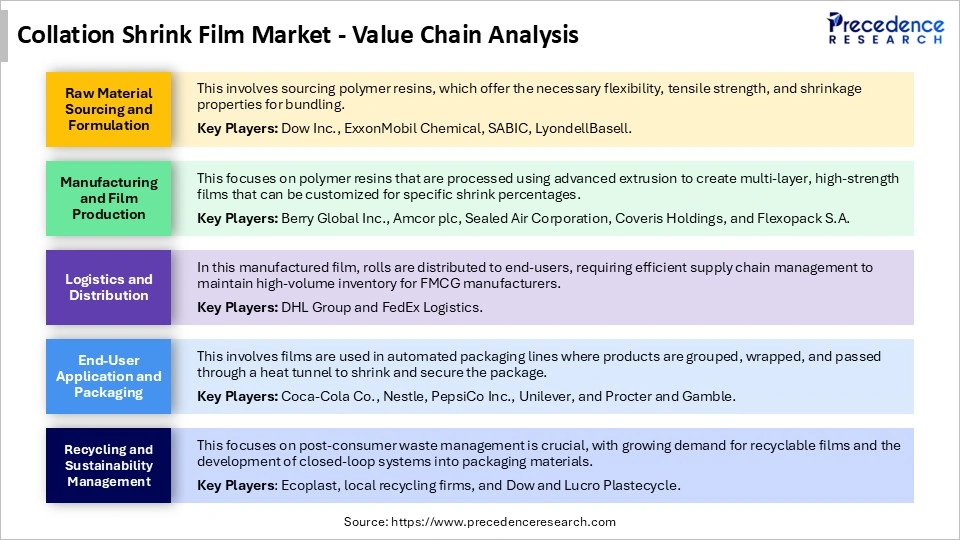
Collation Shrink Film Market Value Chain Analysis
Collation Shrink Film Market Companies
- Amcor plc
- Berry Global Group, Inc.
- Sealed Air Corporation
- Scientex Berhad
- Coveris Holdings S.A.
- Napco National
- Plastotecnica SpA
- Bolloré Group
- Polipaks Ltd.
- EuroFilm Extrusion Limited (Trioworld Group)
- MURAPLAST d.o.o.
- AEP Industries Inc.
- Intertape Polymer Group
- Clondalkin Group Holdings B.V.
- DuPont de Nemours, Inc.
Recent Developments
- In February 2026, Amcor expanded its North America capabilities for polyethylene (PE) shrink films and labels, becoming the largest manufacturer of PE overwrap applications in the region. This move highlights Amcor's expertise in the beverage and industrial markets, providing strong, economical films and labels that enhance product visibility. Angela Lowe, Senior Business Unit Leader at Amcor, stated that their extensive product portfolio and technical support set them apart from other PE shrink manufacturers. (Source: https://www.amcor.com)
- In March 2025, Borealis launched Borcycle™ M CWT120CL, a recycled linear low-density polyethylene (rLLDPE) grade with 85% post-consumer recyclate for non-food flexible packaging. Developed with Ecoplast, this grade offers stretchability, low gel content, and a strong toughness-stiffness balance, aligning with Borealis' commitment to circularity. Peter Voortmans, Borealis Commercial Director, emphasized its role in helping customers achieve sustainability goals. (Source: https://www.borealisgroup.com)
- In May 2025, Taghleef Industries introduced SHAPE360 TDSW, a floatable white polyolefin TD shrink sleeve label film. This innovative film enables the application of opaque labels on clear PET bottles and supports recycling through its low-density properties. Diana Dedeic, Product Manager at Taghleef, noted that this development enhances labeling capabilities while ensuring optimal recyclate purity and compatibility with recycled materials. (Source: https://www.ti-films.com)
Segments Covered in the Report
By Material
- LCPE
- LLDPE
- MDPE
- HDPE
- PP
- Others
By Application
- Bottles
- Cans
- Books and magazines
- Cartons
- Others
By End-Use
- Food and beverages
- Cosmetics
- Personal Care and home Care
- Transport and logistics
- Pharmaceuticals
- Printing and publications
- Others
By Region
- North America
- Asia Pacific
- Europe
- Latin America
- Middle East & Africa
For inquiries regarding discounts, bulk purchases, or customization requests, please contact us at sales@precedenceresearch.com
Frequently Asked Questions





Ask For Sample
No cookie-cutter, only authentic analysis – take the 1st step to become a Precedence Research client




 sales@precedenceresearch.com
 +1 804-441-9344
 Schedule a Meeting



