



Commercial Vehicle Braking System Market Size, Companies, Share, Vehicle Production Volume, Sales Performance, Export & Import Analysis, Technology Adoption, Competitive Positioning, and Demand Trends
Laxmi Narayan is an Automotive and Industrial Systems Market Research Analyst with a focus on the Commercial Vehicle Braking System Market. He monitors the adoption of braking technology, regulatory requirements, fleet electrification, and OEM-aftermarket. This research gives deep market intelligence, competitive analysis, and strategic inputs for decision-making in the commercial vehicle manufacturing and component supply area.
Source: https://www.precedenceresearch.com/commercial-vehicle-braking-system-market
 Get a Sample
 Table Of Content


Commercial Vehicle Braking System Market Size and Forecast 2026 to 2035
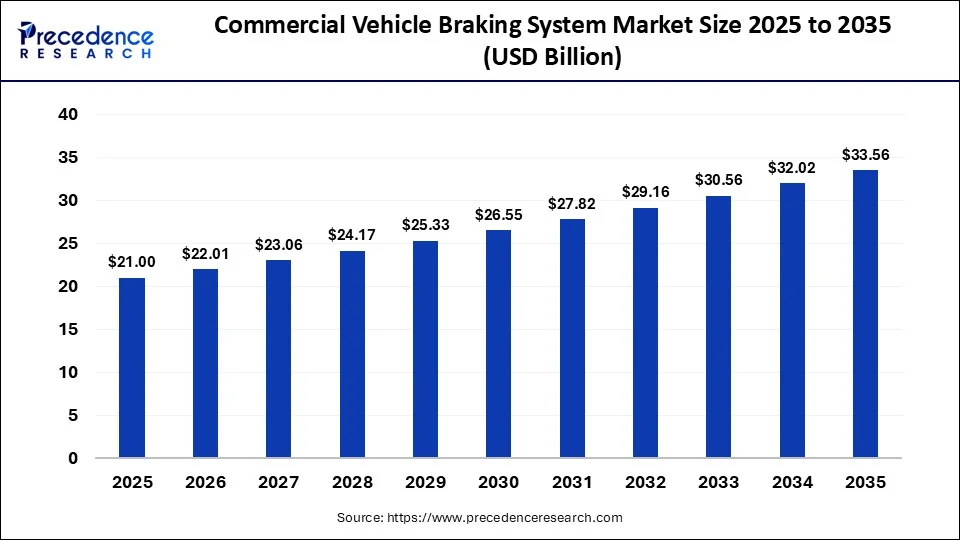
Laxmi Narayan has 5+ years of experience in commercial vehicle systems, braking technologies, and fleet safety compliance research. He has said that the market for commercial vehicle braking systems has good and strong growth prospects in the coming years based on extensive research. The global commercial vehicle braking system market is projected to grow from USD 22.01 billion in 2026 to reach USD 34 billion by 2035 at a CAGR of 4.80% during the forecast period from 2026 to 2035. In his analysis, he points to the increasingly stringent AEB standards and stability-control regulations. A growing number of electric vehicles in the fleet, and a number of major companies in the industry. Such as Knorr-Bremse AG, ZF Friedrichshafen AG, and Continental AG, as the market is continuing to grow steadily.
Key Takeaways
- Asia Pacific dominated the commercial vehicle braking system market in 2025, with a revenue share of 43%, and is expected to grow at the fastest CAGR of 5.8.00% during the forecast period.
- By brake type, the disk brakes segment led the market with a 38% share in 2025.
- By braking system type, the anti-lock braking systems (ABS) segment captured a major revenue share of 43% in 2025.
- By vehicle type, the heavy commercial vehicles (HCVs) segment captured the largest commercial vehicle braking system market share of 41% in 2025.
- By propulsion type, the internal combustion engine (ICE) segment captured the largest market share of 82% in 2025.
- By component, the brake pads & shoes segment captured the largest market share of 23% in 2025.
- By sales channels, the original equipment manufacturer (OEM) segment captured the largest commercial vehicle braking system market share of 67% in 2025.
- By end user, the fleet operators segment captured the largest market share of 35% in 2025
Powering Safer Fleets: The Commercial Vehicle Braking System Market
The market encompasses all mechanical, pneumatic, hydraulic, and electronic technologies. They are used to bring trucks and buses or other heavy vehicles to a halt. As a close follower of developments in this field, I believe this market is becoming a crucial part of fleet safety strategy as braking is becoming more of a software-defined, sensor-driven system. It communicates with the rest of the vehicle. These systems are being used by fleet operators, logistics firms, and OEMs to minimize the risk of accidents and comply with increasingly stringent regulatory standards. Further helping the transition to electrified and adjacent autonomous vehicles.
As regulation and electrification change the definition of what a brake really does, I see the trend of a higher demand for electronic braking systems, autonomous emergency braking and brake-by-wire systems. The integration of sensors and the ECU is progressing towards better stopping performance and predictive maintenance. As the sector deals with the cyclical softness in core truck markets, partnerships and portfolio realignment among Tier-1 suppliers continue. I think future opportunities will be driven by a convergence of regulations in the U.S. and EU. The slowly increasing base of electric commercial vehicles, and the growing aftermarket market due to the aging global CV parc.
Global Commercial Vehicle Braking System Market to Expand From USD 21.0 Billion to Approximately USD 34 Billion by 2035
| Year | Market Value (USD Bn) | Basis |
| 2026 | 22.01 | Reported base year (actual/estimated) |
| 2030 | 26.55 | Interpolated at 4.80% CAGR |
| 2035 | 33.63 | Forecast horizon (Insight Report) |
Table 1: Our research indicates that the braking system market for commercial vehicles continues to be on a steady growth trajectory. The market was valued at USD 21.00 billion in 2025, which is projected to reach USD 26.55 billion by 2030 and USD 33.63 billion by 2035, or roughly USD 34 billion. This is not one of the markets that we follow with double-digit percentage growth. But rather is a robust, high-volume industry that is driven by vehicle parc growth, technology upgrades due to regulations, and replacement cycles. It's a profile institutional investors and Tier-1 suppliers are interested in: a consistent, compounding profile that is based on actual fleet activity and not merely speculation.
Key Insights: The market value of 21 billion in 2025 was attributed to technological upgrades and evolving regulatory landscapes.
Source: Precedence Research database
Global Commercial Vehicle Output Rebounds to Near Pre-Pandemic Levels After 2020 Shock
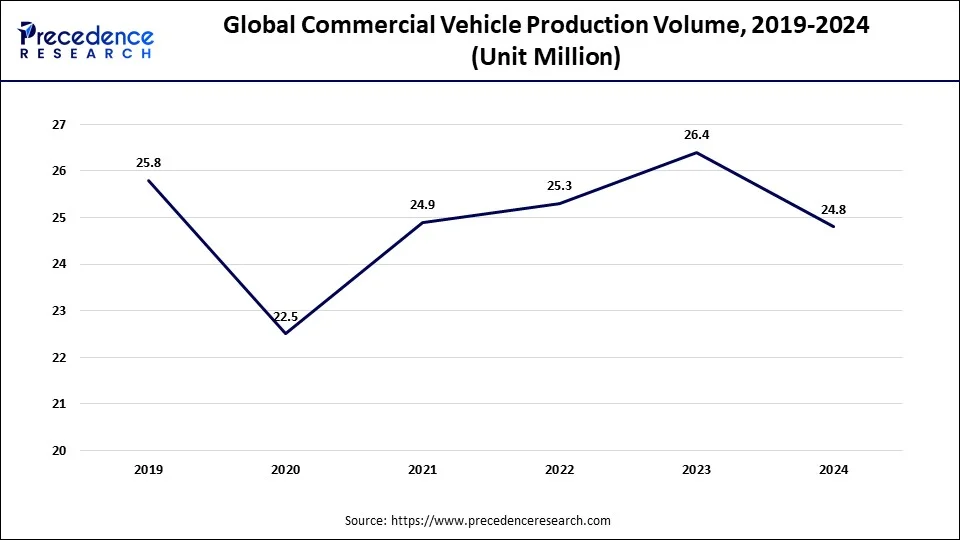
Table 2: According to Aman, the base vehicle production data, global commercial vehicle production stood at 25.8 million in 2019. This was followed by a year-on-year decline of 12.8% in 2020 to 22.5 million units due to the effect of the COVID-19 lockdowns. The rebound has not been linear. Production increased 10.7% in 2021, even as the chip shortage continued. It rose yet another 1.6% in 2022 to 25.3 million units. After a solid year of recovery in 2023 at 26.4 million, production declined 6.1% in 2024 to 24.8 million. This volatility is more significant than may seem at first glance. After all, braking systems are sold against this production base, so this volatility is a key reason why the revenue for braking systems doesn't follow a perfectly straight 4.80% line over the past ten years.
Key Insights: A significant rise in base vehicle production in 2023 and a significant decline in 2024 shows volatility in the production pattern, affecting the revenue of braking systems.
Source: OICA (International Organization of Motor Vehicle Manufacturers), World Motor Vehicle Production Statistics, compiled via Statista (2025); figures include heavy trucks, buses and coaches.
Commercial Vehicle Braking System Market Competitive Landscape & Company Benchmarking
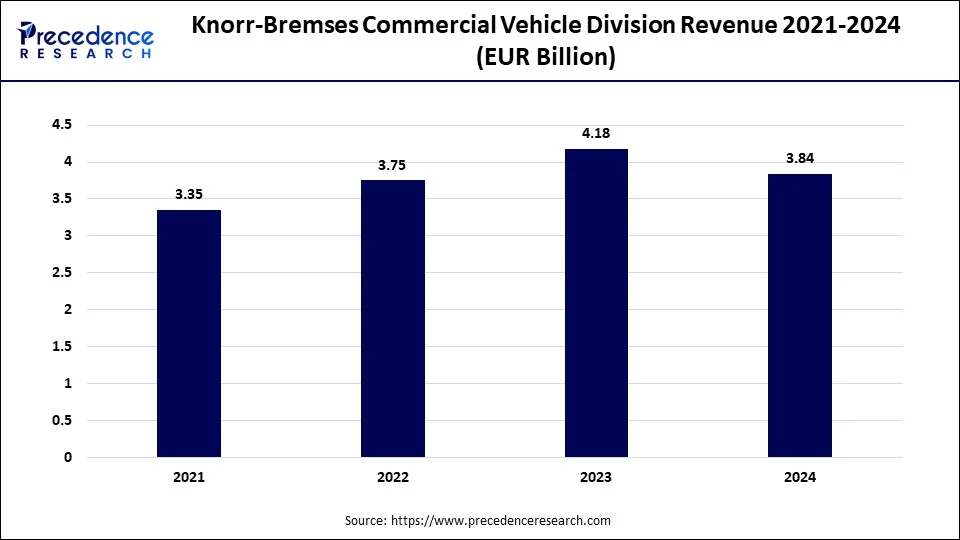
Knorr-Bremse's Commercial Vehicle Division Posts a Rare Revenue Decline as Global Truck Markets Soften
| Metric | 2023 | 2024 | Y/Y Change |
| Commercial Vehicle Systems (CVS) division revenue | €4.18 Bn | €3.84 Bn | -13.9% |
| CVS division order intake | €4.21 Bn | €3.74 Bn | -14.6% |
| CVS division operating EBIT margin | 10.0% | 10.4% | +0.4 pp |
| Group total revenue (CVS + Rail Vehicle Systems) | €7.92 Bn | €7.8-7.9 Bn | stable |
Aman's read on the company-level data, Knorr-Bremse's Commercial Vehicle Systems division posted revenue of €3.84 billion in 2024, down 13.9% from €4.18 billion in 2023. Order intake fell even more sharply, down 14.6% to €3.74 billion from €4.21 billion. What's notable, though, is that operating EBIT margin actually improved slightly, up 0.4 percentage points to 10.4% from 10.0%, suggesting the division managed cost discipline well even as top-line demand softened. Group total revenue, combining commercial vehicle systems and rail vehicle systems, held roughly stable at €7.8–7.9 billion versus €7.92 billion in 2023. The rail business appears to have cushioned some of the CV-side weakness.
Source: Knorr-Bremse AG annual and interim financial reports, 2022-2025.
Named Global Competitors (Qualitative - Company-Reported Positioning)
Knorr-Bremse AG, headquartered in Germany, positions itself in its own investor communications as the global market and technology leader in commercial vehicle braking systems. Other major named suppliers competing in commercial-vehicle brake components and electronic systems include ZF Friedrichshafen AG. This strengthened its position significantly through its 2020 acquisition of WABCO Holdings, Continental AG, and Robert Bosch GmbH, all German. Meritor, operating as Cummins Meritor in the US, Haldex AB out of Sweden, and Wanxiang Group in China round out the list of named global competitors. It's worth flagging that none of these companies publicly disclose a segment-specific, commercial vehicle braking systems only market-share breakdown. Their reported figures cover consolidated CV systems, chassis systems, or aftermarket-parts revenue rather than an isolated braking number. So any precise market-share ranking among them should be treated as directional rather than exact.
Raw Material Price Trends & Cost Structure
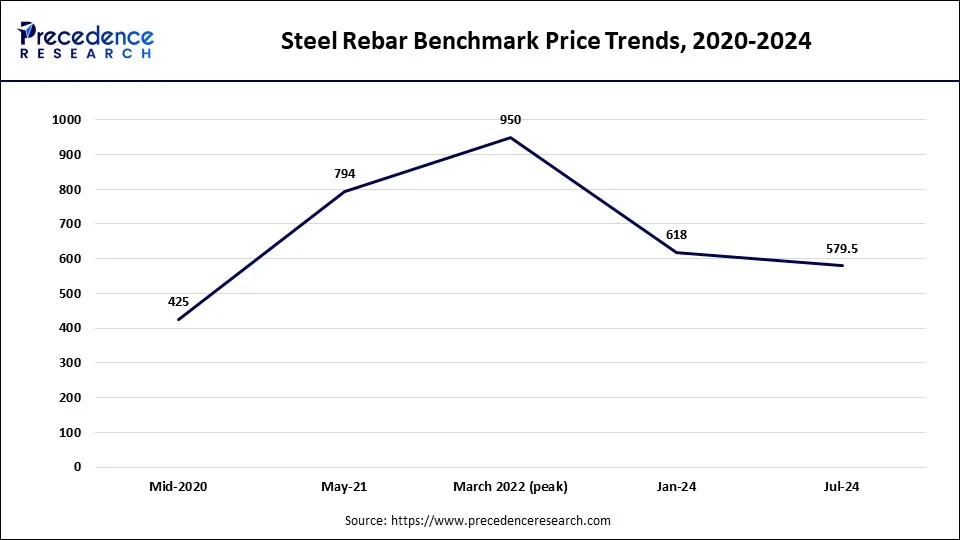
Steel Prices Whipsaw Through a Post-Pandemic Boom-Bust Cycle, Squeezing Brake-Component Margins
| Period | Benchmark Steel Rebar Price (USD/Tonne) | Context |
| Mid-2020 | 425 | Pandemic demand trough |
| May 2021 | 794 | Post-lockdown demand surge, supply bottlenecks |
| March 2022 (peak) | 950 | Russia-Ukraine conflict onset |
| January 2024 | 618 | Post-peak correction |
| July 2024 | 579.5 | -38.4% from March 2022 peak |
As per our research, brake discs, drums, calipers, and structural brackets are steel- and cast-iron-intensive components. This makes steel pricing a direct input-cost driver for both OEM and aftermarket brake margins. Benchmark steel rebar prices sat around USD 425 per tonne in mid-2020, near the pandemic demand trough, before surging to roughly USD 794 by May 2021 as post-lockdown demand collided with supply bottlenecks. Prices kept climbing into March 2022, peaking around USD 950 per tonne as the Russia-Ukraine conflict began. Since then, the market has corrected meaningfully. Down to about USD 618 by January 2024 and further to around USD 579.5 by July 2024, a decline of roughly 38.4% from the March 2022 peak. No publicly disclosed price series exists specifically for commercial vehicle brake steel, but this general benchmark trend is directly relevant to component-margin pressure across the sector.
Key Insights: The 2021-2022 steel price spike (driven by pandemic-era supply disruption and the onset of the Russia-Ukraine conflict) and the subsequent 2023–2024 correction are directly relevant input-cost drivers for OEM and aftermarket brake-component margins, even though no publicly disclosed price series exists specifically for "commercial vehicle brake steel."
Source: Scafom-Rux steel market tracker (scafom-rux.com, accessed July 2024), cross-referenced against World Bank Commodity Markets Outlook and MEPS International Steel Price Outlook for directional consistency.
Technology Adoption & Electrification Trends
Electric Truck Sales Plateau Near 60,000 Units Globally as China's Dominance Gradually Eases
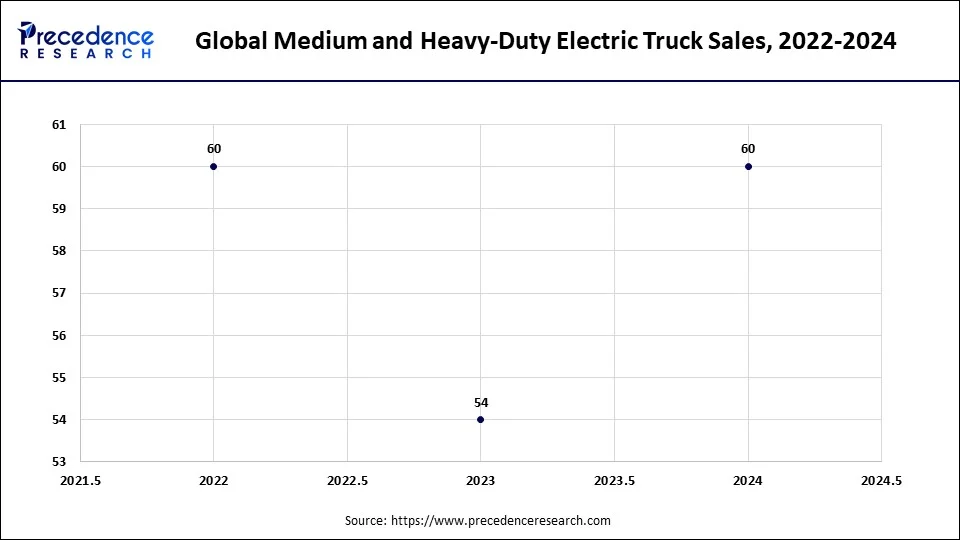
| Year | Global MHD Electric Truck Sales (approx.) | China Share | Europe | United States |
| 2022 | ≈60,000 | ≈85% | - | - |
| 2023 | ≈54,000 | ≈70% | >10,000 units (>1.5% share) | ≈1,200 units (<0.1% share) |
| 2024 | Broadly stable/slightly higher | Declining share (regional diversification) | >10,000 units (2nd consecutive year) | >1,700 units |
Aman's interpretation emphasizes that global medium- and heavy-duty electric truck sales came in around 60,000 units in 2022, with China accounting for roughly 85% of that volume. Sales actually eased slightly to about 54,000 units in 2023, with China's share also easing to around 70%. Europe crossed 10,000 units for the first time, surpassing a 1.5% share, while the US remained tiny at roughly 1,200 units, under a 0.1% share. This underlying electric-truck sales trend is the real demand engine behind the regenerative braking and brake-by-wire segments (Section 2). Both are disproportionately fitted to electric and hybrid commercial vehicles.
Key Insights: Underlying electric-truck sales trend is the real-world demand driver behind the Regenerative Braking Systems and Brake-by-Wire segments (Section 2), which are disproportionately fitted to electric and hybrid commercial vehicles.
Source: International Energy Agency (IEA), Global EV Outlook 2023, 2024 and 2025.
Investment Trends & M&A Activity in Commercial Vehicle Braking System Market
Portfolio Optimization, Not Big-Ticket Acquisitions, Defines Recent Brake-Sector Corporate Activity
| Date | Company | Transaction |
| 2024 | Knorr-Bremse AG | Divested Kiepe Electric and Safety Direct subsidiaries as part of its "BOOST 2026" portfolio-optimization strategy. |
| 2025 | Knorr-Bremse AG | Divested GT Emissions Systems (UK); continued to acquire KB Signaling to strengthen North American rail-signaling presence (rail, not CV brakes). |
| 2020 (historical, for context) | ZF Friedrichshafen AG | Completed acquisition of WABCO Holdings Inc. (commercial vehicle braking and control systems), consolidating a major independent CV brake supplier into ZF's Commercial Vehicle Solutions division. |
Recent corporate activity in this sector has been more about portfolio optimization than major consolidation. In 2024, Knorr-Bremse divested its Kiepe Electric and Safety Direct subsidiaries as part of its BOOST 2026 portfolio-optimization strategy. In 2025, the company divested GT Emissions Systems in the UK, while separately acquiring KB Signaling to strengthen its North American rail-signaling presence. Though that move sits in rail, not commercial vehicle brakes.
Looking back for context, ZF Friedrichshafen's 2020 acquisition of WABCO Holdings remains the sector's most significant consolidation event. Further folding a major independent CV brake supplier directly into ZF's Commercial Vehicle Solutions division.
Key Insights: The acquisition of KB Signaling by Knorr-Bremse is a key driver of strengthening North American rail-signaling presence.
Source: The BRAKE Report, "Knorr-Bremse Boosts Profitability and Cash Flow" (Feb. 2025)
Commercial Vehicle Braking System Market Patent Landscape
No Independently Verifiable, Segment-Specific Patent Count Is Publicly Available for This Niche
According to my research, a rigorous patent-count analysis specific to commercial vehicle braking systems would require direct querying of databases. Like USPTO PatFT, Espacenet, or WIPO PATENTSCOPE, which sits outside what public web sources can verify. Rather than estimate a filing count, this is flagged as a gap that would need dedicated primary-database research as a next step. That said, the qualitative signal is clear enough, such as Knorr-Bremse, ZF (through WABCO), Bosch, Continental, and Meritor all maintain active commercial-vehicle braking R&D. This continues filing patents around electronic braking, brake-by-wire, and AEB-adjacent sensor fusion technologies. Consistent with the shift toward EBS, AEB, and brake-by-wire covered in the system-type segment (Section 2).
Supply Chain, Value Chain & Trade Analysis
Braking-System Value Chains Run Through a Concentrated Tier-1 Supplier Base Into a Regionally Fragmented OEM Assembly Base
| Stage | Representative Participants |
| Raw materials | Steel, cast iron, friction-material compounds (resins, fibers, fillers), electronic components (semiconductors for ECUs/sensors). |
| Tier-1/2 component manufacture | Knorr-Bremse, ZF (WABCO), Continental, Bosch, Meritor, Haldex, Wanxiang. |
| OEM vehicle assembly | Daimler Truck, Volvo Group, Traton (Scania/MAN/Navistar), PACCAR, Tata Motors, Ashok Leyland, BYD, Dongfeng, and other regional CV OEMs. |
| Aftermarket distribution | Fleet-maintenance networks, independent parts distributors, dealer service networks. |
| End users | Fleet operators, logistics/e-commerce carriers, construction & mining operators, public transit agencies, municipal and defense fleets (per Section 2, End User). |
It starts with raw materials, steel, cast iron, friction-material compounds like resins, fibers, and fillers, plus electronic components such as semiconductors for ECUs and sensors. From there, a fairly concentrated group of Tier-1/2 manufacturers takes over, including Knorr-Bremse, ZF (via WABCO), Continental, Bosch, Meritor, Haldex, and Wanxiang. Those components flow into OEM vehicle assembly across a much more regionally fragmented base, including Daimler Truck, Volvo Group, Traton's Scania/MAN/Navistar brands, PACCAR, Tata Motors, Ashok Leyland, BYD, Dongfeng, and other regional CV OEMs.
From there, aftermarket distribution runs through fleet-maintenance networks, independent parts distributors, and dealer service networks before reaching end users. They include fleet operators, logistics and e-commerce carriers, construction and mining operators, public transit agencies, and municipal or defense fleets. One data gap worth flagging.
Key Insights: Supply chain caters to a range of steps, from raw material sourcing to aftermarket distribution to end users.
Risk Assessment & Opportunity Mapping
Regulatory Tailwinds and Fleet Electrification Offset Cyclical Truck-Market and Raw-Material Risk
| Category | Factor | Basis |
| Opportunity | AEB/ESC regulatory mandates expanding in the US and EU | Section 4 (verified regulatory timeline); System Type segment AEB CAGR of 9.5% (Insight Report) |
| Opportunity | Electrification of commercial fleets driving regenerative and brake-by-wire adoption | Section 7 (IEA electric-truck sales data); Regenerative Braking Systems CAGR of 9.4% and BEV propulsion CAGR of 12.5% (Insight Report) |
| Opportunity | Growing aftermarket demand from an expanding global CV parc | Section 2, Sales Channel (Aftermarket CAGR 5.6% vs. OEM 4.4%, Insight Report) |
| Risk | Cyclical weakness in core truck markets (North America, Europe, China) | Section 5 (Knorr-Bremse CVS division revenue -13.9% in 2024, verified) |
| Risk | Raw material (steel) price volatility compressing component margins | ection 6 (verified steel benchmark price swings, 2020-2024) |
| Risk | Delayed/uncertain heavy-vehicle AEB rulemaking timeline in the US | Section 4 (FMCSA/NHTSA rulemaking paused and reopened per 2026 regulatory agenda) |
Aditi's synthesis of the opportunity and risk picture highlighted on the opportunity side, expanding AEB and ESC regulatory mandates across the US and EU are a genuine structural tailwind. Reflected directly in the System Type segment's 9.5% AEB CAGR. Fleet electrification is the second major opportunity, driving adoption of regenerative braking (9.4% CAGR) and, more broadly, BEV propulsion (12.5% CAGR).
Growing aftermarket demand from an expanding global commercial vehicle parc rounds out the opportunity side, with aftermarket growing faster than OEM (5.6% versus 4.4% CAGR). On the risk side, cyclical weakness in core truck markets across North America, Europe, and China is already visible in Knorr-Bremse's Commercial Vehicle Systems division, where revenue fell 13.9% in 2024. Raw material, specifically steel price, volatility continues to compress component margins. The heavy-vehicle AEB rulemaking timeline in the U.S. remains genuinely uncertain, having been paused and reopened as recently as the 2026 regulatory agenda. None of these risk points are speculative. Each one traces back to verified data covered earlier in this piece.
Commercial Vehicle Braking System Market Companies
- ADVICS CO., LTD.
- AISIN CORPORATION
- AKEBONO BRAKE INDUSTRY CO., LTD.
- Brembo S.p.A
- Haldex
- Hitachi Astemo, Ltd.
- NISSIN KOGYO Co., Ltd
- Robert Bosch GmbH
- The Web Co
- ZF Friedrichshafen AG
Recent Developments in Commercial Vehicle Braking System Market
- In August 2026, at Automechanika 2026, Knorr-Bremse rolled out its new CVS Service Platform, further enhancing the digital service capabilities in commercial vehicle braking systems. The platform established by Knorr-Bremse TruckServices from Frankfurt am Main will bring workshops, fleet operators, distributors and service partners together via integrated digital services that cover the entire commercial vehicle lifecycle from September 8 to 12, 2026. The collaboration has also led to over 1 million bookings being made via the company's TRAVIS booking platform since the start of operations in early 2026, while at the same time the TruckServices Expert Network has grown to provide over 1,100 workshops leading up to and since its launch.(Source: https://thebrakereport.com)
- In August 2026, Keto Motors announced its entry into the commercial electric bus market with its first series production electric bus (Urbanova KE9), introducing new market opportunities for the commercial vehicle braking system market. The company also handed over the car at the event of the launch to the company's operating partner. Keto Motors, based in Hyderabad with headquarters in the city, was established in 2018 and is developing commercial electric vehicles, having become a publicly listed company last week via a reverse merger with Taaza International Limited.(Source: https://evreporter.com)
Segment Analysis
Disc Brakes Retain Segment Leadership as Fleets Prioritize Stopping Power and Heat Dissipation
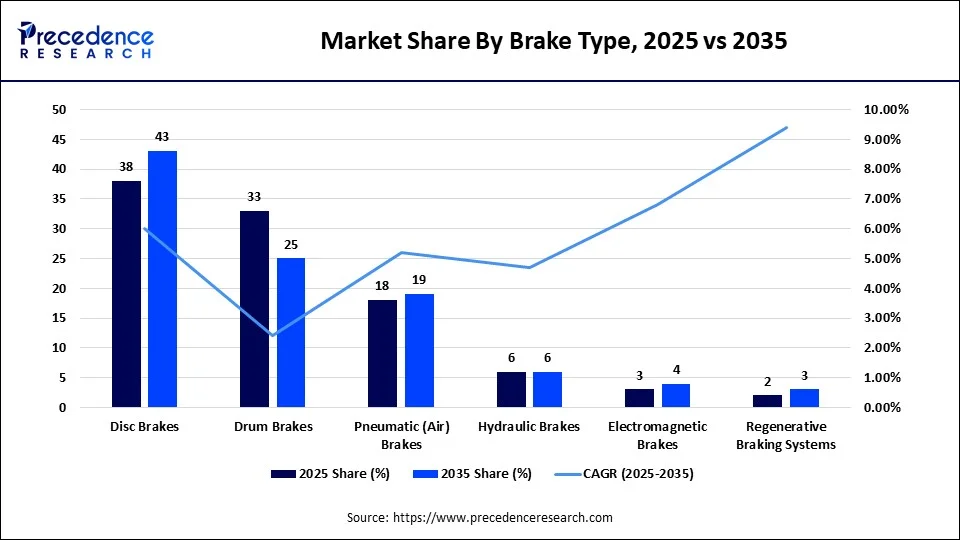
The brake-type segment is dominated by disc brakes, which are expected to rise from 38.0% in 2025 to 43.0% by 2035, with a CAGR of 6.0% in the period. Fleets increasingly favor their superior heat dissipation and stopping power over older drum designs. Drum brakes, on the other hand, are structurally declining, with a share of just 25.0% compared to 33.0% at a comparatively modest 2.4% CAGR. Because of their prevalence in cost-sensitive and legacy vehicle platforms. Fleets continue to focus on stopping power and heat dissipation, even making disc brakes the market leader for segment performance. The rise in BEV truck uptake has led to every electric commercial vehicle sold including regenerative braking.
Key Insights: The dominance of disc brakes stems from their exceptional stopping power, superior heat dissipation, and reduced brake fade.
Source: Precedence Research database
Electronic Braking Systems Set to Overtake ABS as the Leading System Type by 2035
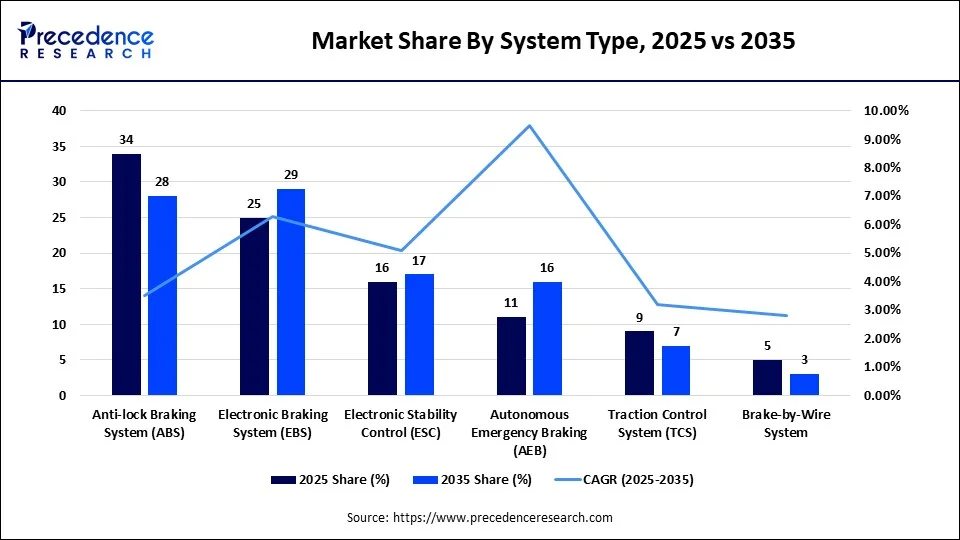
According to our research, this is one of the most evident changes in the entire data set. In 2025, anti-lock braking systems (ABS) dominated the market with a 34.0% share, which will shrink to 28.0% by 2035 at a relatively low 3.5% CAGR. The most notable, however, is a 6.3% CAGR increase of electronic braking system (EBS), the fastest among system types, aligning right on track with the pending EU AEBS rules and the upcoming US FMVSS No. 135 rulemaking.
Autonomous Emergency Braking (AEB) is the fastest-growing segment with a CAGR of 9.5% that leverages radars, cameras, and sensors to detect imminent rear-end crashes or obstacles. AEB is driven by the EU's General Safety Regulation (UN Regulation No. 131) enforcing strict phase-ins by September 2028. EBS is the more sophisticated version of the older ABS, controlling larger amounts of brake force electronically. As opposed to avoiding wheel lock, that's why OEMs are replacing it on new platforms rather than using retrofitted versions of the old ABS architecture.
Key Insights: AEB is the fastest-growing system type (9.5% CAGR), directly reinforced by the regulatory timeline in Section 6 (EU AEBS mandates and the pending US FMVSS No. 135).
Source: Precedence Research database
Heavy Commercial Vehicles Remain the Largest Vehicle-Type Segment; LCVs Post the Fastest Growth
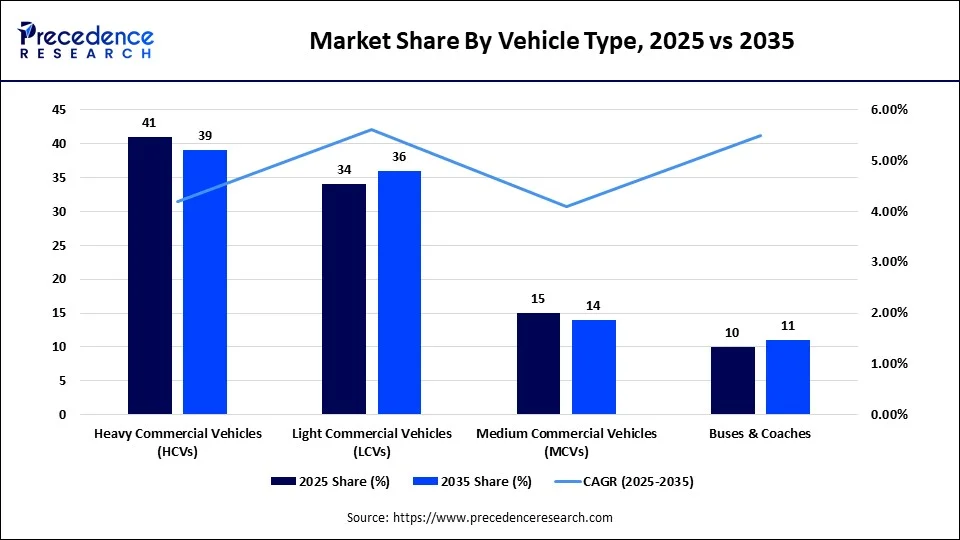
Heavy commercial vehicles (HCVs) continue to be the backbone of this market with 41.0% of the market share in 2025. That is expected to decline to 39.0% by 2035 at 4.2% CAGR. Heavy trucks have the highest value and most safety critical, braking equipment per unit, just happen to stay dominant. The growth of LCVs is accelerating due to the surge in the number of vans and light trucks rolling into urban areas on a baseline of e-commerce deliveries continuing to rise. In the vehicle-type category, light commercial vehicles (LCVs) are the fastest-growing category, recording a 5.6% CAGR, aligning well with the global growth of urban and e-commerce delivery fleets, which grew from 34.0% to 36.0%.
Key Insights: LCV growth (5.6% CAGR) is consistent with the global rise in urban e-commerce delivery fleets.
Source: Precedence Research database
Battery Electric Trucks to More Than Double Their Braking-System Market Share by 2035
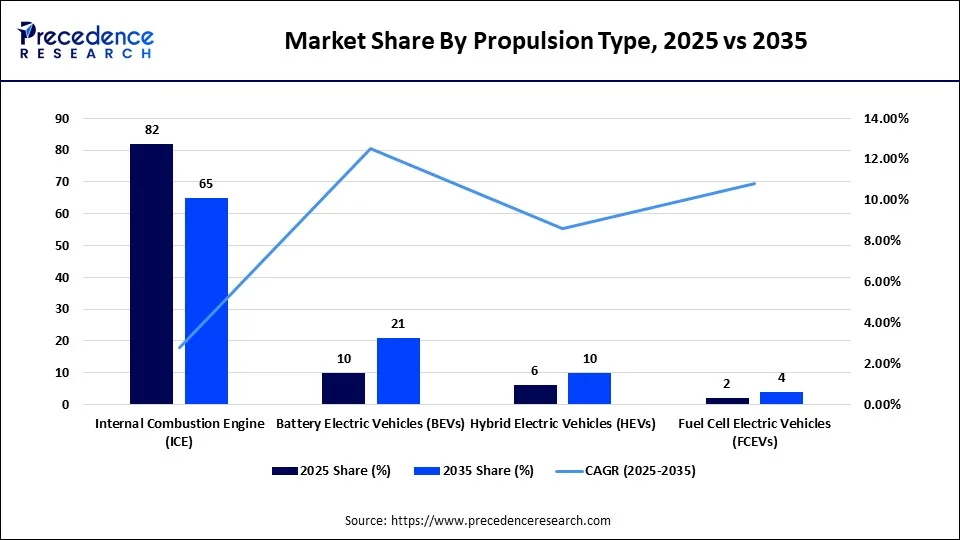
My interpretation says propulsion type is where the electrification story really shows up in the data. Internal combustion engine (ICE) vehicles dominated at an 82.0% share in 2025. But that share is expected to fall sharply to 65.0% by 2035, growing at only 2.8% CAGR, essentially treading water relative to the rest of the market. Battery Electric Vehicles (BEVs), by comparison, more than double their share. Climbing from 10.0% to 21.0% at a 12.5% CAGR, the fastest growth rate among the larger propulsion categories. The independently verified IEA electric-truck sales data covered later in this piece backs up this trajectory directionally, even if the absolute unit numbers there are still modest.
Key Insights: BEVs post the fastest CAGR (12.5%) among the larger segments; independently verified IEA sales data for the underlying electric-truck fleet is presented in Section 8.
Source: Precedence Research database
Electronic Control Units and Brake Sensors Are the Fastest-Growing Component Categories
| Component | 2025 Share (%) | 2035 Share (%) | CAGR (2025-2035) |
| Brake Pads & Shoes | 23.0 | 21.0 | 4.0% |
| Brake Discs & Drums | 19.0 | 18.0 | 4.1% |
| Calipers | 11.0 | 12.0 | 5.6% |
| Master Cylinders | 8.0 | 7.0 | 3.8% |
| Brake Boosters | 9.0 | 9.0 | 4.9% |
| Brake Valves | 8.0 | 8.0 | 4.6% |
| Electronic Control Units (ECUs) | 10.0 | 13.0 | 7.3% |
| Brake Sensors | 8.0 | 10.0 | 7.1% |
| Other Components | 4.0 | 2.0 | 2.6% |
As per my research, component-level demand is shifting from mechanical parts toward electronics. Brake pads & shoes remain the largest single component category at 23.0% share in 2025, easing slightly to 21.0% by 2035 at 4.0% CAGR. On the other hand, electronic control Units, growing from 10.0% to 13.0% share at 7.3% CAGR, benefit directly from ADAS integration and the growing use of predictive maintenance software across commercial fleets. Also, Brake Sensors are expanding from 8% to 10% share at 7.1% CAGR. But AEB, ESC, and EBS aren't about to be actually implemented without electronic components, ECs, and sensors, and while a growth in the System Type segment has finally appeared one level down in the breakdown, it's really an electronic-system shift. However, mechanical components such as pads and discs continue to be strong sellers, just not growth sellers, since they're not where the technology dollars are being spent.
Key Insights: ECUs (7.3% CAGR) and sensors (7.1% CAGR) benefit from ADAS integration and predictive maintenance adoption across fleets.
Source: Precedence Research database
OEM Channel Continues to Dominate, but Aftermarket Grows Faster on Fleet Maintenance Cycles
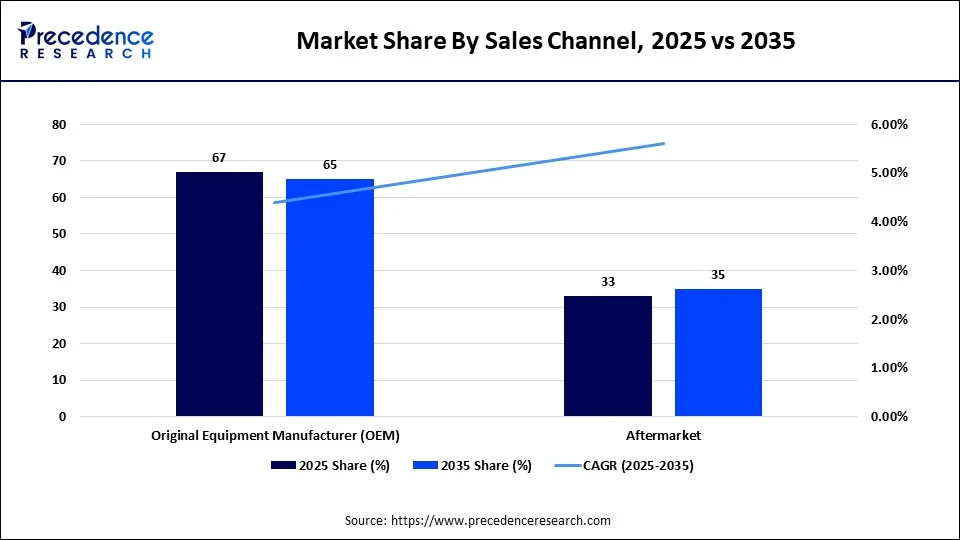
As a market research analyst, I interpret that OEM remains the larger channel, holding a 67.0% share in 2025 and easing only slightly to 65.0% by 2035 at 4.4% CAGR. Aftermarket, though smaller at 33.0% share, grows to 35.0% and grows faster at 5.6% CAGR, a straightforward reflection of the expanding installed base of commercial vehicles that needs recurring brake-component replacement as fleets age and utilization rates stay high. For a long time, OEM remains larger because all new commercial vehicles require a braking system installed at their factory. The aftermarket is larger and growing faster due to brake wear occurring on a recurrent basis, and a higher percentage of the vehicles parked globally are being replaced each year.
Key Insights: Aftermarket's faster CAGR (5.6% vs. 4.4% for OEM) reflects the growing installed base of commercial vehicles requiring recurring brake-component replacement.
Source: Precedence Research database
Fleet Operators and Logistics Companies Anchor End-User Demand
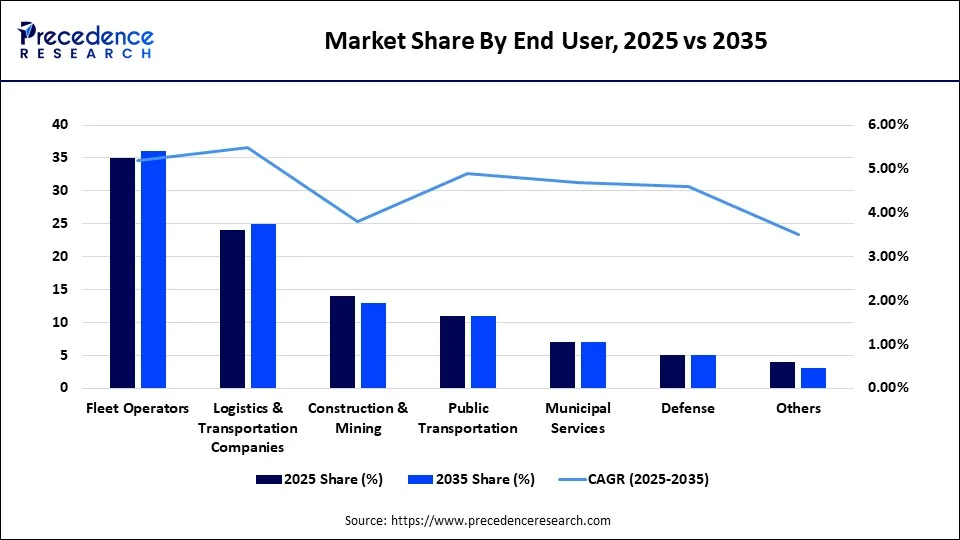
As per my research, I interpret that Fleet Operators are the largest end-user category, holding a 35.0% share in 2025 and edging up to 36.0% by 2035 at 5.2% CAGR. Logistics & Transportation Companies follow closely at 24.0% share, growing to 25.0% at 5.5% CAGR. Together, these two categories account for 59% of 2025 demand, underscoring just how central freight and e-commerce delivery volumes are to this market. The highest fleet vehicle utilisation rates are among logistics companies and fleet operators, as this will lead to an increase in the number of vehicles being put on the brakes, and therefore accelerated wear and replacement purchases. With shares of 59% combined, their usage is more concentrated than other, more intermittent.
Key Insights: Fleet operators and logistics companies together account for 59% of 2025 demand, underscoring the centrality of commercial freight and e-commerce delivery volumes to this market.
Source: Precedence Research database
Regional & Country Analysis
Asia-Pacific Cements Its Position as the World's Largest Commercial Vehicle Braking System Market
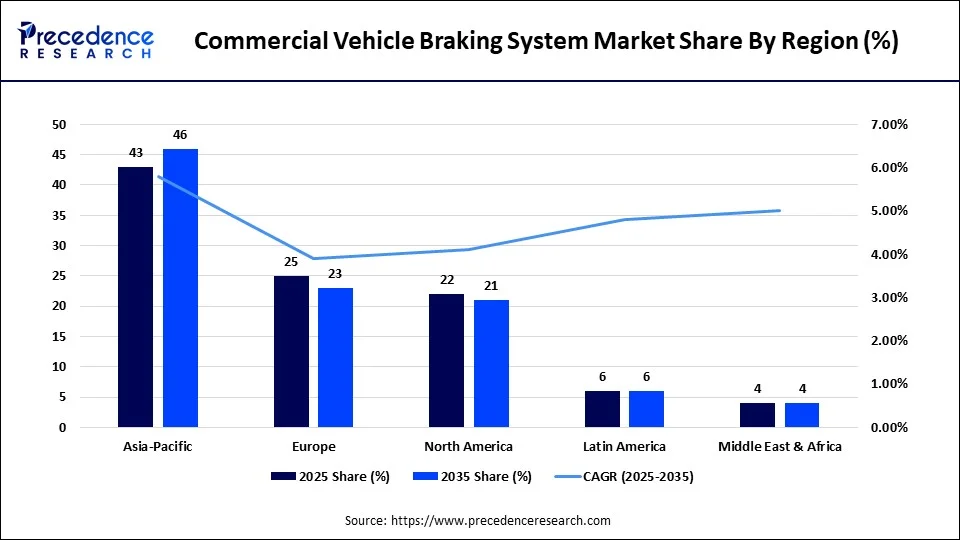
| Region | 2025 Share (%) | 2035 Share (%) | CAGR (2025-2035) |
| Asia-Pacific | 43.0 | 46.0 | 5.8% |
| Europe | 25.0 | 23.0 | 3.9% |
| North America | 22.0 | 21.0 | 4.1% |
| Latin America | 6.0 | 6.0 | 4.8% |
| Middle East & Africa | 4.0 | 4.0 | 5.0% |
Asia-Pacific is already the largest region at 43.0% share in 2025 and extends its lead further to 46.0% by 2035, growing at the fastest regional CAGR of 5.8%. Europe holds the second-largest position at 25.0% share in 2025, narrowing slightly to 23.0% by 2035 at 3.9% CAGR, while North America sits close behind at 22.0% share, easing to 21.0% at 4.1% CAGR. Latin America stays flat at 6.0% share with 4.8% CAGR, and Middle East & Africa, though the smallest region at 4.0% share, actually posts a healthy 5.0% CAGR.
The key is sheer volume of vehicle output, as China produces more commercial vehicles than the next several countries combined, thus sustaining the biggest domestic demand for braking systems in Asia Pacific. That's the strongest growth rate region by region, at 5.8%, albeit partly due to the increased regulatory tightening in the market in the early days, and evidence of fleet electrification having yet to take off in the region compared to more well-established areas such as Europe and North America.
Key Insights: The market growth in Asia-Pacific (43% market share of 2025; 5.8% CAGR) is primarily driven by the presence of a robust manufacturing infrastructure.
Source: Precedence Research database
Country-Level Production Context (Verified, Independent Source)
| Country | 2024 Motor Vehicle Production (Million Units, All Types) |
| China | 31.3 |
| United States | 10.6 |
| Japan, India, Mexico (combined) | Individually below China; together comparable to China's total |
Aman's supporting data point here is worth calling out on its own: China alone produced roughly 31.3 million total motor vehicles in 2024 - more than the next four largest producing countries combined - which goes a long way toward explaining Asia-Pacific's outsized weight in this market. The United States follows at around 10.6 million units, while Japan, India, and Mexico each individually sit below China's total but together add up to a volume comparable to China's alone.
Regulatory Timeline & Compliance Landscape
A Decade of Tightening AEB and Stability-Control Mandates Is Reshaping Braking-System Demand
| Year | Jurisdiction | Milestone |
| 2012 | European Union | Implementing Regulation No. 347/2012 sets detailed technical/test requirements for Advanced Emergency Braking Systems (AEBS) on categories M2, M3, N2, N3 (buses and heavy trucks), under the General Safety Regulation (EC 661/2009). |
| 2015 | United States | NHTSA grants a rulemaking petition from the Truck Safety Coalition, Center for Auto Safety, Advocates for Highway and Auto Safety, and Road Safe America to consider an AEB standard for heavy vehicles. |
| 2022 | European Union | AEB becomes mandatory on all new-model passenger vehicles under the General Safety Regulation. |
| 2023 | United States | NHTSA and FMCSA jointly propose a new FMVSS requiring AEB on heavy vehicles above 4,536 kg (10,000 lb) GVWR, and propose amending FMVSS No. 136 to require electronic stability control on nearly all heavy vehicles. |
| 2024 | United States | NHTSA finalizes FMVSS No. 127, mandating AEB (including pedestrian AEB) on all new passenger cars and light trucks by September 2029. |
| 2026 | United States | Heavy-vehicle AEB rulemaking (FMVSS No. 135) proceeds via a joint FMCSA/NHTSA supplemental proposal mandated by the Infrastructure Investment and Jobs Act; light-vehicle compliance staggers to 50% of 2026 model-year production by September 2026. |
I interpreted that regulation is one of the clearest, most verifiable demand drivers behind the System Type segment, particularly ABS, ESC, and AEB. The timeline starts in 2012, when the European Union's Implementing Regulation No. 347/2012 set detailed technical and test requirements for Advanced Emergency Braking Systems on categories M2, M3, N2, and N3. Buses and heavy trucks, under the broader General Safety Regulation (EC 661/2009). In the US, momentum built more slowly. NHTSA granted a rulemaking petition in 2015 from the Truck Safety Coalition, the Center for Auto Safety, Advocates for Highway and Auto Safety, and Road Safe America to consider an AEB standard for heavy vehicles.
AEB became mandatory on all new-model passenger vehicles in 2022 under the General Safety Regulation. The US caught up meaningfully in 2023, when NHTSA and FMCSA jointly proposed a new FMVSS requiring AEB on heavy vehicles above 4,536 kg (10,000 lb) GVWR. Alongside a proposed amendment to FMVSS No. 136 requiring electronic stability control on nearly all heavy vehicles. In 2024, NHTSA finalized FMVSS No. 127, mandating AEB, including pedestrian AEB, on all new passenger cars and light trucks by September 2029. Additionally, most recently, in 2026, heavy-vehicle AEB rulemaking under FMVSS No. 135 is proceeding via a joint FMCSA/NHTSA supplemental proposal mandated. By the Infrastructure Investment and Jobs Act, with light-vehicle compliance staggering to 50% of 2026 model-year production by September 2026.
Reference: NHTSA, "NHTSA Finalizes Rule on Automatic Emergency Braking," nhtsa.gov (2024); NHTSA/FMCSA Federal Register NPRM, "Heavy Vehicle Automatic Emergency Braking," Document 2023-13622 (July 6, 2023), regulations.justia.com; InterRegs, "EU Regulation on Advanced Emergency Braking Systems Updated," interregs.com; Land Line Media, "AEB rulemaking to resume after FMCSA, NHTSA hit the brakes," landline.media (2026); IIHS, "IIHS welcomes new AEB rule, laments delayed timeline," iihs.org (2024).
Future Outlook
Braking Systems Head Toward a Software-Defined, Electrified, Regulation-Driven Decade
Based on my assessment, three trends are converging here and reinforcing each other through 2035.
- Regulatory convergence toward mandatory AEB and ESC on progressively larger vehicle classes. This is structurally increasing the electronic content in every vehicle, favoring EBS, AEB, and brake-by-wire over legacy ABS and TCS architectures.
- Electrification of medium- and heavy-duty fleets is still under 1% of global truck sales today but clearly growing. This is the real structural driver behind the fastest-growing sub-segments in this entire dataset, including regenerative braking and BEV propulsion.
- Near-term cyclicality, visible in Knorr-Bremse's CVS revenue decline and in raw-material price volatility. This will keep creating year-to-year noise around the smooth compounding curve implied by a 4.80% CAGR, even as that decade-long structural growth rate holds up.
This market's defining decade won't be about brakes getting bigger or stronger in the traditional sense. It'll be about brakes getting smarter, more electronic, and more tightly regulated.
Expert Insights
Based on my assessment, this market is moving from a purely mechanical, replacement-driven business into one shaped by regulation and electronics. I see strong demand ahead for Tier-1 suppliers that can combine deep mechanical manufacturing expertise with electronic and software capability. Such as sensor fusion, ECU integration, and brake-by-wire in particular. In my view, regulatory timing, electrification pace, and steel-cost management will decide which suppliers gain share over the next decade. I also expect the aftermarket to keep outgrowing OEM as the global commercial vehicle parc ages, creating steady, less cyclical revenue for component makers even when new-vehicle production softens.
Our Experts
Laxmi Narayan led the primary market research, developed the methodology, and analyzed segmentation, regional trends, competition, and forecasts, forming the report's analytical foundation.
Aman was responsible for collecting and validating regulatory filings, company financial data, commodity pricing, and other independently sourced quantitative datasets, strengthening the evidence base behind the market estimations.
Aditi reviewed the complete research document, performed quality checks, validated findings, refined content, corrected inconsistences, and finalized the report, ensuring accuracy and clarity.
Commercial Vehicle Braking System Market Segements
By Brake Type
- Disc Brakes
- Drum Brakes
- Pneumatic (Air) Brakes
- Hydraulic Brakes
- Electromagnetic Brakes
- Regenerative Braking Systems
By System Type
- Anti-lock Braking System (ABS)
- Electronic Braking System (EBS)
- Electronic Stability Control (ESC)
- Autonomous Emergency Braking (AEB)
- Traction Control System (TCS)
- Brake-by-Wire System
By Vehicle Type
- Heavy Commercial Vehicles (HCVs)
- Light Commercial Vehicles (LCVs)
- Medium Commercial Vehicles (MCVs)
- Buses & Coaches
By Propulsion Type
- Internal Combustion Engine (ICE)
- Battery Electric Vehicles (BEVs)
- Hybrid Electric Vehicles (HEVs)
- Fuel Cell Electric Vehicles (FCEVs)
By Component
- Brake Pads & Shoes
- Brake Discs & Drums
- Calipers
- Master Cylinders
- Brake Boosters
- Brake Valves
- Electronic Control Units (ECUs)
- Brake Sensors
- Other Components
By Sales Channel
- Original Equipment Manufacturer (OEM)
- Aftermarket
By End User
- Fleet Operators
- Logistics & Transportation Companies
- Construction & Mining
- Public Transportation
- Municipal Services
- Defense
- Others
By Region
- North America
- Latin America
- Europe
- Asia-pacific
- Middle and East Africa
For inquiries regarding discounts, bulk purchases, or customization requests, please contact us at sales@precedenceresearch.com
Frequently Asked Questions





Ask For Sample
No cookie-cutter, only authentic analysis – take the 1st step to become a Precedence Research client
 Get a Sample




 sales@precedenceresearch.com
 Schedule a Meeting
