



Data Center Interconnect Market Trends, Companies, Revenue / Sales Performance, Subscriber Growth, Pricing Strategies, Cloud Adoption, Infrastructure Expansion, Competitive Landscape, and Industry Outlook
Data Center Interconnect Market (By Component: Hardware (DWDM, OTN, Packets), Software-Defined Networking and Control, Services (Managed, Professional); By Connectivity Type: Short-Haul, Long-Haul; By Application: Disaster Recovery and Business Continuity, Shared Data and Resource Clustering, Data (Storage) Mobility, Other Applications; By End-user Industry: Communication Service Providers (CSPs), Internet Content / Carrier-Neutral Providers (ICPs/CNPs), Government, Research and Education, Other Verticals) - Global Industry Analysis, Size, Trends, Leading Companies, Regional Outlook, and Forecast 2026 to 2035
Source: https://www.precedenceresearch.com/data-center-interconnect-market
 Get a Sample
 Table Of Content


What is Data Center Interconnect Market Size?
The global data center interconnect market size was calculated at USD 16.31 billion in 2025 and is predicted to increase from USD 18.73 billion in 2026 to approximately USD 64.96 billion by 2035, expanding at a CAGR of 14.82% from 2026 to 2035. The market is rapidly growing due to the adoption of cloud-based solutions, the rise of hyperscale data centers, which require robust, high-bandwidth interconnection for seamless data traffic management, widespread digital transformation across enterprises and 5G, and the adoption of software-defined networking and network function virtualization enables smarter, more flexible, and scalable DCI solutions.
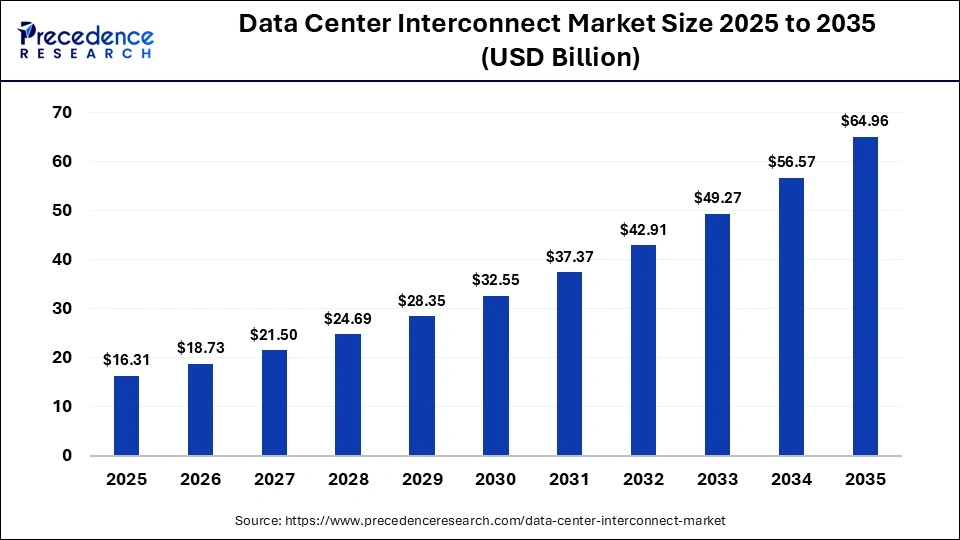
Key Takeaways
- North America held the largest data center interconnect market share in 2025.
- Asia-Pacific is expected to grow at the fastest CAGR during the foreseeable period.
- By component, the hardware segment held the largest market share in 2025.
- By component, the software-defined networking and control segment is expected to grow at the fastest CAGR during the forecast period.
- By connectivity type, the short-haul segment held the largest market share in 2025.
- By connectivity type, the long-haul segment is expected to grow at the fastest CAGR between 2026 and 2035.
- By application, the disaster recovery and business continuity segment held the largest market share in 2025.
- By application, the data (storage) mobility segment is expected to grow at the fastest CAGR during the foreseeable period.
- By end-user industry, the communication service providers (CSPs) segment held the largest market share in 2025.
- By end-user industry, the internet content/carrier-neutral providers (ICPs/CNPs) segment is expected to grow at the fastest CAGR during the foreseeable period.
What is Data Center Interconnect?
The global data center interconnect market comprises a strategic framework leveraging converged optical and packet-switching architectures to integrate geographically dispersed assets into a single, cohesive ecosystem by facilitating low-latency, high-bandwidth pathways. Market growth is driven by heavy AI/ML workloads, rapid cloud adoption, and the need for edge computing. The benefits include enhanced disaster recovery and business continuity, lower latency for real-time services, and increased network flexibility.
How is AI Influencing Data Center Interconnect?
The integration of artificial intelligence (AI), specifically machine learning (ML), is driving an unprecedented surge in demand for data center interconnect capacity, forcing the rapid transition from 400G to 800G and 1.6T speeds. The industry is witnessing a significant rise in east-west traffic, requiring higher bandwidth, near-zero latency, and robust fiber mesh networking. This demand is pushing for advanced technologies like coherent optics and co-packaged optics to manage high density and power constraints. AI is fostering a shift toward automated, software-defined (SDN) networks that use predictive analytics for self-optimizing performance and proactive maintenance.
Data Center Interconnect Market Trends
- The strategic transition to 400G/800G and 1.6T coherent architectures is a critical move to improve cost-per-bit efficiency. By maximizing existing fiber utilization, organizations can achieve exponential capacity scaling while maintaining a lean physical footprint, directly improving long-term CAPEX productivity.
- Modern DCI is evolving from a passive transport layer into a strategic differentiator. By deploying "scale-across" fabrics, enterprises can support the intensive, non-linear traffic patterns of distributed GPU clusters. This ensures deterministic performance and ultra-low latency, which are vital for the real-time synchronization of AI/ML training and inference models.
- The shift toward software-defined networking (SDN) and autonomous orchestration transforms static connectivity into an agile, self-healing utility. By automating bandwidth allocation and traffic engineering, businesses can eliminate manual bottlenecks, accelerate time-to-market, and significantly reduce OPEX through intelligent, policy-driven resource management.
- The rise of 5G, IoT, and real-time analytics is accelerating the deployment of edge data centers closer to the end-user, creating a need for robust metro DCI solutions.
- Sustainability mandates are driving the adoption of energy-efficient hardware, such as co-packaged optics and photonic switching, to reduce the energy-per-bit.
Marrket Scope
| Report Coverage | Details |
| Market Size in 2025 | USD 16.31 Billion |
| Market Size in 2026 | USD 18.73 Billion |
| Market Size by 2035 | USD 64.96 Billion |
| Market Growth Rate from 2026 to 2035 | CAGR of 14.82% |
| Dominating Region | North America |
| Fastest Growing Region | Asia Pacific |
| Base Year | 2025 |
| Forecast Period | 2026 to 2035 |
| Segments Covered | Component, Connectivity Type, Application, End-User Industry, and Region |
| Regions Covered | North America, Europe, Asia-Pacific, Latin America, and Middle East & Africa |
Segmental Insights
Component Insights
Why Did the Hardware Segment Lead the Data Center Interconnect Market?
The hardware segment led the market in 2025 due to massive AI/ML infrastructure investments requiring high-density GPUs and 800G/1.6T optics. The hyperscale fabric expansion, with cloud providers driving high-volume procurement of switches, routers, and high-fiber-count cabling. The industry is prioritizing the transition to 800G/1.6 Ethernet for better cost-per-bit efficiency, alongside the expansion of 5G-advanced networks and edge computing nodes.
The software-defined networking and control segment is expected to grow at the fastest CAGR during the foreseeable period. This is because of the strategic shift towards replacing manual complexity with autonomous operational excellence. These platforms optimize unit economics through dynamic resource allocation while providing a zero-trust security posture for high-velocity data. The software enables the elasticity required to orchestrate modern AI and multi-cloud workloads at a scale that traditional hardware cannot sustain.
Connectivity Type Insights
Which Connectivity Type Segment Dominated the Data Center Interconnect Market?
The short-haul segment held a dominant position in the market in 2025, due to the necessity of dense, high-bandwidth short-haul fabrics to manage the exponential surge in east-west traffic required for AI clustering. By deploying cost-optimized solutions like DACs and AOCs, operators can achieve the ultra-low latency essential for edge computing and 5G responsiveness without the complexity of long-range optics. This localized infrastructure strategy places computing power closer to end-users, significantly enhancing the customer experience through reduced network lag.
The long-haul segment is expected to gain the highest market share between 2026 and 2035. This is because long-haul is essential to bridge geographically dispersed AI clusters while maintaining the ultra-low latency required for real-time synchronization. This high- capacity backbone ensures institutional resilience through automated disaster recovery and seamless data mobility across hybrid cloud environments. By leveraging advanced DSP innovations, organizations can maximize existing fiber ROI, achieving hyperscale throughput without the prohibitive costs of new physical infrastructure
Application Insights
Which Application Segment Dominated the Data Center Interconnect Market?
The disaster recovery and business continuity segment contributed the biggest market share in 2025, due to the need for leveraging high-speed DCI for real-time synchronization. Enterprises can mitigate the catastrophic costs of downtime while satisfying increasingly stringent global regulatory mandates. This resilient infrastructure ensures that mission-critical AI and cloud workloads remain operational despite localized disruptions, providing a seamless transition across geographically dispersed nodes. A robust disaster recovery framework serves as the foundation for digital trust, enabling organizations to scale with confidence in an era of unpredictable volatility.
The data (storage) mobility segment is expected to witness the fastest growth in the market over the forecast period, as a critical business imperative to achieve the workload fluidity necessary for modern operational agility. The high-performance backbone for AI and big data orchestration, ensuring that data-intensive applications can leverage specialized services across diverse platforms without vendor lock-in. It reinforces enterprise resilience by enabling automated, geographically dispersed disaster recovery and consistent data synchronization.
End-User Industry Insights
How the Communication Service Providers (CSPs) Segment Dominated the Market?
The communication services providers (CSPs) segment registered its dominance over the global data center interconnect market in 2025 due to a shift toward low-latency, high-capacity architectures capable of managing unprecedented data surges. This evolution is supported by hyperscale infrastructure investments and the adoption of cutting-edge coherent optics, which maximize spectral efficiency and reduce long-term operational costs. The push for data localization and sovereign cloud environments is driving decentralized network expansion, ensuring high-speed access closer to the end-user.
The internet content/carrier-neutral providers (ICPs/CNPs) segment is expected to grow with the highest CAGR in the market during the studied years. This is because pioneering the adoption of 800G+ coherent optics, these providers achieve the radical cost-per-bit efficiencies required to sustain the massive data throughput of sovereign AI and distributed cloud architectures. This infrastructure serves as the essential nexus for global peering and multi-cloud exchanges, enabling frictionless data mobility across a unified digital ecosystem. The relentless push for infrastructure future-proofing ensures that ICPs and CNPs remain the dominant architects of the modern, high-velocity internet economy.
Regional Analysis
What Made North America the Dominant Region in the Data Center Interconnect Market?
North America held a major market share in 2025. This is mainly due to its mature ICT infrastructure and the unprecedented density of hyperscale operations in strategic corridors, such as Northern Virginia and Silicon Valley. The concentration of cloud and content giants mandates a continuous investment in ultra-high-capacity fiber networks to synchronize the massive datasets required for AI and IoT innovation. The region's aggressive pivot toward hybrid-cloud architectures further drives the demand for resilient, low-latency links that ensure seamless data mobility and operational continuity.
The region is leveraging these specialized "Data Center Alleys," allowing enterprises to achieve superior economies of scale and power efficiency while maintaining a global competitive edge. The North American market serves as the global benchmark for high-velocity digital infrastructure and sophisticated network orchestration.
U.S. Market Analysis
The market in the U.S. is growing due to the fundamental transformation of AI-driven architectures, necessitating a shift toward ultra-high-speed, automated infrastructure. The decentralization of compute through edge and metro-area expansion is creating a new layer of localized connectivity, ensuring the low-latency performance required for real-time digital services. The transition from rigid hardware to software-defined orchestration provides the agility and predictive intelligence needed to secure and scale modern multi-cloud ecosystems.
Why is Asia-Pacific Rapidly Expanding in the Data Center Interconnect Market?
Asia-Pacific is expected to host the fastest-growing market in the coming years, due to the massive surge in AI and hyperscale capacity. Stringent data localization mandates and the rapid adoption of 5G are forcing a decentralized architecture, necessitating high-performance links between burgeoning regional hubs and edge facilities. This digital transformation is further accelerated by the scale of e-commerce and mobile data consumption, driving the transition to high-density, low-latency fabrics capable of supporting up to 50kVA+ per rack.
China Market Analysis
In China, the market is evolving due to the transition to software-defined orchestration and advanced coherent optics, enabling the seamless, secure data mobility required for hybrid-cloud and edge integration. The industry is increasingly aligning with sustainability and data sovereignty mandates, as seen in large-scale green infrastructure projects that balance high-performance networking with carbon neutrality goals. These advancements transform DCI from a basic transport layer into a strategic, resilient backbone for the global digital economy.
Why is Europe Experiencing a Notable Growth in the Data Center Interconnect Market?
Europe is expected to grow at a notable CAGR in the foreseeable future, driven by its sustainability mandates, forcing operators to invest in high-efficiency optics and heat-reuse technologies to satisfy strict environmental and PUE regulations. These factors combine to create a highly resilient, compliant, and energy-conscious interconnection ecosystem that supports the next wave of 5G and industrial IoT digitalization. The massive bandwidth requirements of AI and hyperscale clusters, with the continent's stringent GDPR and data sovereignty frameworks.
Germany Market Analysis
Germany's massive edge deployment strategy, exemplified by the push for thousands of localized nodes to facilitate sub-millisecond 5G and IoT responsiveness. Strategic focus on PUE optimization and green energy integration ensures that this capacity scaling aligns with strict national sustainability and GDPR compliance mandates. The adoption of SDN-driven orchestration provides the necessary agility to manage complex hybrid-cloud traffic, transforming the network into a highly efficient, secure, and elastic business utility.
Why is Latin America Significantly Growing in the Data Center Interconnect Market?
Latin America is considered to be a significantly growing area, due to its data sovereignty mandates, such as Brazil's LGPD, which necessitate robust, localized DCI frameworks to ensure compliance and security. The region's unique renewable energy profile and Mexico's nearshoring potential are attracting sustainable, long-term infrastructure investments. These drivers are transforming the DCI layer into an essential engine for the region's rapid digital transformation and economic integration.
Brazil Market Trends
The region's growth is fueled by various factors such as increasing internet penetration, the rise of cloud computing, and government initiatives promoting digital transformation. The region's market landscape is evolving, with local firms gaining traction alongside established global players.
Will the Middle East and Africa Grow in the Data Center Interconnect Market?
The Middle East and Africa are expected to grow at a considerable CAGR in the upcoming period, driven by sovereign investment in localized high-performance computing and large-scale digital transformation initiatives like Saudi Arabia's Vision 2030. A strategic surge in subsea cable connectivity and 5G deployment, which effectively bridges the digital divide between Europe and Asia while supporting high-density, GPU-ready data center modules. Stringent data residency laws are forcing an architectural shift toward domestic storage, necessitating robust, secure interconnects for the region's growing smart city and hyperscale ecosystems.
Saudi Arabia Market Trends
The region's growth and development are driven by increasing digital initiatives, investments in smart city projects, and the need for enhanced connectivity. The region is also focusing on improving infrastructure to support the growing demand for data services, which in turn helps in fostering innovation, making the region a potential hotspot for data center interconnect solutions.
Value Chain Analysis - Data Center Interconnect Market
- Equipment Manufacturing & DCI Platform Provider Stage
This stage involves the development of specialized DCI hardware and software platforms that integrate the components mentioned above to manage data transport between sites.
Key Players: Ciena Corporation, Huawei Technologies Co., Ltd., Nokia Corporation, Infinera Corporation, Juniper Networks, Inc., ADVA Optical Networking SE. - Network Service Providers & Infrastructure Owners
This stage includes companies that own or lease physical fiber-optic cables and infrastructure needed for connecting distant data centers.
Key Players: Colt Technology Services Group Limited, Equinix Inc., Megaport Limited, Lumen Technologies, Verizon, NTT Communications. - End-Users
This is the final stage where the DCI services and products are used to connect geographically dispersed data centers for disaster recovery, data mobility, and cloud resource sharing.
Key Players: Google (Alphabet), Amazon Web Services (AWS), Microsoft Azure, Equinix Inc., Digital Realty Trust Inc.
Top Companies in the Data Center Interconnect Market
- Nokia Corporation: Nokia Corporation is a global leader in telecommunications and networking solutions, providing a comprehensive range of data center interconnect technologies. The company focuses on delivering innovative optical networking solutions that enable high-speed data transfer and seamless connectivity between data centers.
- ADVA Optical Networking: ADVA Optical Networking specializes in optical networking solutions that enhance data transfer capabilities. The company is recognized for its commitment to innovation and customer-centric solutions, providing organizations with the tools needed to optimize their data center infrastructure.
- Infinera Corporation: Infinera Corporation is a leading provider of intelligent transport networks, offering advanced data center interconnect solutions that enable efficient data transfer across long distances. The company is known for its innovative technologies, including photonic integrated circuits, which enhance the capacity and performance of data center interconnect systems.
Other Major Key Players
- Cisco Systems
- Arista Networks
- Juniper Networks
- Mellanox Technologies
- Ciena Corporation
- Huawei Technologies
- Dell Technologies
- IBM
- Extreme Networks
- Ciena Corporation
- AFL – Hyperscale Solutions
Industry Developments
Strategic partnerships and collaborations are becoming increasingly prevalent in the market. By partnering with technology providers, cloud service providers, and industry leaders, key companies can leverage complementary strengths to enhance their product offerings and expand their market reach. Collaborative efforts also help facilitate knowledge sharing and innovation, enabling companies to develop cutting-edge technologies that can address emerging challenges in the IT domain.
Leading players are adopting a customer-centric approach by tailoring their solutions to meet the specific needs of various industries. By understanding the unique requirements of sectors such as telecommunications, finance, and healthcare, companies can develop specialized solutions that enhance operational efficiency and compliance. This strategy not only fosters customer loyalty but also positions players as trusted advisors in their respective markets, driving long-term growth and market expansion.
Recent Development
- In March 2026, Tejas Networks launched the TJ1600-D3, a hyper-scalable Data Center Interconnect (DCI) platform unveiled by India's Union Minister for Communications, Shri Jyotiraditya Scindia, at Mobile World Congress 2026. Designed for AI-powered, high-density networks, the 3-RU platform delivers up to 51.2 Tbps capacity with line rates from 400G to 1.2T per wavelength, supporting the infrastructure needs of webscalers and cloud providers. (source: https://www.prnewswire.com)
- In March 2026, NVIDIA entered a strategic partnership with Coherent Corp to accelerate the development and manufacturing of next-generation optical technologies for AI infrastructure. The agreement includes a massive purchase commitment to secure capacity for advanced laser and optical networking products, strengthening U.S.-based manufacturing and pioneering future silicon photonics to enhance AI data center scalability. (Source: https://nvidianews.nvidia.com)
Segments Covered in the Report
By Component
- Hardware (DWDM, OTN, Packets)
- Software-Defined Networking and Control
- Services (Managed, Professional)
By Connectivity Type
- Short-Haul
- Long-Haul
By Application
- Disaster Recovery and Business Continuity
- Shared Data and Resource Clustering
- Data (Storage) Mobility
- Other Applications
By End-user Industry
- Communication Service Providers (CSPs)
- Internet Content / Carrier-Neutral Providers (ICPs/CNPs)
- Government, Research and Education
- Other Verticals
By Region
- North America
- Asia Pacific
- Europe
- Latin America
- Middle East & Africa
For inquiries regarding discounts, bulk purchases, or customization requests, please contact us at sales@precedenceresearch.com
Frequently Asked Questions





Ask For Sample
No cookie-cutter, only authentic analysis – take the 1st step to become a Precedence Research client
 Get a Sample




 sales@precedenceresearch.com
 Schedule a Meeting
