



Middle East Microfluidics Market Size is USD 1.68 Billion in 2026
Middle East Microfluidics Market (By Product (Microfluidic-based Devices, Microfluidic Components); By Technology (Lab-on-a-chip, Organ-on-a-chip, Continuous flow microfluidics, Optofluidics and microfluidics, Acoustofluidics and microfluidics, Electrophoresis and microfluidics); By Material (Silicon, Glass, Polymer, PDMS, Others); By Application (Medical, Non-medical) Industry Size, Share, Growth, Trends 2026 to 2035.


The Middle East microfluidics market size was estimated at USD 1.51 billion in 2025 and is expanding at A CAGR of 10.83% from 2026 to 2035. The market is growing quickly due to rising healthcare investments, a strong need for personalized medicine, and the broad use of point-of-care (POC) testing.
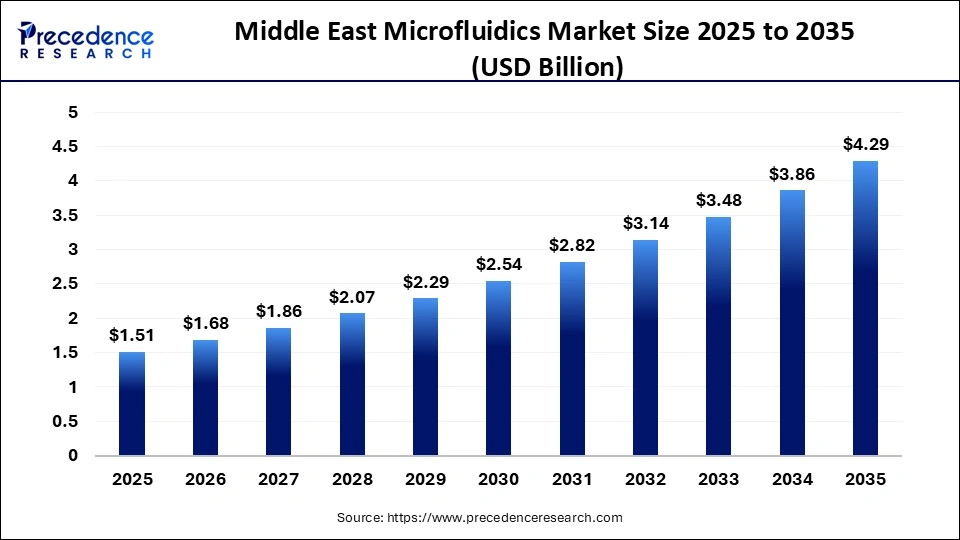
Middle East Microfluidics Market Statical Scope
| Reports Attributes | Statistics |
| Market Size in 2025 | USD 1.51 Billion |
| Market Size in 2026 | USD 1.68 Billion |
| Market Size by 2035 | USD 4.29 Billion |
| CAGR 2026 to 2035 | 11% |
| Base Year | 2025 |
| Forecast Period | 2026 to 2035 |
The microfluidics market in the Middle East is expanding rapidly, fueled by significant investments in healthcare upgrades, especially in Saudi Arabia and the UAE. This growth is vital for enhancing point-of-care testing, personalized medicine , and quick diagnostics for infectious diseases , which greatly improve patient care and lower lab costs. Countries like Saudi Arabia are making substantial investments to boost local biotechnology production and improve healthcare systems, increasing the demand for advanced diagnostic tools.
The market supports the transition from traditional laboratories to quick, miniaturized lab-on-a-chip devices, which are essential for managing chronic and infectious diseases in the area.
Microfluidics offers faster, more accurate, and automated diagnostic solutions, which are crucial for better patient outcomes and fewer hospital readmissions. The growing use of microfluidics in drug delivery, high-throughput screening, and organ-on-chip technology fosters the development of personalized medicine. Additionally, this technology is becoming more important in environmental monitoring and specialized industrial manufacturing.
Middle East Microfluidics Market, By Product, 2025 (%)
| Segments | Shares (%) |
| Microfluidic-based Devices | 60% |
| Microfluidic Components | 40% |
- Microfluidic-based Devices - The microfluidic-based devices segment, with a share of 60%, plays a key role in the market, as it is quickly being adopted for point-of-care (POC) diagnostics , personalized medicine, and life science research. This segment provides faster analysis, requires smaller sample sizes, and offers high sensitivity.
- Microfluidic Components - The microfluidic components segment, with a share of 40%, is essential for the market, as it captures the largest revenue share by allowing precise fluid control in the rapidly growing diagnostics, drug delivery, and pharmaceutical research fields.
Middle East Microfluidics Market, By Technology, 2025 (%)
| Segments | Shares (%) |
| Lab-on-a-chip | 37% |
| Organ-on-a-chip | 15% |
| Continuous Flow Microfluidics | 20% |
| Optofluidics & Microfluidics | 10% |
| Acoustofluidics & microfluidics | 8% |
| Electrophoresis & microfluidics | 9% |
- Lab-on-a-chip - The lab-on-a-chip (LoC) segment, with a share of 37%, is important for the market because it promotes quick, decentralized point-of-care testing and personalized medicine, which aligns with regional initiatives such as Saudi Vision 2030 and the UAE's National Strategy for Advanced Innovation.
- Organ-on-a-chip - The organ-on-a-chip segment, with a share of 15%, is crucial for the market as it enhances personalized medicine, alleviates ethical issues related to animal testing, and backs regional R&D investments aimed at improving drug development efficiency.
- Continuous flow microfluidics - The continuous flow microfluidics segment, with a share of 20%, plays a significant role in the market as it allows for quick, high-throughput analysis and accurate fluid control, essential for the region's growing healthcare, biotechnology , and oil & gas industries.
- Optofluidics & microfluidics - The optofluidics and microfluidics segment, with a share of 10%, is essential mainly as it facilitates fast, decentralized diagnostics, backs precision medicine efforts, and provides high-sensitivity analysis for modernizing healthcare.
Middle East Microfluidics Market, By Material, 2025 (%)
| Segments | Shares (%) |
| Silicon | 15% |
| Glass | 10% |
| Polymer | 45% |
| PDMS | 20% |
| Others | 9% |
- Silicon - The silicon segment, with a share of 15%, is important in the Market since it supports the creation of high-precision, durable, and integrated diagnostic devices that fit with the region's strategic move towards personalized medicine, advanced in-vitro diagnostics (IVD), and local biotechnology.
- Glass - The glass segment, with a share of 10%, is significant in the market because it delivers excellent performance for high-precision diagnostic and research applications, which are currently prioritized by government-led health transformation initiatives in the region.
- Polymer - The polymer segment, with a share of 45%, is the leading and most crucial material category in the market due to its essential role in enabling affordable, rapid, and scalable production of diagnostic and pharmaceutical devices.
- PDMS - The Polydimethylsiloxane (PDMS) sector, with a share of 20%, plays a crucial role in the Market, as it facilitates swift and economical prototyping and manufacturing of lab-on-a-chip devices, which are vital for the region's rapid growth in personalized medicine, diagnostics, and biomedical research.
Middle East Microfluidics Market, By Application, 2025 (%)
| Segments | Shares (%) |
| Medical | 72% |
| Non-medical | 28% |
- Medical - The medical sector, with a share of 72%, is essential to the microfluidics market in the Middle East, as it propels the urgent implementation of point-of-care testing, rapid diagnostics, and precision medicine to tackle the increasing burdens of chronic and infectious diseases.
- Non-medical - The non-medical sector, with a share of 28%, holds significant importance in the market, as it supports regional goals for industrial diversification, particularly in oil and gas, environmental monitoring, and food safety.
Top Companies in the Middle East Microfluidics Market
- Illumina, Inc.
- F. Hoffmann-La Roche Ltd
- Revitty
- Agilent Technologies, Inc.
- Bio-Rad Laboratories, Inc.
- Danaher
- Thermo Fisher Scientific, Inc.
- Abbott
- Standard BioTools Inc.
Segments Covered in the Report
By Product
- Microfluidic-based Devices
- Microfluidic Components
By Technology
- Lab-on-a-chip
- Organ-on-a-chip
- Continuous flow microfluidics
- Optofluidics and microfluidics
- Acoustofluidics and microfluidics
- Electrophoresis and microfluidics
By Material
- Silicon
- Glass
- Polymer
- PDMS
- Others
By Application
- Medical
- Non-medical
| Product | 2025 | 2026 | 2027 | 2028 | 2029 | 2030 | 2031 | 2032 | 2033 | 2034 | 2035 |
|---|---|---|---|---|---|---|---|---|---|---|---|
| Microfluidic-based Devices | 0.91 | 1.01 | 1.13 | 1.26 | 1.41 | 1.57 | 1.75 | 1.96 | 2.19 | 2.44 | 2.72 |
| Microfluidic Components | 0.60 | 0.66 | 0.73 | 0.81 | 0.89 | 0.99 | 1.10 | 1.21 | 1.34 | 1.47 | 1.62 |
| Technology | 2025 | 2026 | 2027 | 2028 | 2029 | 2030 | 2031 | 2032 | 2033 | 2034 | 2035 |
|---|---|---|---|---|---|---|---|---|---|---|---|
| Lab-on-a-chip | 0.42 | 0.47 | 0.53 | 0.60 | 0.67 | 0.75 | 0.85 | 0.96 | 1.08 | 1.21 | 1.36 |
| Organ-on-a-chip | 0.18 | 0.21 | 0.24 | 0.28 | 0.32 | 0.37 | 0.42 | 0.48 | 0.55 | 0.63 | 0.72 |
| Continuous flow microfluidics | 0.30 | 0.33 | 0.36 | 0.39 | 0.43 | 0.47 | 0.51 | 0.56 | 0.61 | 0.66 | 0.71 |
| Optofluidics and microfluidics | 0.21 | 0.23 | 0.26 | 0.29 | 0.32 | 0.35 | 0.39 | 0.43 | 0.47 | 0.51 | 0.55 |
| Acoustofluidics and microfluidics | 0.15 | 0.17 | 0.18 | 0.20 | 0.22 | 0.24 | 0.27 | 0.29 | 0.32 | 0.35 | 0.38 |
| Electrophoresis and microfluidics | 0.24 | 0.27 | 0.30 | 0.33 | 0.36 | 0.39 | 0.43 | 0.47 | 0.51 | 0.56 | 0.61 |
Research Methodology
Related Databooks
March 2026
March 2026
March 2026
March 2026


 sales@precedenceresearch.com
 +1 804-441-9344
 Download Databook
 Schedule a Meeting