



Electronic Toll Collection Market Trends, Leading Companies, Company Revenue / Sales Performance, Subscriber Growth, Pricing Strategies, Cloud Adoption, Infrastructure Expansion, Competitive Landscape, and Industry Outlook
Electronic Toll Collection Market (By Type: Automatic Vehicle Classification (AVC), Violation Enforcement System (VES), Automatic Vehicle Identification System (AVIS), Others (Transaction Processing/Back Office); By Technology: Radio Frequency Identification (RFID), Dedicated Short Range Communication (DSRC), Global Navigation Satellite System (GNSS)/GPS, Video Analytics, Cell Phone Tolling, Others (Barcode-Based ETC); By End-user: Highway, Urban Area) - Global Industry Analysis, Size, Trends, Leading Companies, Regional Outlook, and Forecast 2026 to 2035
Source: https://www.precedenceresearch.com/electronic-toll-collection-market
 Get a Sample
 Table Of Content


What is the Electronic Toll Collection Market Size?
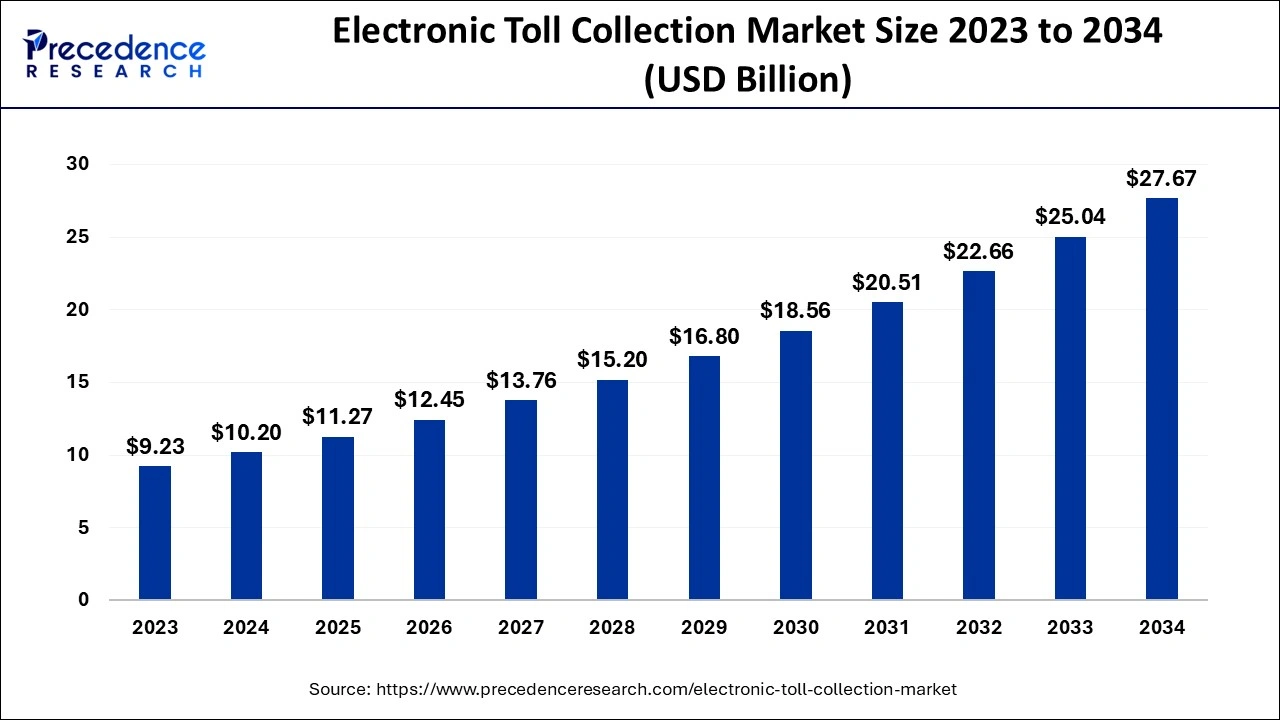
The global electronic toll collection market size was calculated at USD 12.45 billion in 2026 and is predicted to reach around USD 30.13 billion by 2035, expanding at a CAGR of 10.22% from 2026 to 2035. The electronic toll collection market growth is attributed to the increasing activities in highway & road infrastructure upgradation in emerging countries and growing environmental concerns.
Electronic Toll Collection Market Key Takeaways
- The global electronic toll collection market was valued at USD 12.45 billion in 2026.
- It is projected to reach USD 30.13 billion by 2035.
- The electronic toll collection market is expected to grow at a CAGR of 10.22% from 2026 to 2035.
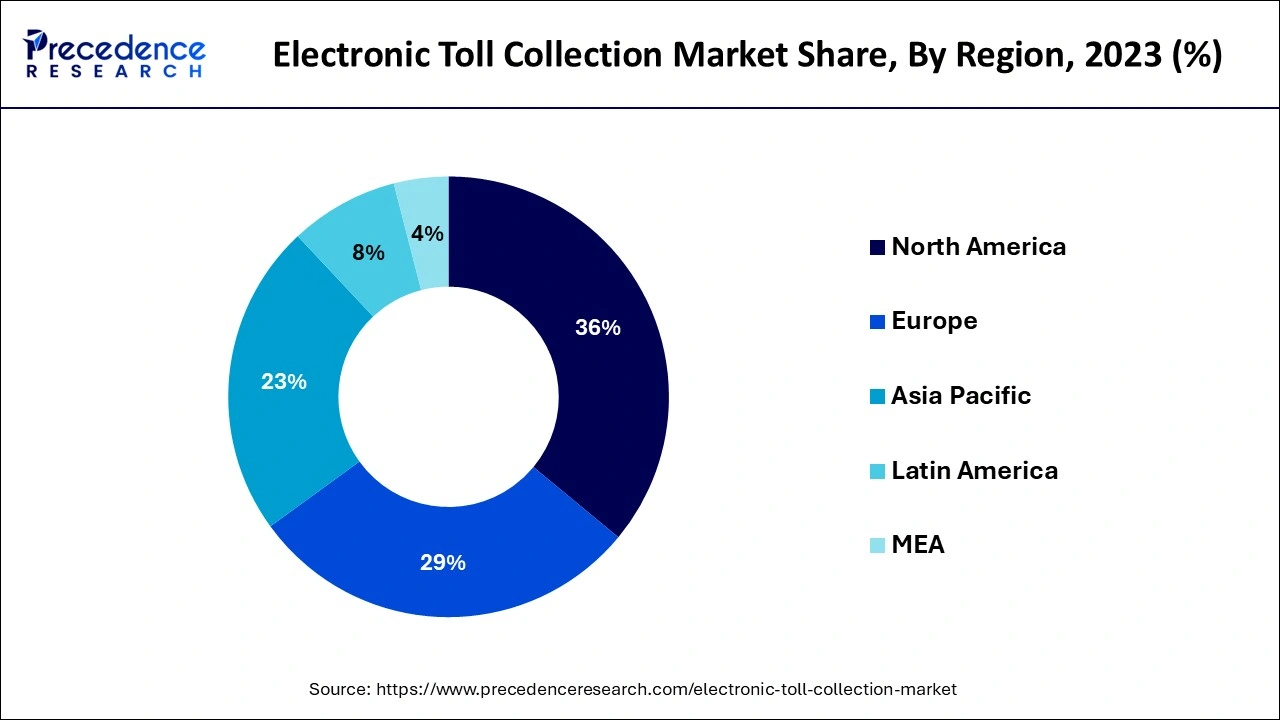
- North America dominated the electronic toll collection market with the largest market share of 36% in 2025.
- Asia Pacific is expected to grow at the fastest rate in the market during the forecast period.
- By type, the automatic vehicle identification system (AVIS) segment held the largest share of the market in 2025.
- By technology, the radio frequency identification (RFID) segment contributed the highest market share of 28% in 2025.
- By technology, the cell phone trolling segment is expected to grow rapidly during the forecast period.
- By end user, the highway segment generated a significant share of the market in 2025.
- By end user, the urban area segment is expected to grow significantly during the forecast period.
Market Overview
The electronic toll collection market deals with the technology used to collect tolls or fees for the use of tunnels, bridges, and highways without requiring drivers to stop and manually swipe a card or cash. Electronic toll collection systems provide a more convenient and efficient method of collecting tolls than traditional toll collection processes like cash payment. With the increasing number of vehicles on the road that can handle high volumes of traffic without causing congestion, there is a need for toll collection systems.
In addition, some tolling providers are emerging all-in-one tolling services that can be used across various toll tunnels, bridges, and roads. These services are capable of reducing the need for multiple toll accounts and tags and improving the tolling process for drivers. The adoption of satellite-based tolling, expansion of mobile payment options, use of blockchain, integration with connected vehicles, and an artificial intelligent-based toll collection system driving the electronic toll collection market growth.
Why is AI changing the Electronic Toll Collection Market?
As the demand for reliable and efficient transportation infrastructure grows, electronic toll collection market products have become an advanced roadway management. Integrating artificial intelligence into these services is transforming the market growth. AI technologies help improve user experiences, reduce costs, and enhance accuracy. AI enhances these processes by machine learning algorithms and employing computer vision to identify license plates and vehicles accurately.
AI helps to manage congestion, optimize roadway usage, and generate revenue more efficiently by adjusting toll rates according to traffic conditions. These advanced factors are expected to revolutionize the growth of the electronic toll collection market in the coming future. AI-generated analytics platforms can manage huge amounts of data generated by ETC systems. AI facilitates seamless toll payments through various digital channels, such as online platforms and mobile applications.
Electronic Toll Collection Market Growth Factors
- The increasing activities in highway and road infrastructure upgrades in emerging countries, growing environmental concerns, and increased government initiatives have contributed to the growth of the market.
- There are rising technological advancements such as the global positioning system (GPS) and radio frequency identification (RFID). These technologies make toll collection systems more reliable, efficient, and accurate and are expected to drive market growth.
- The increasing poor road conditions and traffic congestion have attracted demand for automatic toll collection, and the rising demand for contactless operation in toll plazas is anticipated to enhance the market growth.
- The increase in highway construction and the increasing adoption of digital toll payments across the globe are further anticipated to drive the growth of the electronic toll collection market during the forecast period.
Market Scope
| Report Coverage | Details |
| Market Size by 2035 | USD 30.13 Billion |
| Market Size in 2025 | USD 11.27 Billion |
| Market Size in 2026 | USD 12.45 Billion |
| Market Growth Rate from 2026 to 2035 | CAGR of 10.22% |
| Largest Market | North America |
| Base Year | 2025 |
| Forecast Period | 2026 to 2035 |
| Segments Covered | Type, Technology, End-user, and Regions |
| Regions Covered | North America, Europe, Asia-Pacific, Latin America and Middle East, and Africa |
Market Dynamics
Driver
Rising demand for efficient traffic management
The major factor driving the electronic toll collection market growth is the increasing demand for efficient traffic management solutions in toll collection centers. A well-managed traffic across urban areas is crucial to increasing traffic congestion and urbanization. This automatic toll collection system helps to save time and handle the traffic flow at the toll plaza. In addition, increasing traffic on the highways causes extra congestion at the toll booths, resulting in a loss of fuel and time. The advanced automatic toll collection system uses various technologies such as dedicated short-range communication, RFID tags, and others. This system saves additional costs and waiting time compared to traditional tolling. In addition, this system is used to reduce traffic congestion and seamless passage at toll booths.
Restraint
Lack of standardization in the implementation of the ETC system
The implementation of the electronic toll collection market has various problems. Several electronic system manufacturers have different standardizations owing to compatibility problems. Various companies produce various standard tools that result in challenges for commuters. Although there is increased growth in electronic toll services, incompatibility issues between manufacturers associated with several technologies restrain the market expansion. The companies leading ETC's patent rights resulted in a fight in court to save it. Several electronic toll collection technologies have various equipment and systems. For example, readers relate to various computer systems, but the other manufacturer's tool cannot read the RFID tags produced by other manufacturers. If two tags are linked to one vehicle, it may cause interference problems.
Opportunity
Rising investment in the transportation infrastructure
Infrastructure investment includes improvements to the current network and the building of new transport facilities. It is one of the major factors influencing performance in the electronic toll collection market. Developing and developed countries can benefit socially and economically from efficient transportation infrastructure by increasing market productivity and accessibility, ensuring that communities are connected, encouraging labor mobility, and promoting balanced regional economic development. However, only one-third of the evaluated enterprises are included in the supply of infrastructure for electric vehicles or environmental toll schemes.
Segment Insights
Type Insights
The automatic vehicle identification system (AVIS) segment held the largest share of the electronic toll collection market in 2025. Based on type insights, the market is segmented into Automatic Vehicle Identification System (AVIS), Automatic Vehicle Classification (AVC), Violation Enforcement System (VES), and others. The segment growth is attributed to the rising popularity of FASTag at the toll collection booth in the market. FASTag is the most convenient and easiest way to collect toll tax without slowing down or stopping the vehicles. In addition, several government authorities in developing countries are taking the initiative to execute an automatic vehicle identification service that is responsible for market expansion. Automatic vehicle identification-based ETC reduces delays and transaction times and increases throughput at the toll plaza. For instance, an automatic vehicle identification system takes around 8 seconds per vehicle to drive in the toll plaza. This type of ETC lane handles around 1,200 vehicles per hour and is further expected to drive the segment growth in the market.
Technology Insights
The radio frequency identification (RFID) segment dominated the electronic toll collection market in 2025. Based on technology insights, the market is segmented into cell phone tolling, video analytics, Global Navigation Satellite System (GNSS)/GPS, Dedicated Short-Range Communication (DSRC), Radio Frequency Identification (RFID), and others. Radiofrequency identification distances from a range of around 72 meters, that is 235 feet, and the transponder reads the speed up to 290 km/h.
The cell phone trolling segment is expected to grow rapidly during the forecast period. The segment growth is attributed to the increasing adoption of digital payments across roadways for electronic toll collection. The rising adoption of high-construction projects in becoming prevelant.
- Toll income from the National Highway of India will triple in the next three years to over USD 1.7 billion per year, according to the transport minister.
End-user Insights
The highway segment generated a significant share of the electronic toll collection market in 2025. Based on end-user insights, the market is segmented into urban areas and highways. The segment growth is attributed to the rising investment in highway and road construction projects across the world. In addition, highway vehicles need higher transition at the toll booth. An automatic toll collection system enables vehicles to pay tolls without slowing down and stopping vehicles in toll plazas.
The urban area segment is expected to grow significantly in the electronic toll collection market during the forecast period. The segment growth is attributed to the Increasing smart city investment in urban areas across the globe. In addition, rising global urbanization is further anticipated to enhance the segment growth.
Regional Insights
What is the U.S. Electronic Toll Collection Market Size?
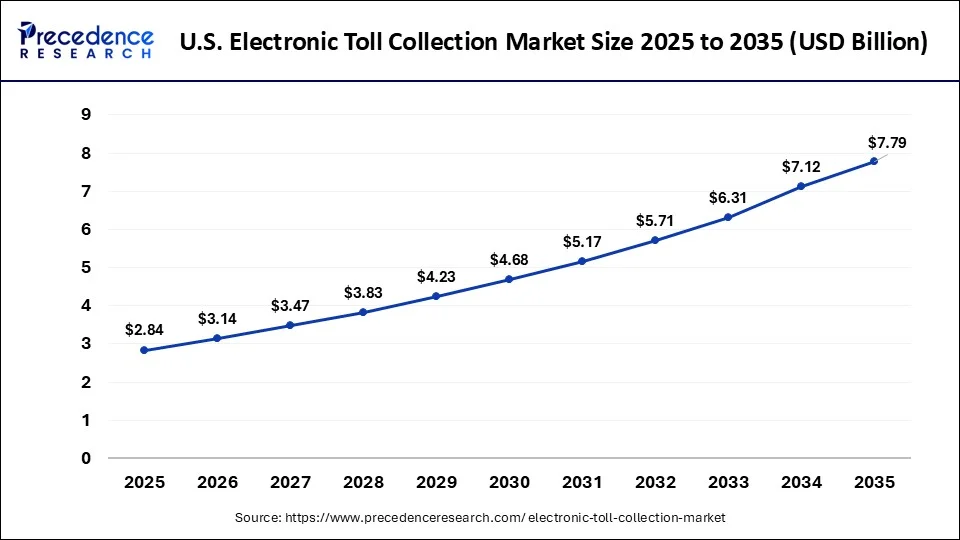
The U.S. electronic toll collection market size was evaluated at USD 3.14 billion in 2026 and is projected to be worth around USD 7.79 billion by 2035, growing at a CAGR of 10.62% from 2026 to 2035.
North America dominated the electronic toll collection market in 2025. The market growth in the region is fueled by increasing investment toward modern roadways and early adoption of advanced technology-based ETC. The U.S. and Canada are the major countries in the region. The market in the U.S. is growing rapidly, leading to the rapid implementation of modern technologies in the transportation and road industry. In the U.S., a significant amount was invested in highway networks across urban areas. However, traffic congestion has been far outpaced by population growth and has increased in most urbanized areas.
Asia Pacific is expected to grow at the fastest rate in the electronic toll collection market during the forecast period. The market growth in the region is driven by the Increasing use of automatic tooling devices in urban areas and on the highway. In addition, the top major market players are adopting various business plans of action, such as product developments, acquisitions, business partnerships, and collaborations, further driving the growth of the market. China, India, Japan, and South Korea are the major countries in the region.
- In June 2024, the central government and its agencies announced the launch of a GNSS-based electronic toll collection system in India.
What are the Advancements in the Electronic Toll Collection Market in Europe?
Europe is expected to have significant market growth, driven by regulatory mandates and cross-border interoperability initiatives. The market demand is further being driven by the region's stringent regulations aimed at reducing traffic congestion and promoting sustainable transport solutions. Countries like Germany and France are leading players, implementing advanced tolling systems that integrate with smart city initiatives. The European Union's directives on transport efficiency further bolster market growth.
Germany Market Trends
The country's market landscape is characterized by a mix of established players and innovative startups, all of whom are competing for the highest market share. The focus on interoperability and user-friendly solutions is also shaping the future of ETC in the region.
What are the Key Trends in the Electronic Toll Collection Market in Latin America?
Latin America is expected to witness significant growth in the upcoming years, where advanced toll infrastructure and automation technologies are shaping regional leadership. Countries like Brazil and Mexico are leading players as they are seen implementing advanced tolling systems to manage their growing traffic demands effectively.
Brazil Market Trends
The country has a high focus on integrating ETC with mobile payment solutions and enhancing user convenience, which is driving innovation and market penetration in the region, making it a place for future growth.
How is the Middle East and Africa Region Growing in the Electronic Toll Collection Market?
The Middle East and Africa region is expected to have significant market growth in the upcoming years. This is because the region is seen as actively investing in modern toll collection systems to support smart mobility initiatives. Countries like South Africa and the UAE are leading players, implementing modern tolling systems to address urban congestion and enhance revenue collection.
Saudi Arabia Market Trends
Companies in the region are increasingly focusing on developing user-friendly solutions that cater to the unique needs of the region. The growth potential is quite significant, especially as governments prioritize smart city initiatives and sustainable transport solutions.
Electronic Toll Collection Market Companies
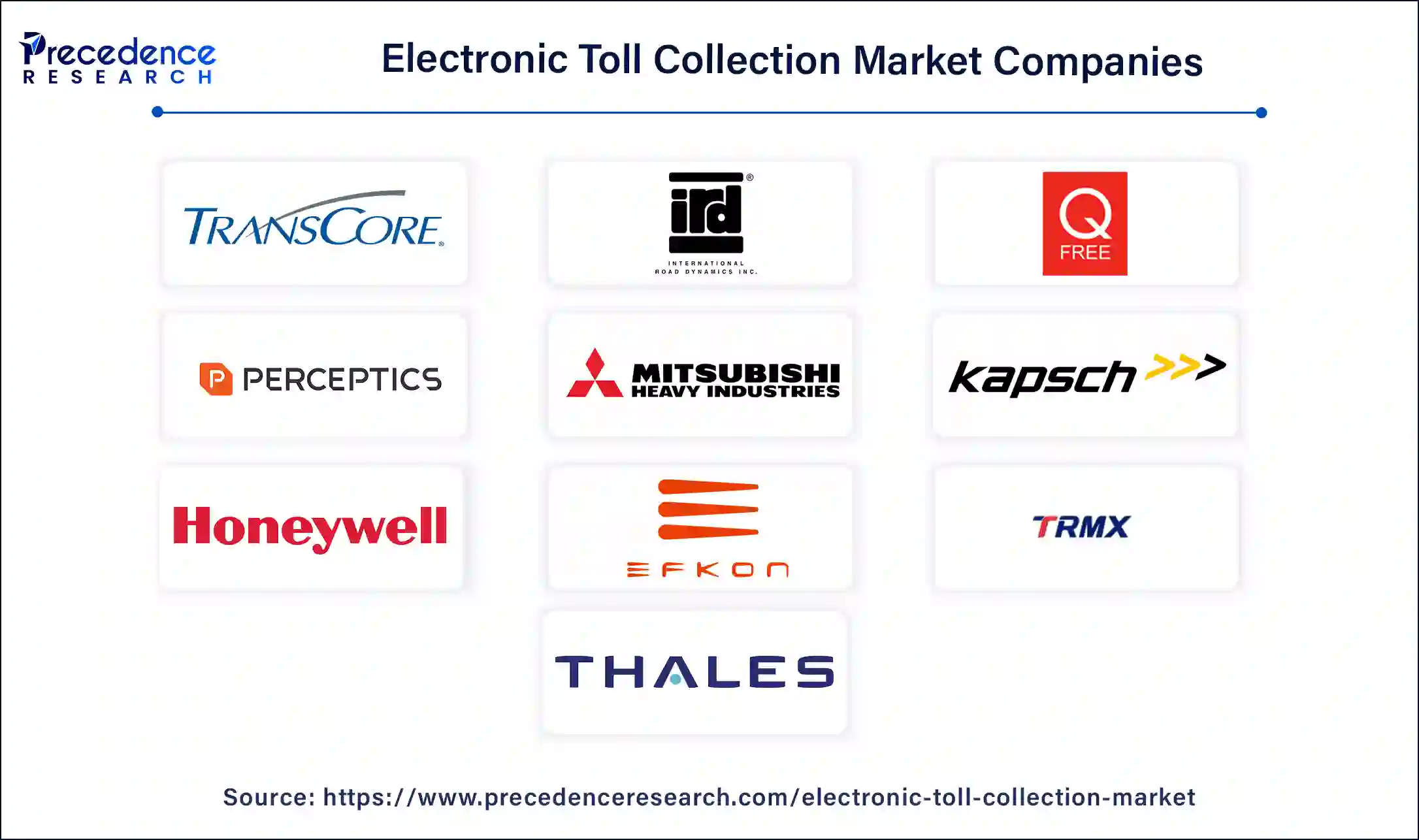
- Thales Group (U.S.)
- TRMI Systems Integration (Japan)
- EFKON (Austria)
- Honeywell International, Inc. (U.S.)
- Kapsch TrafficCom AG (Austria)
- Mitsubishi Heavy Industries, Ltd. (Japan)
- Perceptics (U.S.)
- Q-Free (Norway)
- IRD (Canada)
- Transcore Holdings, Inc. (U.S.)
Latest Advancements by Industry Players
- In February 2024, in India, Union Minister Nitin Gadkari announced the launch of GPS-based toll collection. The aim behind this launch was to reduce traffic congestion and charge motorists for the exact distance traveled on the highways.
Recent Developments
- In November 2024, NHAI launched the Dwarka Expressway, the first multi-lane free flow (MLFF) toll collection. The tolling system will consist of field equipment and sensors mounted on gantries, which will capture information from passing vehicles. This data will be transmitted to the electronic toll payment system to deduct the user fee.
- In April 2024, Ohio Turnpike launched a USD 250 million modernized toll collection system comprising Interstate 80, I-90, and I-76.
- In September 2024, the latest design for its FASTag was introduced by the State Bank of India (SBI), which will bring down travel time for travelers. "The bank has introduced a new design for SBI FASTag in the Vehicle Class (VC-04) category. The advanced FASTag design enhances vehicle identification and toll collection efficiency aimed at reducing travel time for millions of commuters in India."
Segments Covered in the Report
By Type
- Automatic Vehicle Classification (AVC)
- Violation Enforcement System (VES)
- Automatic Vehicle Identification System (AVIS)
- Others (Transaction Processing/Back Office)
By Technology
- Radio Frequency Identification (RFID)
- Dedicated Short Range Communication (DSRC)
- Global Navigation Satellite System (GNSS)/GPS
- Video Analytics
- Cell Phone Tolling
- Others (Barcode-Based ETC)
By End-user
- Highway
- Urban Area
By Geography
- North America
- Asia Pacific
- Europe
- Latin America
- Middle East and Africa
For inquiries regarding discounts, bulk purchases, or customization requests, please contact us at sales@precedenceresearch.com
Frequently Asked Questions





Ask For Sample
No cookie-cutter, only authentic analysis – take the 1st step to become a Precedence Research client
 Get a Sample




 sales@precedenceresearch.com
 Schedule a Meeting
