


Europe & Italy NGS Market Size, Key Companies, Company Market Share, Patient Volume, Treatment Adoption Rates, Pricing Analysis, Regulatory Landscape, Competitive Positioning, and Demand Forecast
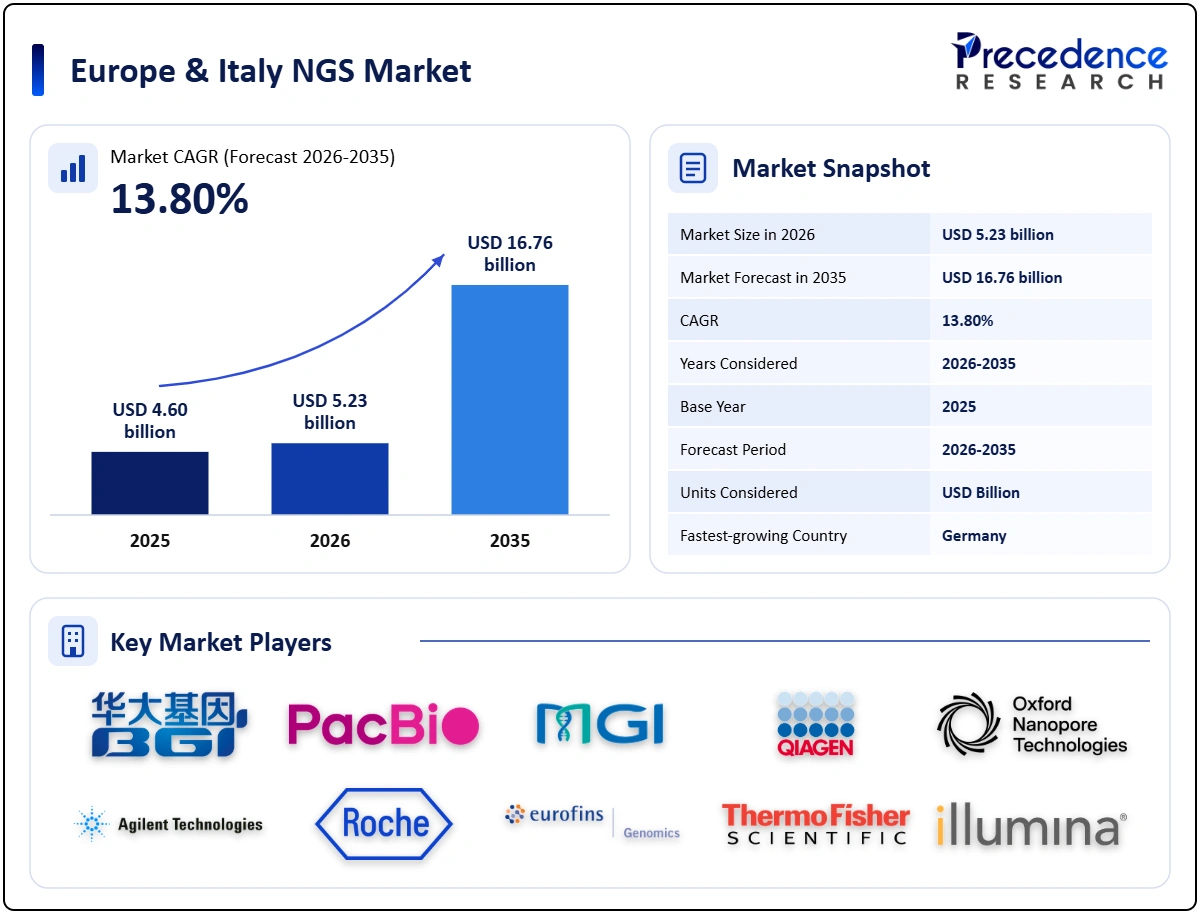
Payal Rabde, a Healthcare Industry Expert, highlights that the Europe and Italy NGS market has reached USD 5.23 billion in 2026 and is on track to reach USD 16.76 billion by 2035, advancing at a CAGR of 13.80%. Key Europe and Italy NGS market companies shaping the market include Illumina, Thermo Fisher Scientific, Eurofins Genomics, while major growth segments span product & service, technology, application, end user and region.
Source: https://www.precedenceresearch.com/europe-italy-ngs-market
 Get a Sample
 Report Description
Key Takeaways
Market Size & Growth Outlook
- Market Size in 2025: USD 4.60 Billion
- Estimated Market Size in 2026: USD 5.23 Billion
- Projected Market Size by 2035: USD 16.76 Billion
- CAGR (2026-2035): 13.80%
Regional Market Highlights
- Germany accounted for 22.80% of the market share and reached USD 1.05 billion in 2025.
- The U.K. captured 20.40% market share and generated USD 0.94 billion in 2025.
- Italy held a 10.60% share, with a market size of USD 0.49 billion in 2025, and is projected to be the fastest-growing country, at a CAGR of 14.97% from 2026 to 2035.
Segmental Spotlight
- By product & service, the consumables segment accounted for a 52.60% share and reached USD 2.42 billion in 2025.
- By technology, short-read sequencing contributed an 82.40% market share, generating USD 3.79 billion in 2025.
- By application, the oncology segment held a 34.20% share and was valued at USD 1.57 billion in 2025.
- By end user, academic & research institutes accounted for 36.40% of the market share (USD 1.67 billion) in 2025.
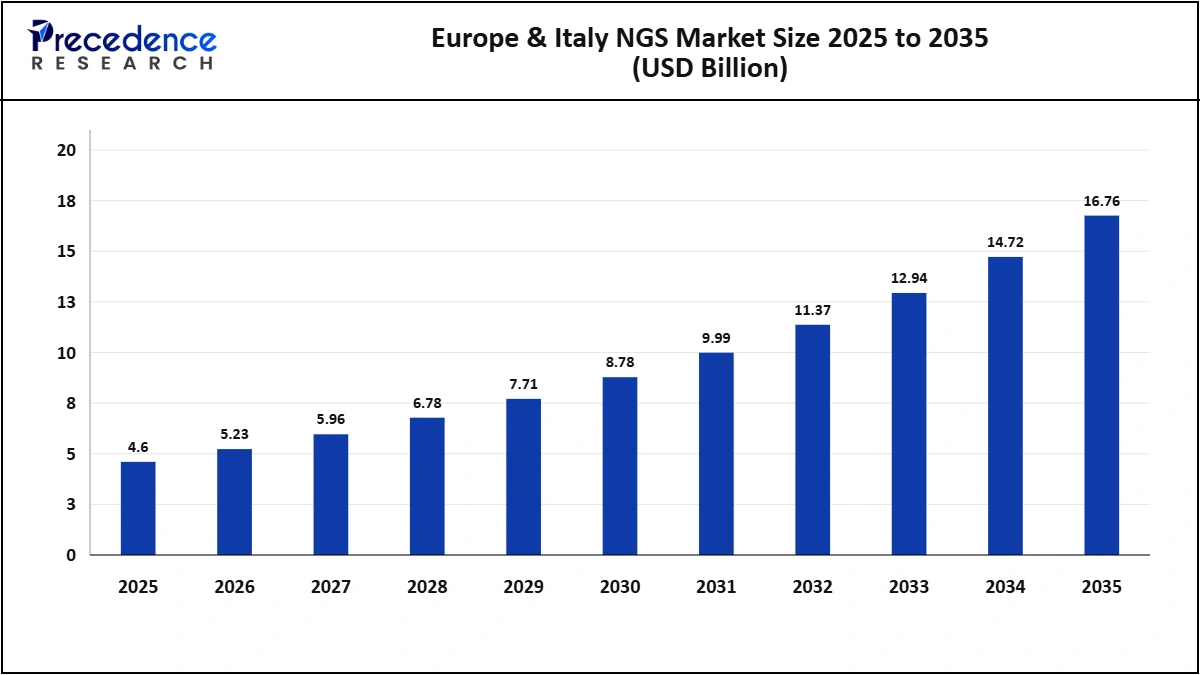
Europe & Italy NGS Market Size and Forecast, 2025-2035 (USD Billion)
Note: 2025 is the base year; 2026-2035 values are forecasts.
Sources: Expert interviews, secondary sources, Precedence Research database, and Precedence Research analysts.
The Europe and Italy NGS market is expected to grow from USD 4.60 billion in 2025 to USD 16.76 billion by 2035, driven by the growing adoption of sequencing in routine clinical care. National genomics programmes and rising cancer biomarker testing are increasing sequencing volumes across Europe. Lower sequencing costs, comprehensive genomic profiling in oncology, rare disease and newborn screening, advances in benchtop and long-read platforms, and wider clinical reimbursement, particularly in Italy, further accelerate market growth. The market will reach USD 8.78 billion by 2030, with a CAGR of 13.80% from 2026 to 2035.
Analyst View: The market is entering a strong growth phase, driven by the shift from research-based sequencing to routine clinical applications. Rising demand for cancer profiling, rare disease diagnosis, and newborn screening, along with lower sequencing costs and broader adoption of advanced platforms, is accelerating market expansion. The growth rate is based on evidence below some published estimates, reflecting strong clinical adoption moderated by falling per-sample prices and research budget pressure.
Market Trends
- National genomic medicine programs are expanding the use of sequencing in healthcare.
- Comprehensive genomic profiling in oncology is gaining traction to support more precise cancer diagnosis.
- Long-read sequencing adoption is increasing due to its ability to detect complex genomic variations.
- New sequencing chemistries and advanced platforms are improving accuracy, speed, and cost efficiency.
- Demand for IVDR-certified NGS assays is growing as laboratories adapt to European regulatory requirements.
- Cloud-based solutions and AI-powered interpretation are making genomic data analysis faster.
Drivers, Restraints, and Opportunities
Driver
The expansion of national genomic medicine programs and growing demand for biomarker cancer testing are accelerating NGS adoption across Europe. Meanwhile, falling sequencing costs and the increasing use of genomic testing for rare disease diagnosis are making these technologies more accessible.
Restraint
Market growth faces challenges due to differences in reimbursement policies across European countries. In addition, stricter IVDR requirements are increasing compliance costs for manufacturers and laboratories, while data storage, privacy regulations, and pressure on research budgets create further constraints.
Opportunity
Growing demand for affordable and clinically relevant sequencing solutions, liquid biopsy, minimal residual disease (MRD) testing, and newborn genome sequencing is creating new growth opportunities. Increasing clinical genomics adoption in Italy and Spain, rising demand for multiomics solutions, and the development of the European Health Data Space (EHDS) are further expanding the market potential.
Market Segmentation: 2025 Share and Size
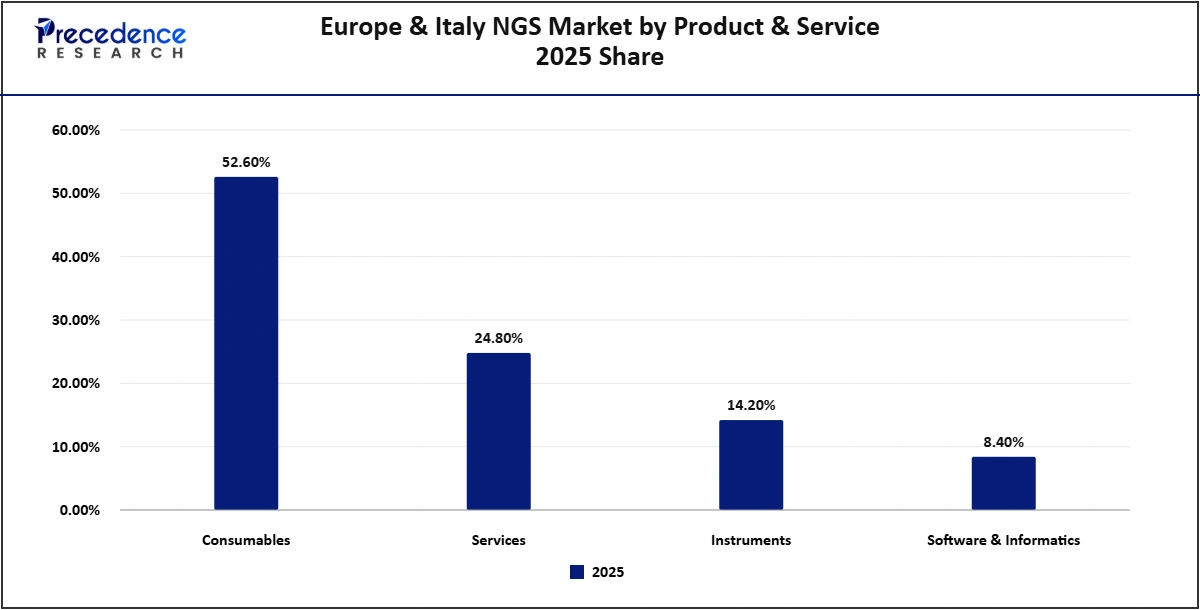
Europe & Italy NGS Market by Product & Service 2025 Share
Note: 2025 is the base year; 2035 values are forecasts.
Sources: Expert interviews, secondary sources, Precedence Research database, and Precedence Research analysts.
Consumables dominate the market with a 52.60% share (USD 2.42 billion) in 2025, services held 24.80% (USD 1.14 billion), instruments 14.20% (USD 0.65 billion), and software & informatics 8.40% (USD 0.39 billion) in 2025. Consumables lead, while software and informatics are growing fastest.
Consumables: This segment accounted for a 52.60% share and reached USD 2.42 billion in 2025. It is projected to grow to USD 8.49 billion by 2035, at a CAGR of 13.38% from 2026 to 2035. Consumables include flow cells, sequencing reagent kits, library preparation, and target enrichment kits. They lead because every run consumes them, and Illumina, Thermo Fisher, Oxford Nanopore, and others earn most of their revenue from consumables.
Services: The service segment was valued at USD 1.14 billion in 2025 and is expected to reach USD 4.15 billion by 2035, expanding at a CAGR of 13.78% over the forecast period. Services include sequencing provided by commercial genomics laboratories such as Eurofins Genomics and national sequencing centers, and clinical testing services.
Instruments: With 14.20% market share in 2025, the instruments segment is forecast to expand from USD 0.65 billion to USD 2.37 billion by 2035, at a CAGR of 13.78% during 2026-2035. Instruments include benchtop and production-scale sequencers, such as Illumina's NovaSeq X and MiSeq i100, Thermo Fisher's Ion Torrent, Oxford Nanopore's devices, and Roche's new AXELIOS 1 research platform launched in 2026.
Software & Informatics: This segment was valued at USD 0.39 billion in 2025 and is estimated to reach USD 1.75 billion by 2035, growing at a CAGR of 16.28% over the forecast period. Software & informatics include secondary and tertiary analysis, variant interpretation, and data management. They are the fastest-growing segment because clinical sequencing creates large data volumes that require automated, compliant analysis.
Europe & Italy NGS Market by Technology 2025 Share & Size
| Segments | 2025 Share | 2025 Value (USD Billion) | 2035 Value (USD Billion) | CAGR 2026-2035 |
| Short-Read Sequencing | 82.40% | 3.79 | 12.89 | 13.02% |
| Long-Read Sequencing | 17.60% | 0.81 | 3.87 | 16.92% |
Note: 2025 is the base year; 2035 values are forecasts.
Sources: Expert interviews, secondary sources, Precedence Research database, and Precedence Research analysts.
Short-read sequencing accounted for an 82.40% (USD 3.79 billion) share in 2025, and long-read sequencing held a 17.60% (USD 0.81 billion) share in 2025.
Short-Read Sequencing: This segment captured 82.40%(USD 3.79 billion) market share in 2025 and is forecast to reach USD 12.89 billion by 2035, at a CAGR of 13.02%. Short-read sequencing, mainly sequencing by synthesis, dominates because of high accuracy, throughput, and low cost per base for most clinical and research applications.
Long-Read Sequencing: The long-read sequencing segment held a 17.60% share of the market in 2025, valued at USD 0.81 billion. It is expected to reach USD 3.87 billion by 2035, growing at a CAGR of 16.92%. Long-read sequencing from Oxford Nanopore and PacBio is the fastest-growing technology because it resolves structural variants, repeat expansions, and methylation, and U.K.-based Oxford Nanopore has a strong European user base.
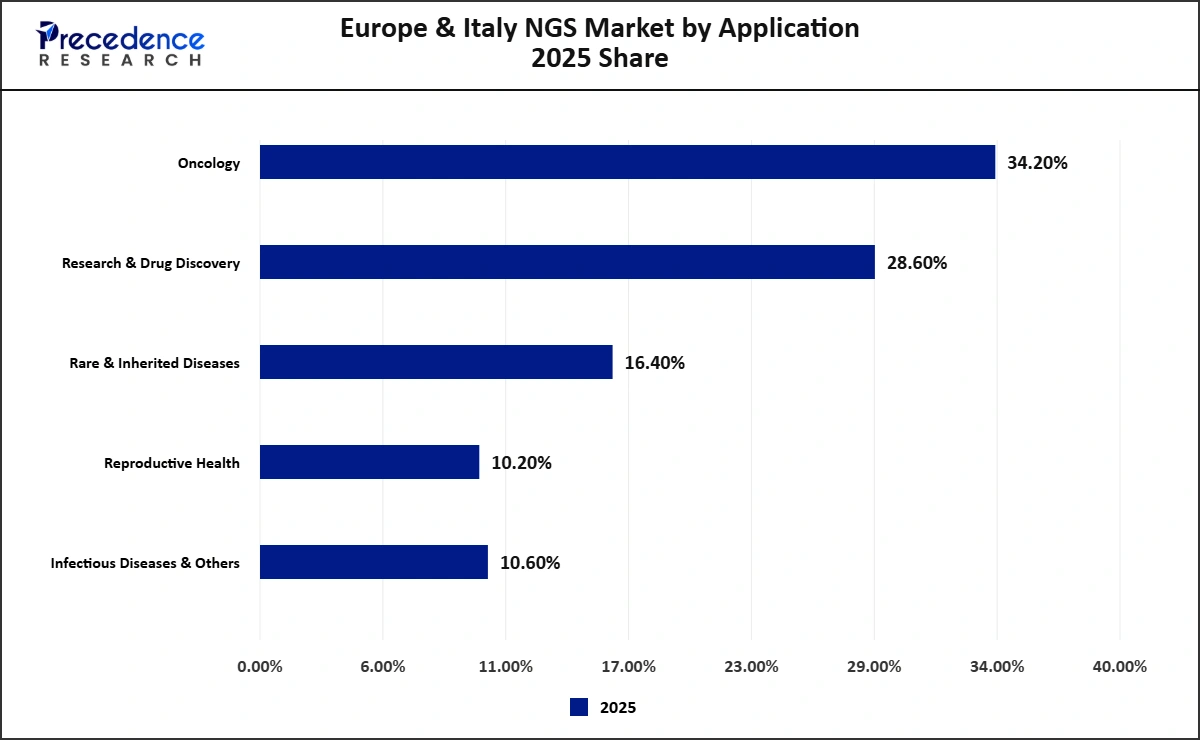
Europe & Italy NGS Market by Application 2025 Share
Note: 2025 is the base year; 2035 values are forecasts.
Sources: Expert interviews, secondary sources, Precedence Research database, and Precedence Research analysts.
Oncology contributed 34.20% market share and reached USD 1.57 billion in 2025. Research & drug discovery accounted for 28.60% (USD 1.32 billion), rare & inherited diseases held 16.40% (USD 0.75 billion), reproductive health at 10.20% (USD 0.47 billion), and infectious diseases & others for 10.60% (USD 0.49 billion) share in 2025.
Oncology: This segment held 34.20% market share, with a market size of USD 1.57 billion in 2025 and is projected to reach USD 6.13 billion by 2035, at a CAGR of 14.58% from 2026 to 2035. Oncology is the largest application, covering tumor panels, comprehensive genomic profiling, liquid biopsy, and hereditary cancer testing, with Italy, Germany, and France expanding reimbursement and molecular tumor boards.
Research & Drug Discovery: The market size of this segment was valued at USD 1.32 billion in 2025 and is forecast to reach USD 4.62 billion by 2035, exhibiting a CAGR of 13.38% during the study period. Research & drug discovery includes genomics, transcriptomics, single-cell, spatial, and population studies in universities and pharma companies.
Rare & Inherited Diseases: The rare & inherited diseases segment, valued at USD 0.75 billion in 2025. It is projected to reach USD 2.65 billion by 2035, registering a 13.38% CAGR over the forecast period. Rare & inherited diseases use exome and whole-genome sequencing for diagnosis, with national programs in the U.K., France, and other countries.
Reproductive Health: This segment accounted for 10.20% and reached USD 0.47 billion in 2025 and is expected to grow to USD 1.65 billion by 2035, at a CAGR of 13.38%. Reproductive health includes non-invasive prenatal testing, preimplantation genetic testing, and carrier screening.
Infectious Diseases & Others: The infectious diseases & others segment accounted for 10.60% (USD 0.49 billion) of the market in 2025 and is projected to reach USD 1.71 billion by 2035, at a CAGR of 13.38%. Infectious diseases & others include pathogen genomics, outbreak surveillance, wastewater monitoring, and microbiome sequencing.
Europe & Italy NGS Market by End User 2025 Share & Size
| Segments | 2025 Share | 2025 Value (USD Billion) | 2035 Value (USD Billion) | CAGR 2026-2035 |
| Academic & Research Institutes | 36.40% | 1.67 | 5.68 | 13.00% |
| Hospitals & Clinical Laboratories | 34.80% | 1.60 | 6.42 | 14.90% |
| Pharmaceutical & Biotechnology Companies | 20.20% | 0.93 | 3.27 | 13.40% |
| Others | 8.60% | 0.40 | 1.39 | 13.40% |
Note: 2025 is the base year; 2035 values are forecasts.
Sources: Expert interviews, secondary sources, Precedence Research database, and Precedence Research analysts.
Academic & research institutes accounted for 36.40% (USD 1.67 billion) in 2025, hospitals & clinical laboratories for 34.80% (USD 1.60 billion), pharmaceutical & biotechnology companies for 20.20% (USD 0.93 billion), and others for 8.60% (USD 0.40 billion).
Academic & Research Institutes: This segment held a 36.40% market share and was valued at USD 1.67 billion in 2025 and is expected to reach USD 5.68 billion by 2035, growing at a CAGR of 13.00% during the forecast period. Academic & research institutes are the largest end users, including the Wellcome Sanger Institute, EMBL, Max Planck institutes, and Italian research centers.
Hospitals & Clinical Laboratories: The hospitals & clinical laboratories segment represents 34.80% of the market in 2025. It was valued at USD 1.60 billion and is forecast to rise to USD 6.42 billion by 2035 at a CAGR of 13.78%. Hospitals & clinical laboratories are the fastest-growing end users as sequencing becomes part of routine oncology and rare disease care, including in Italian regional hospital networks.
Pharmaceutical & Biotechnology Companies: This segment was valued at USD 0.93 billion of the market in 2025 and is projected to reach USD 3.27 billion by 2035, expanding at a CAGR of 13.40% over the forecast period. Pharmaceutical & biotechnology companies use NGS for target discovery, biomarker development, and clinical trials.
Others: This segment accounted for 8.60% (USD 0.40 billion) in 2025 and is forecast to reach USD 1.39 billion by 2035, expanding at a CAGR of 13.40% from 2026 to 2035. Others include public health agencies, agriculture, and forensic laboratories.
- Analyst View: The market is driven by consumables and short-read sequencing, reflecting their established role in routine sequencing workflows. Oncology remains the leading application, while hospitals and clinical laboratories are emerging as key growth drivers as sequencing moves into routine patient care. Academic & research institutes continue to provide a strong demand base, supported by pharmaceutical R&D and expanding clinical genomics programs. Overall, the market is gradually shifting from research-led adoption towards wider clinical use, creating opportunities across platforms, services and data analysis solutions.
Europe & Italy NGS Market Country Analysis
Europe Italy NGS Market By Country 2025 Share & Size
| Country | 2025 Share | 2025 Value (USD Billion) | 2035 Value (USD Billion) | CAGR 2026-2035 |
| Germany | 22.80% | 1.05 | 3.81 | 13.76% |
| U.K. | 20.40% | 0.94 | 3.41 | 13.76% |
| France | 14.20% | 0.65 | 2.37 | 13.76% |
| Italy | 10.60% | 0.49 | 1.97 | 14.96% |
| Spain | 7.40% | 0.34 | 1.24 | 13.76% |
| Rest of Europe | 24.60% | 1.13 | 3.96 | 13.36% |
Note: 2025 is the base year; 2035 values are forecasts.
Sources: Expert interviews, secondary sources, Precedence Research database, and Precedence Research analysts.
Germany dominates the market with a 22.80% share and reached USD 1.05 billion in 2025. The U.K. accounted for 20.40% (USD 0.94 billion), France for 14.20% (USD 0.65 billion), Italy for 10.60% (USD 0.49 billion), Spain for 7.40% (USD 0.34 billion), and the rest of Europe for 24.60% (USD 1.13 billion). Germany leads, while Italy is growing fastest among the major countries.
Germany: The market size of Germany was valued at USD 1.05 billion in 2025 and is projected to reach USD 3.81 billion by 2035, at a CAGR of 13.76% from 2026 to 2035. Germany is Europe's largest NGS market, with a large hospital and laboratory network, statutory health insurance reimbursement, strong research funding, and the presence of major manufacturers and reference laboratories.
U.K.: The country held a 20.40% share, valued at USD 0.94 billion in 2025 and is projected to reach USD 3.41 billion by 2035, exhibiting a 13.76% CAGR. The U.K. has one of the world's most advanced genomic medicine systems, including Genomics England and the NHS Genomic Medicine Service, the Wellcome Sanger Institute and Oxford Nanopore Technologies, giving it a share close to Germany's.
France: This country contributed 14.20% of the market share and reached USD 0.65 billion in 2025. It is expected to rise to USD 2.37 billion by 2035, at a CAGR of 13.76% over the forecast period. France has a large and well-funded laboratory sector, consolidated private laboratory groups, and strong public research, supporting steady NGS demand.
Italy: Italy valued at USD 0.49 billion in 2025, the country is forecast to reach USD 1.97 billion by 2035, growing at a CAGR of 14.96%. Italy has a large regional health system, many hospitals and private laboratories, an ageing population with high chronic disease burden, and leading domestic diagnostics companies such as DiaSorin. It is the fastest-growing major country in this market as regions invest in laboratory modernization, precision medicine, and National Recovery and Resilience Plan funding for healthcare digitalization and equipment.
Spain: This country held a 7.40% share and was valued at USD 0.34 billion in 2025 and is projected to reach USD 1.24 billion by 2035, at a CAGR of 13.76% over the forecast period. Spain has a growing laboratory market, with regional health services investing in modern equipment and expanding precision medicine programs.
Rest of Europe: With a market size of USD 1.13 billion in 2025, the rest of Europe is estimated to reach USD 3.96 billion by 2035, expanding at a CAGR of 13.36% over the forecast period. The rest of Europe includes the Netherlands, Switzerland, the Nordic countries, Belgium, Austria, Poland, and other countries, with high spending in Western Europe and faster growth in Central and Eastern Europe.
Analyst View: Germany and the U.K. lead the market, supported by strong research infrastructure, established genomic medicine programs, and advanced clinical testing networks. France maintains steady demand through its well-funded laboratory and research ecosystem, while Italy is emerging as the fastest-growing major market, driven by healthcare modernization and precision medicine investments. Overall, market growth is increasingly supported by wider clinical adoption and national healthcare investments.
Competitive Landscape
Top 10 Players in the Europe & Italy NGS Market, 2025
| Rank | Company Name | Market-Specific Revenue (USD Billion) | 2025 Share | Key Products / Business | Headquarters |
| 1 | Illumina | 1.55 | 33.70% | NovaSeq, NextSeq and MiSeq platforms | United States |
| 2 | Thermo Fisher Scientific | 0.42 | 9.13% | Ion Torrent and Oncomine assays | United States |
| 3 | Eurofins Genomics | 0.20 | 4.35% | Sequencing services | Luxembourg |
| 4 | Roche | 0.15 | 3.26% | AVENIO, KAPA and AXELIOS 1 | Switzerland |
| 5 | Agilent Technologies | 0.12 | 2.61% | SureSelect target enrichment | United States |
| 6 | Oxford Nanopore Technologies | 0.10 | 2.17% | Nanopore long-read sequencers | United Kingdom |
| 7 | QIAGEN | 0.10 | 2.17% | Sample prep and QCI interpretation | Netherlands |
| 8 | MGI Tech | 0.08 | 1.74% | DNBSEQ sequencers | China |
| 9 | PacBio | 0.05 | 1.09% | Revio and Vega long-read systems | United States |
| 10 | BGI Genomics | 0.05 | 1.09% | Sequencing services | China |
Note: Company revenues and shares are 2025 estimates.
Sources: Company press releases, expert interviews, secondary sources, Precedence Research database, and Precedence Research analysts.
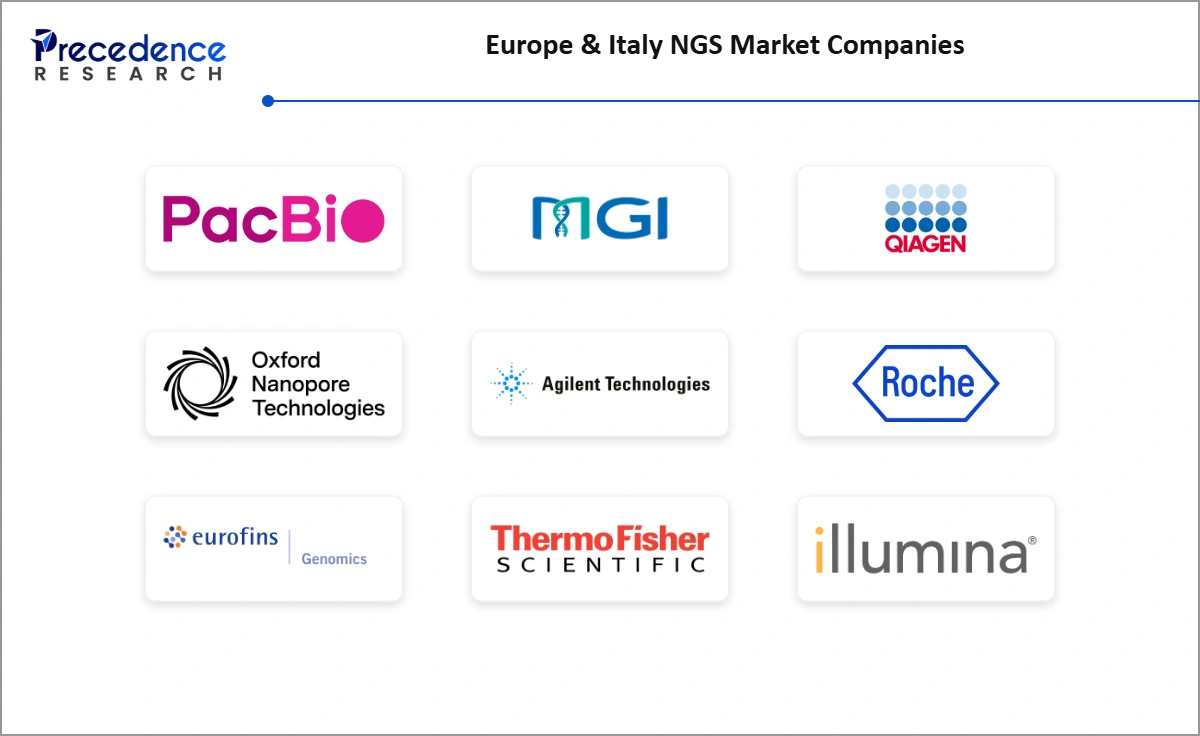
Illumina led the Europe & Italy NGS market with a 33.70% share and generated USD 1.55 billion in 2025 revenue, followed by Thermo Fisher Scientific at 9.13% (USD 0.42 billion) and Eurofins Genomics at 4.35% (USD 0.20 billion). Illumina leads with the largest installed base of short-read sequencers and consumables across European research and clinical laboratories. Thermo Fisher Scientific sells Ion Torrent systems and Oncomine oncology assays, and Eurofins Genomics is a leading sequencing service provider. Roche, Agilent, Oxford Nanopore, QIAGEN, MGI Tech, PacBio, and BGI Genomics compete through library prep and its new SBX-based platform, target enrichment, long-read nanopore sequencing, interpretation software, alternative short-read platforms, long-read systems and services.
The top 10 companies accounted for 61.30% share (USD 2.82 billion) of 2025 revenue, while the remaining 38.70% share (USD 1.78 billion) was shared among clinical genomics laboratories, bioinformatics companies and regional distributors. The Europe & Italy NGS market is concentrated around a few platform providers, and competition centers on cost per genome, accuracy, throughput, turnaround time, clinical assay menus, IVDR-certified kits, informatics, and service. New entrants and long-read platforms are increasing price competition.
Companies Ecosystem
The Europe & Italy NGS ecosystem links platform and consumable makers with library prep and informatics providers, service laboratories, national genomics programs, hospitals, and payers.
| Ecosystem Stage | Role in the Market | Key Companies |
| Platform Makers | Supply sequencers and consumables | Illumina, Thermo Fisher, Oxford Nanopore, PacBio, MGI, Roche |
| Library Prep & Enrichment | Supply sample and library kits | Agilent, Roche, QIAGEN, Twist Bioscience |
| Informatics | Analyze and interpret data | QIAGEN, Illumina, bioinformatics firms |
| Service & Clinical Labs | Perform sequencing | Eurofins Genomics, national centers, hospital labs |
| Programs & Payers | Fund sequencing | Genomics England, French genomic plan, Italian regions, insurers |
Sources: Company press releases, expert interviews, secondary sources, Precedence Research database, and Precedence Research analysts.
Precedence Research Companies Quadrant
The Precedence Research Companies Quadrant positions key participants in the Europe & Italy NGS market by market strength, reflecting revenue scale, market share and geographic reach, and by innovation and growth strategy, reflecting product portfolio breadth, R&D intensity and partnerships. Positions reflect each company's estimated 2025 European NGS revenue and our assessment of its technology, launches and clinical menus.
Sources: Company press releases, expert interviews, secondary sources, Precedence Research database and Precedence Research analysts.
Leaders: Illumina, Thermo Fisher Scientific, Eurofins Genomics, Roche, and Agilent Technologies combine large European NGS revenue with broad platforms and clinical and research adoption.
Innovators: Oxford Nanopore Technologies, QIAGEN, MGI Tech, and PacBio bring long-read and new sequencing chemistries.
Niche Players: BGI Genomics serves narrower service segments.
Recent Developments
- June 2026: Roche launched AXELIOS 1, its first next-generation sequencing platform powered by sequencing-by-expansion (SBX) technology. Designed for research use, the platform enables same-day whole-genome sequencing, with the Hartwig Medical Foundation in the Netherlands.
Europe Italy NGS Market Segments
By Product & Service
- Consumables
- Services
- Instruments
- Software & Informatics
By Technology
- Short-Read Sequencing
- Long-Read Sequencing
By Application
- Oncology
- Research & Drug Discovery
- Rare & Inherited Diseases
- Reproductive Health
- Infectious Diseases & Others
By End User
- Academic & Research Institutes
- Hospitals & Clinical Laboratories
- Pharmaceutical & Biotechnology Companies
- Others
By Country
- Germany
- France
- Italy
- U.K.
- Spain
- Rest of Europe
Research Methodology
The Europe & Italy NGS market covers next-generation sequencing instruments, consumables, library preparation, software, and services across clinical and research applications, with a specific focus on Italy. The 2025 market baseline was developed using a bottom-up approach based on sequencer installed base, sequencing runs, sample volumes, and pricing across products, technologies, applications, end users, and countries. The estimates were cross-validated using a top-down assessment of European revenues from sequencing platform and service providers.
Market values across segments, countries, and companies were allocated based on product portfolios, technologies, applications, end-user demand, and country-level demand patterns. Key estimates were validated against company disclosures, regulatory and industry data, and published third-party research. Inputs that could not be reconciled were excluded. All segment, regional, and company estimates were aligned with the same 2025 base year. The 2026–2035 forecast applies a constant CAGR to the 2025 market baseline, with all projections recalculated and validated for consistency.
Analyst View
The Europe & Italy NGS market is steadily moving beyond research applications, with growing adoption in clinical oncology, rare disease diagnosis, and precision medicine. National genomics programs, expanding clinical testing, and advances in sequencing technologies are supporting market growth across major European countries. While long-read sequencing and broader clinical adoption create new opportunities, reimbursement differences, regulatory requirements, and declining sequencing prices remain key challenges. Overall, the market is well positioned for sustained growth as NGS becomes increasingly integrated into routine healthcare.
Sources and References
- Roche. "Roche announces the launch of AXELIOS 1, a transformative next-generation sequencing platform". June 2026. Press release. (Source: roche.com)
For inquiries regarding discounts, bulk purchases, or customization requests, please contact us at sales@precedenceresearch.com
Frequently Asked Questions





Ask For Sample
No cookie-cutter, only authentic analysis – take the 1st step to become a Precedence Research client
 Get a Sample




 sales@precedenceresearch.com
 Schedule a Meeting