Europe Synthetic Rubber Market Size, Share and Trends 2026 to 2035
Europe Synthetic Rubber Market (By Form Type: Solid and Liquid; By Type: Styrene Butadiene Rubber (SBR), Butadiene Rubber (BR), Ethylene Propylene Diene Monomer (EPDM), Nitrile Rubber (NBR), Butyl Rubber (IIR), Polychloroprene (CR)/Neoprene, Silicone Rubber (SiR), Fluoroelastomers (FKM)/Viton, Acrylic Rubber (ACM), Isoprene Rubber (IR), Polysulfide Rubber (PSR), and Others; By End Use Industry: Transportation, Building & Construction, Medical, Textile & Apparel, Food & Beverage, and Others) Industry Size, Share, Growth, Trends 2025-2035
 Get a Sample
 Table Of Content


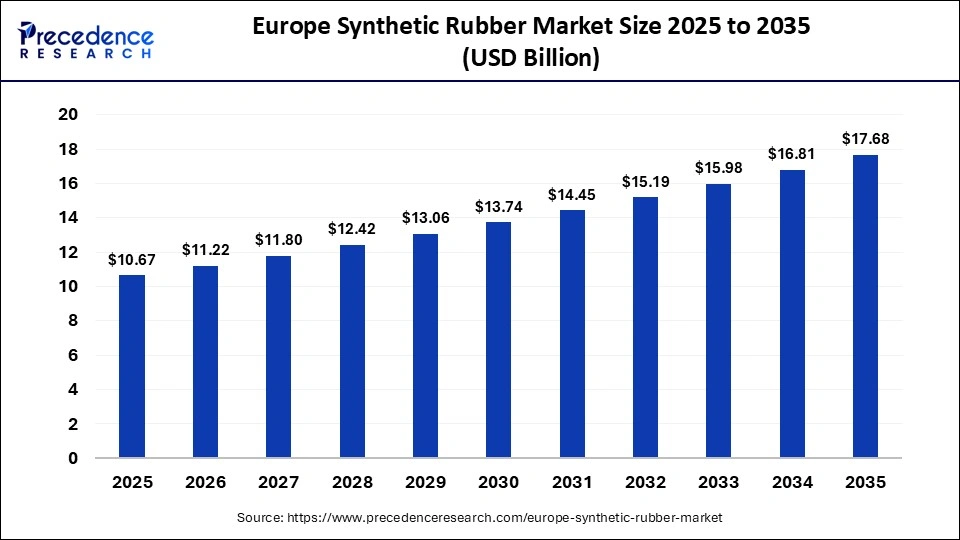
The Europe synthetic rubber market size was estimated at USD 10.67 billion in 2025 and is projected to be worth around USD 17.68 billion by 2035, growing at a CAGR of 5.18%. The market in Europe is mainly driven by strong demand from the automotive and tire manufacturing industries, along with increasing uses in industrial rubber products, medical devices, and construction.
Europe Synthetic Rubber Market Statical Scope
| Reports Attributes | Statistics |
| Market Size in 2025 | USD 10.67 Billion |
| Market Size in 2026 | USD 11.22 Billion |
| Market Size by 2035 | USD 17.68 Billion |
| CAGR 2026 to 2035 | 5.18% |
| Base Year | 2025 |
| Forecast Period | 2026 to 2035 |
The market is crucial for Europe as it connects with the high-end automotive, construction, and electric vehicle sectors. The European market promotes innovation in eco-friendly elastomers and advanced tires to meet strict local regulations. The transition to electric vehicles by manufacturers like Volkswagen, BMW, and Stellantis, along with the production of high-performance tires, necessitates specialized and durable synthetic elastomers. Ethylene Propylene Diene Monomer (EPDM) synthetic rubber is widely used in the European construction industry for roofing membranes and weather-resistant seals.
The market is rapidly moving towards sustainable and recyclable rubber products, with innovations such as rubber derived from dandelions and adherence to strict microplastic and chemical regulations. Major industry players like ARLANXEO (Netherlands) and Eneos are actively enhancing their production capabilities and offering solution-polymerized rubber to satisfy regional needs.
Europe Synthetic Rubber Market, By Form Type, 2025
| Segments | Shares (%) |
| Solid | 82.30% |
| Liquid | 17.70% |
- Solid - The solid segment, with a share of 82.30% in 2025, plays a dominant role in the synthetic rubber market in Europe as it serves as the base for the region's leading automotive and tire manufacturing sectors. Solid elastomers are essential for providing the mechanical strength, thermal stability, and wear resistance needed for high-performance uses such as heavy-duty engineering products, gaskets, and seals.
- Liquid - Liquid synthetic rubber, with a share of 17.70% in 2025, is also important in Europe, especially with the region's strict emission regulations and the growing electric vehicle (EV) market. Car manufacturers utilize liquid rubber formulations to achieve lightweight designs, insulation, and accurate liquid injection molding for complex, durable parts.
Europe Synthetic Rubber Market, By Type, 2025
| Segments | Shares (%) |
| Styrene Butadiene Rubber (SBR) | 22.40% |
| Butadiene Rubber (BR) | 17.10% |
| Ethylene Propylene Diene Monomer (EPDM) | 12.80% |
| Nitrile Rubber (NBR) | 10.90% |
| Butyl Rubber (IIR) | 8.60% |
| Polychloroprene (CR)/Neoprene | 7.20% |
| Silicone Rubber (SiR) | 6.50% |
| Fluoroelastomers (FKM)/Viton | 4.70% |
| Acrylic Rubber (ACM) | 3.40% |
| Isoprene Rubber (IR) | 2.80% |
| Polysulfide Rubber (PSR) | 1.60% |
| Others | 2.00% |
- Styrene Butadiene Rubber (SBR) - The Styrene Butadiene Rubber (SBR) segment, with a share of 22.40% in 2025, leads the European synthetic rubber market as it is the most affordable, high-volume synthetic substitute for natural rubber. This is driven by the large automotive and tire industries in the region, particularly in Germany, France, and Italy, where SBR offers excellent abrasion resistance, durability, and processing benefits.
- Butadiene Rubber (BR) - Butadiene Rubber (BR), with a share of 17.10% in 2025, ranks as the second most produced synthetic rubber worldwide. Its segment is essential to the European Synthetic Rubber Market due to its outstanding elasticity, flexibility at low temperatures, and abrasion resistance. It mainly acts as a key material for high-performance automotive tires and various industrial applications.
Europe Synthetic Rubber Market, By End Use Industry, 2025
| Segments | Shares (%) |
| Transportation | 46.20% |
| Building and Construction | 18.10% |
| Medical | 10.40% |
| Textile & Apparel | 8.30% |
| Food & Beverage | 6.80% |
| Others | 10.20% |
- Transportation - The transportation sector, with a share of 46.20% in 2025, is the leading consumer in the Europe Synthetic Rubber Market, making up a significant portion of the demand. This sector is crucial as it drives volume, technological advancements, and sustainability needs for elastomers like Styrene Butadiene Rubber (SBR) and Polybutadiene Rubber (BR).
- Building and Construction - The building and construction segment, with a share of 18.10% in 2025, is a fundamental part of the Europe synthetic rubber market. It is heavily relied upon to supply essential, high-performance materials for modern infrastructure, such as durable roofing membranes, waterproof coatings, and thermal insulation.
Competitive Landscape
The European synthetic rubber market is dominated by major petrochemical companies and specialized elastomer manufacturers. The automotive industry, tire production, and strict sustainability regulations drive key players to concentrate on high-quality grades, bio-based materials, and energy-efficient manufacturing methods.
- Arlanxeo (Germany/Netherlands) is a joint venture that focuses on high-performance elastomers, offering products like Buna for tires and Keltan™ EPDM for automotive seals and roofing.
- Lanxess AG (Germany) is recognized for its specialty chemicals, producing Therban (HNBR) and Keltan™ Eco, which uses bio-based materials to reduce the carbon footprint of its products.
- Versalis S.p.A. (Italy), the chemical arm of Eni, provides a wide range of Styrene Butadiene Rubber (SBR) and Polybutadiene Rubber (BR), which are extensively used in the European tire and footwear sectors.
- Synthos SA (Poland) is a leading European producer of emulsion-styrene butadiene rubber (E-SBR) and high-cis polybutadiene rubber (Nd-BR), mainly catering to the eco-friendly tire market.
- ExxonMobil (USA/Europe) leads the regional supply with its Vistalon™ EPDM and Exxelor™ modifiers, offering materials that are highly resistant to weather and chemicals.
- Trinseo (Switzerland) supplies synthetic rubber binders, SBR, and solution-styrene butadiene rubber (SSBR) designed for tire treads and technical rubber products.
Segments Covered in the Report
By Form Type
- Solid
- Liquid
By Type
- Styrene Butadiene Rubber (SBR)
- Butadiene Rubber (BR)
- Ethylene Propylene Diene Monomer (EPDM)
- Nitrile Rubber (NBR)
- Butyl Rubber (IIR)
- Polychloroprene (CR)/Neoprene
- Silicone Rubber (SiR)
- Fluoroelastomers (FKM)/Viton
- Acrylic Rubber (ACM)
- Isoprene Rubber (IR)
- Polysulfide Rubber (PSR)
- Others
By End Use Industry
- Transportation
- Building and Construction
- Medical
- Textile & Apparel
- Food & Beverage
- Others
For inquiries regarding discounts, bulk purchases, or customization requests, please contact us at sales@precedenceresearch.com
Frequently Asked Questions





Ask For Sample
No cookie-cutter, only authentic analysis – take the 1st step to become a Precedence Research client




 sales@precedenceresearch.com
 Schedule a Meeting