



Eye Tracking Market Trends, Companies, Revenue / Sales Performance, Subscriber Growth, Pricing Strategies, Cloud Adoption, Infrastructure Expansion, Competitive Landscape, and Industry Outlook
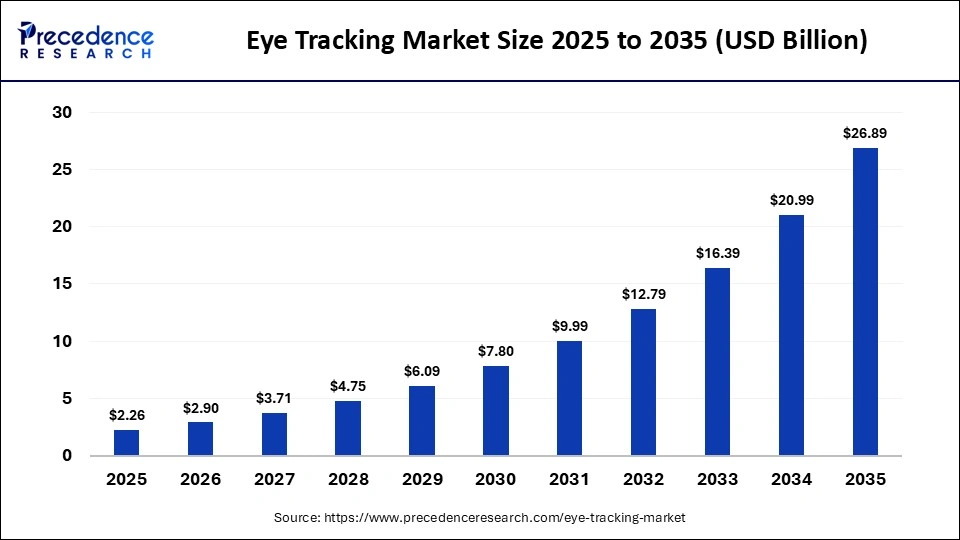
ICT industry specialist Shivani Zoting estimates the eye tracking market at USD 2.90 billion in 2026, with continued technology adoption expected to take the market to USD 26.89 billion by 2035 at a CAGR of 28.10%. Leading eye tracking market providers such as Tobii AB, EyeTech Digital Systems, SensoMotoric Instruments, Smart Eye AB, Gazepointare expanding their capabilities across segments including By Type, By Component, By Technology, By Application, By End Use.
Source: https://www.precedenceresearch.com/eye-tracking-market
 Get a Sample
 Table Of Content


What is the Eye Tracking Market Size?
The global eye tracking market size was calculated at USD 2.26 billion in 2025 and is predicted to increase from USD 2.90 billion in 2026 to approximately USD 26.89 billion by 2035, expanding at a CAGR of 28.10% from 2026 to 2035.The growing adoption of eye tracking solutions in the gaming sector, along with the surging spending on AR and VR technology by tech developers, has boosted market expansion.
Key Takeaways
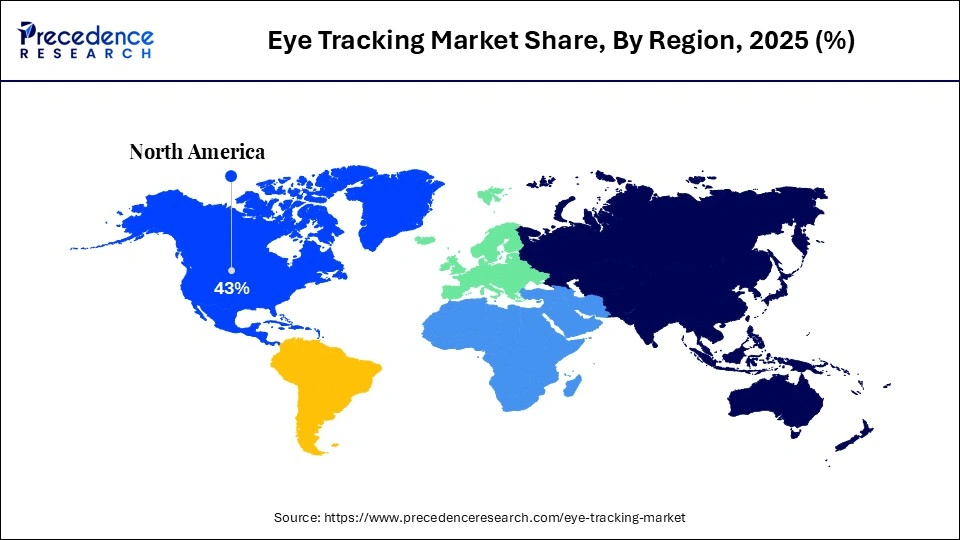
- North America led the market with the largest market share of 43% in 2025.
- Asia Pacific is expected to grow at the fastest CAGR during the forecast period.
- By type, the remote eye trackers segment held the largest share of the market in 2025.
- By type, the mobile eye trackers segment is expected to expand with the highest CAGR during the forecast period.
- By component, the hardware segment dominated the market in 2025.
- By component, the software segment is expected to grow with the fastest CAGR during the forecast period.
- By technology, the screen-based eye tracking segment held the highest share of the market in 2025.
- By technology, the wearable eye tracking segment is expected to grow at the fastest rate during the forecast period.
- By application, the healthcare segment held the largest share of the market in 2025.
- By application, the gaming segment is expected to grow at the highest CAGR between 2026 and 2035.
- By end use, the consumer electronics segment led the market in 2025.
- By end use, the education segment is expected to expand with the fastest CAGR during the forecast period.
Market Overview
The eye tracking market comprises companies developing advanced technologies to measure gaze points, eye positions, and movements to determine a person's viewpoint. An eye tracking device uses advanced sensors and high quality cameras to analyze a wide range of applications. These devices enable the detection of cognitive processes, visual attention, and behavior in numerous fields, including marketing, human computer interaction, psychology, and assistive technology. It uses infrared light to illuminate the pupil and produce corneal reflections, which are recorded by advanced cameras and processed by software to calculate the exact gaze location. This market is expected to grow significantly with the growth of the consumer electronics sector around the world.
How is AI Impacting the Eye Tracking Market?
Artificial intelligence plays a significant role in shaping the landscape of the eye tracking industry. In this sector, AI helps in analyzing eye movements to deliver instantaneous insights into human attention, behavior prediction, and user engagement. AI can predict consumers' decision-making in a short time period by tracking human eyes. Additionally, AI has been used for real time monitoring of driver behavior by detecting eye fatigue, health issues, or distraction, by examining pupil dilation and blink patterns.
- In July 2025, Harmoneyes launched Theia. Theia is an AI-enabled predictive eye-tracking device designed to enhance contextual intelligence.
Eye Tracking Market Trends
- Innovations: Several researchers are engaged in innovating advanced eye tracking solutions to address health issues in humans. For instance, in January 2026, the researchers of China innovated a new blink powered eye tracking device. This device is designed to help paralyzed individuals control wheelchairs through assistive technology.
- Partnerships: Numerous eye tracking device companies are partnering with tech providers to develop high quality eye tracking solutions. For instance, in January 2026, Pupil Labs partnered with NIL Technology. This partnership aims to integrate NILT's ultra-compact metaEye technology into Pupil Labs' upcoming eye tracking product.
- Rising Popularity of AR/VR Devices: The popularity of AR/VR devices has grown significantly in the entertainment and gaming sectors for delivering an immersive experience. For instance, in July 2024, Omnivision launched the OG0TC BSI global shutter (GS) image sensor. This new range of sensors is designed for enhancing eye tracking capabilities in AR/VR devices.
Market Scope
| Report Coverage | Details |
| Market Size in 2025 | USD 2.26 Billion |
| Market Size in 2026 | USD 2.90 Billion |
| Market Size by 2035 | USD 26.89 Billion |
| Market Growth Rate from 2026 to 2035 | CAGR of 28.10% |
| Dominating Region | North America |
| Fastest Growing Region | Asia-Pacific |
| Base Year | 2025 |
| Forecast Period | 2026 to 2035 |
| Segments Covered | Type, Component, Technology, Application, End Use, and Region |
| Regions Covered | North America, Europe, Asia-Pacific, Latin America, and Middle East & Africa |
Market Dynamics
Drivers
Growing Adoption in Healthcare and Research
Eye tracking technology is increasingly being used in ophthalmology, neurology, and psychology research to study vision and cognitive functions. Its ability to provide precise measurements for diagnostics, rehabilitation, and patient monitoring is driving higher adoption across hospitals, clinics, and research institutions.
Restraint
High Cost of Eye-Tracking Devices
Advanced eye tracking systems remain expensive, limiting accessibility for smaller clinics and startups. The cost of hardware, software, and calibration, along with maintenance requirements, can deter widespread deployment despite the technology's benefits.
Opportunity
Integration with AR/VR and Automotive Applications
Eye tracking is becoming crucial for immersive experiences in augmented and virtual reality, as well as for driver monitoring systems in vehicles. This opens opportunities for new product development and adoption in gaming, training simulations, and intelligent safety systems in the automotive sector.
Segment Insights
Type Insights
Why Did the Remote Eye Trackers Segment Dominate the Eye Tracking Market?
The remote eye trackers segment dominated the market with the largest share in 2025. This is due to their capability to capture eye movements without using any wearable devices. These trackers use advanced sensors and high quality cameras to detect gaze patterns and naturally monitor pupil movement. Their simple, user friendly interfaces and ease of use make them suitable for a wide range of applications, such as market research, advertisement analysis, and usability testing.
The mobile eye trackers segment is expected to grow at the fastest CAGR during the forecast period, as they capture precise data in dynamic environments. Mobile eye trackers are designed to act as lightweight wearable glasses that allow users to move freely while recording gaze patterns. Their flexibility makes them suitable for numerous sectors, including consumer behavior analysis, retail research, sports performance analysis, and driver monitoring.
Component Insights
What Made Hardware the Leading Segment in the Eye Tracking Market?
The hardware segment led the market with the largest share in 2025, owing to the crucial role of cameras and sensors in capturing precise eye movement to enhance visual behavioral analysis. Eye tracking systems rely on high quality cameras to monitor pupil position and detect gaze in real time. These advanced cameras are widely used in remote and wearable tracking solutions for enabling superior data collection in numerous industries. The startups are investing rapidly in developing advanced cameras for enhancing eye tracking capabilities.
The software segment is expected to grow at the fastest CAGR during the forecast period due to its prominent role in analyzing and processing a large volume of data that is generated by eye tracking systems. Software solutions are highly used in several industries, such as healthcare diagnostics, gaming, academic research, and marketing research, to convert raw data into useful insights.
Technology Insights
The Screen-Based Segment Led the Eye Tracking Market in 2025
The screen based segment led the market with the largest share in 2025. This is because these systems are widely used in research, healthcare, consumer behavior studies, and gaming applications, where users interact with screens like monitors, tablets, and smartphones. Screen based eye trackers are relatively easy to deploy, offer high accuracy, and support non intrusive monitoring, making them the preferred choice for both commercial and academic applications.
The wearable eye trackers segment is expected to grow at the fastest rate in the coming years due to the rising demand for mobile and real world tracking applications, such as sports performance analysis, VR/AR experiences, and driver monitoring systems. Wearable devices allow hands free, natural movement tracking, providing real time insights outside laboratory settings, which is driving their adoption across healthcare, automotive, and consumer sectors.
The video based eye tracking segment held a significant share in 2025, owing to its superior precision, high accuracy, and wide applicability in the industrial sector. This technology uses high quality cameras and infrared illuminations to capture eye movements to enable precise gaze tracking in real-time activities. The video based eye tracking technology is widely adopted by healthcare and automotive companies.
The electrooculography segment held a considerable share in 2025 and is expected to grow at a notable rate during the forecast period. This is due to its high reliability in detecting iris movements through electrical signals generated by human eyes. This technology is widely adopted in neurological research, medical diagnostics, sleep studies, and assistive communication.
Application Insights
Why Did the Healthcare Segment Dominate the Eye Tracking Market?
The healthcare segment dominated the eye tracking market with the largest share in 2025. This is due to the surging adoption of remote eye tracking devices for enhancing diagnostic capabilities in the healthcare sector. Eye tracking systems are used to monitor visual attention, cognitive functions, autism issues, and Parkinson's disease.
The gaming segment is expected to grow at the highest CAGR between 2026 and 2035, owing to the growing integration of human-computer interaction technologies in gaming platforms. Eye tracking technology enhances gaming experience by controlling in-game actions, camera angles, and user interfaces through human eye movements.
End Use Insights
What Made Consumer Electronics the Leading Segment in the Eye Tracking Market?
The consumer electronics segment led the market in 2025. This is due to the rapid integration of gaze-tracking technology in modern devices, such as smartphones, laptops, and tablets. Eye tracking technology enables several features in consumer electronics, including biometric authentication, gaze enabled navigation, and eye-based screen control.
The education segment is expected to grow at the fastest rate in the coming years because schools, universities, and training centers are increasingly using this technology to study student attention, reading patterns, and learning behaviors. Eye tracking enables personalized learning, cognitive research, and adaptive teaching tools, helping educators improve engagement and learning outcomes, which is driving wider adoption in this sector.The virtual reality segment held a considerable share in 2025 and is expected to grow at a significant rate during the forecast period, due to the growing demand for immersive technologies for delivering realistic user interactions in virtual environments. Eye tracking devices are integrated into VR systems to improve immersion and enhance responsiveness in healthcare visualizations, gaming, and training simulations.
Regional Insights
What is the North America Eye Tracking Market Size?
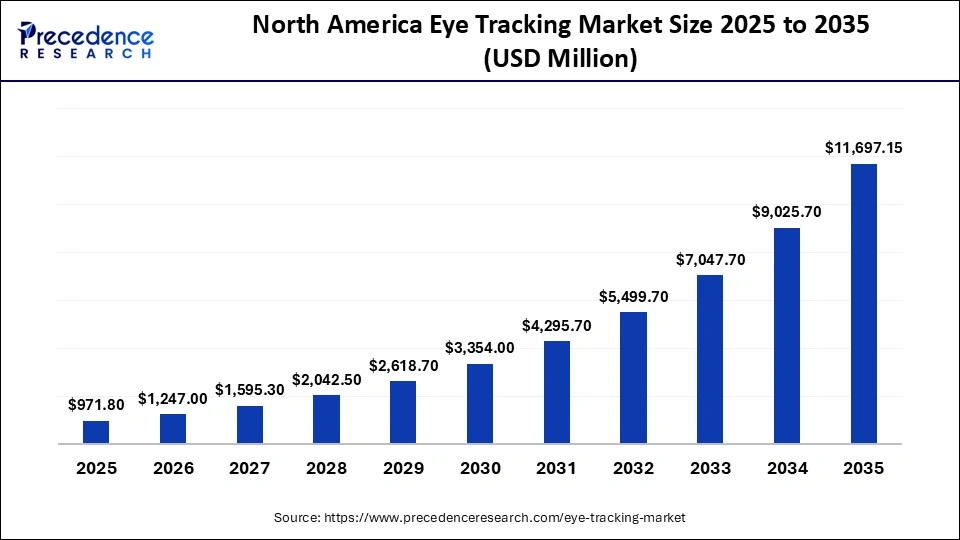
The North America eye tracking market size is estimated at USD 971.80 million in 2025 and is projected to reach approximately USD 11,697.15 million by 2035, with a 28.25% CAGR from 2026 to 2035.
Why Did North America Dominate the Eye Tracking Market?
North America dominated the eye tracking market with the largest share in 2025 due to the rapid adoption of eye tracking technology from consumer electronics companies such as Apple and Alphabet for enhancing operational efficiency, as well as the increasing sales of smart wearables. The major eye tracking companies, including EyeTracking Inc, Biopac Systems Inc, and Gazepoint, are continuously innovating advanced systems, which have contributed to market growth. Additionally, the integration of Iris scanners in corporate offices, along with the growing use of remote monitoring solutions in the defense sector, is driving the market expansion.
- In May 2025, Gazepoint launched GP3 HD. GP3 HD is an advanced eye tracking system that is compatible with the PsychoPy platform.
U.S. Eye Tracking Market Size and Growth 2026 to 2035
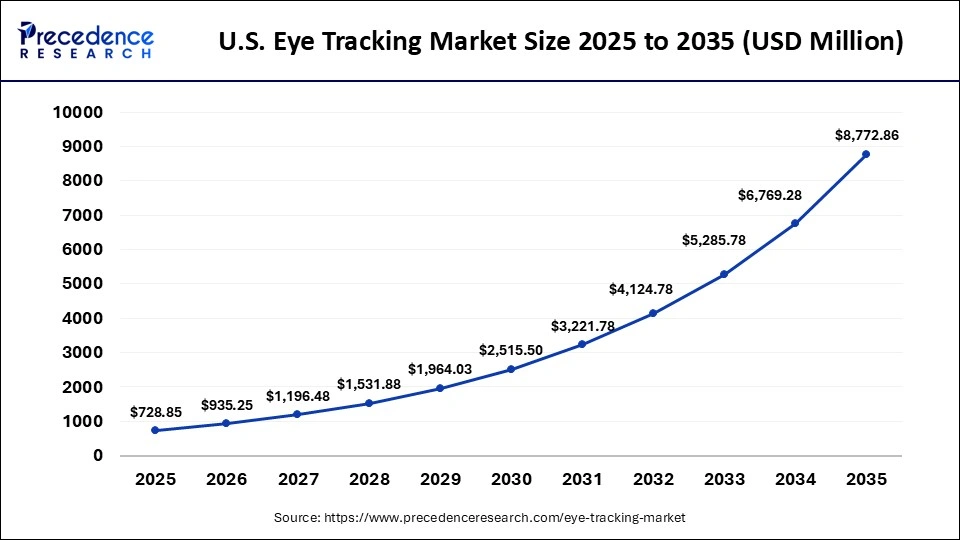
The U.S. eye tracking market size is calculated at USD 728.85 million in 2025 and is expected to reach nearly USD 8,772.86 million in 2035, accelerating at a strong CAGR of 28.25% between 2026 and 2035.
U.S. Eye Tracking Market Analysis
The U.S. leads the market within North America due to the rising demand for portable tracking devices, along with the integration of mobile based eye trackers in the manufacturing sector. Moreover, the increasing use of advanced tracking devices in the advertising sector, as well as collaborations among automakers and VR providers, is positively contributing to the growth of the market.
How is the Opportunistic Rise of Europe in the Eye Tracking Market?
Europe is expected to expand at a significant CAGR during the forecast period, owing to the increasing use of remote eye trackers in the aerospace sector, as well as the rapid expansion of the gaming industry in Italy, the UK, and France. The growing trend of telemedicine, along with the surging sales of wearable eye tracking devices, is contributing to industrial growth. This region is home to numerous automakers, including BMW, Land Rover, Audi, Ferrari, and Ducati, which increases the adoption of high quality eye tracking solutions.
The increase in the number of market research institutions, coupled with the dominance of several market players, including Ergoneers GmbH, Pupil Labs GmbH, and Smart Eye AB, is expected to propel the industry in a positive manner.
- In October 2025, Pupil Labs collaborated with OpenBCI. This collaboration is done to launch an eye tracking headset in Europe.
Germany Eye Tracking Market Analysis
Germany leads the European market due to the surging deployment of advanced monitoring systems in heavy industries, as well as the rapid government investment in strengthening the military sector. Additionally, the proliferation of software startups, along with technological advancements in the healthcare industry, has driven the market growth.
Asia Pacific: The Fastest Growing Region
Asia Pacific is expected to grow at the fastest rate in the upcoming period due to rising investments in healthcare infrastructure, increased adoption of advanced technologies in research and education, and the expanding automotive and gaming sectors. Additionally, growing awareness of eye tracking applications, favorable government initiatives, and the presence of emerging tech companies are accelerating market penetration across countries like China, Japan, India, and South Korea.
China Market Analysis
The Chinese market is mainly fueled by booming gaming, AR/VR ecosystems, and aggressive investments in human-computer interaction (HCI) AI technologies by domestic tech companies. Chinese producers are pushing the boundaries of integration; for instance, flagship devices such as the Honor Magic 6 Pro feature AI-based eye tracking that enables users to interact with phones and even connected vehicles hands-free.
How is Eye Tracking Market Growth Shaping Latin America across the Globe?
Latin America is expected to grow at a lucrative CAGR during the forecast period. Latin America is shaping the wider global market via the rapid adoption of e-commerce analytics, healthcare, and digital consumer research. Healthcare represents a vast share of global eye tracking applications, driven heavily by diagnosing and treating neurological conditions. Latin America's increasing healthcare infrastructure investments led to global demand for assistive communication devices, such as those by global leaders like Tobii.
Brazil Market Analysis
The Brazilian market involves heavy government investment in healthcare innovation and a growing need for user experience (UX) analytics in the country's booming e-commerce sector. Brazil's public health initiatives thus heavily prioritize upgrading infrastructure and even developing advanced diagnostic or rehabilitation tools for visual and neurological impairments. The integration of eye-tracking enables better screening for diabetic retinopathy and enhanced cataract and refractive procedures.
How Eye Tracking Market Growing Rapidly in the Middle East and Africa?
The Middle East and Africa are expected to grow at a notable CAGR during the forecast period. This growth is mainly fueled by healthcare advancements, government-backed infrastructure, and even consumer behavioral research. The technology is increasingly being utilized to diagnose neurological conditions such as autism and other mental disorders. In addition, government-sponsored disability inclusion mandates are elevating the procurement of assistive communication hardware for those with motor impairments.
Saudi Arabia Market Analysis
The Saudi Arabian market is driven by the nation's digital transformation along with healthcare investments under Saudi Vision 2030. Rising rates of diabetes and age-related ophthalmic conditions are heavily boosting the need for advanced diagnostic and visual tracking equipment. Moreover, eye-tracking tech is increasingly integrated into neurological diagnostics and assistive communication devices for patients.
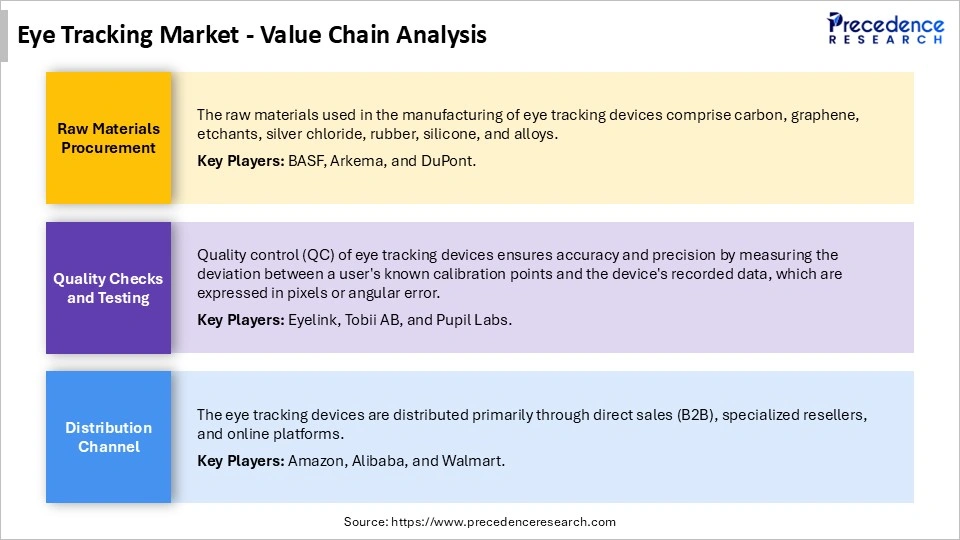
Eye Tracking Market Value Chain Analysis
Eye Tracking Market Companies
- Tobii AB
- EyeTech Digital Systems
- SensoMotoric Instruments
- Smart Eye AB
- Gazepoint
- Pupil Labs
- iMotions
- Cognixion
- Seeing Machines
Recent Developments
- In January 2026, Ganzin launched the AURORA IIE eye-tracking solution. This solution is designed to deliver 120 Hz processing throughput for meeting the demands of VR/MR devices, research labs, and medical institutions.(Source: https://www.ledinside.com)
- In January 2026, TDK Corporation launched TDK AIsight SED0112. TDK AIsight SED0112 is a next-generation ultra-low power DSP platform that integrates a state machine, microcontroller, and hardware CNN engine for AI Glasses.(Source: https://www.tdk.com)
- In November 2025, Valve launched Steam Frame. Steam Frame is an advanced VR headset that supports eye-tracking streaming.(Source: https://en.mashdigi.com)
- In October 2025, Volvo launched its new eye-tracking technology. This technology is developed to enhance safety in trucks.(Source: https://www.heavyquipmag.com)
- In March 2025, Google announced to acquire AdHawk Microsystems Inc. This acquisition is to advance the eye-tracking technology to manufacture smart glasses.(Source: https://economictimes.indiatimes.com)
Segments Covered in the Report
By Type
- Remote Eye Trackers
- Wearable Eye Trackers
- Mobile Eye Trackers
- Screen-based Eye Trackers
- Integrated Eye Trackers
By Component
- Hardware
- Cameras
- Sensors
- Processing Units
- Display Systems
- Software
By Technology
- Electrooculography
- Video-based Eye Tracking
- Optical Tracking
- Screen-based Eye Tracking
- Wearable Eye Trackers
By Application
- Healthcare
- Gaming
- Advertising
- Automotive
By End Use
- Consumer Electronics
- Healthcare Devices
- Automotive Systems
- Research Institutions
- Virtual Reality
By Region
- North America
- Latin America
- Europe
- Asia-pacific
- Middle and East Africa
For inquiries regarding discounts, bulk purchases, or customization requests, please contact us at sales@precedenceresearch.com
Frequently Asked Questions
Tags





Ask For Sample
No cookie-cutter, only authentic analysis – take the 1st step to become a Precedence Research client
 Get a Sample




 sales@precedenceresearch.com
 Schedule a Meeting
