



Tracking as a Service Market Size, Key Companies, Company Market Share, User Adoption, Technology Deployment, Revenue Growth, Competitive Positioning, and Demand Forecast
Tracking as a Service Market (By Component: Services, Software; By Enterprise Size: Small & Medium Enterprises, Large Enterprises; By Asset Type: Manufacturing Assets, In-transit Equipment, Electronics & IT Assets, Others; By Industry: Transportation & Logistic, Retail, Manufacturing, IT & Telecom, Healthcare, Food & Beverage, Others) - Global Industry Analysis, Size, Trends, Leading Companies, Regional Outlook, and Forecast 2025 to 2034
Source: https://www.precedenceresearch.com/tracking-as-a-service-market
 Get a Sample
 Table Of Content


What is the Tracking as a Service Market Size?
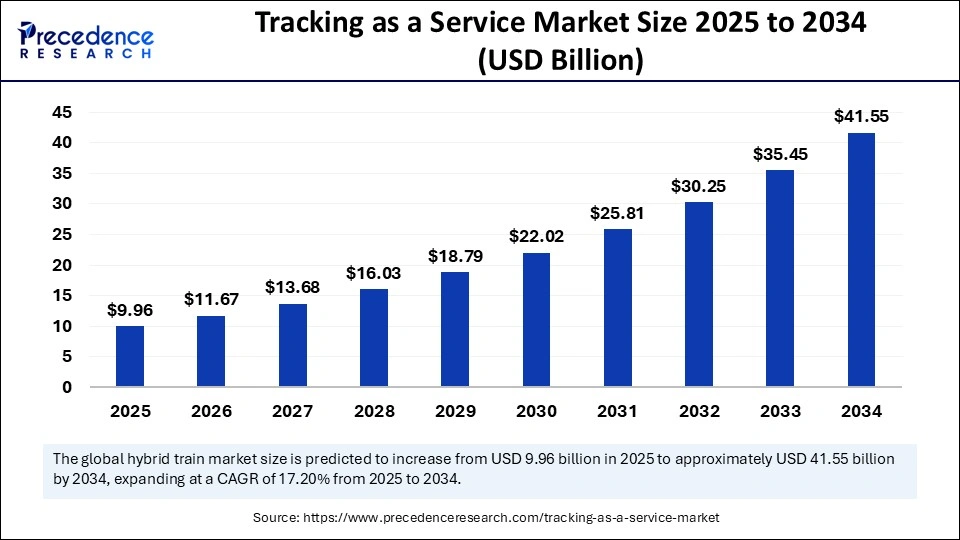
The global tracking as a service market size is calculated at USD 9.96 billion in 2025 and is predicted to increase from USD 11.67 billion in 2026 to approximately USD 41.55 billion by 2034, expanding at a CAGR of 17.20% from 2025 to 2034. The market growth is attributed to the increasing demand for real-time tracking solutions across industries, driven by the need for improved operational efficiency, cost reduction, and enhanced supply chain visibility.
Tracking as a Service Market Key Takeaways
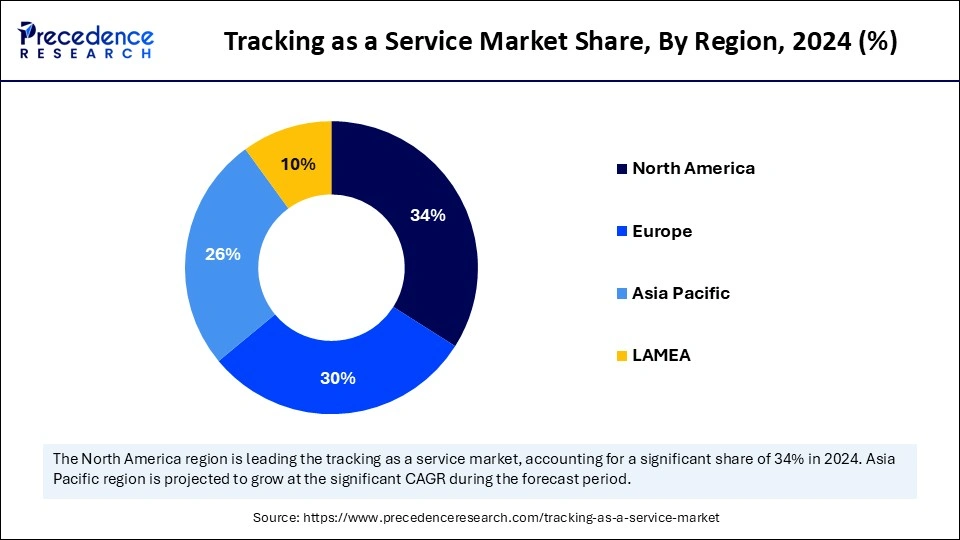
- North America dominated the tracking as a service market with the largest 34% share in 2024.
- Asia Pacific is anticipated to witness the fastest growth in the market during the forecast period.
- By component, the software segment held the major market share of 63% in 2024.
- By component, the service segment is expected to grow at the fastest rate between 2025 and 2034.
- By enterprise size, the large enterprises segment accounted for the largest market share of 67% in 2024.
- By enterprise size, the small & medium enterprises (SMEs) segment is projected to grow at the highest CAGR during the assessment years.
- By asset type, the manufacturing assets segment led the global market in 2024.
- By asset type, the in-transit assets segment is projected to expand rapidly in the coming years.
- By industry, the manufacturing segment dominated the market in 2024.
- By industry, the retail segment is projected to grow at the fastest rate during the forecast period.
Artificial Intelligence: The Next Growth Catalyst in Tracking as a Service
The market for tracking as a service receives powerful improvements through artificial intelligence, which enables real-time analytics with predictive tracking. Companies are increasingly using AI platforms to track their assets, shipments, and personnel. AI can analyze huge amounts of data from GPS, RFID, and IoT sensor networks to predict potential failures, enabling proactive maintenance and reducing downtime. Through AI systems, organizations can spot irregularities, such as route divergences and equipment breakdowns, to make immediate corrective actions. Moreover, AI can analyze traffic data and weather conditions to optimize routes, reducing delivery times.
Strategic Overview of the Global Tracking as a Service Industry
The rising need for real-time tracking solutions is boosting the growth of the tracking as a service market. Real-time monitoring capabilities of tracking as a service (TaaS) solutions enable businesses in industries like manufacturing and retail to track their assets, personnel, and inventories. These solutions improve the supply chain visibility while reducing operational costs and enhancing efficiency. The rising government investments in digital logistics systems to address supply chain challenges further support market growth. The U.S. government scheduled funds under the Infrastructure Investment and Jobs Act in 2024 to enhance digital logistics systems that incorporated TaaS solutions for supply chain management advancement.
Tracking as a Service Market Growth Factors
- Advancements in IoT Technology: The continuous evolution of internet of things (IoT) technologies is expected to enhance the capabilities of TaaS solutions, making them more efficient and scalable.
- Growing E-commerce Industry: The rapid growth of e-commerce and online retail is likely to increase the demand for real-time tracking and logistics solutions to streamline supply chain management.
- Improved Data Analytics: The integration of advanced data analytics and machine learning into TaaS solutions leads to smarter, more proactive decision-making in asset management.
- Increase in Cross-Border Trade: The rise in international trade and global supply chains is likely to boost the need for effective and scalable tracking solutions across borders.
- Enhancements in 5G Technology: The deployment of 5G networks is expected to enable faster, more reliable real-time tracking, accelerating the adoption of TaaS solutions in various industries.
- Improved Regulatory Compliance: Stricter industry regulations requiring real-time visibility into asset movements are anticipated to push businesses to adopt TaaS solutions.
- Focus on Cost Optimization: The growing pressure on businesses to reduce operational costs and increase efficiency is likely to drive the widespread adoption of cost-effective TaaS solutions.
Market Outlook
- Market Growth Overview: The Tracking as a Service market is expected to grow significantly between 2025 and 2034, driven by the integration of IoT, AI, machine learning, and cloud computing, increasing e-commerce and logistics demand, and rising demand for fleet management.
- Sustainability Trends: Sustainability trends involve carbon footprint management, eco-friendly hardware and power solutions, and EGS reporting and compliance.
- Major Investors: Major investors in the market include Amazon, Alphabet, Verizon Communications Inc. and AT&T Inc., and IBM Corporation.
- Startup Economy: The startup economy is focused on AI and machine learning for optimization, autonomous and electric mobility, and specialized and end-to-end traceability.
Market Scope
| Report Coverage | Details |
| Market Size by 2034 | USD 41.55 Billion |
| Market Size in 2025 | USD 9.96 Billion |
| Market Size in 2026 | USD 11.67 Billion |
| Market Growth Rate from 2025 to 2034 | CAGR of 17.20% |
| Dominated Region | North America |
| Fastest Growing Market | Asia Pacific |
| Base Year | 2024 |
| Forecast Period | 2025 to 2034 |
| Segments Covered | Component, Enterprise Size, Asset Type, Industry, and Region |
| Regions Covered | North America, Europe, Asia-Pacific, Latin America and Middle East & Africa |
Market Dynamics
Drivers
Rising Demand for Real-Time Asset Tracking Solutions
The increasing demand for real-time asset tracking solutions is a key factor driving the growth of the tracking as a service market. TaaS solutions ensure the security of assets by enabling real-time monitoring and tracking. Various logistics, defense, and healthcare businesses depend on real-time monitoring of their critical assets to maintain prompt deliveries. Monitoring operations in real-time using predictive analytics with alerts enables better inventory control and incident response. Furthermore, the real-time tracking systems integrated into emergency departments can improve the flow of patients.
Surge in E-Commerce Activities
The rising e-commerce activities worldwide is another major factor driving the growth of the tracking as a service market. Advanced tracking solutions are in high demand due to the rising e-commerce activities. TaaS solutions enable real-time packaging tracking, boosting transparency. The Investments by online retail platforms into complete delivery tracking bring benefits for customer satisfaction. End-to-end shipment monitoring allows businesses to maximize delivery efficiency during the last mile. This leads to lower delivery durations along with improved brand trustworthiness. Furthermore, the rapid expansion of the e-commerce sector in emerging markets propels the growth of the market.
Restraint
High Implementation Costs
High costs involved in implementation limit the widespread deployment of TaaS solutions. The integration of advanced tracking platforms, including TaaS solutions, requires substantial investments in hardware and software. This creates barriers for some businesses, especially small-scale businesses that operate with limited budgets. These businesses often postpone the implementation of advanced technologies because they lack sufficient resources, limiting the adoption of TaaS solutions.
Opportunity
Rising Investment in Fleet Management Technologies
Rising investment in fleet management technologies is anticipated to create immense opportunities for players competing in the tracking as a service market. The market continues to grow because companies make substantial investments in fleet management technologies. The use of advanced tracking technologies by fleet operators enables more efficient route scheduling. This simultaneously observes driver activities and makes fuel consumption superior. Transportation organizations often invest in modern solutions designed to make operations safer and more efficient, which further boosts market growth. Moreover, advanced technologies, like 5G, blockchain, and IoT, enhance the capabilities of TaaS solutions, fueling the growth of the market.
Component Insights
The software segment dominated the tracking as a service market with the largest share in 2024. This is mainly due to the increased adoption of cloud-based solutions with real-time data analytics capabilities. Businesses are enhancing their tracking capabilities according to their unique requirements through software solutions. These solutions offer adjustable functionality and do not require enormous initial funding. Software solutions enable real-time tracking and data analytics, making them indispensable for optimizing supply chains. Moreover, the rapid digital transformation further bolstered the segment's growth.
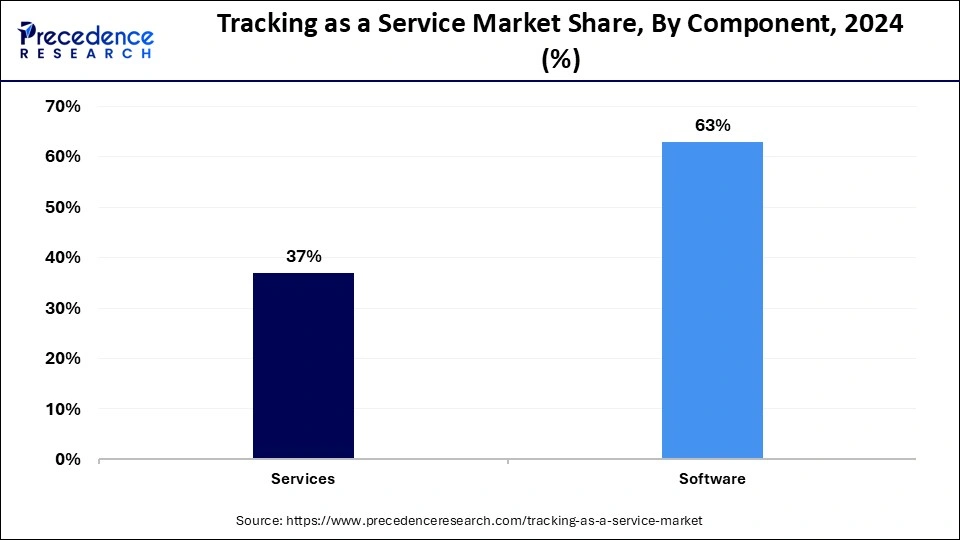
The service segment is expected to grow at the fastest rate in the upcoming years. Implementing TaaS solutions in existing infrastructure creates complexities. This, in turn, boosts the need for managed and professional services to facilitate seamless integration. These services also address supply chain complexities and improve visibility.
Enterprise size Insights
The large enterprises segment held the largest share of the tracking as a service market in 2024. Large enterprises often require reliable solutions to streamline operations by optimizing routes and ensuring compliance with regulations. These organizations often have substantial resources, enabling them to deploy advanced tracking solutions. The implementation of TaaS solutions enables large enterprises to optimize routes while tracking driver actions to improve operations. Furthermore, the increased importance of data-based operational decisions increased the adoption of TaaS solutions in large enterprises.
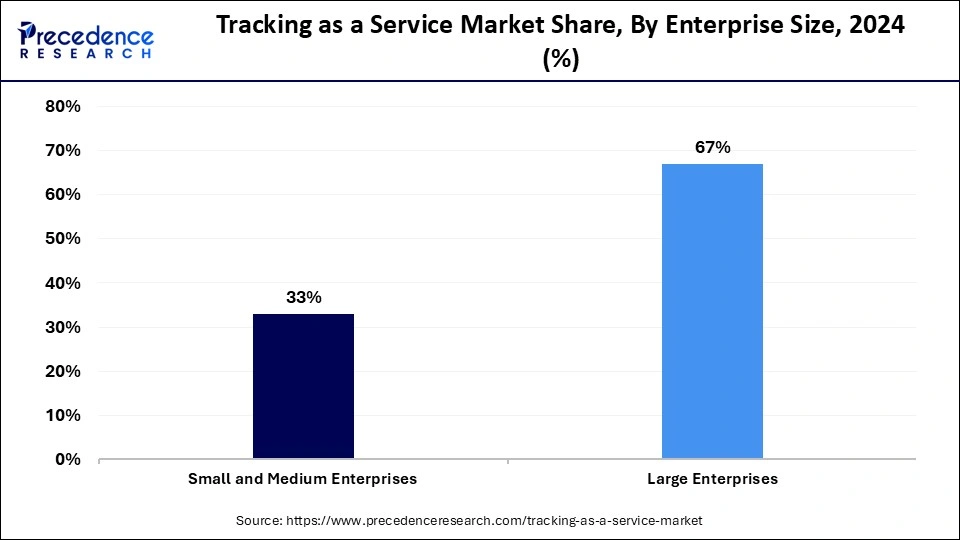
The small & medium enterprises (SMEs) segment is projected to grow at the highest CAGR during the assessment years. The growth of the segment can be attributed to the rising adoption of cloud-based solutions among SMEs. TaaS is a cloud-based solution which brings several benefits, including scalability, flexibility, and easy integration. Moreover, the rising enhanced supply chain transparency requirements among SMEs contribute to segmental growth.
Asset Type Insights
The manufacturing assets segment dominated the tracking as a service market in 2024. Manufacturers heavily depend on real-time monitoring, boosting the demand for tracking as a service (TaaS) solutions to track machinery. TaaS solutions monitor manufacturing assets in real-time, identifying potential failures. This improves operational performance and reduces downtime incidents. Additionally, advanced tracking systems have gained immense popularity in the manufacturing industry because manufacturing processes have become more complex.
The in-transit assets segment is projected to expand rapidly in the coming years, owing to the e-commerce growth together with expanding global trade operations, requiring efficient supply chain management monitoring solutions. Organizations use TaaS for tracking containers, machinery, and construction trailers during transportation. Moreover, in-transit equipment tracking solutions enable businesses to enhance operational effectiveness.
Industry Insights
The manufacturing segment held the largest share of the tracking as a service market in 2024. This is mainly due to the heightened need to reduce downtime and enhance operational efficiency. TaaS solutions enable real-time tracking and monitoring of manufacturing assets, identifying irregularities. This enables proactive maintenance, significantly reducing downtime and enhancing operational efficiency.
The retail segment is projected to grow at the fastest rate during the forecast period. Businesses in the retail sector are adopting tracking solutions to track inventory and manage shipments. TaaS solutions enable retail businesses to improve the order fulfillment process, improving customer satisfaction. The rising need for enhancing operational efficiency is likely to support the growth of the segment.
Regional Insights
U.S. Tracking as a Service Market Size and Growth 2025 to 2034
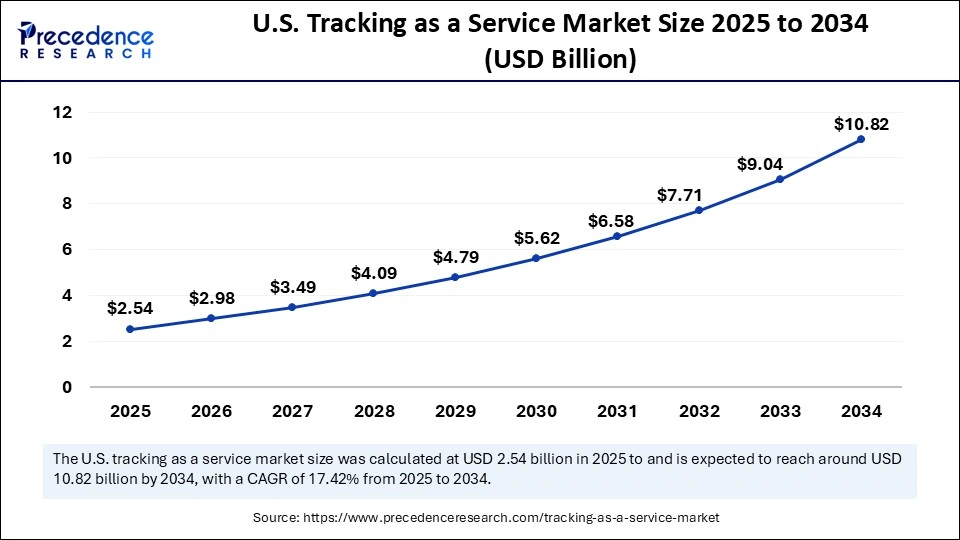
The U.S. tracking as a service market size is evaluated at USD 2.54 billion in 2025 and is projected to be worth around USD 10.82 billion by 2034, growing at a CAGR of 17.42% from 2025 to 2034.
North America led the tracking as a service market by capturing the largest share in 2024. This is mainly due to its robust infrastructure for deploying TaaS solutions. The company is home to leading market participants, including IBM, Cisco, and Oracle. The increased logistics operations in the region led to the rapid adoption of TaaS solutions. Furthermore, the Federal Automated Vehicles Policy and the Infrastructure Investment and Jobs Act imposed by the government created immense opportunities in the market. With the increased e-commerce activities, the demand for tracking solutions has increased in the region, boosting the growth of the market.
North America: U.S. Tracking as a Service Trends
The U.S. market is primarily shaped by the integration of IoT, AI, and cloud technology to provide real-time asset visibility. The dominance of cloud-based solutions and the use of AI for predictive analytics in logistics and supply chain management. The technology is rapidly expanding into diverse new verticals, such as healthcare and manufacturing, to optimize resource utilization and efficiency.
Asia Pacific: China Tracking as a Service Market Trends
China's explosive e-commerce and logistics demand. It is a hotbed of technological innovation, heavily utilizing IoT, 5G, and AI for real-time tracking and automation. The market is dominated by domestic tech and e-commerce giants, such as Alibaba and Tencent, who leverage vast cloud and data resources. Significant government support through initiatives like the "Digital Silk Road" promotes advanced technology adoption in logistics.
Top Companies in the Tracking as a Service Market & Their Offerings
- Trimble Inc. offers TaaS by leveraging its expertise in GPS, construction, and transportation to provide advanced fleet management and asset tracking solutions.
- Sortly contributes to TaaS by providing a user-friendly, cloud-based inventory and asset management solution accessible from any device. Its mobile-first approach, barcode and QR code functionality, and real-time tracking enable small and large businesses to organize and manage assets efficiently.
- Rockwell Automation plays a role in the TaaS market by providing industrial automation solutions that support tracking for manufacturing and industrial environments.
- PCCW Solutions contributes to TaaS through its extensive IT services portfolio, offering digital infrastructure, systems integration, and application development. This strategic partnership with Lenovo delivers customized solutions that can include tracking capabilities, empowering businesses to transform operations with technology.
- Mojix specializes in end-to-end traceability and real-time item-level visibility solutions for supply chains, leveraging RFID technology. Their SaaS platform helps businesses track billions of unique identities from source to shelf, supporting inventory management, brand authentication, and regulatory compliance.
- Midmark Co. primarily operates in the healthcare and animal health markets, and its contribution to TaaS involves tracking medical equipment and assets within clinical environments. Midmark offers solutions for asset management, ensuring the location and condition of critical medical devices are known at all times.
- MicroMain, through its Computerized Maintenance Management System (CMMS), enables TaaS for asset tracking and maintenance management. It centralizes asset information, work order management, and preventive maintenance scheduling to ensure operational efficiency and asset longevity.
- Infor provides TaaS capabilities through its comprehensive suite of enterprise software, particularly within its supply chain and asset management solutions. Its industry-specific cloud and AI-driven platforms help service industries and manufacturers gain real-time visibility into their operations and supply chains.
- Finale Inventory contributes to TaaS by offering a barcode-driven inventory management solution focused on small to medium-sized ecommerce businesses.
- EZO provides asset and inventory tracking software, including features for scheduling, maintenance, and usage.
Tracking as a Service Market Companies
- Trimble Inc.
- Sortly
- Rockwell Automation
- PCCW Solutions
- Mojix
- Midmark Co.
- MicroMain
- Infor
- Finale Inventory
- EZO
Latest Announcement by Industry Leader
- In April 2025, RedBeam, a trusted provider of asset and inventory tracking solutions for over two decades, launched its newly expanded tracking platform, signaling a strategic shift in its commitment to simplifying physical asset management. Building on its legacy in barcode-based systems, the platform now incorporates cloud-based infrastructure and RFID-enabled capabilities to deliver enhanced automation and operational flexibility. David Bissonnette, CEO of RedBeam, emphasized the importance of this transformation, noting that evolving from a single-product tool to a comprehensive, scalable platform meets the increasingly complex tracking needs of growing organizations. The updated solution is designed to streamline workflows across a broader range of sectors, including education, government, manufacturing, warehousing, and healthcare. By offering a unified, intuitive system that adapts to both asset tracking and more advanced inventory requirements, RedBeam is reinforcing its position as a versatile, future-ready provider in the asset management landscape.
Recent Developments
- In March 2025, L&T Technology Services Limited (LTTS), an engineering and technology services firm, unveiled TrackEi, an AI-powered railway track inspection solution. Utilizing the NVIDIA Jetson platform for edge AI and robotics, TrackEi enables real-time defect detection and predictive maintenance, significantly improving safety for rail networks worldwide. Traditionally, rail inspections were manual and often slow, sometimes missing critical flaws that could lead to derailments. TrackEi addresses this issue by automating inspections at speeds of over 60 miles per hour, using high-resolution cameras and laser profiling to detect issues such as broken rails, cracks, track misalignments, and other structural defects.
- In December 2024, Reliance Jio launched the JioTag Go, an Android-based tracking tag that works seamlessly with Google's Find My Device network. This coin-sized tracker allows users to track essential items such as keys, wallets, luggage, and other gadgets, providing semi-real-time location updates through Google's Find My Device service.
- In November 2024, Airgain, Inc., a leading provider of wireless connectivity solutions, introduced the AT-Flight asset tracker, targeting the healthcare and life sciences IoT sectors. Designed specifically for high-value, temperature-sensitive assets, the AT-Flight offers an ideal solution for real-time tracking across both ground and air transportation. This technology ensures compliance and operational efficiency, particularly in cold chain logistics and critical healthcare applications. By combining advanced artificial intelligence with ambient sensor technology, the AT-Flight automatically detects flight events and activates airplane mode to comply with FAA regulations, eliminating the need for manual intervention.
- In October 2024, SSC entered a launcher tracking service agreement with India's Skyroot Aerospace, offering ground station tracking services for the Vikram-1 launch vehicle. This agreement marks a significant milestone in SSC's commitment to supporting the growing New Space industry. It follows a previous Memorandum of Understanding (MoU) between SSC and Skyroot, which enables Skyroot to utilize facilities at Esrange Space Center in Sweden and SSC's global ground station network. The agreement ensures Skyroot's commercial launches of the Vikram-1 rocket be supported from SSC's Western Australia Space Center (WASC) near Perth. Skyroot, founded in 2018 in Hyderabad, successfully launched India's first private rocket in 2022.
Segments Covered in the Report
By Component
- Services
- Software
By Enterprise Size
- Small & Medium Enterprises
- Large Enterprises
By Asset Type
- Manufacturing Assets
- In-transit Equipment
- Electronics & IT Assets
- Others
By Industry
- Transportation & Logistic
- Retail
- Manufacturing
- IT & Telecom
- Healthcare
- Food & Beverage
- Others
By Region
- North America
- Europe
- Asia Pacific
- Latin America
- Middle East & Africa
For inquiries regarding discounts, bulk purchases, or customization requests, please contact us at sales@precedenceresearch.com
Frequently Asked Questions





Ask For Sample
No cookie-cutter, only authentic analysis – take the 1st step to become a Precedence Research client
 Get a Sample




 sales@precedenceresearch.com
 Schedule a Meeting
