



Federated Learning Market Trends, Companies, Revenue / Sales Performance, Subscriber Growth, Pricing Strategies, Cloud Adoption, Infrastructure Expansion, Competitive Landscape, and Industry Outlook
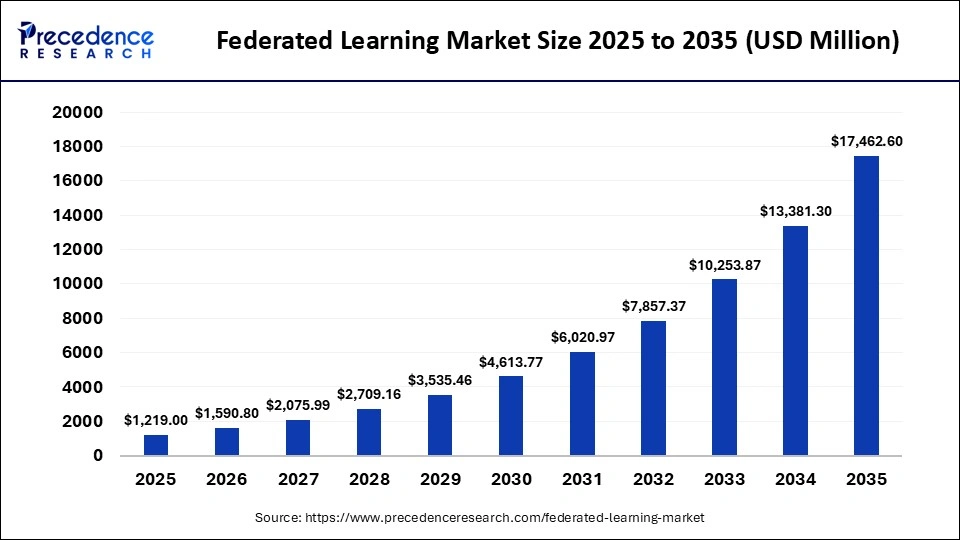
ICT industry specialist Shivani Zoting estimates the federated learning market at USD 1,590.80 million in 2026, with continued technology adoption expected to take the market to USD 17,462.60 million by 2035 at a CAGR of 30.50%. Leading federated learning market providers such as Google LLC, Apple Inc., IBM Corporation, Microsoft Corporation are expanding their capabilities across segments including By Model Type, By Application, By Deployment Mode, By End-User.
Source: https://www.precedenceresearch.com/federated-learning-market
 Get a Sample
 Table Of Content


What is the Federated Learning Market Size in 2026?
The global federated learning market size accounted for USD 1,219.00 million in 2025 and is predicted to increase from USD 1,590.80 million in 2026 to approximately USD 17,462.60 million by 2035, expanding at a CAGR of 30.50% from 2026 to 2035. The market is driven by the increasing demand for privacy-preserving AI, rising adoption of edge computing and IoT devices, and the need for secure collaborative model training across industries such as healthcare, finance, and telecommunications.
Key Takeaways
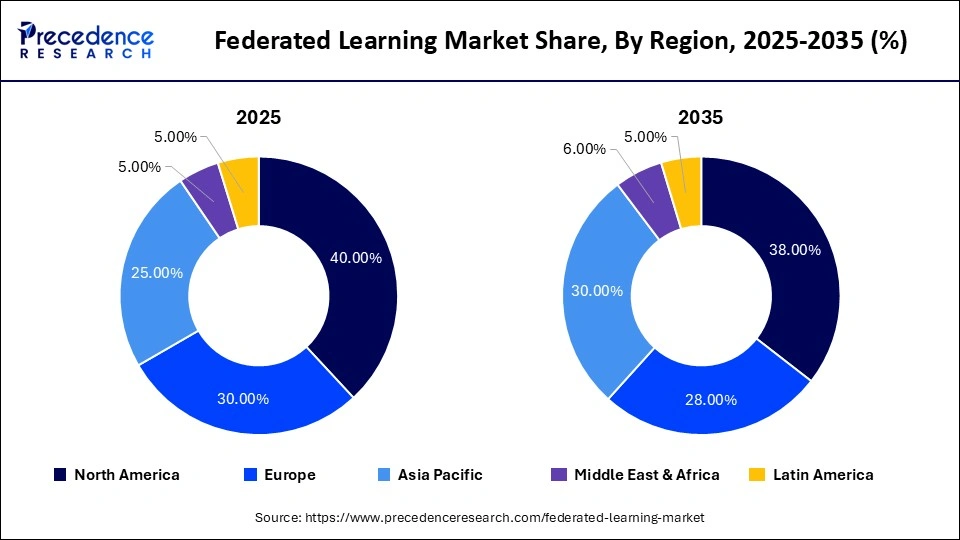
- North America held the largest market share of 40% in 2025.
- Asia Pacific is projected to grow at the fastest CAGR during the foreseeable period of 2026-2035.
- By model type, the deep learning segment held the largest market share of 55% in 2025.
- By model type, the reinforcement learning model segment was the second-largest shareholder, holding a share of 15% in 2025, and is expected to grow at the
- fastest CAGR during the foreseeable period of 2026-2035.
- By application, the healthcare & life sciences segment held a major market share of 25% in 2025.
- By application, the BFSI segment held the second-largest market share of 20% in 2025 and is expected to grow at a significant CAGR during the foreseeable period.
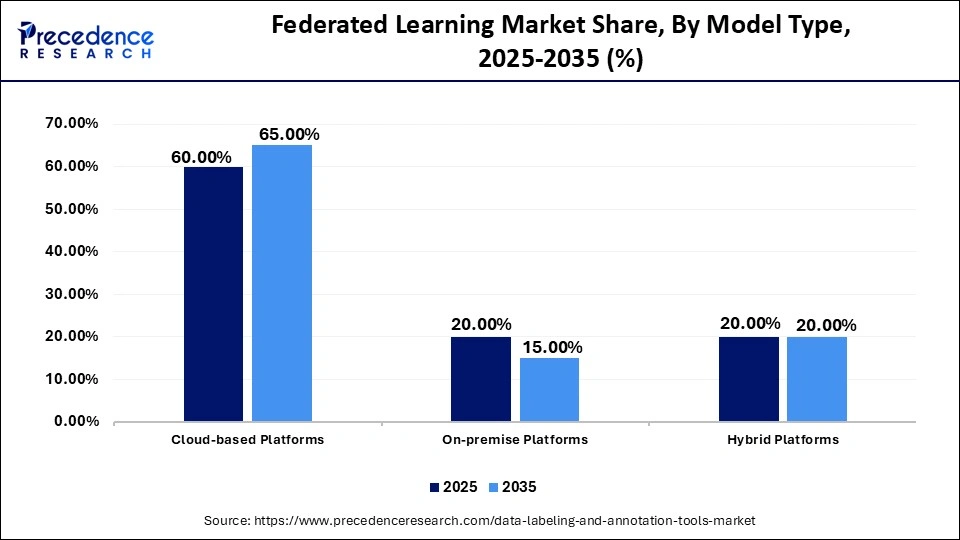
- By deployment mode, the cloud-based federated learning segment held the largest market share of 55% in 2025.
- By deployment mode, the on-premise federated learning segment held the second-largest market share of 25% in 2025 and is expected to grow at a significant CAGR during the forecast period.
- By end-user, the healthcare providers & pharmaceutical companies segment held the largest market share of 25% in 2025.
- By end-user, the banks & financial institutions segment held the second-largest market share of 20% in 2025 and is projected to grow at a significant CAGR during the foreseeable period of 2026-2035.
Market Overview
Federated learning is a decentralized machine learning approach in which AI models are trained on local devices such as smartphones, edge devices, or organizational servers without sharing raw data. Instead, only model updates are sent to a central server, where they are aggregated to improve a shared global model. This approach enhances data privacy, strengthens security, and reduces communication latency. The federated learning market focuses on enabling collaborative and privacy-preserving AI development across industries such as healthcare, finance, and IoT. It supports organizations in training robust models without exposing sensitive data, while also helping them comply with data localization and sovereignty regulations.
Federated Learning Market Trends
- There is a rapid shift from a one-size-fits-all global model approach toward more personalized and domain-specific models, enabling improved accuracy, better adaptability, and enhanced performance for individual users and organizations.
- The integration of federated learning with edge AI is enabling model training directly on IoT devices and smartphones. This reduces latency, lowers bandwidth consumption, and supports real-time intelligent applications.
- There is increasing adoption of privacy-enhancing technologies such as differential privacy and homomorphic encryption to prevent data leakage during model training and update aggregation processes.
- The use of blockchain and other decentralized ledger technologies is increasing to enhance transparency, security, and traceability in federated learning systems, particularly for auditing model updates and ensuring trust among participants.
Market Scope
| Report Coverage | Details |
| Market Size in 2025 | USD 1,219.00 Million |
| Market Size in 2026 | USD 1,590.80 Million |
| Market Size by 2035 | USD 17,462.60 Million |
| Market Growth Rate from 2026 to 2035 | CAGR of 30.50% |
| Dominating Region | North America |
| Fastest Growing Region | Asia Pacific |
| Base Year | 2025 |
| Forecast Period | 2026 to 2035 |
| Segments Covered | Model Type, Application, Deployment Mode, End-User, and Region |
| Regions Covered | North America, Europe, Asia-Pacific, Latin America, and Middle East & Africa |
Market Dynamics
Drivers
Increasing Demand for Privacy-Centric AI Models
Organizations in healthcare, finance, and other data-sensitive industries are increasingly prioritizing privacy-centric AI models due to strict regulatory frameworks such as HIPAA and GDPR. Federated learning enables compliance with these regulations by eliminating the need to transfer or centralize raw data. It allows AI models to be trained across decentralized and heterogeneous datasets, improving model accuracy while preserving data privacy. This approach also reduces latency and bandwidth usage by limiting large-scale data transmission. As a result, federated learning is gaining strong global traction and supporting market expansion across multiple regulated industries.
Restraint
Data Heterogeneity
The market faces challenges due to the lack of standardization and the technical complexity of federated learning systems. Data across various clients is often in a non-uniform state, called Non-IID data, which creates a challenge in model conversion and precision that can be solved with specialized algorithms. However, setting up the required infrastructure for decentralized training needs high upfront costs, which is a barrier for smaller businesses.
Opportunity
Vertical-Specific Platforms Expansion
The rapid expansion of vertical-specific federated learning platforms creates immense opportunities in the federated learning market. These platforms are designed for use cases like drug discovery, healthcare analytics, and finance services. These specialized platforms minimize deployment complexity for data-sensitive industries.
Ongoing innovations in privacy-preserving methods like homomorphic encryption, differential privacy, and secure multi-party computation are maintaining higher security and model performance. Additionally, the increasing blockchain integration with federated learning for a tamper-proof and transparent record of model updates is strengthening the market expansion globally.
Segment Insights
Model Type Insights
Federated Learning Market Share, By Model Type, 2025-2035 (%)
| Model Type | 2025 | 2035 | CAGR (%) |
| Deep Learning Models | 55.00% | 57.00% | 31.00% |
| Reinforcement Learning Models | 15.00% | 18.00% | 35.00% |
| Transfer Learning Models | 10.00% | 12.00% | 28.00% |
| Ensemble Learning Models | 10.00% | 8.00% | 18.00% |
The Deep Learning Models Segment Held a 55% Market Share in 2025
The deep learning models segment dominated the federated learning market with the largest share of 55% in 2025. This is mainly due to their capability of processing huge amounts of complex datasets, even with a simple, human tone prompt. These models can work on decentralized data, making them a preferred option for various applications like image and speech recognition.
The reinforcement learning models segment held the second-largest market share of 15% in 2025 and is expected to grow at the fastest CAGR during the foreseeable period. This is because these models play a critical role in real-time decision-making. They are ideal for systems like autonomous systems, robotics, and gaming.
The transfer learning models segment held a market share of 10% in 2025 and is expected to grow at a notable rate during the forecast period, as these models allow leveraging knowledge or data from one domain to improve learning in different domains. This approach makes these models highly effective for the federated learning process.
The ensemble learning models segment held the market share of 10% in 2025. This is because of their ability to combine multiple models' results to offer precise outcomes. This makes them highly critical for a federated learning system.
Application Insights
The Healthcare & Life Sciences Segment Held a 25% Market Share in 2025
The healthcare & life sciences segment dominated the federated learning market with a share of 25% in 2025. This is because federated learning has gained immense traction in the healthcare sector due to its unmatched privacy-preserving collaborative AI training method. It is particularly applicable in medical imaging, genomics, and diagnostics.
The BFSI segment was the second-largest shareholder in 2025, holding a share of 20%, and is expected to grow at a notable CAGR during the foreseeable period. The segment is primarily driven by stringent data protection regulations that can be achieved by federated learning while leveraging AI models. Financial institutions use federated learning for fraud detection, credit scoring, and algorithmic trading, ensuring privacy and compliance with data protection regulations.
Federated Learning Market Share, By Application, 2025-2035 (%)
| Application | 2025 | 2035 | CAGR (%) |
| Healthcare & Life Sciences | 25.00% | 28.00% | 32.00% |
| Banking, Financial Services, and Insurance (BFSI) | 20.00% | 22.50% | 29.00% |
| Retail & E-commerce | 15.00% | 17.00% | 30.50% |
| Telecommunications & IT | 15.00% | 16.50% | 30.00% |
| Automotive & Mobility | 10.00% | 12.00% | 31.50% |
| Government & Defense | 10.00% | 8.50% | 25.00% |
| Others | 5.00% | 6.00% | 24.50% |
The retail & e-commerce segment held a 15% share of the market in 2025 and is expected to grow at a significant CAGR in the upcoming period. The segment is expanding significantly as retailers and e-commerce platforms use federated learning for customized recommendations, behavior analysis of consumers, and data privacy. The segment growth is also driven by the increasing need for demand forecasting while maintaining data privacy.
The automotive & mobility segment held the market share of 10% in 2025 and is expected to grow at the highest CAGR over the forecast period of 2026-2035. The segment growth is driven by the increasing use of federated learning in the automotive sector for autonomous driving systems and connected vehicles. It is ideal for predictive maintenance without compromising the data safety of smart vehicles.
Deployment Mode Insights
Why Did the Cloud-based Federated Learning Segment Led the Market in 2025?
The cloud-based federated learning segment dominated the federated learning market with the largest share of 55% in 2025. The segment's dominance is attributed to the higher scalability and flexibility of cloud-based federated learning solutions. This deployment is ideal for centralized management, offering easy access to federated learning systems.
Federated Learning Market Share, By Deployment Mode, 2025-2035 (%)
| Deployment Mode | 2025 | 2035 | CAGR (%) |
| Cloud-based Federated Learning | 55.00% | 60.00% | 33.00% |
| On-premise Federated Learning | 25.00% | 20.00% | 18.50% |
| Hybrid Federated Learning | 20.00% | 20.00% | 29.50% |
The on-premise federated learning segment held the second-largest market share of 25% in 2025 and is expected to grow at a significant CAGR during the foreseeable period. The segment is driven by the increasing adoption of on-premises federated learning solutions by several organizations to keep their sensitive data within premises. These solutions reduce dependency on third-party vendors and potential data breaches.
The hybrid federated learning segment held the market share of 20% in 2025 and is expected to grow at the highest CAGR during the forecast period. This is because hybrid models are becoming highly popular as they provide the combined benefits of cloud and on-premises deployment. It includes higher security and scalability at the same time, making it an in-demand model for a federated learning system.
End-User Insights
Healthcare Providers & Pharmaceutical Companies Held a 25% Market Share in 2025
The healthcare providers & pharmaceutical companies segment dominated the federated learning market with the maximum share of 25% in 2025. This is because these companies heavily use federated learning for privacy-preserving research, collaborative diagnostics, and AI model training without compromising patient data. Stringent data protection regulations encourage these companies to invest in federated learning solutions.
The banks & financial institutions segment was the second-largest shareholder in 2025, holding a 20% share, and is projected to grow at a significant CAGR during the foreseeable period of 2026-2035. The segment is growing as these institutes are increasingly leveraging federated learning for improving data security in AI-based risk analysis, fraud detection, and algorithmic trading. It does not require sharing sensitive consumer data with other models.
Federated Learning Market Share, By End-Use Industry, 2025-2035 (%)
| End-Use Industry | 2025 | 2035 | CAGR (%) |
| Healthcare Providers & Pharmaceutical Companies | 25.00% | 28.00% | 35.00% |
| Banks & Financial Institutions | 20.00% | 22.00% | 30.00% |
| Retailers & E-commerce Platforms | 15.00% | 16.00% | 28.00% |
| Telecommunications Providers | 15.00% | 13.50% | 29.50% |
| Automotive OEMs & Suppliers | 10.00% | 12.00% | 32.00% |
| Government & Research Institutions | 10.00% | 8.50% | 27.00% |
| Others | 5.00% | 5.00% | 25.00% |
The telecommunications providers segment held a market share of 15% in 2025, driven by high adoption of federated learning by telecom service providers for network optimization and predictive maintenance. It has also proven to be highly beneficial for AI-driven consumer support systems.
The government & research institutions segment held a market share of 10% in 2025 and is expected to grow at a notable rate during the foreseeable period of 2026–2035. This growth is primarily driven by increasing collaboration between government bodies and research organizations to develop AI models using federated learning. This approach enables sensitive public and national data to remain within secure boundaries, reducing the risk of data breaches and ensuring compliance with data protection regulations. As a result, federated learning is gaining strong adoption in this segment to support secure, privacy-preserving AI development.
Regional Insights
North America Federated Learning Market Size and Growth 2026 to 2035
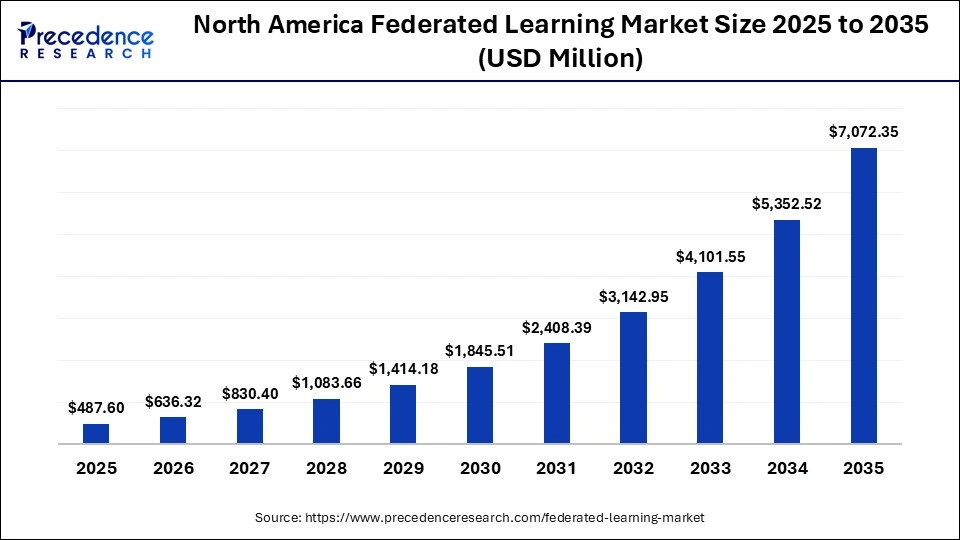
The North America federated learning market size is estimated at USD 487.60 million in 2025 and is projected to reach approximately USD 7.072.35 million by 2035, with a 30.66% CAGR from 2026 to 2035.
North America Held the Highest Market Share of 40% in 2025
North America dominated the federated learning market with the largest share of 40% in 2025. This dominance is attributed to early adoption of AI across high-impact industries, stringent data privacy regulations, significant investments in AI development, and the strong presence of key industry players. Major companies such as NVIDIA, IBM, Microsoft, and Google are actively driving innovation, collaboration, and large-scale deployment of federated learning solutions. Strict regulatory frameworks such as HIPAA in the healthcare sector are further encouraging organizations to adopt federated learning, as it enables collaborative AI model training without the need to transfer sensitive data to a central server.
U.S. Federated Learning Market Size and Growth 2026 to 2035
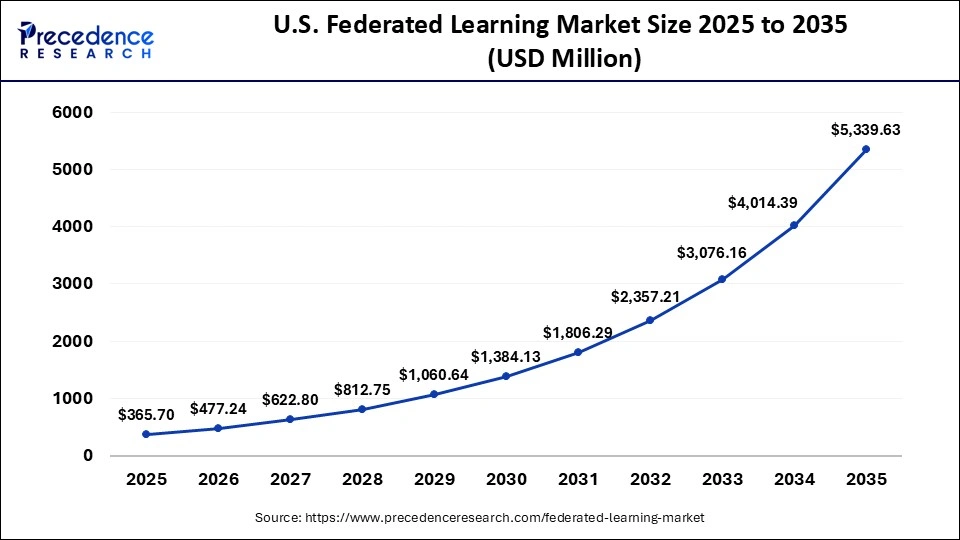
The U.S. federated learning market size is calculated at USD 365.70 million in 2025 and is expected to reach nearly USD 5,339.63 million in 2035, accelerating at a strong CAGR of 26.95% between 2026 and 2035.
U.S. Federated Learning Market Analysis
The U.S. is a major contributor to the North American market due to early adoption across data-sensitive industries, strong regulatory enforcement, and the presence of leading technology companies. The country has witnessed significant real-world adoption, with federated learning initiatives reportedly involving over 150 cross-institutional collaborations in areas such as pharmaceutical research and bank fraud detection. This highlights the U.S.'s leadership in advancing privacy-preserving AI technologies.
Europe: The Second Largest Market
Europe is the second-largest market, holding a 30% share in 2025. This is mainly due to the increasing demand for data sovereignty, strict data protection regulations such as GDPR, and strong adoption across highly regulated industries, including finance, healthcare, and automotive. Europe is also witnessing a strong emphasis on the ethical and secure use of AI, which is further driving the adoption of federated learning to prevent unauthorized access to sensitive datasets. Additionally, European organizations are increasingly prioritizing data localization by keeping sensitive information within their own infrastructure. This approach further supports the expansion of the federated learning market across the region.
Germany Federated Learning Market Analysis
Germany is a frontrunner in adopting federated learning, particularly in the healthcare and automotive sectors, driven by strict compliance requirements under GDPR. The European Union actively supports research and innovation in federated learning through various funding programs, creating a strong regulatory and financial ecosystem. Initiatives such as “Digital Jetzt” provide financial support to small and medium-sized enterprises (SMEs) to adopt advanced digital technologies, including AI-based solutions. This further accelerates the integration of federated learning across industries in Germany.
How is the Opportunistic Rise of Asia Pacific in the Federated Learning Market?
Asia Pacific is expected to grow at the fastest rate in the coming years due to rapid digital transformation, expanding internet penetration, and large-scale adoption of AI across industries such as healthcare, finance, and manufacturing. The growth of cloud infrastructure, 5G networks, and IoT ecosystems is further enabling efficient decentralized model training across distributed data sources. Additionally, increasing data privacy concerns and supportive government initiatives in countries like China, India, and Japan are accelerating the adoption of federated learning solutions in the region.
Top Companies in the Federated Learning Market
- Google LLC
- Apple Inc.
- IBM Corporation
- Microsoft Corporation
- Intel Corporation
- NVIDIA Corporation
- OpenMined
- Hewlett Packard Enterprise (HPE)
- Samsung Electronics
- Qualcomm Technologies, Inc.
- Cisco Systems, Inc.
- Huawei Technologies Co., Ltd.
- Accenture Plc
- Alibaba Cloud
- Turing Inc
Recent Developments
- In February 2026, the AI center and DeepC introduced an open-source platform called FLIP, aiming to enable health AI innovation at scale, in collaboration with Flower Labs and OneLondon. FLIP is an open-source platform for federated learning designed to support the development of large-scale healthcare AI.
(Source: https://www.deepc.ai) - In January 2026, the Health Ministry of Taiwan launched a new AI compute center and international federated learning program aiming to integrate the Taiwan healthcare sector with AI technologies. The initiative is largely focused on the development of smart applications, core technologies, and digital infrastructure.(Source: https://www.rti.org.tw)
Segments Covered in the Report
By Model Type
- Deep Learning Models
- Reinforcement Learning Models
- Transfer Learning Models
- Ensemble Learning Models
By Application
- Healthcare & Life Sciences
- Banking, Financial Services, and Insurance (BFSI)
- Retail & E-commerce
- Telecommunications & IT
- Automotive & Mobility
- Government & Défense
- Others
By Deployment Mode
- Cloud-based Federated Learning
- On-premises Federated Learning
- Hybrid Federated Learning
By End-User
- Healthcare Providers & Pharmaceutical Companies
- Banks & Financial Institutions
- Retailers & E-commerce Platforms
- Telecommunications Providers
- Automotive OEMs & Suppliers
- Government & Research Institutions
- Others
By Region
- North America
- Latin America
- Europe
- Asia-pacific
- Middle and East Africa
For inquiries regarding discounts, bulk purchases, or customization requests, please contact us at sales@precedenceresearch.com
Frequently Asked Questions
Tags





Ask For Sample
No cookie-cutter, only authentic analysis – take the 1st step to become a Precedence Research client
 Get a Sample




 sales@precedenceresearch.com
 Schedule a Meeting
