



Fluid Management Visualization Systems Market Size, Companies, Share, Patient Volume, Treatment Adoption Rates, Pricing Analysis, Regulatory Landscape, Competitive Positioning, and Demand Forecast
Fluid Management Visualization Systems Market (By Product: Instruments, Dialyzers, Fluid Waste Management System, Others, Accessories; By Application: Urology, Orthopedics, Gynecology, Cardiology, Others; By End-use: Hospitals Specialty Clinics, Ambulatory Surgical Centers) - Global Industry Analysis, Size, Trends, Leading Companies, Regional Outlook, and Forecast 2026 to 2035
Source: https://www.precedenceresearch.com/fluid-management-visualization-systems-market
 Get a Sample
 Table Of Content


What is the Fluid Management Visualization Systems Market Size in 2026?
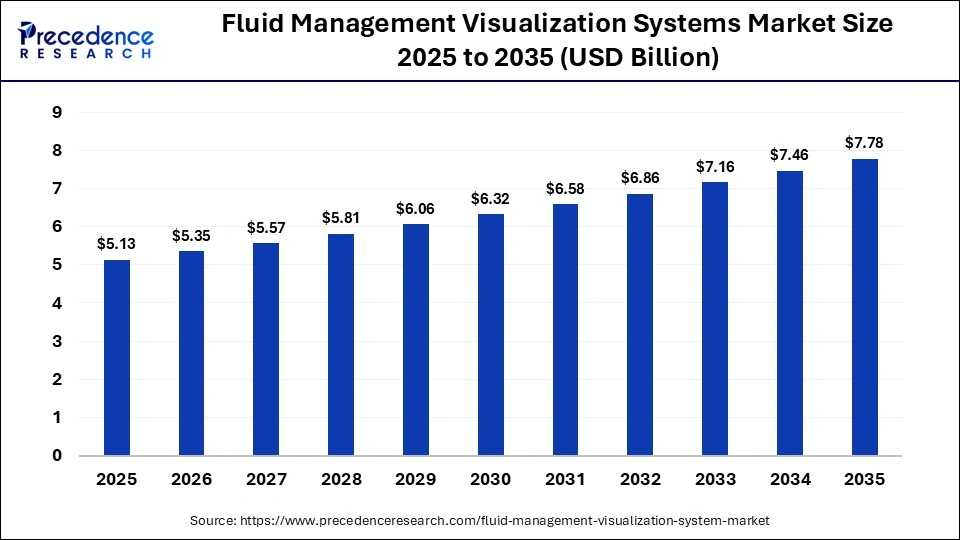
The global fluid management visualization systems market size was calculated at USD 5.13 billion in 2025 and is predicted to increase from USD 5.35 billion in 2026 to approximately USD 7.78 billion by 2035, expanding at a CAGR of 4.25% from 2026 to 2035. The market is rapidly growing due to the rising preference for minimally invasive surgery, the rising prevalence of chronic diseases, integration of AI, robotics, and smart sensors, which allows for better, automated, and real-time monitoring of fluid, reducing human errors and enhancing efficiency.
Key Takeaways
- North America held the largest market share in 2025.
- Asia-Pacific is expected to grow at the fastest CAGR during the foreseeable period.
- By product, the accessories segment held the largest market share in 2025.
- By product, the instruments segment is expected to grow at the fastest CAGR during the forecast period.
- By end use, the hospital segment held the largest market share in 2025.
- By end use, the ambulatory surgical centers segment is expected to grow at the fastest CAGR between 2026 and 2035.
- By application, the urology segment held the largest market share in 2025.
- By application, the orthopedics segment is expected to grow at the fastest CAGR during the foreseeable period.
What are Fluid Management Visualization Systems?
The global fluid management visualization systems market comprises a critical medtech vertical, utilizing automated architecture to regulate irrigation, suction, and waste sequestration during high-precision interventions. This platform's growth is driven by operational efficiency by maintaining hemostatic control and visual clarity in minimally invasive surgeries, significantly reducing operative times and post-surgical infection risks. By integration with high-definition imaging, these systems optimize clinical outcomes across urology, cardiology, and orthopedics, supporting value-based care through accelerated patient recovery.
How is AI Influencing the Fluid Management Visualization Systems Market?
The integration of AI, specifically machine learning (ML), is transforming fluid management visualization systems by providing real-time, AI-driven data analytics that optimize fluid monitoring during high-stakes medical procedures. By analyzing vast datasets, including sensor data and patient records, AI enables predictive modeling to forecast fluid loss, allowing for proactive, personalized treatment plans that enhance patient safety. These intelligent, smart visualization systems integrate AI to transform complex data streams into clear, actionable, and multidimensional visuals, significantly reducing cognitive overload for clinicians. AI-powered systems now feature automated, cloud-connected devices that streamline data capture for surgical records, improving operational efficiency.
Fluid Management Visualization Systems Market Trends
- The integration of ML has transitioned fluid monitoring from reactive observation to proactive risk mitigation. Modern systems utilize real-time, predictive algorithms to detect fluid deficits and potential imbalance before they reach critical thresholds.
- The industry is moving away from fragmented, standalone devices in favor of interconnected surgical ecosystems. These unified platforms consolidate irrigation, aspiration, and waste sequestration into a single, high-efficiency interface
- To combat cross-contamination and hospital-acquired infections (HAIs), there is a strategic pivot toward sensor-integrated single-use accessories.
- The advancement in minimally invasive surgery in urology, gastroenterology, and gynecology has driven demand for high-definition, real-time imaging systems.
- As patient care shifts away from hospital settings, there is a rising trend toward portable and wearable dialysis fluid management devices.
- This development supports the expansion of in-home therapy for patients with chronic kidney diseases.
Market Scope
| Report Coverage | Details |
| Market Size in 2025 | USD 5.13 Billion |
| Market Size in 2026 | USD 5.35 Billion |
| Market Size by 2035 | USD 7.78 Billion |
| Market Growth Rate from 2026 to 2035 | CAGR of 4.25% |
| Dominating Region | North America |
| Fastest Growing Region | Asia Pacific |
| Base Year | 2025 |
| Forecast Period | 2026 to 2035 |
| Segments Covered | Product, Application, End-use , and region |
| Regions Covered | North America, Europe, Asia-Pacific, Latin America, and Middle East & Africa |
Segmental Insights
Product Insights
Which Product Segment Led the Fluid Management Visualization Systems Market?
The accessories segment led the market by holding the largest share in 2025. This is because industries shift towards single-use technologies, and these components mitigate cross-contamination risks while supporting the high procedure volumes seen in urology and orthopedics. The integration of sensor-enabled, specialized tools with advanced visualization platforms has transformed these consumables into high-value assets for modern operating rooms. The constant demand for infection-control compliance has established accessories as the most resilient and high-frequency revenue stream in the surgical ecosystem.
The instruments segment is expected to grow at the fastest CAGR during the foreseeable period due to rising chronic conditions, such as renal failure, alongside a pervasive industry shift towards minimally invasive surgery. The integration of AI-enabled, closed-loop architecture and IoT-connected devices is transforming fluid control from a reactive utility into a predictive, real-time safety system. The stringent environmental and safety standards are mandating the adoption of automated waste sequestration, while the rise of portable, smart disposables is extending clinical-grade accuracy into home-care settings.
End-Use Insights
Why Did the Hospital Segment Lead the Fluid Management Visualization Systems Market?
The hospital segment contributed the biggest market share in 2025. This is because its primary application is for complex surgical interventions, where high capital investment facilitates the integration of automated, real-time visualization systems. The mitigating staff exposure to biohazardous fluid and enhancing procedural precision in urology, gynecology, and orthopedics foster the segment's growth. With the rising prevalence of chronic, age-related illnesses, hospitals are leveraging this technology to maintain a stringent fluid balance and safe IV therapies.
The ambulatory surgical centers segment is expected to expand rapidly in the market in the coming years, due to cost-effective, high-efficiency fluid management architectures. Accelerated by expanded Medicare approvals for complex cardiology and orthopedic interventions, ASCs are prioritizing compact, open-architecture systems that optimize operating room turnover and patient recovery times. These specialized platforms enable a high-velocity operational model, providing the necessary precision and automated waste sequestration within a streamlined, lower-overhead environment.
Application Insights
How the Urology Segment Dominated the Fluid Management Visualization Systems Market?
The urology segment accounted for the highest market share in 2025, as injections serve as a critical shift towards endoscopic interventions, where integrated sensors and digital visualization provide real-time, non-invasive monitoring to prevent life-threatening fluid overload. The convergence of high disease prevalence and advanced safety protocols ensures that urological platforms remain the primary engine for procedural innovation in the surgical ecosystem.
The orthopedics segment is expected to witness the fastest growth in the market over the forecast period, due to a shift from traditional open surgery to arthroscopy for joint injuries, significant amounts of sterile irrigation fluid, directly boosting the demand for fluid management consumables and disposable devices. Increased population and increased obesity contribute to higher rates of osteoarthritis and sports-related injuries, requiring more orthogeriatric interventions. Enhanced visualization, such as high-definition cameras, 3D imaging, and automated, precise, and user-friendly fluid management systems, has made procedures safer and more effective.
Regional Insights
Why North America Dominated the Fluid Management Visualization Systems Market?
North America registered its dominance in the market in 2025. This is mainly due to a high prevalence of chronic renal and urological conditions within an aging demographic. The sophisticated healthcare infrastructure seamlessly integrates AI-driven, automated irrigation and suction systems into digitally connected operating rooms. Favorable Medicare reimbursement policies, hospitals, and ASCs are rapidly adopting high-value, single-use disposables to mitigate infection risks and optimize surgical throughput.
There is a presence of industry titans like Stryker and Baxter that ensures a continuous pipeline of technological innovation, keeping the U.S. at the forefront of procedural safety and clinical precision. This synergy of regulatory support, capital investment, and market-leading R&D secures North America as the primary engine for value-based surgical evolution.
U.S. Market Trends
The market in the U.S. is growing due to the surging demand for intelligent, closed-loop architectures is a critical component of enhanced recovery pathways (ERPs), directly contributing to reduced hospital lengths of stay and improved patient safety. The integration of real-time data for hemostatic monitoring and automated waste sequestration is significantly mitigating infection risks for surgical teams in both hospitals and ASCs.
How is Asia-Pacific Growing in the Fluid Management Visualization Systems Market?
Asia-Pacific is expected to experience the fastest growth during the predicted timeframe, due to the rapid modernization of healthcare infrastructure and a demographic surge in chronic renal and urological conditions. The integration of AI-enabled, closed-loop technologies and advanced endoscopic platforms across China, India, and Japan, where government investments are drastically improving surgical accessibility.
The rising economic profile of the region is facilitating a shift towards portable, home-based dialysis and high-precision minimally invasive surgery kits. The digital MedTech adoption is bridging the gap between clinical-grade hospital systems and scalable home-care solutions.
China Market Trends
In China, the market is evolving due to a regional surge in robotic-assisted and minimally invasive surgery. The integration of AI-driven, closed-loop architectures with real-time imaging is drastically enhancing surgical accuracy, while stringent safety protocols are accelerating the adoption of automated waste sequestration systems. The strategic pivot toward portable in-home dialysis and localized partnerships in China is successfully bridging the gap between clinical-grade hospital infrastructure and scalable patient-centric solutions.
Will Europe Grow in the Fluid Management Visualization Systems Market?
Europe is expected to grow at a notable CAGR in the foreseeable future, due to the rising public healthcare expenditure, which means these systems are now essential for optimizing workflow efficiency and surgical safety across urological and gastrointestinal endoscopies. Europe remains a global leader in the adoption of high-cost, technologically integrated medical equipment that prioritizes patient recovery and clinical precision.
The shift toward minimally invasive surgery mandates high-precision irrigation and visualization. The region's advanced healthcare infrastructure is rapidly integrating AI-enabled, closed-loop architectures and smart disposables to comply with some of the world's most stringent infection prevention protocols.
Germany Market Trends
Germany's advanced fluid management, leveraging high-density healthcare investment to pioneer the adoption of AI-driven smart systems. The rapidly transforming towards fully integrated platforms that unify irrigation, suction, and 4K visualization to streamline high-volume workflows in urology, gynecology, and arthroscopy.
Which Factors Drive the Fluid Management Visualization Systems Market in Latin America?
Latin America is considered to be a significantly growing area, due to the integration of AI-driven diagnostic solutions and closed-loop architectures, transforming surgical workflows and significantly enhancing patient safety and recovery times for cardiovascular and urological interventions. As regional governments prioritize expanded access to advanced treatments, the adoption of automated fluid control systems is becoming the new standard for clinical efficiency.
Why is the Middle East and Africa Growing in the Market?
The Middle East and Africa is expected to grow at a considerable CAGR in the upcoming period, driven by improving economic conditions in Egypt and South Africa. Healthcare systems are rapidly pivoting toward smart sensors and real-time monitoring to manage high-acuity urological and gynecological procedures. The region is emerging as a critical growth hub for digitized MedTech, bridging the gap between sophisticated hospital-based visualization and scalable, efficient medical solutions.
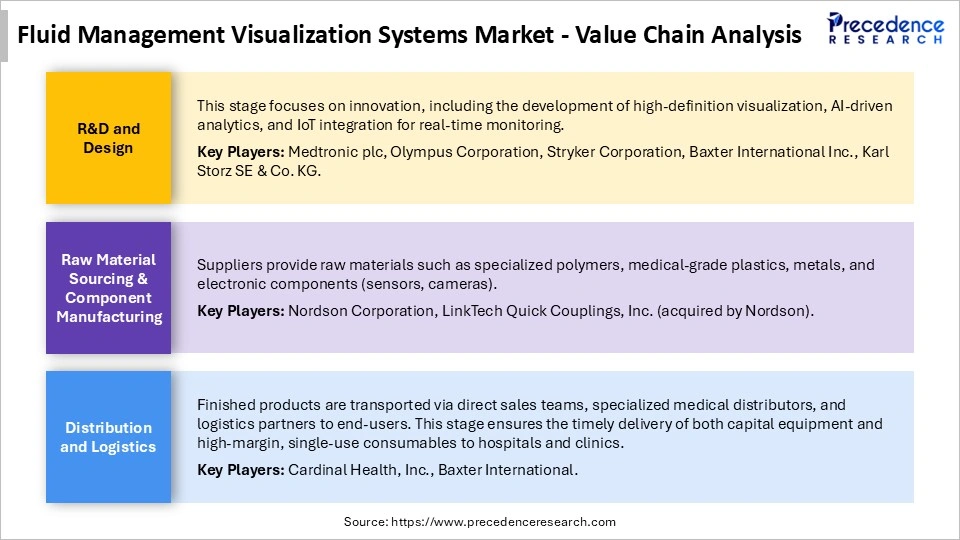
Fluid Management Visualization Systems Market Value Chain Analysis
Fluid Management Visualization Systems Market Companies
- Medtronic plc
- Stryker Corporation
- CONMED Corporation
- Smith & Nephew plc
- Hologic, Inc.
- Traubco LLC
- Serres
- Ecolab, Inc.
- Angiodynamics, Inc.
- B. Braun
- Olympus Corporation
- Fresenius Medical Care
Recent Developments
- In February 2026, KARL STORZ announced a collaboration with Smith+Nephew to combine integration and visualization solutions with advanced surgical technology to transform the field of sports medicine. The collaboration combines the expertise of both companies, including Smith+Nephew's fluid management solutions.(Source: https://www.businesswire.com)
- In January 2026, Baxter International announced the Dynamo Series, a smart stretcher designed to reduce patient transfers and enhance safety through integrated technology and a wide care surface. The new, connected stretcher helps prevent falls with features like SafeView+ visual cues, aiming to reduce the physical and cognitive burden on care teams in emergency and perioperative environments.(Source: https://www.baxter.com)
- In January 2026, MUSC Health and Baxter International announced a multi-year strategic partnership to transform bedside care by integrating connected technologies to reduce administrative burdens on nurses, enhance patient safety, and improve staff retention.(Source: https://www.baxter.com)
Segments Covered in the Report
By Product
- Instruments
- Dialyzers
- Fluid Waste Management System
- Others
- Accessories
By Application
- Urology
- Orthopedics
- Gynecology
- Cardiology
- Others
By End-use
- Hospitals
- Specialty Clinics
- Ambulatory Surgical Centers
By Region
- North America
- Europe
- Asia-Pacific
- Latin America
- Middle East & Africa
For inquiries regarding discounts, bulk purchases, or customization requests, please contact us at sales@precedenceresearch.com
Frequently Asked Questions





Ask For Sample
No cookie-cutter, only authentic analysis – take the 1st step to become a Precedence Research client
 Get a Sample
.webp)



 sales@precedenceresearch.com
 Schedule a Meeting
