


Gas Treatment Market Trends, Leading Companies, Company Revenue / Sales Performance, Installed Capacity, Production Output, Grid Expansion, Market Share, Technology Adoption, and Industry Outlook
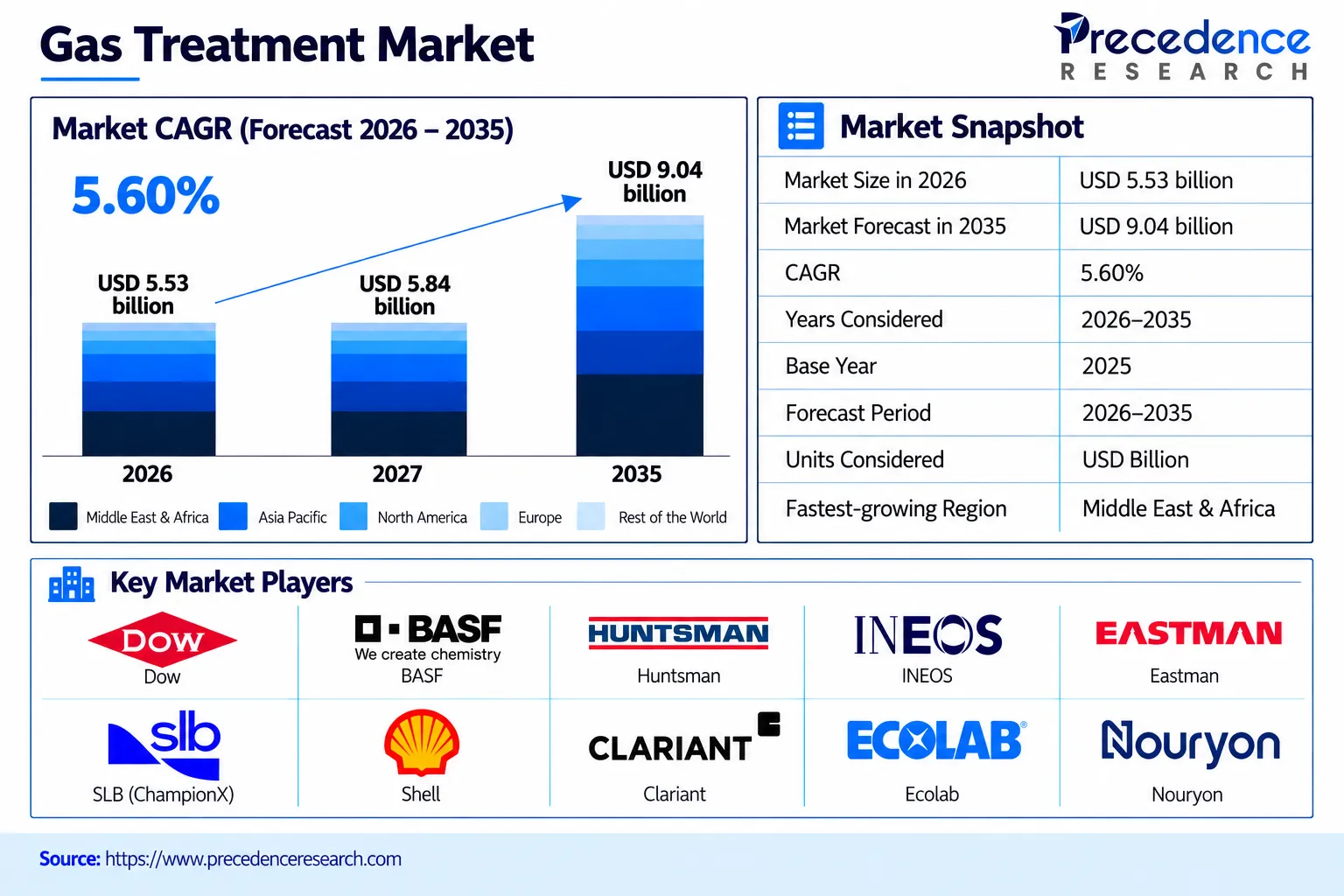
According to energy and power expert Laxmi Narayan, the gas treatment market has reached USD 5.53 billion in 2026 and is expected to grow to USD 9.04 billion by 2035, registering a CAGR of 5.60%. The gas treatment market companies such as Dow, BASF, Huntsman, INEOS, Eastman are playing a key role in market expansion, with major opportunities emerging across type, application, end use and region segments.
Source: https://www.precedenceresearch.com/gas-treatment-market
 Get a Sample
 Table Of Content


Gas Treatment Market Demand, Size, and Growth Rate Forecast 2035
The gas treatment market is expected to grow from USD 5.53 billion in 2026 to USD 9.04 billion by 2035, at a CAGR of 5.60% from 2026 to 2035. The market was valued at USD 5.24 billion in 2025, which is the base year.
The gas treatment market includes chemicals used to remove hydrogen sulphide, carbon dioxide, water and other unwanted substances from natural gas, refinery gas, LNG feed gas, syngas and flue gas. These chemicals include amine solvents such as MDEA, MEA and formulated amines. Other products include H2S scavengers, glycols and physical solvents.
 Key Takeaways
Market Size & Growth Outlook
- Market size in 2025: USD 5.24 billion
- Estimated market size in 2026: USD 5.53 billion
- Projected market size by 2035: USD 9.04 billion
- CAGR (2026-2035): 5.60%
Regional Market Spotlight
- Asia Pacific led the market in 2025, with a 31.40% share, worth USD 1.65 billion.
- North America held a 28.60% share of the market in 2025, worth USD 1.50 billion.
- Middle East & Africa accounted for 20.80% of the market in 2025, worth USD 1.09 billion. It is expected to be the fastest-growing region, with a CAGR of 6.67% from 2025 to 2035.
Segmental Spotlight
- By type, amines held the largest share in 2025, at 72.60%, worth USD 3.80 billion.
- By application, acid gas removal led the market in 2025, with a 68.40% share, worth USD 3.58 billion.
- By end use, natural gas processing held the largest share in 2025, at 46.80%, worth USD 2.45 billion.
Gas Treatment Market Size and Forecast, 2025-2035 (USD Billion)
Amines held the largest share of the market in 2025, accounting for 72.60%. This is because amine units are widely used to remove acid gases in gas processing plants, refineries, and LNG facilities. Asia Pacific held 31.40% of the market revenue in 2025, supported by gas processing, refining, and LNG import facilities in China, India, Australia, and Southeast Asia.
The market is growing because natural gas and LNG production are increasing, more sour gas fields are being developed in the Middle East, and rules on sulphur and emissions are becoming stricter. Amine solvents are also being used in carbon capture projects. Chemical companies are introducing advanced amine technologies for carbon capture and developing selective solvents that can reduce energy use.
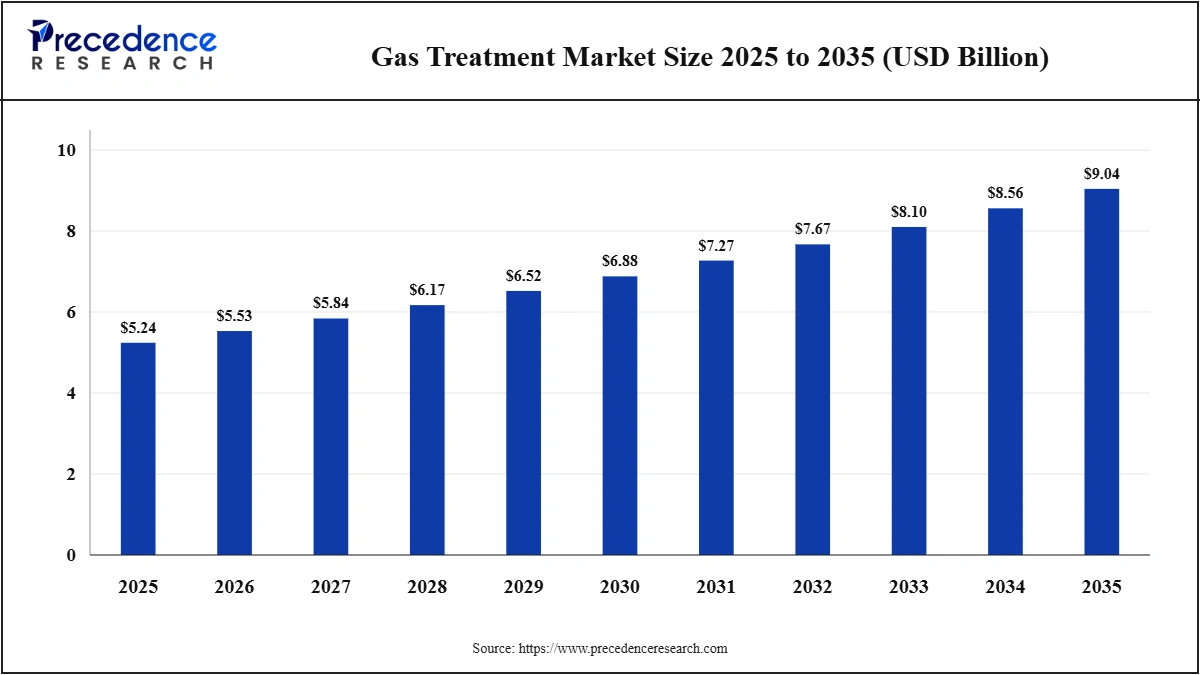
Note: 2025 is the base year, while the figures for 2026-2035 are forecasts.
Sources: Expert interviews, secondary sources, Precedence Research database, and Precedence Research analysts.
The gas treatment market is expected to grow from USD 5.24 billion in 2025 to USD 9.04 billion by 2035. This growth is mainly due to the rising need to treat natural gas, including sour gas that contains high levels of H2S and CO2. LNG plants, refineries, and new carbon capture facilities also need amine solvents to remove unwanted gases.
More companies are choosing selective and energy-efficient formulated amines instead of standard solvents. These products can improve performance and reduce energy use, adding value to the market. As a result, the market is expected to reach USD 6.88 billion by 2030 and grow at a CAGR of 5.60% from 2026 to 2035.
- Analyst View: We estimated the market by looking at the amount of gas treated in natural gas processing plants, LNG facilities, refineries, chemical plants, and carbon capture projects. We then considered the amount of acid gas removed, the quantity of solvents and other chemicals used, and their average prices.
Gas volumes were based on production levels, LNG capacity, and refinery output. Chemical use was estimated by considering solvent losses, chemical breakdown, and the amount of scavengers needed for different applications.
We cross-checked the results against gas treatment chemical revenue from leading amine producers and oilfield chemical suppliers, as well as published market estimates. This process placed our base-year estimate slightly above comparable figures. The expected growth reflects higher gas and LNG production and rising demand from carbon capture projects, while improvements in solvent efficiency may limit some of the growth.
Market Trends
- Selective amines are helping reduce energy use in sulphur recovery.
- Amine solvents are increasingly being used in carbon capture projects.
- The development of sour gas fields is increasing the need to remove H2S.
- LNG plants need gas with very low CO2 levels before liquefaction.
- Non-regenerable scavengers are used at wellheads and in smaller gas streams.
- Solvent recovery and cleaning help reduce amine losses.
Drivers, Restraints and Opportunities
Driver
Natural gas and LNG production continue to increase, creating a greater need to remove H2S, CO2, and water from gas. Sour gas fields in the Middle East require large units to remove acid gases. Carbon capture projects also use amine solvents to capture CO2 from flue gas.
Restraint
More efficient solvents and solvent recovery systems can reduce the amount of new chemicals needed. Changes in gas prices can also affect investment in gas processing facilities. In addition, carbon capture projects may face delays or depend on government support and subsidies.
Opportunity
Carbon capture projects at power plants, cement plants and waste-to-energy facilities could create new demand for solvents. Selective amines can also help refineries and gas processing plants increase capacity without building new units. LNG expansion in the Middle East, North America and Africa is expected to create demand for large gas treatment facilities.
Market Segmentation: 2025 Share and Value
Gas Treatment Market By Type 2025 Share & Size
Note: 2025 is the base year.
Sources: Expert interviews, secondary sources, Precedence Research database, and Precedence Research analysts.
Amines held 72.60% of the market in 2025, worth USD 3.80 billion. Products such as MDEA, MEA, and formulated amine solvents are widely used to remove H2S and CO2 in large treatment units where the solvents can be reused.
Non-amine products accounted for 27.40% of the market, worth USD 1.44 billion. This group includes H2S scavengers used at wellheads and in smaller gas streams, glycols used to remove water, and physical solvents used to treat gas at high pressure.
Gas Treatment Market By Application 2025 Share & Size
| Segments | 2025 Share | 2025 Market Value |
| Acid Gas Removal | 68.40% | USD 3.58 billion |
| Dehydration | 31.60% | USD 1.66 billion |
Note: 2025 is the base year.
Sources: Expert interviews, secondary sources, Precedence Research database, and Precedence Research analysts.
Acid gas removal accounted for 68.40% of the market in 2025, worth USD 3.58 billion. It is also the fastest-growing application because sour gas projects, LNG gas quality requirements, and carbon capture facilities all need H2S and CO2 to be removed.
Dehydration accounted for 31.60% of the market, worth USD 1.66 billion. This process uses glycol and other chemicals to remove water from gas before it is transported through pipelines or converted into LNG.
Gas Treatment Market By End Use 2025 Share & Size
Note: 2025 is the base year.
Sources: Expert interviews, secondary sources, Precedence Research database, and Precedence Research analysts.
Natural gas processing was the largest end-use segment in 2025, accounting for 46.80% of the market, worth USD 2.45 billion.
Refineries accounted for 22.40%, worth USD 1.17 billion. They use amines in sulphur recovery and tail gas treatment. LNG plants accounted for 12.60%, worth USD 0.66 billion.
Carbon capture and other applications accounted for 9.60%, worth USD 0.50 billion, and are expected to be the fastest-growing end-use group. Chemicals and petrochemicals accounted for 8.60%, worth USD 0.45 billion.
- Analyst View: We estimated the value of each segment by matching the amount of gas treated in different industries with the chemicals used, the treatment process, chemical replacement rates, and average prices. Amines lead the market because large gas processing facilities mainly use reusable amine systems to remove acid gases. We expect acid gas removal, formulated amines, and carbon capture applications to gain a larger share over time.
Regional Analysis
Gas Treatment Market By Region 2025 Share & Size
Note: 2025 is the base year.
Sources: Expert interviews, secondary sources, Precedence Research database, and Precedence Research analysts.
Asia Pacific held the largest market share in 2025, at 31.40%, worth USD 1.65 billion. Demand is supported by gas processing, refining, and LNG infrastructure in China, India, Australia, and Southeast Asia.
North America accounted for 28.60% of the market, worth USD 1.50 billion. Shale gas processing, LNG export facilities, and early carbon capture projects support demand in the region.
The Middle East & Africa accounted for 20.80% of the market, worth USD 1.09 billion, and is expected to be the fastest-growing region. Growth is supported by sour gas projects and LNG expansion in Qatar, Saudi Arabia, and the UAE.
Europe held a 13.20% share, worth USD 0.69 billion, with demand supported by refinery operations and carbon capture projects. Latin America accounted for 6.00%, worth USD 0.31 billion, with gas processing activities in Brazil, Argentina and Trinidad supporting demand.
Asia Pacific accounted for 31.40% of the market in 2025, worth USD 1.65 billion. Gas processing, refining and LNG activities in China, India and Australia support regional demand.
North America accounted for 28.60% of the market in 2025, worth USD 1.50 billion. Shale gas processing and LNG exports are the main sources of demand.
The Middle East & Africa accounted for 20.80% of the market in 2025, worth USD 1.09 billion, and is expected to grow faster than other regions. Sour gas projects and LNG expansion are driving this growth.
Europe accounted for 13.20% of the market in 2025, worth USD 0.69 billion. Refinery operations and carbon capture projects support demand.
Latin America accounted for 6.00% of the market in 2025, worth USD 0.31 billion. Gas processing in Brazil and Argentina supports the regional market.
- Analyst View: We estimated regional market shares by looking at the amount of gas treated, LNG capacity, and refinery output in each region. We also considered the amount of acid gas in the gas and the prices of treatment chemicals.
Asia Pacific leads because it has a large gas processing and refining industry. We expect the Middle East & Africa to grow the fastest because sour gas projects and LNG capacity are expanding quickly in the region.
Top 10 Companies in the Gas Treatment Market
| Rank | Company Name | Market-Specific Revenue (USD Billion) | 2025 Share | Key Products / Business | Headquarters |
| 1 | Dow | 0.78 | 14.89% | UCARSOL amine solvents | United States |
| 2 | BASF | 0.62 | 11.83% | OASE gas treatment technologies | Germany |
| 3 | Huntsman | 0.42 | 8.02% | Gas treating amines | United States |
| 4 | INEOS | 0.36 | 6.87% | GAS/SPEC amine solvents | United Kingdom |
| 5 | Eastman | 0.24 | 4.58% | Amines and gas treating chemicals | United States |
| 6 | SLB (ChampionX) | 0.22 | 4.20% | H2S scavengers and production chemicals | United States |
| 7 | Shell | 0.2 | 3.82% | Sulfinol and CANSOLV solvent technologies | United Kingdom |
| 8 | Clariant | 0.14 | 2.67% | H2S scavengers and gas treatment chemicals | Switzerland |
| 9 | Ecolab | 0.12 | 2.29% | Gas treatment and process chemicals | United States |
| 10 | Nouryon | 0.1 | 1.91% | Ethyleneamines and gas treating chemicals | Netherlands |
Note: Company revenues and market shares are estimates for 2025.
Sources: Company press releases, expert interviews, secondary sources, Precedence Research database, and Precedence Research analysts.
Dow led the gas treatment market in 2025, with estimated revenue of USD 0.78 billion and a market share of 14.89%. BASF followed with USD 0.62 billion and an 11.83% share, while Huntsman ranked third with USD 0.42 billion and an 8.02% share.
Dow's position is supported by its UCARSOL formulated amines. BASF offers OASE gas treatment technologies for gas processing, LNG and carbon capture, while Huntsman supplies gas treating amines.
The top 10 companies accounted for an estimated 61.07% of the market in 2025, worth USD 3.20 billion. The remaining 38.93%, worth USD 2.04 billion, was shared by regional amine producers, oilfield chemical suppliers and companies that license solvent technologies.
The market is moderately concentrated. Companies mainly compete by offering solvents that selectively remove unwanted gases, use less energy, resist breakdown, provide reliable technical support and come with useful technology licensing options.
Recent Developments
- July 2025: SLB completed its USD 7.8 billion acquisition of ChampionX, adding H2S scavengers and production chemicals to its product portfolio. (Source: https://www.slb.com/newsroom)
- October 2025: BASF and ANDRITZ signed a licence agreement for BASF's OASE blue technology for a planned carbon capture plant in Aarhus, Denmark. The plant is designed to capture about 435,000 tons of CO2 per year.(Source:: https://www.basf.com)
Gas Treatment Market Segments
By Type
- Amines
- Non-Amines
By Application
- Acid Gas Removal
- Dehydration
By End Use
- Natural Gas Processing
- Refineries
- LNG
- Carbon Capture & Others
- Chemicals & Petrochemicals
By Region
- North America (U.S., Canada, Mexico)
- Europe (Germany, U.K., France, Italy, Spain, Rest of Europe)
- Asia Pacific (China, Japan, India, South Korea, Taiwan, Rest of Asia Pacific)
- Latin America (Brazil, Argentina, Rest of Latin America)
- Middle East & Africa (GCC, South Africa, Rest of MEA)
Research Methodology
The gas treatment market includes amine and non-amine chemicals used to treat natural gas, LNG feed gas, refinery gas, syngas, and flue gas around the world.
The 2025 base-year estimate was developed by calculating the amount of gas treated, the quantity of acid gases removed, the amount of solvents and other chemicals used, and their prices. The estimate was then checked against gas treatment chemical revenue from leading amine producers and oilfield chemical suppliers.
Market values for each segment, region and company were estimated based on chemical type, application, end use and regional gas processing capacity. Key estimates were checked against company disclosures, regulatory and industry data, and published estimates from other sources. Inputs that could not be matched or confirmed were excluded.
All segment, regional and company figures were aligned with the same 2025 base year. The forecasts for 2026–2035 were then recalculated using a constant CAGR from the 2025 base and checked for consistency.
Analyst View Overall Market
The gas treatment market is expected to grow as natural gas production, LNG activity, and refining increase. Carbon capture is also becoming a new source of demand for amine solvents.
Our estimate connects market demand with the amount of gas treated, the level of acid gases present, and the prices of treatment chemicals. This means the forecast depends mainly on gas production and the development of carbon capture projects.
The main growth opportunities come from sour gas projects, LNG expansion, and carbon capture. However, improvements in solvent efficiency and delays to projects could limit market growth.
Sources and References
- BASF. "BASF and ANDRITZ sign license agreement for OASE technology". 2025-10-23. OASE blue for Aarhus carbon capture. (Source: https://www.basf.com)
- Digital Refining. "BASF SE and ExxonMobil introduce OASE sulfexx". 2020-07-06. Selective amine technology.(Source: https://www.digitalrefining.com)
- World Oil. "SLB completes USD 7.8 billion ChampionX acquisition". 2025-07-16. SLB ChampionX acquisition.(Source: https://worldoil.com)
- Dow. "Gas treating solutions". Undated. UCARSOL gas treating products. (Source: https://www.dow.com)
For inquiries regarding discounts, bulk purchases, or customization requests, please contact us at sales@precedenceresearch.com
Frequently Asked Questions





Ask For Sample
No cookie-cutter, only authentic analysis – take the 1st step to become a Precedence Research client
 Get a Sample




 sales@precedenceresearch.com
 Schedule a Meeting