



Generative AI in Clinical Trials Market Size, Companies, Share, Patient Volume, Treatment Adoption Rates, Pricing Analysis, Regulatory Landscape, Competitive Positioning, and Demand Forecast
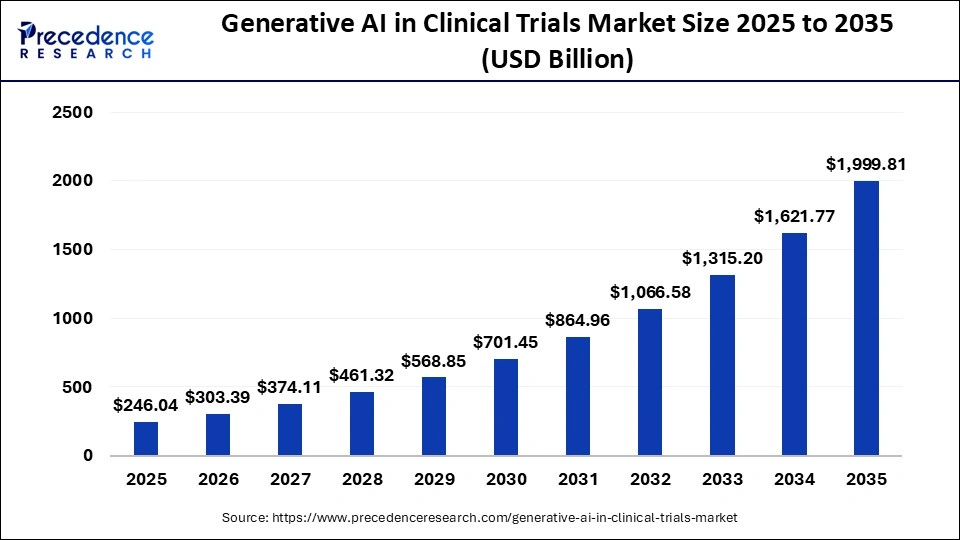
Rohan Patil, a Healthcare Industry Expert, highlights that the generative AI in clinical trials market has reached USD 303.39 billion in 2026 and is on track to reach USD 1999.81 billion by 2035, advancing at a CAGR of 23.31%. Key generative AI in clinical trials market companies shaping the market include IBM, Microsoft, Google Health, IQVIA, Parexel, ICON plc , while major growth segments span By Application, By Deployment Type, By Technology, By End Use, By Region.
Source: https://www.precedenceresearch.com/generative-ai-in-clinical-trials-market
 Get a Sample
 Table Of Content


What is the Generative AI in Clinical Trials Market Size in 2026?
The global generative AI in clinical trials market size was calculated at USD 246.04 billion in 2025 and is predicted to increase from USD 303.39 billion in 2026 to approximately USD 1999.81 billion by 2035, expanding at a CAGR of 23.31% from 2026 to 2035. The market is growing due to increasing demand for faster drug development and decreasing trial costs. Increasing use of AI for patient data analysis and trial optimization is another factor contributing to market growth. Complexity in clinical trials is another factor contributing to market growth for advanced AI solutions.
Key Takeaways
- North America dominated the global market with the largest market share in 2025.
- Asia-Pacific is expected to grow at the highest CAGR from 2026 to 2035.
- By application, the patient recruitment segment dominated the generative AI in clinical trials market in 2025.
- By application, the monitoring reporting segment is expected to grow at the fastest CAGR in the market between 2026 and 2035.
- By deployment type, the cloud-based segment led the market in 2025.
- By deployment type, the on-premises segment is expected to grow with the highest CAGR in the market during the studied years.
- By technology, the natural language processing segment contributed the biggest market share in 2025.
- By technology, the deep learning segment is expected to witness the fastest growth in the market over the forecast period.
- By end use, the pharmaceutical companies segment held the largest market share in 2025.
- By end use, the contract research organizations segment is expected to expand rapidly in the market in the coming years.
Generative AI in Clinical Trials Market Overview
The generative AI in the clinical trials industry is witnessing tremendous growth as various healthcare institutions are adopting cutting-edge technologies for better clinical trial efficiency. Generative AI facilitates the process of designing clinical trial protocols, selecting appropriate patients for clinical trials, predicting trial outcomes, and analyzing clinical trial data. This technology reduces human intervention, minimizes errors, and accelerates clinical trial development processes. This technology has been widely used for various clinical trial activities, including patient recruitment, designing clinical trials, and real-time monitoring.
How is AI Influencing the Generative AI in Clinical Trials Market?
Artificial intelligence (AI) is significantly transforming the generative AI in the clinical trials industry by making clinical trials operations more efficient and accurate. It helps automate complex operations, saving on costs and human resources. It is also important in ensuring that generative AI models simulate patient responses, hence making it possible for researchers to carry out more effective and optimized clinical trials. These models can also help in predictive analysis, making it possible for researchers to identify potential risks and outcomes.
AI is also important in making patient recruitment more effective by using large data sets such as electronic health records to help in the quick identification of potential participants. It is also important for making trials more effective by tracking data in real time, ensuring more effective monitoring and compliance. It helps minimize trial failures and delays by making accurate and precise data. AI accelerates the speed of trials and regulatory procedures to be approved more quickly by providing well-structured and precise data.
Market Trends in the Generative AI in Clinical Trials Market
- Wider Adoption of Generative AI Platforms: Pharmaceutical and biotechnology companies increasingly adopt generative AI platforms to improve operational efficiency in clinical trials. These platforms help in automating various tasks involved in trials, such as protocol development, data processing, and document generation. This helps in speeding up the process of bringing new drugs to the market.
- Improved Patient Recruitment Accuracy: Generative AI is improving patient recruitment accuracy by using large amounts of data available in electronic patient records and genetic datasets. It helps in selecting the right candidates for trials in less time, thus improving patient diversity and accuracy in matching, which results in a high success rate.
- Growth of Decentralized Clinical Trials: AI is facilitating decentralized clinical trials by allowing remote patient monitoring and participation. With this, more patients can participate in trials from their homes using digital technologies. This will help in improving patient engagement, increasing the overall participation rates, and reducing the dropout rates. It will also help more patients from remote and hard-to-reach areas.
- Enhanced Predictive Analytics Capabilities: Generative AI models help enhance predictive analysis capabilities by predicting trial results and outcomes. With this, researchers can change their strategies and designs in real time. It will help minimize failures and maximize efficiency in conducting trials.
- Increased Focus on Data Security and Compliance: With the increasing adoption of generative AI in clinical trials, there is an increased focus on data security and compliance. Companies are investing in highly secure systems and advanced encryption techniques to ensure the security of patient information. In addition, they are focusing on compliance with global healthcare regulations to build trust in AI solutions.
Market Scope
| Report Coverage | Details |
| Market Size in 2025 | USD 246.04 Billion |
| Market Size in 2026 | USD 303.39 Billion |
| Market Size by 2035 | USD 1,999.81 Billion |
| Market Growth Rate from 2026 to 2035 | CAGR of 23.31% |
| Dominating Region | North America |
| Fastest Growing Region | Asia-Pacific |
| Base Year | 2025 |
| Forecast Period | 2026 to 2035 |
| Segments Covered | Application, Deployment Type, Technology, End Use, and Region |
| Regions Covered | North America, Europe, Asia-Pacific, Latin America, and Middle East & Africa |
Market Dynamics
Drivers
Growing Need for Faster Drug Development
The increasing need to reduce the time taken for drug development is another significant driver for the use of generative AI in clinical trials. Conventional clinical trials are lengthy and expensive, with some trials taking several years to complete. Generative AI can aid in speeding up processes in clinical trials. AI can quickly identify potential candidates for a clinical trial and can forecast the outcome of a clinical trial. Such efficiency in clinical trials is critical in health crises and in the development of personalized medicine, thus making AI an essential tool in clinical trials.
Restraint
Data Privacy and Regulatory Challenges
The market faces formidable challenges, such as data privacy and stringent regulations. In a clinical trial, data is sensitive information. When it comes to AI, data privacy and regulations must be followed. There is a fear of data being hacked and data privacy being violated. There is a lack of transparency in AI models. Another challenge is that regulations for AI in the healthcare industry are still evolving, limiting its widespread use.
Opportunity
Growth of Personalized Medicine
There is a tremendous growth opportunity for generative AI in the field of clinical trials through personalized medicine, which has been gaining more attention in recent times. This would improve the overall success rate of clinical trials and provide better results for patients. Researchers focus on developing personalized medicines as they cure a disease from its root cause. Companies investing in AI-based solutions would also gain a competitive edge over others by providing more efficient and personalized solutions for clinical trials.
Segmental Insights
Application Insights
Which Application Segment Dominated the Generative AI in Clinical Trials Market?
The patient recruitment segment accounted for the highest market share in 2025, due to the need for identifying patients who are eligible to participate in clinical trials promptly. This can be achieved through the analysis of large amounts of data using generative AI. Generative AI can perform numerous tasks for patient recruitment, including discovery, engagement, pre-screening, and support & retention. It can also allow participants to match user queries to structured eligibility criteria, enabling them to participate in personalized trials.
The monitoring reporting segment is expected to show the fastest growth over the forecast period, due to the ability of generative AI to track data in real-time. Generative AI has emerged as an essential tool to monitor and report patients' health data and vital signs, especially for clinical trials that are conducted on a large scale. This eliminates the need for patients to visit a trial site for health monitoring.
Deployment Type Insights
Why Did the Cloud-based Segment Dominate the Generative AI in Clinical Trials Market?
The cloud-based segment contributed the biggest market share in 2025 because of its flexibility and cost-effectiveness. Cloud-based solutions can easily provide access to integrated data from different locations, making them best suited for clinical trials. They can store and manage vast amounts of patient data and can be accessed by investigators, sponsors, and patients from anywhere and at any time. They eliminate the need for a suitable infrastructure in a healthcare setting.
The on-premises segment is expected to gain the highest market share between 2026 and 2035, due to increasing concerns about data security and privacy. Organizations are opting for on-premise solutions to maintain control over sensitive patient information. It will also help companies meet strict regulatory requirements and compliance forms. Large organizations, especially those with robust capabilities, are increasingly opting for on-premises solutions.
Technology Insights
Which Technology Segment Led the Generative AI in Clinical Trials Market?
The natural language processing segment led the market in 2025 due to its ability to analyze unstructured clinical data, such as medical records and research papers, extracting useful information in an efficient manner. Natural language processing (NLP) improves trial efficiency and enhances key decision-making support. It can predict patient responses, target specific demographics, and enhance participant matching.
The deep learning segment is expected to witness the fastest growth in the market over the forecast period. This is because it provides advanced capabilities in predictive analytics and pattern recognition. Deep learning tools have emerged as transformative tools for optimizing clinical trial design, patient recruitment, and real-time monitoring. They can synthesize evidence from literature and predict trial and patient outcomes, enabling investigators to make effective decisions.
End Use Insights
How the Pharmaceutical Companies Segment Dominated the Generative AI in Clinical Trials Market?
The pharmaceutical companies segment registered its dominance over the market in 2025. This is because these companies are investing heavily in research and development and are early adopters of generative AI to facilitate drug discovery and clinical trials. They have the financial strength and focus on innovation to deploy AI technologies on a large scale. The increasing competition among pharmaceutical companies encourages them to expand their product pipeline and strengthen their market position.
The contract research organizations segment is expected to grow with the highest CAGR in the market during the studied years, owing to the rise in outsourcing of clinical trials. CROs are increasingly using AI tools for improving efficiency and cost savings, as well as for providing high-end services to clients. CROs have specialized infrastructure and skilled professionals for planning and executing clinical trials. By collaborating with CROs, pharmaceutical companies can focus on their core competencies, such as product sales and marketing.
Regional Analysis
Why North America Dominated the Generative AI in Clinical Trials Market?
North America held a major market share in 2025. This is because of the well-established healthcare infrastructure and the high adoption of advanced technology in the region. In addition, major pharmaceutical and AI companies in the region are helping the market grow. Moreover, investments in research and development activities, along with favorable government regulations, are helping the regional market grow. In addition, the number of clinical trials in the region is increasing, which is helping the market grow.
U.S. Market Trends
The U.S. leads the market in North America, owing to the presence of a suitable clinical trial infrastructure and favorable government support. The U.S. conducts the highest number of trials in the world. As of March 23, 2026, a total of 190,290 trials were registered on the clinicaltrials.gov website, representing 32.9% of all global trials.
How is Asia-Pacific Growing in the Generative AI in Clinical Trials Market?
Asia-Pacific is expected to experience the fastest growth during the predicted timeframe. This is because of the rising clinical trials, rapidly expanding pharmaceutical and biotech sectors, and the increasing adoption of AI technology. Countries in the Asia-Pacific region are developing their infrastructure. The cost of clinical trials is low, and the patient population is large. Evolving regulatory landscapes and the increasing investments in clinical research also contribute to market growth.
China Market Trends
China is making constant efforts to become a global hub in clinical trials, with the growing adoption of advanced technologies and the burgeoning biotech sector. The increasing drug discovery research and the need for indigenous development of novel drugs and medical devices foster market growth.
Will Europe Grow in the Generative AI in Clinical Trials Market?
Europe is expected to grow at a notable CAGR in the foreseeable future, driven by the growing pharmaceutical industry and enhanced research and innovation. The region is heavily investing in AI technologies for driving digitization in the healthcare sector. Government bodies are launching initiatives such as Horizon Europe, aiding the adoption of AI technologies for healthcare. The approval process is complex and time-consuming, but it is being streamlined.
Generative AI in Clinical Trials Market Companies
- IBM
- Microsoft
- Google Health
- IQVIA
- Parexel
- ICON plc
- Labcorp Drug Development
- Oracle Health
- Siemens
- Roche
- Novartis
- Bristol Myers Squibb
Recent Developments
- In January 2026, Oracle announced the launch of its Life Sciences AI Data Platform, a generative AI tool built to help pharmaceutical, medical device, and life sciences companies speed up research, clinical trials, safety checks, and commercialization. The platform analyzed diverse healthcare data, including 129 million anonymized health records and unified fragmented data, improved efficiency, supported drug discovery, monitored safety, and streamlined regulatory work (Source: https://www.techtarget.com)
- In June 2025, City of Hope announced the use of generative AI to create operational efficiency, enable AI-driven patient personalization, improve access to clinical trials, and empower breakthrough research. The hospital aims to transform physician workloads and fuel more focused, personalized patient care.(Source: https://www.businesswire.com)
Segments Covered in the Report
By Application
- Patient Recruitment
- Monitoring Reporting
- Trial Design
- Data Analysis
By Deployment Type
- Cloud-Based
- On-Premises
By Technology
- Natural Language Processing
- Deep Learning
- Machine Learning
By End Use
- Pharmaceutical Companies
- Biotechnology Firms
- Contract Research Organizations
By Region
- North America
- Latin America
- Europe
- Asia-pacific
- Middle and East Africa
For inquiries regarding discounts, bulk purchases, or customization requests, please contact us at sales@precedenceresearch.com
Frequently Asked Questions





Ask For Sample
No cookie-cutter, only authentic analysis – take the 1st step to become a Precedence Research client
 Get a Sample




 sales@precedenceresearch.com
 Schedule a Meeting
