



Generative AI Server Market Size, Trends, Companies, Pricing, Cloud Adoption, Infrastructure Expansion, Competitive Landscape, and Industry Outlook
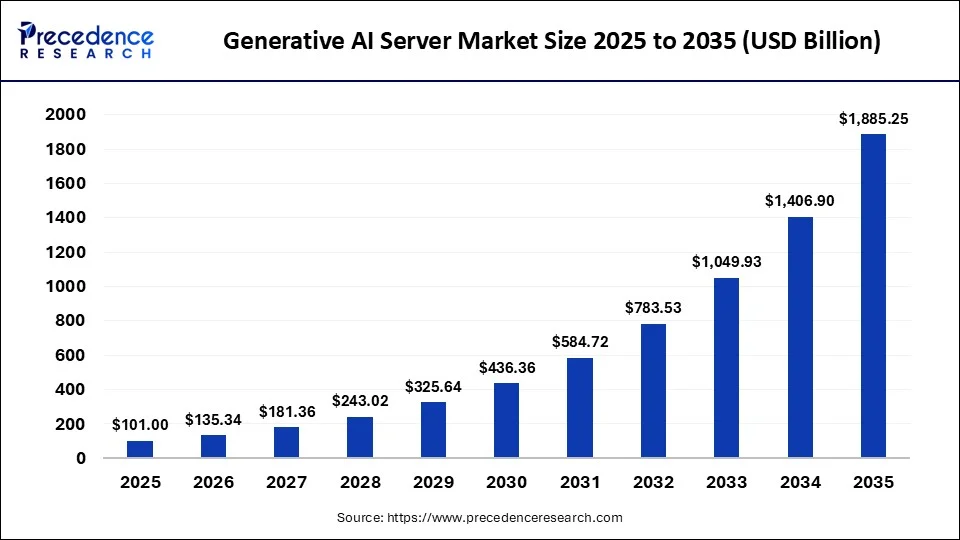
ICT industry specialist Gautam Mahajan estimates the generative AI server market at USD 135.34 billion in 2026, with continued technology adoption expected to take the market to USD 1,885.25 billion by 2035 at a CAGR of 34.00%. Leading generative AI server market providers such as Adlink Technology Inc., Advanced Micro Devices, Inc are expanding their capabilities across segments including server type, processor type, deployment, form factor, cooling technology, enterprise size, application, end user, region.
Source: https://www.precedenceresearch.com/generative-ai-server-market
 Get a Sample
 Table Of Content


Generative AI Server Market Size and Forecast 2026 to 2035
The global generative AI server market size is predicted to increase from USD 135.34 billion in 2026 to approximately USD 1,885.25 billion by 2035, expanding at a CAGR of 34.00% from 2026 to 2035.
Key Takeaways
- By server type, the AI training servers segment contributed the highest market share of 46% in 2026.
- By server type, the AI inference servers segment held a 31% share of the market in 2026 and is expected to grow at a significant CAGR of 36.5% between 2026 and 2035.
- By processor type, the GPU-based servers segment held a major market share of 67% in 2026.
- By processor type, the AI Accelerator-based servers segment held a 18% share in 2026 and is expected to register significant growth of 38.7% CAGR during 2026 and 2035.
- DRAM prices rose 50–55% quarter-over-quarter in early 2026, directly pushing up AI server manufacturing and selling prices.
- TSMC's CoWoS packaging capacity is expanding to approximately 130,000 wafers/month by late 2026, easing the GPU supply bottleneck limiting server shipments.
- Samsung and SK Hynix began HBM4 mass production in February 2026, addressing the memory shortage constraining accelerator output.
- IEA projects data center electricity use to double to approximately 945 TWh by 2030, making power availability a binding constraint on new AI server deployment.
- Gartner found only 28% of enterprise AI use cases met ROI expectations in a late 2026 survey, shaping how cautiously enterprises now procure AI infrastructure.
Market Size Description
In 2026, the global generative AI server market accounted for USD 135.34 billion. The market is forecast to grow at 34.00% CAGR till 2035. This increase doesn't really signal a growth wave but more of a structural change in how enterprises use computing resources. Shipments continue to surge with hyperscalers bidding for GPUs based server racks for both training and inference. The average selling price is still high because there is limited supply of advanced chips and specialized cooling systems.
The cost of manufacturing Tesla continues to rise as the servers' architectures become more complicated. They now employ liquid cooling, more dense interconnects, and custom silicon. In industries such as healthcare diagnostic, financial modelling, adoption of GPT is increasingly growing. Enterprises are moving towards larger compute clusters. Expansion of hyperscale infrastructure is now the number one reason for server demand in the world.
This is a response from the supplier side of the hardware industry as well. Energy efficiency improvements for ARM-based CPUs account for the rapid growth in their share. From about 5% to nearly 20% of data center servers, since 2020. Optical interconnect suppliers are also making rapid progress, shifting to 1.6T opticals by 2026 to cope with growing data traffic requirements. Device manufacturers like Amphenol have developed particular products, like the NVLink spine cartridge. They are engineered to accommodate those tighter architectures of the servers. The dynamics that were set in motion during 2026 and beyond are likely to persist across shipment patterns, pricing dynamics, and manufacturing priorities in the generative AI server market into the future.
Market Snapshot
The generative AI server market continues to increase in shipments. The instantaneous GPUs and custom-silicon server classes are registering the fastest growth. The region with the significant presence of continuous hyperscaler buildouts across key cloud campuses has been North America as the leading region. Asia Pacific is emerging as one of the fastest-growing regions of the world. This region has intense data center construction in 2025 and 2026 projected to drive growth. The use of the cloud deployment model for generative AI workloads is still predominant over on-premises installations. There is also some pricing stability in the trend, as we are facing a shortage situation in the Advanced Packaging industry as well as the memory supply chain. Industry-wide, agentic AI workloads are now driving the procurement of applications. These changes directly translate to today's commercial and investment adoptions, impacting executive strategy.
Executive Insights
GPUs reign supreme, and executives are closely following the rapidly changing competitive dynamics with custom silicon. Google's Ironwood TPU was made available for general use in 2026. Making it more appealing for hyperscalers to look at as a viable option to conventional GPU purchases. On the other hand, Google Cloud said Ironwood will soon be generally available. Joining a new Arm-based Axion instance, highlighting how hyperscalers are looking to go beyond Nvidia. This diversification trend is not only changing the investment trajectory for the mobile industry, but for the server industry as well.
The growth of AI infrastructure is also closing in at a fast pace. Facilitated with new networking architectures developed specifically for huge clusters of chips. Virgo Network is Google's technology that enables linking 134,000 of its TPUs into a single fabric in one data center. Over one million TPUs across multiple data centers. The same fabric is used for NVIDIA hardware as well. Illustrating the new interoperability-powered infrastructure design process. These competitive moves have established the need for planning future capacity and resilience in the leadership teams.
CEO Perspective
Executives were relying on a single supplier for chip solutions. But now the focus is on multi-vendor solutions. Having split procurement orders between GPU and custom ASIC insulates against any bottlenecks caused by allocation. Partnership coordination with several silicon design companies at the same time. This is more essential for supply chain resilience. It is a move that has been made evident by Google's own recent chip releases.
The 8th generation chips feature a Broadcom-designed training chip called TPU 8t. Chip diversification should be considered by executives as a core infrastructure strategy, and not an afterthought for procurement. The future facing is equally strong due to inference workloads exceeding numbers in the training era. Additionally, companies whose CEOs have synchronized procurement, power strategy, and vendor diversification are now better prepared for the challenge of a demand curve.
Market Overview
What are Generative AI Servers?
Generative AI servers are specially designed computers. They are optimized for training and inference of large language models. They are made up of dense clusters of GPUs or accelerators, high-bandwidth memory, and special interconnects, unlike enterprise servers. They are designed to facilitate training a model and real-time inference at large scale. The density and memory bandwidth are certainly. Not possible with traditional servers for the deployment of foundation models. This concept of a "server", as it were, is an architectural boon that continues to reshape the meaning of that word in the server industry.
Evolution of AI Server Infrastructure
AI infrastructure has grown fast, moving away from central processing units (CPUs) to dedicated, diverse designs. Early enterprise workloads could easily be able to be deployed on any CPU without the need for dedicated accelerators. Vendors then moved deeper into the realm of custom AI accelerators for different types of workloads.
This is the next evolution step in 2026, typified by AMD's Instinct MI400 series. This lineup includes the MI430X for sovereign AI and HPC, and the MI440X and MI455X for AI-specific precision workloads. The accelerators are supposed to be the first graphics processors to support UALink's new scale-up interconnect standard. The heterogeneous approach is now becoming the description of hyperscale AI infrastructure up until the end of the year 2026 and into the future.
Scope of the Market
The market covered in this report includes servers, accelerators, interconnects, cooling solutions, and rack-scale infrastructure. The covered deployment environments are hyperscale cloud, colocation facilities, enterprise data centers, and sovereign AI installations. Applications range from fine-tuning foundation models to agentic workloads and training models. Cloud, Telecommunications, Healthcare, Financial Services, and Government Sectors are among the industries included. Geographic coverage includes North America, Europe, and Asia Pacific, which remains home to the continued acceleration of hyperscale buildouts. Further increasing the rack-scale competition.
Executive Market Intelligence
Why the Generative AI Server Market Is Growing Rapidly
Machine technology and digital transformation are growing and maturing together at a rapid pace. Generative AI adoption is moving forward at unprecedented speed. Alongside hyperscaler investment and enterprise digital transformation. The size of foundation models continues to increase. They are creating a new challenge for providers of infrastructure in planning capacity.
OpenAI's Stargate project signals the scale of the need, with Oracle's current role. Further expanding to get OpenAI to provide the development of another 4.5 gigawatts of capacity to build its AI data centers by 2026. Correspondingly, cloud AI services are growing, with tech giants chasing their own in order to meet enterprise demand for access to foundation models. The combination of adoption, capital commitment, and semiconductor advances is what has continued to drive up growth number after growth number each year.
Key Strategic Insights
Major business forces are currently driving global decisions about the spending of AI infrastructure. Providers are finding that multi-tenant models are addressing their need to diversify risk instead of single-anchor deployments. Almost every hyperscale project announced for 2026 has energy availability as its key strategic constraint. Furthermore, the leadership teams manage infrastructure investments through strategic moves towards multi-partner development, power-first planning, and sustainable cooling.
Generative AI Server Market Trends
Rapid Enterprise Adoption of AI Inference Infrastructure
The changing inference use cases of enterprise are driving shifts in compute sourcing for production AI workloads. There are now nine of the top 10 AI model providers on CoreWeave's customer list. Including the latest additions from Meta and Anthropic announced in April of this year. The more than one-source model gives enterprises scalable inference without having to completely rewrite the system.
Transition Toward Liquid Cooling Technologies
Because of the growing density of these chips. Data centers are moving away from air cooling almost entirely. Supermicro says that it makes 5,000 server racks a month, including 2,000 units designed as liquid-cooled units for NVIDIA GPUs. In-row coolant distribution units now provide warm water operation, reducing energy use and water consumption.
Rise of AI Accelerator-Based Computing
The industry has been branching out to diversify GPU architectures as accelerators. At CES 2026, AMD announced its new Ryzen AI platforms for AI PCs and embedded applications. In addition to the Ryzen AI Halo developer platform. This "accelerator sprawl" on NPUs, ASICs, and special purpose chips now requires more flexible and modular designs of the server.
Modular AI Infrastructure Development
Composable infrastructure enables operators to scale AI capacity without having to rearchitect systems. Data Center Building Block is Supermicro's innovation of putting compute, cooling, power, networking, and storage into one deployable unit. This modularity directly benefits sovereign and government AI deployments. They are growing at an increasing pace across the globe.
Sovereign AI Infrastructure Investments
Governments are building national AI compute power. They're not just depending on hyperscalers. In the fall of 2025, NVIDIA announced its NVIDIA AI Factory for Government reference design. Created in collaboration with Supermicro to facilitate the creation of secure and compliant AI architectures for government agencies. South Korea's SK Telecom is also using sovereign AI infrastructure to ensure that national AI workloads remain within the country.
AI-as-a-Service Expansion
Access to GPUs by consumption has become the new standard. They are an access technology for enterprise applications related to AI. Lambda is setting up a new private AI data center in Kansas City with over 10,000 Blackwell Ultra GPUs to rent to the cloud. CoreWeave's growing customer base is making raw compute an “as-a-service” option.
Market Segmentation Analysis
Server Type Insights
What Made AI Training Servers Lead the Global Generative AI Server Market?
The AI training servers segment dominated the market with a share of 69% in 2026, due to rising deployment of foundation models requiring extensive computational resources.
The AI inference servers segment held a 31% share of the market in 2026 and is expected to grow at the fastest CAGR of 36.5% between 2026 and 2035, driven by the rapid commercialization of generative AI applications across enterprise and consumer environments.
Processor Type Insights
How Did GPU-Based Servers Secure the Largest Share of the Global Generative AI Server Market?
The GPU-based servers segment dominated the market with a share of 67% in 2026, due to the exceptional parallel processing capabilities required for large-scale generative AI model development.
The AI accelerator-based servers segment held a 18% share of the market in 2026 and is expected to grow at the fastest CAGR of 38.7% between 2026 and 2035, driven by the increasing requirement for energy-efficient AI processing across enterprise-scale deployments.
Deployment Insights
Why Was Cloud-Based Deployment the Preferred Choice in the Global Generative AI Server Market?
The cloud-based segment dominated the market with a share of 54% in 2026 and is expected to grow at the highest CAGR of 36.8% between 2026 and 2035, supported by the increasing demand for scalable computing infrastructure supporting large-scale AI development and deployment.
Form Factor Insights
How Did Rack Servers Emerge as the Leading Form Factor in the Global Generative AI Server Market?
The rack servers segment dominated the market with a share of 56% in 2026, due to the increasing deployment of high-density AI infrastructure across hyperscale and enterprise data centers.
Generative AI Server Market Share, By Form Factor, 2026 (%)
| Form Factor | Market Share (%) | CAGR (%) |
| Rack Servers | 56.00% | 34.1 |
| Blade Servers | 12.00% | 29.8 |
| Tower Servers | 4.00% | 18.9 |
| Modular AI Servers | 17.00% | 37.6% |
| Open Compute Project (OCP) Servers | 11.00% | 36.3 |
The modular AI servers segment held a 17% share of the market in 2026 and is expected to grow at a rapid CAGR of 37.6% between 2026 and 2035, due to the increasing demand for flexible computing infrastructure supporting rapidly evolving AI workloads.
Enterprise Size Insights
What Enabled Air Cooling to Remain the Dominant Technology in the Global Generative AI Server Market?
The air cooling segment dominated the market with a share of 49% in 2026, due to the extensive installed base of conventional data center infrastructure across enterprise and cloud facilities.
Generative AI Server Market Share, By Enterprise Size, 2026 (%)
| Enterprise Size | Market Share (%) | CAGR (%) |
| Large Enterprises | 78.00% | 33.1 |
| Small & Medium Enterprises (SMEs) | 22.00% | 37.8% |
The direct liquid cooling (DLC) segment held 34% of market share in 2026 and is expected to grow at the fastest CAGR of 42.5% between 2026 and 2035, due to the increasing deployment of high-density AI servers generating significantly greater thermal loads.
Application Insights
How Did Large Language Model (LLM) Training Become the Primary Application in the Global Generative AI Server Market?
The large language model (LLM) training segment dominated the market with a share of 29% in 2026, due to the increasing development of foundation models requiring massive computational capacity.
Generative AI Server Market Share, By Application, 2026 (%)
| Application | Market Share (%) | CAGR (%) |
| Large Language Model (LLM) Training | 29.00% | 35.6 |
| AI Model Inference | 22.00% | 37.2% |
| Natural Language Processing (NLP) | 12.00% | 34 |
| Computer Vision | 10.00% | 32.6 |
| Recommendation Systems | 8.00% | 31.8 |
| Generative Design | 6.00% | 34.8 |
| Drug Discovery | 5.00% | 36.5 |
| Code Generation | 4.00% | 35.9 |
| Content Generation | 4.00% | 35.4 |
The AI Model Inference segment held 22% of market share in 2026 and is expected to grow at the fastest CAGR of 37.2% between 2026 and 2035, owing to the increasing commercialization of generative AI across enterprise and consumer-facing applications.
End User Type Insights
What Drove Cloud Service Providers to Lead the Global Generative AI Server Market?
The cloud service providers segment dominated the market with a share of 33% in 2026, due to the increasing demand for scalable AI computing infrastructure from enterprises, developers, and research organizations.
Generative AI Server Market Share, By End User Type, 2026 (%)
| End User Type | Market Share (%) | CAGR (%) |
| Cloud Service Providers | 33.00% (Dominating) | 35.8 |
| Hyperscale Data Centers | 24.00% | 38.2% (Fastest Growing) |
| IT & Telecommunications | 11.00% | 32.5 |
| Banking, Financial Services & Insurance (BFSI) | 8.00% | 33.6 |
| Healthcare & Life Sciences | 7.00% | 35.1 |
| Government & Defense | 5.00% | 31.4 |
| Manufacturing | 4.00% | 32.9 |
| Retail & E-Commerce | 4.00% | 34.2 |
| Media & Entertainment | 2.00% | 35 |
| Automotive | 2.00% | 34.7 |
The hyperscale data centers segment held 24% of market share in 2026 and is expected to grow at the fastest CAGR of 38.7% between 2026 and 2035, owing to the increasing deployment of large-scale AI infrastructure supporting next-generation generative AI workloads.
Market Dynamics
Market Drivers
Increasing Investments in Foundation Models
The majority of gains in investments are made in foundation models.
The amount of investment in foundation models increased the most. As the competition among OpenAI, Anthropic, Google, Meta, xAI, and DeepSeek continues, so does their need for more servers. In May 2026, separately, Anthropic entered into a deal to access all of xAI's original Colossus 1 facility, which has more than 220,000 additional GPUs. Such inter-company compute-sharing highlights how the quest for a foundation model tends to go hand-in-hand with the quest for increased server capacity.
Massive Expansion of Hyperscale Data Centers
Cloud service providers continue to invest heavily in physical systems to closely follow the model training requirements that come with the foundation. OpenAI then followed suit with ongoing Stargate expansion, with October 2026 seeing construction get underway on a new site in Michigan from OpenAI. Alongside the sites belonging to Oracle, Related Digital, and Blackstone. The 1.65 million-square-foot structure, known as "The Barn," is composed of three data halls seeking LEED certification. It's the combination of these parallel hyperscale dollar commitments across a range of providers. That continues to drive server shipment volumes up Y-O-Y.
Enterprise Adoption of Generative AI
The use of AI is gaining traction in the healthcare, finance, manufacturing, retail, telecom, and government sectors. This degree of change is driving enterprise IT teams to have specific inference infrastructure in all departments. The government is doing the same by implementing secure, compliant AI Factory reference designs tailored to regulated environments. As this expanded enterprise footprint continues, the number of enterprises requiring a specific dedicated generative AI server continues to grow.
Semiconductor Performance Improvements
Semiconductor innovation continues to reveal new levels of performance for AI accelerators every day. In the fourth quarter of 2026, TSMC officially started its 2-nanometer N2 process to roll out in volume production. This change will also enhance electrostatic control and minimize current leakage across the ever-dense design of AI chips. Throughout 2026, foundries have continued moving to these smaller nodes, and server-grade accelerators continue to provide notable efficiencies and densities.
Market Restraints
AI Chip Supply Constraints
The entire generative AI server supply chain remains strained due to GPU shortages. Despite securing support for more wafer and packaging capacity, NVIDIA continues to be ‘supply constrained', NVIDIA Chief Executive Officer Jensen Huang confirmed at Computex 2026. On the other hand, SK Hynix also said it will double its memory wafer capacity in the next five years to match soaring demand.
Extremely High Infrastructure Costs
Deployment of generative AI servers costs much more than enterprise IT budgets. A new type of liquid cooling system, with some advanced power distribution and reinforced construction of the building, is now required in dense topologies. Furthermore, to address some of these cost pressures for regulated parties, Supermicro's federal infrastructure business highlights the benefits of building block deployment.
Data Center Power Availability
The limiting factor has turned out to be how much electricity can be provided to new AI infrastructure. Utility Dive estimated that requests are up 50-100 times the number of data facility construction projects. This is an increasing pressure mismatch between the power requested and available on partially sited hyperscale campuses, causing delays to projects.
Market Opportunities
Sovereign AI Infrastructure Programs
Compute programs increasingly offered by governments are providing large new markets across the globe. NVIDIA explained how Yotta Shakti Cloud is powered by over 20,000 Blackwell Ultra GPUs at the campuses in Navi Mumbai and Greater Noida in India. Larsen & Toubro is also developing a sovereign gigawatt-scale AI factory capacity, including a new facility in Chennai and Mumbai.
AI Infrastructure for Emerging Economies
Key new AI infrastructure markets appear to be rising and coming in Asia, the Middle East, and Africa. In a deal for the Internet of Things. Abu Dhabi's G42 is teaming up with Cerebras to introduce 64 supercomputers in India by May 2016. This type of collaboration between emerging economies is providing a pathway to high-tech computing directly from America. Rather than by means of a hyperscaler.
AI Infrastructure as a Managed Service
GPU cloud platforms make having infrastructure a scalable, on-demand choice. Crusoe Energy is differentiating itself with its managed offering, fueling data centers with stranded natural gas and renewables. The managed-service approach is enabling enterprises to get to frontier-grade compute. Without having to purchase physical machines.
Edge AI Infrastructure Expansion
Localized AI processing is a rapidly expanding opportunity. In addition to centralized data centres. Zettabyte and LiteOn will be cooperating in a new partnership to deploy micro edge AI inferencing pods directly at cell tower locations in February 2026. This decentralised way improves inference at users' fingertips and reduces stress on hyperscale capacity.
Market Challenges
AI Infrastructure Energy Consumption
With the rapid pace of increased electricity consumption driven by AI. Sustainability issues are becoming more acute. AI consumption of electricity is growing at a rapid pace, and sustainability issues are growing stronger. IEA estimates that the global demand for electricity to power all data centers will more than double to approximately 945 TWh in 2030, especially as a result of AI workloads.
Cooling High-Density AI Clusters
Chip power consumption continues to increase in the coming years. Thermal management is increasingly becoming a serious constraint. Vertiv added new MegaMod HDX configurations in January 2026. This utilizes hybrid direct-to-chip and air cooling technologies to achieve rack densities as high as 50 kW and above 100 kW.
Supply Chain Dependencies
The manufacturing of the advanced semiconductors is still very much concentrated among a global few suppliers. Becoming dependent is a dangerous state. The Taiwan facilities are the main source of the leading-edge chip fabrication. Held by just TSMC, which has an estimated 90% share. To start introducing an Industry viable alternative to Taiwan based manufacturing. Intel has started ramping its other manufacturing process, 18A, at the various Fabs in Arizona (2025 and 2026).
Market Ecosystem Analysis
Complete AI Infrastructure Value Chain
There is much more to the generative AI server value chain than just silicon design, such as end-user deployment. The accelerators are developed by chip designers such as NVIDIA, AMD, and hyperscaler-backed chip design companies. They are fabricated in the physical manufacturing lines of the foundries, including TSMC and Samsung. There is a vendor-to-vendor chain to complete before enterprises are finally able to take their final product to work in networking vendors, coolers, cloud platforms, and software vendors.
Industry Stakeholders
Stakeholders have become much more than just the chip firms. They include design partnerships and long-term supply contracts. In April 2026, Broadcom and Google announced a long-term custom TPU development and supply agreement that will run through 2031. In June 2026, Foxconn announced that it would partner with Intel to create custom-built AI chips and rack-based Xeon systems. The alliances overlap, revealing just how intertwined chip designers, foundries, and hyperscalers' roadmaps are now.
Ecosystem Relationships
New AI infrastructure now moves at the pace of collaboration between GPU vendors, cloud providers, networking companies, and software developers. Strong growth in deployments of hybrid architecture. Hyperscalers are increasingly using dual tracks, running both custom ASICs and NVIDIA GPUs in the same data centers. Storage and networking firms work closely with designers to make sure interconnect fabrics don't lag behind the innovation of new accelerators delivering bandwidth. These collaborations will continue to grow, moving from dependency on a single vendor to a real multi-supplier system design.
AI Infrastructure Supply Chain Analysis
GPU Manufacturing Landscape
Wafer manufacturing and advanced packaging have continued to be the biggest producers' constraints in the entire supply chain. TSMC will ramp up the production of the advanced packaging CoWoS to around 130,000 wafers monthly by the end of 2026. The firm also quickened plans to have a new advanced packaging plant in Arizona, as of December, 2025.
AI Accelerator Manufacturing
The spectrum of accelerators produced by the industry is truly diverse, covering TPUs, NPUs, ASICs, and FPGAs. Maia 200 is also a 140 billion-unit 3nm custom chip by Microsoft from January 2026, which is manufactured by TSMC. Meta is now moving from 7nm and 5nm to 3nm production for large scale inference workloads with their MTIA chips. AMD also remains on a steady growth path in Pensando networking silicon to support a wider range of accelerator coverage with its Instinct GPU portfolio.
Memory Supply Analysis
The most limited component in the manufacturing of AI accelerators is now high-bandwidth memory (HBM). To promote the next-generation GPU platforms. Micron is also rapidly scaling up volume production at its plant in 2026. The major HBM supply partners now coordinate the production cycles to align with the packaging schedule of the supplier and delivery timing with TSMC's GPU deliveries.
Networking Components
InfiniBand, Ethernet, and SmartNIC technologies are undergoing more upgrades. They are maintaining pace with the growth of bandwidth in accelerators. NVIDIA is still working on its own Ethernet (NVIDIA's Spectrum-X Ethernet) and InfiniBand (NVIDIA's Quantum-X800 InfiniBand) platforms as competitors to the Interconnection Alliance approach. This emerging competition between Ethernet and InfiniBand. Further has fundamentally changed the way hyperscalers are designing their backend AI networks for 2026.
Storage Infrastructure
Current AI Storage architectures should support the ingestion into the mass of GPUs without slowing the cluster down. In January 2026, VAST Data announced a new inference architecture designed to run directly on NVIDIA's NVIDIA Onnx Runtime servers. There is an increasing need for high throughput, low latency storage infrastructure. It supports broadly distributed training and tuning applications. Storage vendors are starting to co-design with chip vendors to compete at the level of data ingestion rates of GPUs.
AI Server Hardware Architecture Analysis
Processor Architecture Comparison
In modern AI servers, GPUs, CPUs, and special accelerators are combined into compute pools. The GB300 NVL72 system consists of NVIDIA's Blackwell Ultra GPUs joined together with NVIDIA Grace CPUs to form one cohesive system. This disparity allows CPUs to take care of orchestration. While GPUs dedicate their complete power to purely parallel AI calculations.
- In June 2026, AMD's INSTINCT MI355X GPUs matched NVIDIA's B200 performance. The comparisons of these architectures are becoming more important. Than the actual chip specifications to consider when checking out real-world server performance!
Compute Performance Benchmarking
The NVL72 system trained models about 1.6 times faster than the previous generation NVL72 system from NVIDIA. With 8,192 GPUs and 7.07 minutes of training. Microsoft Azure has the quickest training time for Llama 3.1 405B. Reaching the targeted model quality. At this GPU scale, CoreWeave delivered the fastest DeepSeek-V3 671B training performance in 2.02 minutes. These benchmark results provide the industry's most accurate representation of throughput and workload optimisation in real world conditions.
Memory Architecture
Large models train and serving become more dependent on memory bandwidth to the point that it can limit it. In addition to these special pools of high-bandwidth memory. DDR memory is used to perform general functions in the system. Their layered forms of memory architectures make it possible to effectively train trillion-parameter models via thousands of GPUs.
Networking Infrastructure
The ability to effectively cross the theoretical performance bottleneck. As more and more GPUs depend on the concept of AI cluster networking. Flat architectures like InfiniBand and Ethernet fabrics are now an architectural close call in every new hyperscale AI deployment. Increasing cluster sizes make it more of a fact than a guess that networking performance. This is becoming a ubiquitous part of the benchmarks that go with raw compute power.
AI Data Center Infrastructure Analysis
AI Server Rack Architecture
Rack-scale infrastructure is constantly evolving with the rise in denser deployments of AI Accelerators. With the use of air-assisted liquid cooling technology. Meta's racks are able to support approximately 140 kW of power per rack. This robust design brings power and network fabric into the rack itself. Meta is introducing its new supercluster of racks called Prometheus. That will be part of the initial release later this year.
High-Density AI Clusters
The new deployment strategies are no longer around standard data center buildings, but gigawatt-scale campuses. The supercluster dubbed Prometheus is to be built in New Albany, OH, by Meta. This is expected to be the first gigawatt-class AI data center when it goes live in 2026. It's also developing Hyperion in Louisiana, a concentrated area of computing power. That will eventually total five gigawatts. These titan-sized clusters are not just on a different scale. On the other hand, the entirety of hyperscale deployment is really a brand new attempt as compared with the industry.
AI Power Infrastructure
This has created a massive engineering challenge for power delivery. That has been the determining factor in such huge cluster-sized AI deployments. Meta announced plans to get charged up for its Prometheus data center in Ohio, from nuclear energy sources. The hyperscale interest is in reliable, carbon-free electricity to sustain their AI operations. They are manifesting this in a nuclear-powered method. Energy plans are projected now years in advance of the deployment of GPUs to meet these massive energy demands.
AI Storage Infrastructure
The need for GPUs for large language model (LLM) workloads rises. Storage optimization is becoming a key factor in whether or not the pricey GPU clusters remain in use. WEKApod Prime and the Nitro are WEKA's next-generation appliances. Designed solely as an AI training and checkpointing solution. Additionally, the speed of checkpoint writes and loading of data becomes more critical for real-world training. This data to GPU coordination is becoming vital.
Cooling Technology Analysis
Air Cooling Systems
A significant portion of enterprise AI deployment is still done via traditional air cooling. Air cooling is less and less effective with the thermal current of modern GPU accelerators. That is the reason that liquid alternatives are surging in popularity all around hyperscale sites.
Direct Liquid Cooling (DLC)
The fastest-growing thermal management technology in the AI server market is direct liquid cooling. Demand around the extreme heat output generated on today's GPU-driven training clusters. Direct liquid cooling is fast beginning to be the preferred option for new hyperscale builds as rack levels continue to rise over 2026.
Immersion Cooling
Immersion cooling is really becoming more of a reality in super high-density AI cluster deployments. The new GRC series10 immersion system. That supports the chilled water configuration now offers up to 368 kW of cooling capacity. There are more vendor ecosystems that are growing. And immersion cooling is progressively being adopted as a mainstream infrastructure strategy.
Rear Door Heat Exchanger Systems
The rewind heat exchanger (HE) is a viable pathway. Because it can be used for liquid cooled infrastructure in facilities with existing air-cooled infrastructure. These systems are able to be used to directly collect waste heat at the rack exhaust with no change needed to the server-level hardware.
Pricing Analysis
Average Manufacturing Price Analysis
The costs of AI servers have jumped significantly as memory products become scarce worldwide. SK Hynix said it already had orders for all of its 2026 semiconductor RAM capacity many months ago. Manufacturing pressures should continue. Memory vendors continue to focus more on high-margin server offerings than consumer products.
Average Selling Price Analysis
These increases in component costs are driving up selling prices by server type. At the end of December 2025, DigiTimes stated that AMD is expected to hike prices for GPUs beginning in January 2026. Followed by a price increase for NVIDIA graphics cards in February. The most basic inference servers are subject to more modest changes, but not immune to the increase in component expenses.
GPU Pricing Trends
The selling price of GPUs has tracked closely over the past year and a half. Extending even this series of price increases into 2026. As per Tom's Hardware, contract prices of conventional DRAM were expected to increase by another 13% to 18% for Q3 2026. More procurement teams are entering into long-term contracts with suppliers to insure them against the continued volatility. It is not uncommon to see multi-year contracts on the way for any organisation that's deploying a large volume of GPUs.
Cost Breakdown
Each element of the AI server can impact the cost structure. Memory is currently accounting for the largest growth in cost. Direct result of the buyer shortage in HBM and DRAM throughout the industry. Forced liquid cooling infrastructure. However, there can be significant upfront cost versus a traditional design based on air cooling. The remainder comes from assembly and integration costs, many of which are added by ODMs such as Foxconn and Quanta itself, which take up some of the heavier lifting of the end.
Future Pricing Outlook
Prospects are good that this scarcity of memory will drive up prices for several years out, as well. Capacity that is to be expected from Samsung, Intel, and TSMC in the late 2020s should also result in more stable wafer level pricing in the coming years. Growing production capacity and semiconductor innovation will help gradually re-establish more predictable pricing. This stable growth pattern in the prices of AI servers in the long term.
AI Infrastructure Investment Analysis
Global Capital Investment Trends
Hyperscaler investments in AI infrastructure continue to ramp up across multiple continents at the same time. NVIDIA and the German telecom firm separately unveiled a cloud of 10,000 GPUs in Germany. It is envisaged as a forerunner to a gigafactory. The significant investment by these hyperscalers spreads down from the typical centers in the U.S. to other parts of Europe.
Private Equity and Venture Investments
AI infrastructure startup investment is now going into P/F funds and government-backed funds. By May 2026, the value of the Sovereign AI fund had tripled. They have supported nine startups and three directly with equity funding. Early-stage AI infrastructure businesses are increasingly obtaining their initial capital this way through the public/private partnership.
Government AI Infrastructure Funding
Governments in Europe and Asia compete to take control of their national compute resources. The number of sovereign AI programs is accelerating. In 2026, Japan also agreed to invest in a physical AI factory based on NVIDIA's Vera Rubin architecture on its own. This was announced this month. These national programs increasingly see computing as a strategic infrastructure like those of energy or transportation.
Manufacturing Capacity Expansion
In terms of the manufacturing of AI servers. There are new factories that are springing up around the country at an unprecedented rate during this tech cycle. In August of 2025, Foxconn and SoftBank signed an agreement to form a strategic partnership. Further creating a joint manufacturing plant for data center equipment in Lordstown, Ohio. The mega footprints this rapid manufacturing on a local level achieves make it possible for hyperscalers to actually get the server racks That they are capital commitments rely on.
Patent & Innovation Landscape
AI Server Innovation Trends
New architectures, cooling, networking, and power-saving designs are becoming a high-speed phenomenon. The co-packaged optics deliver five times greater power efficiency than traditional pluggable optics. This offers a new power-savings option on NVIDIA's two platforms. On the other hand, a switch dubbed Spectrum-X Ethernet Photonics is set to hit the market in the second half of the year 2026. This will help massive AI clusters reach up to 409.6 terabits per second in bandwidth.
Patent Filing Analysis
TSMC had nearly twice the 26 patents Intel filed in 2024, with 50 patents concentrated in Silicon Photonics, which was the core technology. The upsurge of patents parallels the aggressive plan to start mass-producing co-packaged optics as early as 2026. This further underscores TSMC's central place in the new generation of AI networking equipment.
Emerging AI Infrastructure Technologies
Photonic computing and chiplet-based optical networking are gaining traction. From the research labs and heading into the real world of hardware. At the OFC 2026 conference, Ayar Labs revealed a 1024-accelerator reference design powered by Wiwynn chips. Ended a massive Series E funding round in March of 2026 to scale its TeraPHY optical chiplets.
Regulatory & Policy Landscape
AI Infrastructure Regulations
Export controls and semiconductor governance are constantly changing. Impacting companies' sales and deployment of AI infrastructure worldwide.
This export licensing guidance has been updated by the US Department of Commerce on the 31st of May 2026. States that export licensing requirements apply to Chinese-headquartered legal entities regardless of where they are physically located. The rules have been changing almost quarterly and continue to impact chipmakers' China-market plans.
Data Sovereignty Requirements
AI ambitions for infrastructure localization in key economies are becoming more stringent by the day in 2026. The EU AI Act mandates higher requirements for every model trained with more than 10^25 floating point operations (FLOPs). This is considered a systemic risk.
This is equivalent to training a frontier-scale model in about 6 months on a cluster of NVIDIA H100s. Such data sovereignty requirements are driving more AI labs to move away from centralized global clusters and towards regionally hosted infrastructure.
Energy Efficiency Standards
Electricity usage continues to rise. The proliferation of sustainability legislation is starting to focus increasingly on the data center directly. New rules under the EU's Energy Efficiency Directive mandate that data centers. Exceeding a certain threshold of energy usage record and publish their annual energy consumption. Energy transparency is a key piece of the hyperscale enterprise that makes artificial intelligence possible.
Customer Buying Behavior Analysis
Enterprise Purchasing Criteria
Performance, scalability, energy savings, software ecosystem, and vendor support are now all taken into consideration by enterprise buyers. The software environment compatibility of various vendors. It is becoming increasingly important as IT leaders compare the various options available to them. Buyers are also coming to expect that all vendors should be prepared to support them. Before they agree to large-scale investments in GPUs and accelerators.
Hyperscaler Procurement Strategy
Cloud providers are making a conscious choice to buy in multiple chips rather than a single supplier. Additionally, AWS is continuing to augment its Trainium accelerator line-up and NVIDIA GPUs in facilities such as Project Rainier. With this dual-sourcing strategy. Hyperscalers can leverage better allocation, and that way they lower their dependency risk on any single chipmaker.
Enterprise AI Infrastructure Decision Framework
The most significant uncertainty in driving enterprise infrastructure selections is determining ROI for AI tools. In the latter part of 2025, Gartner surveyed 782 infrastructure and operations leaders. This revealed that just 28% of AI use cases achieved ROI expectations. Another 20% prefaced their failure with no success. Highlighting that implementation isn't resolving infrastructure investment disparity.
Market Regional Analysis: North America, Europe, Asia-Pacific
Why Did North America Lead the Generative AI Server Market?
North America led the market, capturing the largest revenue share in 2026, accounting for an estimated 43% market share, due to the concentration of advanced AI computing infrastructure and global cloud platforms.
U.S. Generative AI Server Market Size and Growth 2026 to 2035
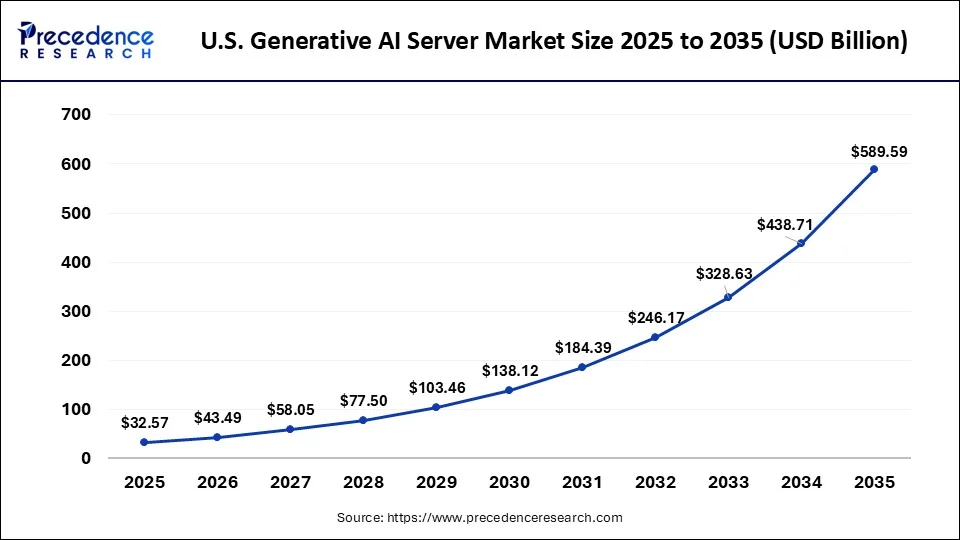
The U.S. generative AI server market size was evaluated at USD 43.49 billion in 2026 and is projected to reach around USD 589.59 billion by 2035, growing at a CAGR of 33.59% from 2026 to 2035.
U.S.
The use of generative AI across various sectors such as healthcare, financial services, defense and software development led to faster enterprise adoption and increased demand for high-performance AI servers for large-scale training and inference workloads.
As technology firms increase the amount of computing power allocated to more complex foundation models, rapid deployment of more of these AI-focused data centers is expected to bolster the growth in server shipments.
The Asia Pacific Is Expected to Grow at a CAGR of 37.9% During the Forecast Period
Asia Pacific is the region held second largest market share, with contributed 31% to the market in 2026 and is estimated to grow at a strong CAGR of 37.9% over the projected period, supported by the increasing deployment of AI infrastructure across emerging digital economies.
China (Dominant)
China has secured the regional market by investing heavily in establishing AI infrastructure, advancing semiconductor technology of semiconductors, and by virtue of continuous efforts to expand its hyperscale cloud computing facilities.
India (Fastest-Growing)
Expanding hyperscale data centre construction and growing industry take-up of AI and digital transformation projects will drive growth in India.
Europe Held Significant Market Share of 20% in 2026
The Europe region held a 20% share of the market in 2026 and is expected to grow at a 32.4% CAGR between 2026 and 2035, driven by sovereign computing initiatives and increasing enterprise investments in trusted artificial intelligence platforms.
Germany (Dominant)
Germany's strong use of industrial AI, sovereign cloud initiatives, and an uptick in enterprise cloud AI infrastructure investments notably propelled its regional market.
United Kingdom (Fastest-Growing)
The UK is expected to see the biggest growth in AI startup activity, cloud infrastructure investments, and enterprise use of generative AI applications.
Latin America Held Notable Market Share with 3% in 2026
The Latin America region is expected to grow at a notable CAGR of 33.2% between 2026 and 2035, due to the rising cloud adoption and increasing digital transformation across enterprise sectors.
Brazil
Financial, retail, and telecom firms scrambled for AI deployments, bolstering demand for the country's scalable servers.
Stronger infrastructure growth is anticipated as generative AI of all types continues to be used for customer engagement, business automation, and analytics.
Middle East & Africa Held a Considerable Market Share of 3% in 2026
The Middle East & Africa region is expected to grow at a strong CAGR of 34% between 2026 and 2035, fuelled by regional demand through ambitious national AI strategies and expanding digital infrastructure programs.
United Arab Emirates. (Dominant)
High-performance AI server systems saw significant investment in advanced data centers and government-led programs of AI transformation.
Saudi Arabia (Fastest-Growing)
The growth in hyperscale data centers, sovereign AI projects, and intelligent cities will likely drive a boost in demand for next-generation AI servers.
Competitive Landscape
Market Structure
Competition is not just a concern for the AI Server players. Considering both GPU vendors, server OEMs, ODMs, cloud vendors, and even infrastructure vendors. NVIDIA and AMD dominate the accelerator segment, with Dell, HPE, Lenovo, and Supermicro head-to-head for integrated server systems. Original design manufacturers (OEMs) of these branded systems, Foxconn, Quanta, Wistron, and Wiwynn do much of the actual manufacturing work.
Networking is not only a vital part of the battle but now a battle in itself. The latest sale came as HPE completed its buy of Juniper Networks on July 2nd 2026. The specific intent is to take on more aggressive competition in the space of AI-native networking. Now those competing companies that have been able to marry up compute, networking, and software into a unified stack will get rewarded.
Competitive Benchmarking
Generations of companies are moving towards differentiation based on the breadth of their AI server portfolio. Partnerships of GPUs, manufacturing capability, and the depth of their ecosystem. Dell keeps building its breadth by integrating management software directly on its AI-focused PowerEdge server products. Supermicro makes a difference by speeding production. Using modular building blocks to get sub-chunked GPUs to customers before other companies can keep pace upon arrival. As per geographic reach, there is growing importance because sovereign programs of AI need region-specific manufacturing and support capabilities.
Market Share Analysis
The competition among the key vendors is moving from volume hardware to value in the shared infrastructure. Foxconn continues to rank as the world's leading producer of AI servers by volume. More progress for Broadcom and Marvell with the custom ASIC design side of the business, as it relates to hyper-scaler silicon initiatives. This is a multi-platform approach in 2026, with hardware, networking, and custom silicon all becoming part of competitive leadership.
Strategic Developments
The competitive environment continued to evolve, with mergers, partnerships, and the launch of new products being key factors. NVIDIA maintained its cooperation with ASML and the COUPE platform with TSMC going into mass production in April 2026. These all indicate that the competition is emerging around partnerships. Integrated compute-networking-software products rather than around sales of standalone solutions.
Company Profiles
NVIDIA Corporation
NVIDIA continues to be a key benchmark for all generative AI servers. It now offers GB300 NVL72 systems. The soon-to-be-announced Vera CPU and the Rubin-class architecture platforms are now in preview. Collaborations with manufacturing partners span from Foxconn and Quanta to Dell and Supermicro, all around NVIDIA's reference designs.
Dell Technologies
Dell's approach is to offer end-to-end AI solutions. By selling both hardware and simplified management software via its APEX consumption model. The company's PowerEdge server portfolio is now part of its support of NVIDIA's most recent Blackwell and Vera Rubin platforms. Specifically designed for AI-optimized servers. Dell remains on the growth path with its AI server expansion. Further combating margin reductions due to growing commoditization trends in server configurations.
Generative AI Server Market Companies
- Adlink Technology Inc.
- Advanced Micro Devices, Inc.
- Aime
- Aivres
- Asustek Computer Inc.
- Cisco Systems, Inc.
- Dell Inc.
- Fujitsu
- Gigabit Technologies Pvt Ltd.
- H3C Technologies Co. Ltd.
- Hewlett Packard Enterprise Development LP
- Huawei Technologies Co. Ltd.
- IBM
- Inspur Co. Ltd.
- Lenovo
- Nvidia Corporation
- Quanta Computers
- Super Micro Computer, Inc.
- Wistron Corporation
Future Market Outlook (2026–2035)
Short-Term Outlook (2026–2028)
Packaging capacity for chips will be the main constraint in 2026 and 2027. TSMC's sales of about 130,000 CoWoS wafers per month by late 2026 will be a significant buffer against the current allocation caps for GPUs. This is the entry point for NVIDIA's Vera Rubin platform into volume production, and it will see Rubin GPUs ramping up in the fourth quarter of fiscal '27. On the other hand, AMD is doling out the details of its next-gen Instinct MI500 series, and is positioning itself as a viable alternative supplier in the meantime. Supply for GPUs is expected to get tighter by a few notches in 2028, but not as tight as it is right now. The demand continues to follow each single %age increase of new availability.
Medium-Term Outlook (2028–2032)
The industry won't distinguish itself as much by its infrastructure choices. It'll be a modular world, and a world of mature liquid cooling. AI accelerator diversity will continue to grow as hyperscaler design teams and Broadcom and Marvell start to pick up a larger %age of predictable inference workloads. In addition to custom ASICs. During this period, further investment projects in the AI sector. Such as the EU's project on AI Gigafactories, will start their ramp-up to a full-scale
Long-Term Outlook (2032–2035)
Next-generation AI computing architectures are likely to focus on photonic computing as opposed to purely electrical interconnects in the coming years. Mature, mainline photonic compute vendors, such as Lightmatter or Ayar Labs, are already shipping early optical chiplets in 2026. They are expected to be in the marketplace by the early 2030s. New AI capacity will be powered by nuclear, renewables, and special co-located power sources. Rather than the traditional grid. The generative AI server market is expected to become less server boxes and more full-sized photonically connected AI factories by 2035.
Strategic Recommendations
Recommendations for Server Manufacturers
Server manufacturers should make modular, building-block design their top priority for the future. Liquid cooling should be normal gear. Not a premium offering for their top customer base. Companies that wait would otherwise fall behind fully liquid-cooled AI systems that are rack-ready and currently available.
Recommendations for Cloud Providers
Cloud vendors need a dual-path approach and not rely on any one chip vendor. Providers will need to place a heavy focus on networking fabric. That can support the deployments of million-XPU scale clusters. The promise of flexibility—driven by consumption and products rather than long-term commitments—should increasingly become a focus point of customer acquisition strategies.
Recommendations for Investors
Rather than GPU exposure as merely vector diversification. Investors should be interested in AI acceleration diversification. Pure hardware plays aren't the only contenders. Networking hardware and infrastructure, or AI software apps, such as storage platforms like WEKA and VAST Data, should be explored as well.
Recommendations for Enterprise Buyers
In an era in which so many AI pilots go limp and fail to achieve a return on investment. Enterprise buyers should develop measurement infrastructure before scaling up into deployments. Cost of ownership should include liquid cooling retrofits/upgrades to power infrastructure, as well as the upfront expense of hardware.
Complete Market Segmentation
By Server Type
- AI Training Servers
- AI Inference Servers
- Hybrid AI Servers
- Edge AI Servers
- Rack-Scale AI Systems
By Processor Type
- GPU-Based Servers
- CPU-Based Servers
- AI Accelerator-Based Servers
- Heterogeneous Computing Servers
By Deployment
- On-Premises
- Cloud-Based
- Hybrid Cloud
By Form Factor
- Rack Servers
- Blade Servers
- Tower Servers
- Modular AI Servers
- Open Compute Project (OCP) Servers
By Cooling Technology
- Air Cooling
- Direct Liquid Cooling (DLC)
- Immersion Cooling
- Rear Door Heat Exchanger Cooling
By Enterprise Size
- Large Enterprises
- Small & Medium Enterprises (SMEs)
By Application
- Large Language Model (LLM) Training
- AI Model Inference
- Natural Language Processing (NLP)
- Computer Vision
- Recommendation Systems
- Generative Design
- Drug Discovery
- Code Generation
- Content Generation
By End User
- Cloud Service Providers
- Hyperscale Data Centers
- IT & Telecommunications
- Banking, Financial Services & Insurance (BFSI)
- Healthcare & Life Sciences
- Government & Defense
- Manufacturing
- Retail & E-Commerce
- Media & Entertainment
- Automotive
By Region
- North America
- Latin America
- Europe
- Asia-Pacific
- Middle East and Africa
For inquiries regarding discounts, bulk purchases, or customization requests, please contact us at sales@precedenceresearch.com
Frequently Asked Questions





Ask For Sample
No cookie-cutter, only authentic analysis – take the 1st step to become a Precedence Research client
 Get a Sample




 sales@precedenceresearch.com
 Schedule a Meeting
