



Gigacasting Presses Market Size, Companies, Share, Vehicle Production Volume, Sales Performance, Export & Import Analysis, Technology Adoption, Competitive Positioning, and Demand Trends
Gigacasting Presses Market (By Casting: Rear Underbody, Front Underbody, Battery Tray; By Customer Type: Automotive OEM, Tier-1/Foundry; By Alloy: High-Pressure Die-Casting (HPDC), Thixomolding) - Global Industry Analysis, Size, Trends, Leading Companies, Regional Outlook, and Forecast 2026 to 2035
Source: https://www.precedenceresearch.com/gigacasting-presses-market
 Get a Sample
 Table Of Content


What is Gigacasting Presses Market Size in 2026?
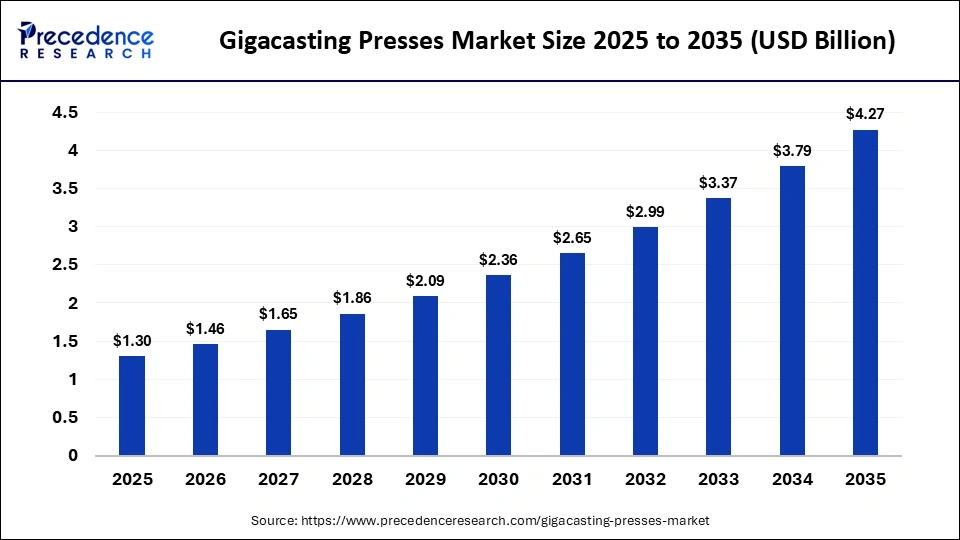
The global gigacasting presses market size was calculated at USD 1.30 billion in 2025 and is predicted to increase from USD 1.46 billion in 2026 to approximately USD 4.27 billion by 2035, expanding at a CAGR of 12.63% from 2026 to 2035. The market is driven by rising EV production and demand for cost-efficient automotive manufacturing.
Key Takeaways
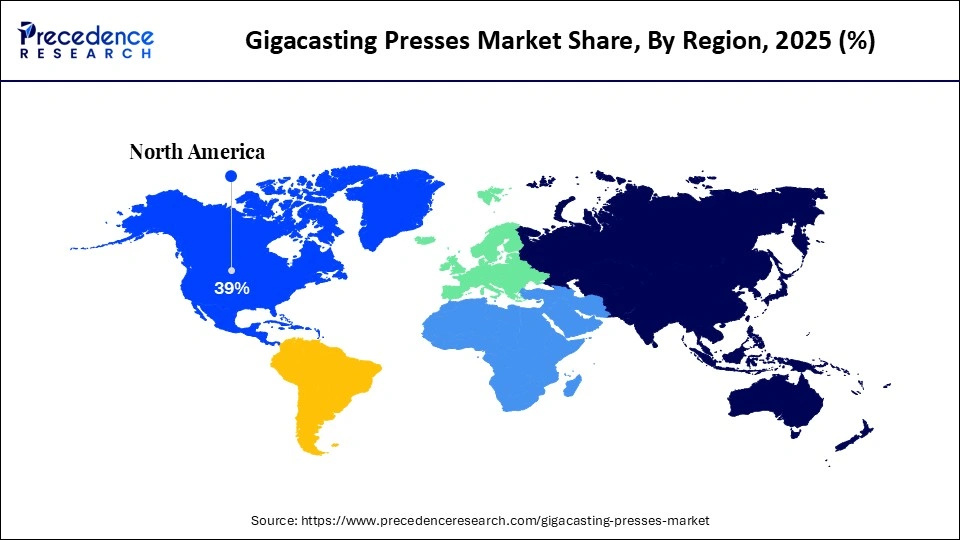
- North America held the largest share of 39% in 2025.
- Asia Pacific is expected to witness the fastest growth during the forecasted years.
- By casting, the rear underbody segment held a significant share of the market in 2025.
- By casting, the battery tray segment is expected to grow at a significant rate over the forecast period.
- By customer type, the automotive OEM segment held the largest share of the market in 2025.
- By customer type, the tier-1/foundry segment is anticipated to grow at a considerable rate in the market over the forecast period.
- By alloy, the high-pressure die-casting segment held the largest market share in 2025.
- By alloy, the thixomolding segment is anticipated to grow at a significant CAGR in the market over the forecast period.
Market Overview
The gigacasting presses market is experiencing robust growth as automotive OEMs are re-architecturing their vehicle structures to reduce the number of larger structural parts and improve manufacturing efficiency and scalability. One of the major factors driving the growth of this market is the rising electric vehicle manufacturing, where lightweight structures, cost optimization, and flexible platform designs are critical. The advantages of consolidating various parts into single castings include a reduction in the unit costs per vehicle to manufacture, an increase in the structural rigidity, and a shorter timeframe for the introduction of models in the market by the OEMs. As global automakers intensify their focus on innovation, efficiency, and large-scale production, gigacasting presses are emerging as a core technology shaping the next generation of automotive manufacturing.
How is AI Influencing the Gigacasting Presses Market?
Artificial Intelligence is significantly impacting the market for gigacasting presses. Advanced AI-controlled process control systems leverage real-time data from temperature, pressure, and flow sensors to optimize injection speeds, cooling rates, and metal flow within molds during gigacasting. This significantly reduces porosity and defects while improving structural consistency in aluminum castings. In addition, AI-powered computer vision systems enable high-precision detection of surface irregularities and dimensional deviations through automated quality inspections. As OEMs demand higher throughput, reliability, and efficiency, the integration of AI into gigacasting press operations is accelerating to enhance production agility, cost optimization, and overall operational intelligence.
Gigacasting Presses Market Trends
- Platform consolidation strategies are being embraced by automotive OEMs, in which gigacasting is being used to consolidate many structural components into large castings, resulting in fewer components, better structural rigidity, and lower total vehicle manufacturing expenses.
- The increasing production of electric vehicles is increasing the demand for ultra-large die-casting machines capable of producing battery housing, rear underbodies, and structural frames with superior lightweight performance and scalable designs.
- Advancements in high-tonnage casting equipment and automation technologies are improving precision, shortening cycle times, and enabling real-time defect detection through digital monitoring and smart factory integration.
- Strategic collaborations between automotive suppliers and press manufacturers are expanding, focusing on customized gigacasting solutions tailored to specific vehicle platforms and high-volume production requirements.
- Rising investments in advanced aluminum alloys and sustainable casting processes are enhancing material strength, recyclability, and energy efficiency, aligning gigacasting technologies with global sustainability and carbon reduction goals.
Marekt Scope
| Report Coverage | Details |
| Market Size in 2025 | USD 1.30 Billion |
| Market Size in 2026 | USD 1.46 Billion |
| Market Size by 2035 | USD 4.27 Billion |
| Market Growth Rate from 2026 to 2035 | CAGR of 12.63% |
| Dominating Region | North America |
| Fastest Growing Region | Asia Pacific |
| Base Year | 2025 |
| Forecast Period | 2026 to 2035 |
| Segments Covered | Casting, Customer Type, Alloy, and Region |
| Regions Covered | North America, Europe, Asia-Pacific, Latin America, and Middle East & Africa |
Segment Insights
Casting Insights
Why Did the Rear Underbody Segment Dominate the Gigacasting Presses Market?
The rear underbody segment dominated the market by holding a significant share in 2025 due to its need for large, structurally critical components ideally suited for consolidation via gigacasting. Rear underbody assemblies have a mix of several structural components, such as crash management systems, suspension mounts, and battery housing interfaces, which are perfect for consolidation using the gigacasting technology. Manufacturers of electric vehicles are moving to single-piece rear castings to replace dozens of stamped and welded parts, reducing body shop operations, tooling investments, and assembly time. This approach enhances vehicle safety and performance while lowering production costs through improved structural rigidity from large aluminum castings.
The battery tray segment is expected to grow at a significant CAGR in the upcoming period. This is because battery trays are considered one of the most important and costly parts in EVs. Manufacturers are focusing on structural protection, thermal management, and weight reduction, all of which are enhanced by gigacasting technology. Gigacast battery trays combine mounting brackets, reinforcement elements, and cooling channels into a single aluminum casting, delivering an excellent strength-to-weight ratio. Additionally, the integrated cooling pathways improve thermal control, directly enhancing battery life and extending vehicle range, making gigacast trays a key enabler for EV performance and efficiency.
Customer Type Insights
What Made Automotive OEM the Leading Segment in the Gigacasting Presses Market?
The automotive OEM segment led the market while holding the largest share in 2025. The dominance of the segment is attributed to the strong focus of OEMs on production control, cost optimization, and competitive differentiation in the production of electric vehicles. OEMs are spending heavily on ultra-large die-casting systems to bring critical structural component production in their premises. Gigacasting enables OEMs to combine dozens of stamped and welded components into one-piece aluminum alloys, cutting the complexity of tools, assembly time, and factory space by a large factor. In addition, the direct possession of the casting operations helps OEMs to increase quality control, expand the scope of production, and reduce the time to develop a vehicle.
The tier-1/foundry segment is expected to grow at the fastest CAGR over the forecast period because automotive manufacturers are switching to collaborative and asset-lite production models. These suppliers play a crucial role in gigacasting adoption by providing specialized technical expertise, metallurgical knowledge, and high-capacity production facilities. This approach is particularly attractive to new EV manufacturers and mid-sized automakers, allowing them to scale production without expanding their own factory footprint. Additionally, tier-1 suppliers often serve multiple OEMs, creating combined economies of scale and enabling faster adoption of advanced gigacasting technologies across the industry.
Alloy Insights
Why Did the High-Pressure Die-Casting Segment Dominate the Gigacasting Presses Market?
The high-pressure die-casting (HPDC) segment held the largest share of the market in 2025 due to its better production efficiency and scalability. HPDC is extensively used in gigacasting processes since it allows the injection of molten aluminum into large molds at exceptionally high pressure, which gives the process good dimensional and surface finish. This capability is essential in the production of oversized structural automotive parts like rear underbodies, front frames, and battery enclosures. Moreover, high-pressure die casting (HPDC) supports advanced aluminum alloys engineered for optimal lightweight strength, crash performance, and thermal stability. These alloys are also highly compatible with automated production systems, enhancing throughput, reducing cycle times, and improving overall cost efficiency in automotive manufacturing.
The thixomolding segment is expected to grow at a significant rate in the market. Thixomolding is part of the metal processing method in which a partially solid alloy is injected into molds to produce lower porosity with increased uniformity in microstructure and high fatigue strength, as opposed to traditional casting. These features render it especially appealing in safety and load-bearing structural elements in which durability over time is crucial. Thixomolding is also gaining popularity as the need for vehicle performance and safety is increasing.
Regional Insights
North America Gigacasting Presses Market Size and Growth 2026 to 2035
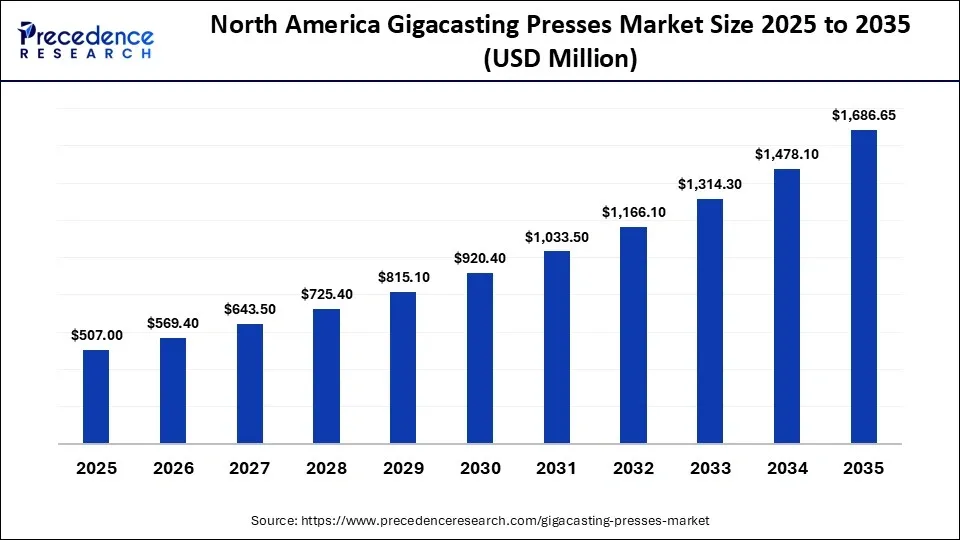
The North America gigacasting presses market size is estimated at USD 507.00 million in 2025 and is projected to reach approximately USD 1,686.65 million by 2035, with a 12.77% CAGR from 2026 to 2035.
What Made North America the Leading Region in the Global Gigacasting Presses Market?
North America led the market with a major share in 2025 because of its advanced automotive manufacturing infrastructure and rapid adoption of electric vehicle production technologies. High R&D intensity, early implementation of structural consolidation strategies, and substantial capital availability enable manufacturers to operate ultra-large gigacasting machines efficiently. Supportive government policies, including EV purchase subsidies, localized manufacturing incentives, and investments in lightweighting technologies, further drive market growth. Additionally, North American OEMs emphasize vertical integration to reduce supply chain risks and optimize costs, facilitating direct acquisition of high-tonnage casting systems.
U.S. Gigacasting Presses Market Size and Growth 2026 to 2035
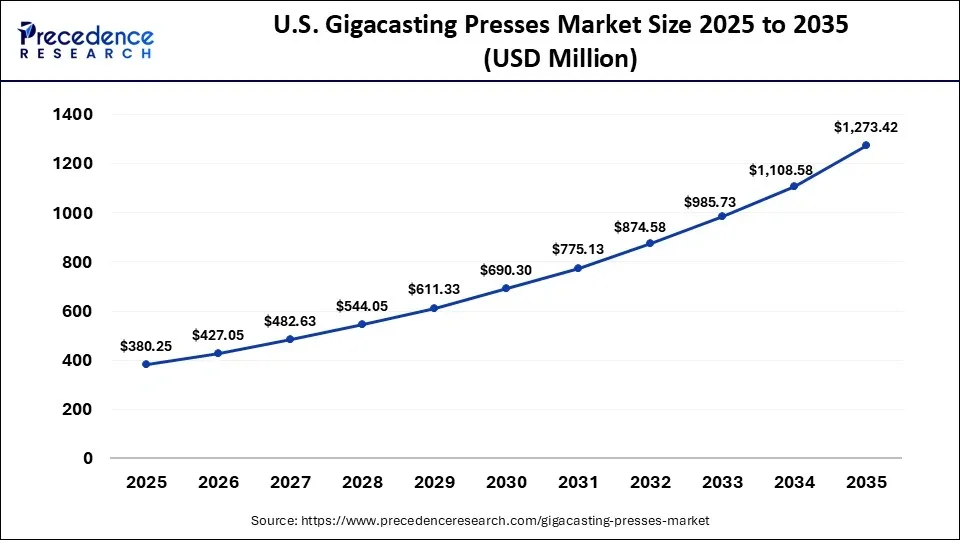
The U.S. gigacasting presses market size is calculated at USD 380.25 million in 2025 and is expected to reach nearly USD 1,273.42 million in 2035, accelerating at a strong CAGR of 12.85% between 2026 to 2035.
U.S. Market Analysis
The U.S. is a major contributor to the North American gigacasting presses market. This is due to its well-established automotive manufacturing ecosystem, strong presence of leading OEMs and EV manufacturers, and high R&D investment in advanced production technologies. Moreover, U.S. automakers are early adopters of ultra-large gigacasting machines and structural consolidation strategies to enhance efficiency, reduce assembly complexity, and cut costs.
Why is Asia Pacific Witnessing the Fastest Growth in the Gigacasting Presses Market?
Asia Pacific is expected to grow at the fastest CAGR during the forecast period because of its high automotive manufacturing capacity, as well as increasing electric vehicle manufacturing. China, Japan, and South Korea are investing a lot in the next-generation vehicle platforms, which demand structural lightweighting and low-cost assembly. The region enjoys effective incentives from the government to adopt EVs, local ecosystems of battery manufacturing, and good industrial policies to support advanced manufacturing technologies. China is the leading producer of EVs in the world, which poses significant pressure on the high-tonnage die-casting machines producing structural parts and battery housings.
China Market Analysis
The gigacasting presses market in China is growing due to its rapidly growing electric vehicle industry, large-scale automotive manufacturing base, and substantial investments in advanced production technologies. Chinese automakers are increasingly adopting gigacasting to produce lightweight, high-strength structural components for EVs, improving efficiency and reducing assembly complexity. Additionally, supportive government policies promoting EV adoption, local manufacturing incentives, and investment in high-tonnage casting infrastructure further strengthen China's dominant role in the region.
How is the Opportunistic Rise of Europe in the Gigacasting Presses Market?
Europe is expected to grow at a notable rate in the upcoming period due to stringent environmental regulations and ambitious electric vehicle transition targets. European automakers are increasingly adopting gigacasting technology to reduce carbon emissions, improve energy efficiency, and enable the production of lightweight vehicles. Countries such as Germany, France, and the United Kingdom are investing in advanced die-casting infrastructure to enhance production efficiency and structural integration in EV platforms. The region's strong engineering expertise, focus on sustainable manufacturing, and commitment to circular economy principles further support the adoption of recyclable aluminum casting solutions.
Gigacasting Presses Market Companies
- IDRA Group
- Buhler Carat
- LK Machinery
- UBE Machinery
- Yizumi
- Haitian
- EMI
- Zhixin
Recent Developments
- In October 2025, Linamar announced its acquisition of Aludyne to expand its North American casting operations and strengthen its automotive manufacturing footprint. The acquisition is aimed at enhancing Linamar's structural casting capabilities and increasing regional production capacity. This strategic move also positions the company to meet the rising demand for advanced gigacasting technologies in the automotive sector.(Source: https://www.linamar.com)
- In May 2025, Falcon Lakeside was taken by the ArtiFlex Family of Companies to increase the expertise of the group in high-pressure die casting and the industrial capacity of casting. The acquisition diversified the ArtiFlex casting business and enhanced its market base in providing large structural parts to car manufacturers.(Source: https://artiflexmfg.com)
- In February 2025, GAC Group in China commenced with a new gigacasting foundry facility that has an investment of over Y=1.2 billion (~$138 million). The plant was designed to specialize in structural parts of high volume through gigacasting, and production would be phased in 2026.(Source: https://www.euroguss.de)
Segments Covered in the Report
By Casting
- Rear Underbody
- Front Underbody
- Battery Tray
By Customer Type
- Automotive OEM
- Tier-1/Foundry
By Alloy
- High-Pressure Die-Casting (HPDC)
- Thixomolding
By Region
- North America
- Europe
- Asia-Pacific
- Latin America
- Middle East & Africa
For inquiries regarding discounts, bulk purchases, or customization requests, please contact us at sales@precedenceresearch.com
Frequently Asked Questions
Tags





Ask For Sample
No cookie-cutter, only authentic analysis – take the 1st step to become a Precedence Research client
 Get a Sample




 sales@precedenceresearch.com
 Schedule a Meeting
