



Graph Database Market Trends, Companies, Revenue / Sales Performance, Subscriber Growth, Pricing Strategies, Cloud Adoption, Infrastructure Expansion, Competitive Landscape, and Industry Outlook
Graph Database Market (By Database Type: Property Graph, RDF Graph; By Deployment: On-Premise, Cloud-based, Hybrid; By Application: Social Network, Fraud Detection, Recommendation Systems, Knowledge Graphs, Supply Chain and Logistics, Customer 360, AI & Machine learning; By Industry: BFSI, Healthcare & Life Science, Retail & E-Commerce, IT & Telecom, Manufacturing, Energy & Utilities, Government, Media & Entertainment, Others) - Global Industry Analysis, Size, Trends, Leading Companies, Regional Outlook, and Forecast 2026 to 2035
Source: https://www.precedenceresearch.com/graph-database-market
 Get a Sample
 Table Of Content


What is the Graph Database Market Size?
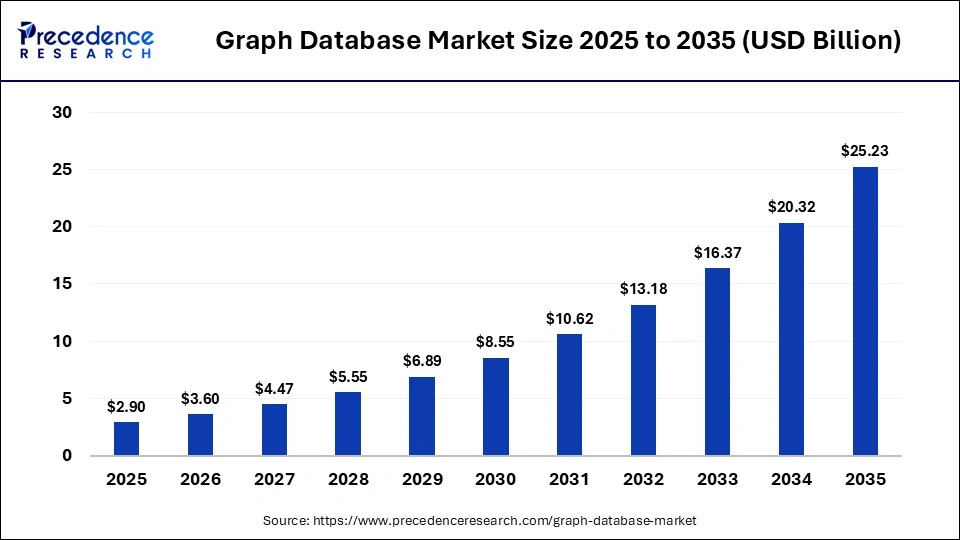
The global graph database market size was calculated at USD 2.90 billion in 2025 and is predicted to increase from USD 3.60 billion in 2026 to approximately USD 25.23 billion by 2035, expanding at a CAGR of 24.15% from 2026 to 2035. The market is rapidly growing as organizations increasingly adopt graph databases to manage complex, interconnected data for advanced analytics, fraud detection, recommendation engines, and real-time decision-making.
Key Highlights
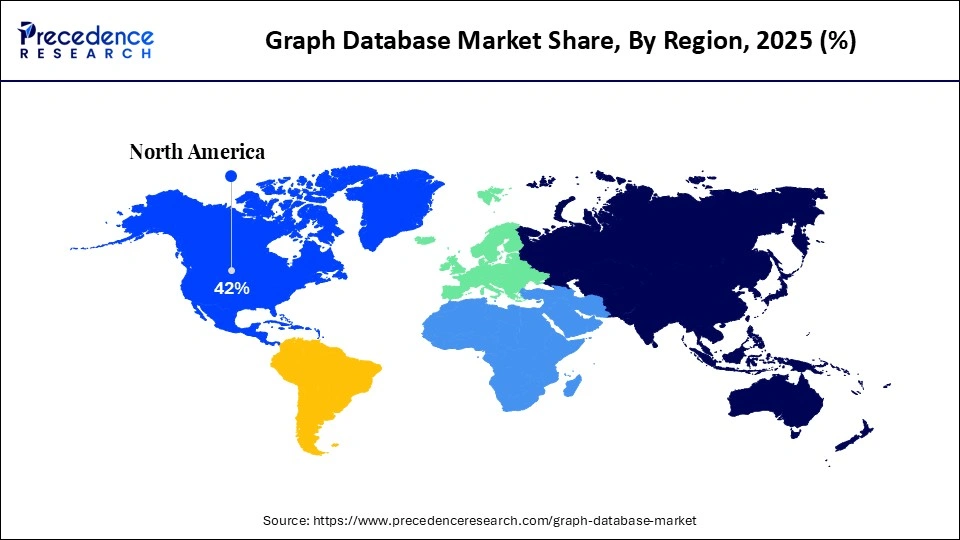
- North America led the global graph database market with the largest market share of 42% in 2025.
- By region, Asia Pacific is observed to be the fastest-growing region in the forecasted period.
- By database type, the property graph segment led the market in 2025.
- By database type, the RDF graph segment is expected to grow at the fastest CAGR in the foreseen period.
- By deployment, the cloud-based segment led the market with the largest share in 2025.
- By application, the social network segment dominated the global market with 23% in 2025.
- By application, the AI & machine learning segment is expected to grow at the fastest rate in the upcoming period.
- By industry, the BFSI segment led the market in 2025.
- By industry, the healthcare & life science segment is expected to grow at the fastest rate in the coming years.
Market Overview
The graph database market refers to database systems specifically designed to store, manage, and query highly interconnected data. Unlike traditional relational databases, graph databases represent information as nodes and edges, enabling efficient modelling of relationships between data points. This structure allows for faster, real-time querying and improved visibility into complex networks. Graph databases and knowledge graphs are particularly effective for applications requiring relationship-centric insights, including fraud detection, recommendation engines, and network analysis. As organizations increasingly rely on advanced analytics to extract value from complex datasets, graph database solutions have become essential for driving deeper insights, operational efficiency, and sustained market growth.
Why is Graph Database Crucial for Artificial Intelligence?
Graph databases and artificial intelligence serve a mutually strengthening relationship. Artificial intelligence requires substantial data resources and computational power, and graph databases provide an ideal structure to meet these demands. To operate AI systems efficiently and at scale, robust graph database frameworks are essential. Advancements in AI, in turn, help unlock greater value from graph data. Graph databases support effective data integration and information sharing by representing complex metadata and delivering rich semantics for natural language processing (NLP). AI also plays a critical role in areas such as fraud detection.
Retrieval-augmented generation (RAG) systems represent an innovative approach in artificial intelligence by combining retrieval-based methods with generative AI. Traditional AI models often struggle with understanding relationships because much of their capability depends on pattern recognition. In contrast, graph databases are specifically designed to store and manage data about interconnected entities, enabling AI systems to better interpret links between seemingly disparate elements.
Graph Database Market Trends
- Accelerating enterprise shift toward cloud-based graph databases is reshaping the market landscape, driven by cost efficiency, scalability, real-time processing, enhanced security, global accessibility, and seamless cloud integration.
- AI and ML integration with graph database is emerging as a key trend across finance, healthcare, and telecom, enhancing fraud detection, predictive analytics, relation driven insights.
- Growing integration of graph databases with the RAG framework is enhancing contextual retrieval, strengthening relationship mapping, and improving knowledge discovery across a complex data environment.
Market Scope
| Report Coverage | Details |
| Market Size in 2025 | USD 2.90 Billion |
| Market Size in 2026 | USD 3.60 Billion |
| Market Size by 2035 | USD 25.23 Billion |
| Market Growth Rate from 2026 to 2035 | CAGR of 24.15% |
| Dominating Region | North America |
| Fastest Growing Region | Asia Pacific |
| Base Year | 2025 |
| Forecast Period | 2026 to 2035 |
| Segments Covered | Database Type, Deployment, Application, Industry, and region |
| Regions Covered | North America, Europe, Asia-Pacific, Latin America, and Middle East & Africa |
Segment Analysis
Database Type Insights
What Made Property Graph the Dominant Segment in the Graph Database Market?
The property graph segment dominated the market with the largest share in 2025. The dominance of this segment is attributed to its ability to provide a comprehensive view of how data can be modelled across many different databases and how various types of metadata are related. A property graph excels at uncovering connections among disparate sets of data that have been spread across multiple data architectures and schemas. In real-world data analytics, it is becoming increasingly important to identify complex incongruities and patterns. Businesses use property graphs to model business-level requirements, improve data storage and querying, and better understand clients' product preferences. Their ability to represent real-world relationships across different databases is a key factor supporting market growth.
The RDF graph segment is projected to grow at the fastest rate over the forecast period. This growth is driven by its effectiveness in representing master data and complex metadata, and its strong support for analytics and querying. Using RDF, data can be published in a standardized format with well-defined semantics. Organizations that work extensively with statistical and structured data, such as pharmaceutical companies, healthcare institutions, and government agencies, are increasingly adopting RDF graphs. Their broad applicability across sectors and their ability to handle complex metadata are key factors supporting the growth of this segment.
Deployment Insights
How Did the Cloud-Based Segment Dominate the Market?
The cloud-based segment dominated the graph database market in 2025 and is projected to grow at the fastest pace in the coming years. Cloud software is hosted and managed on the provider's servers and accessed through web-based interfaces, eliminating the need for heavy on-site infrastructure. Since its early adoption, cloud computing has gained strong traction among enterprises due to the flexibility it offers, ranging from cost and time efficiency to enhanced agility and scalability.
Cloud-based servers use virtualization technology to host applications off-site, removing capital expenditure requirements while enabling regular data backups and a pay-as-you-use model. This approach supports faster deployment, cost-efficient digital business models, improved business continuity, wider geographic reach, and greater operational flexibility.
In contrast, the hybrid segment is expected to grow at a significant rate in the coming years. This is because it combines the advantages of both on-premises and cloud-based systems, offering flexibility, scalability, and control over sensitive data. Organizations can store critical or regulated data on-premises while leveraging the cloud for large-scale analytics, collaboration, and elastic computing resources. This model supports cost optimization, faster deployment, and seamless integration with existing IT infrastructure. Additionally, as enterprises increasingly adopt multi-cloud strategies, hybrid graph databases enable real-time connectivity and analytics across distributed datasets, driving their rising adoption.
Application Insights
What Made Social Network the Leading Segment in the Market?
The social network segment dominated the graph database market in 2025, as social networks are best modeled using the labelled property graph, capturing both structure and semantics. In these graphs, users, posts, and comments are represented as nodes, while relationships like follows, likes, and replies are represented as edges. Despite challenges such as highly dynamic networks, dense connections, and complex queries, social network graphs enable improved collaboration, friend-of-friend recommendations, discovery of unique relationships, and faster time to market, driving market growth.
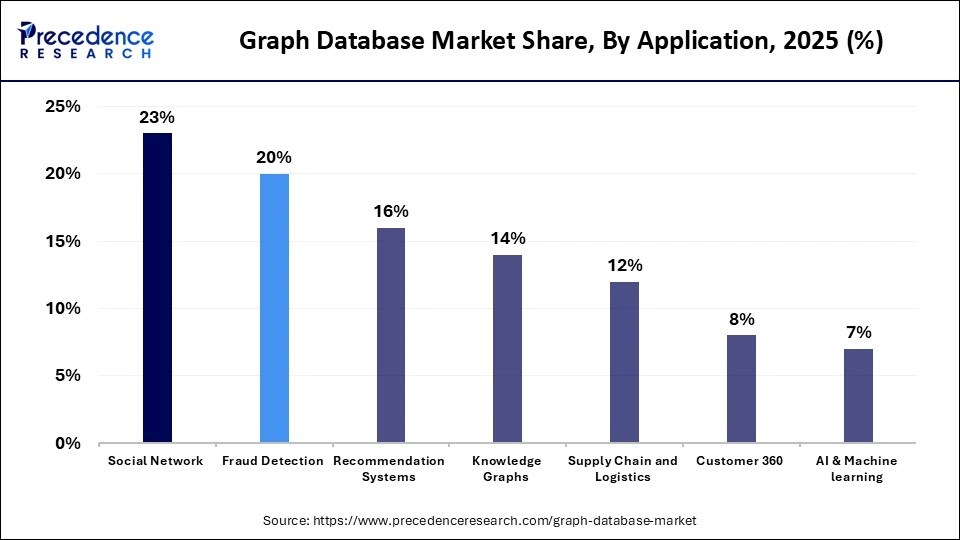
The AI & machine learning segment is expected to record the fastest growth during the forecast period because graph databases provide a natural structure for representing complex, interconnected data, which is essential for training and deploying AI and machine learning models. By capturing relationships between entities as nodes and edges, graph databases enable faster pattern recognition, predictive analytics, recommendation systems, and fraud detection. They also support real-time querying of highly connected datasets, improving the accuracy and efficiency of AI and ML algorithms. As organizations increasingly rely on AI-driven insights, the demand for graph databases to power these applications continues to expand rapidly.
Industry Insights
How Did the BFSI Segment Lead the Market?
The BFSI (banking, financial services, and insurance) segment led the graph database market while holding a major share in 2025. The segment's dominance is mainly attributed to growing concerns over fraudulent activities such as credit card fraud, money laundering, and identity theft. Financial institutions are increasingly adopting graph databases to strengthen fraud detection and enhance protective measures.
By mapping transactions and linking entities that share common attributes, such as email addresses, passwords, or physical addresses, graph databases enable deeper visibility into hidden relationships and transaction flows. Data is represented as interconnected nodes and edges, allowing institutions to track transactions and identify suspicious patterns more effectively. This capability supports real-time fraud detection, faster query responses, and improved access to interconnected data, making graph technology a preferred solution within the BFSI sector.
The healthcare & life science segment is expected to grow at the fastest CAGR over the projection period because these industries rely on highly interconnected data, such as patient records, genomic information, clinical trials, and drug interactions. Graph databases enable efficient modeling of complex relationships between diseases, treatments, genes, and proteins, supporting precision medicine, drug discovery, and clinical decision-making. They also enhance real-time analytics, fraud detection, and patient care coordination, allowing healthcare providers to uncover hidden insights from vast datasets. With the increasing focus on personalized medicine, advanced diagnostics, and efficient research workflows, the adoption of graph databases in healthcare and life sciences continues to accelerate.
Regional Insights
What is the North America Graph Database Market Size?
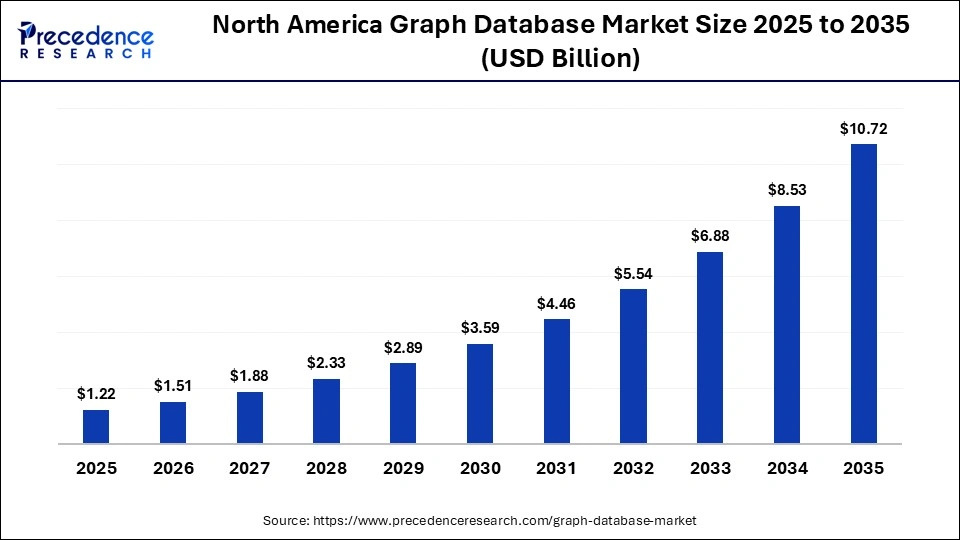
The North America graph database market size is estimated at USD 1.22 billion in 2025 and is projected to reach approximately USD 10.72 billion by 2035, with a 24.27% CAGR from 2026 to 2035.
What contributes to North America's Leading Position in the Graph Database Market?
North America led the graph database market by capturing the largest share in 2025. The region's leadership position in the market is supported by a mature data management ecosystem, strong adoption of advanced technologies, and growing recognition of relationship-based data models across industries. Vigorous cloud adoption, active venture capital participation, and substantial government AI funding have further strengthened the regional market's landscape. North American organizations were among the first to explore graph database solutions, creating mature demand and a robust ecosystem.
U.S. Graph Database Market Size and Growth 2026 to 2035
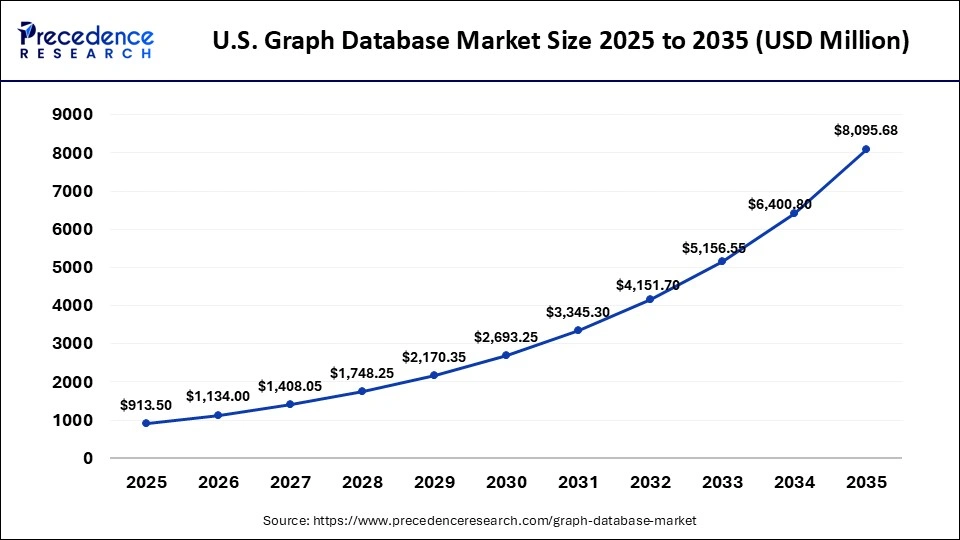
The U.S. graph database market size is calculated at USD 913.50 million in 2025 and is expected to reach nearly USD 8,095.68 million in 2035, accelerating at a strong CAGR of 24.38% between 2026 to 2035.
U.S. Market Analysis
The U.S. continues to lead the North American graph database market, driven by substantial investments in AI, R&D, and innovation across industries such as financial services, healthcare, e-commerce, transportation, energy, and defense. Organizations are leveraging graph-based technologies to extract deeper insights from connected data, enhance fraud detection, and improve customer personalization. The presence of major technology providers like Neo4j, Amazon Web Services, IBM, and Microsoft Azure further accelerates the deployment, innovation, and integration of graph databases into enterprise data strategies. This strong ecosystem reinforces the U.S.'s position as a key driver of market growth.
Canada Market Analysis
Canada also plays a significant role in regional market growth, as banks and fintech companies expand graph database workloads to enhance fraud detection and deliver personalized digital services. Strong R&D investment, advanced technology infrastructure, and high cloud adoption further support market growth.
How is the Opportunistic Rise of Asia Pacific in the Graph Database Market?
Asia Pacific is expected to grow at the fastest rate in the market in the foreseeable future, driven by rapid economic progress, globalization, digitalization, and increasing adoption of high‑performance technologies. The rising presence of graph database providers has further expanded market opportunities. Governments in Japan, Singapore, and India are advancing smart-city initiatives that rely on relationship-based data models, supporting wider adoption of graph database solutions. Ongoing data centre expansion across Southeast Asia has reduced latency and lowered entry barriers, encouraging local enterprises to integrate graph databases into e-commerce, telecom, and logistics platforms.
China's substantial AI investments contribute significantly to market growth, while data sovereignty regulations are strengthening demand for domestic technology providers. Japan is greatly contributing to the market, supported by its strong industrial base and ongoing digital transformation efforts. Key sectors such as finance, telecom, manufacturing, and public services are adopting graph databases to enhance fraud detection, improve supply chain transparency, and enable more personalized service delivery.
How is Europe Expanding in the Graph Database Market?
Europe is the second-largest graph database market. Data governance, cyber-security, and AI transparency have all become important high-level goals for businesses in Europe in recent years, and these trends have driven the increasing demand for graph databases. Businesses can also use graph databases to better manage complex, connected data sets that exist in areas such as healthcare, manufacturing, and finance. Graph analytics deployment is increasing, enabling businesses to improve their ability to detect fraud, gain visibility into their supply chain, and enhance enterprise intelligence.
Germany Market Trends
Germany has the largest graph database market in Europe. This is mainly due to its high rate of industrial digitization and adoption of Industry 4.0 in Germany. In addition, many manufacturing and automotive companies have turned to graph technology as a way to gain supply chain intelligence, improve predictive maintenance capabilities, and enhance operations through connected operational analytics. With increased investment into AI-based enterprise systems and growth in cloud integration, the use of graph databases in large-scale industrial applications will continue to grow throughout Europe.
How is Latin America Emerging in the Graph Database Market?
Latin America is growing in the graph database industry because of the rise in the use of cloud services and the growth of the digital banking realm. Investments in AI-based apps and connected data platforms are creating more opportunities for graph database companies. The expansion of availability and use of cloud-based graph analytics services across Latin America is also helping to increase adoption by businesses that are looking for ways to manage scalable and cost-effective data.
Brazil Market Trends
Brazil is the largest country in Latin America because of the fast pace of growth in fin-tech and the rapid increase in the number of businesses moving to digital. Graph databases are being utilized by financial institutions and telecommunications to analyze customer relationships, detect fraud and optimize networks. In Brazil, the increase of cloud infrastructure and the adoption of AI-driven solutions by enterprises continue to create demand for advanced graph analytics technology.
How is the Middle East and Africa Developing in the Graph Database Market?
As the graph database market continues to expand in the Middle East and Africa, there are many reasons why that growth is happening. Smart cities are becoming more and more common, digital transformation is increasing all over the world, and more companies are starting to invest in the Cloud. With the introduction of AI technologies, there has been a significant increase in the demand for connected data analytics and an increase in AI adoption leads to greater development of the market. UAE
UAE Market Trends
The UAE has the largest market share of any country in the Middle East and Africa because of its strong investment into the areas of artificial intelligence, smart government and digital infrastructure projects. With the growing availability of Cloud services and an increasing number of companies implementing AI powered enterprise systems, more businesses are now implementing graph databases in both their public and private sectors.
Competitive Landscape
The market for graph databases is moderately fragmented due to the involvement of global technology firms, cloud computing services providers, and specialist database providers. Leading organizations are emphasizing their efforts toward enhancing data connectivity, real-time analysis, and graph processing capabilities based on AI. Organizations are developing cloud-based graph databases to cater to different applications like fraud detection, recommendation engines, cybersecurity, and knowledge management.
Competition in the market has intensified because of strategic alliances, acquisitions, and developments in products. Graph technology firms are combining machine learning, generative AI, and big data analytics to better analyze connections between data sets. The need for a connection between data from various industries, such as banking, healthcare, retail, and telecommunications sectors, is propelling technological progress in the industry.
Top Companies Operating in the Graph Database Market
- Neo4j
- TigerGraph
- ArangoDB
- Graphwise
- Amazon Web Services (AWS)
- Microsoft
- Oracle
- IBM
- SAP SE
- DataStax
- Stardog
- Franz Inc.
- Memgraph
- Dgraph
- OpenLink Software
Recent Developments
- In 2026, U.S. tech titan Apple acquired Kuzu, a graph database startup founded by Turkish academicians, aiming to accelerate on-device artificial intelligence processing and enhance privacy-focused data handling on its Apple Silicon-powered devices.
(Source: https://www.turkiyetoday.com) - In 2025, Neo4j introduced Infinigraph, its most scalable graph database solution for unified operational and analytical workloads at 100TB+ scale. Infinigraph allows Neo4j's database to handle both operational and analytical processing within a single system at 100TB+ scale, without fragmenting the graph, duplicating infrastructure, or sacrificing performance.
(Source: https://www.prnewswire.com)
Segments Covered in the Report
By Database Type
- Property Graph
- RDF Graph
By Deployment
- On-Premise
- Cloud-based
- Hybrid
By Application
- Social Network
- Fraud Detection
- Recommendation Systems
- Knowledge Graphs
- Supply Chain and Logistics
- Customer 360
- AI & Machine learning
By Industry
- BFSI
- Healthcare & Life Science
- Retail & E-Commerce
- IT & Telecom
- Manufacturing
- Energy & Utilities
- Government
- Media & Entertainment
- Others
By Region
- North America
- Europe
- Asia-Pacific
- Latin America
- Middle East & Africa
For inquiries regarding discounts, bulk purchases, or customization requests, please contact us at sales@precedenceresearch.com
Frequently Asked Questions
Tags





Ask For Sample
No cookie-cutter, only authentic analysis – take the 1st step to become a Precedence Research client
 Get a Sample




 sales@precedenceresearch.com
 Schedule a Meeting
