



Hair Serum Market Trends, Leading Companies, Company Revenue / Sales Performance, Retail Sales, Production Volume, Consumer Spending, Market Penetration, Competitive Landscape, and Industry Outlook
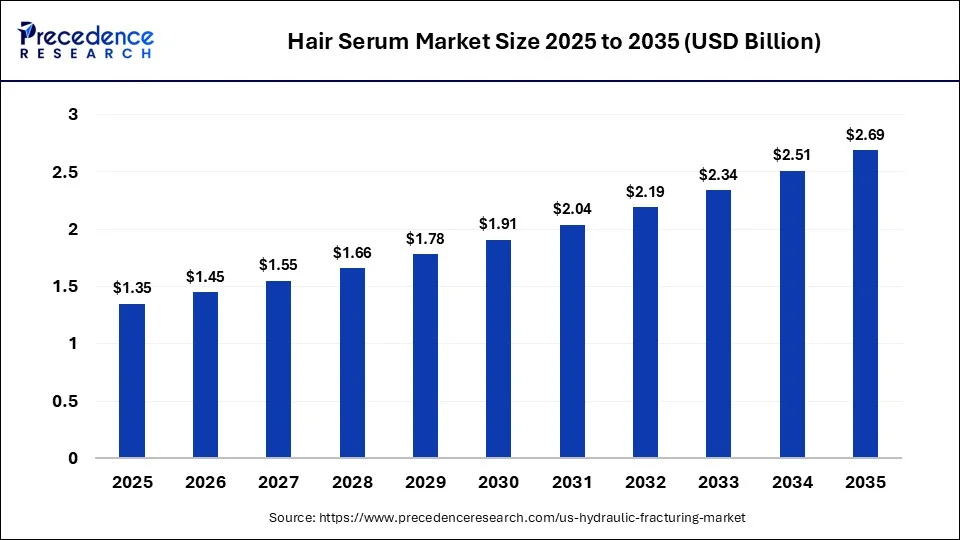
The hair serum market was valued at USD 1.45 billion in 2026 and is projected to grow at a CAGR of 7.14% through 2035. Market growth is driven by rising consumer focus on hair health, increasing demand for targeted hair-care solutions, growing awareness of hair damage and scalp concerns, and expanding premium beauty and personal-care spending. Key trends include the growing adoption of anti-frizz, hair-growth, anti-hair-fall, heat-protection, moisturizing, and scalp-care serums, alongside natural, herbal, clean-label, and multifunctional formulations. The expansion of e-commerce, social-media-driven beauty trends, premiumization, and product innovation is expected to create new opportunities for hair-care brands and serum manufacturers through 2035.
Source: https://www.precedenceresearch.com/hair-serum-market
 Get a Sample
 Table Of Content


Hair Serum Market Analysis, Demand, and Growth Rate Forecast 2035
The hair serum market is forecasted to expand from USD 1.45 billion in 2026 to USD 2.69 billion by 2035, growing at a CAGR of 7.14% from 2026 to 2035.
Key Takeaways
- Hair serum is shifting from a styling add-on to a multi-benefit treatment category, with consumers increasingly looking for products that address frizz, hair damage, heat exposure, breakage, hydration, hair fall, scalp health, and color protection in a single product.
- Treatment-oriented serums represent the strongest value pool, accounting for approximately 66.6% of market revenue in available 2025 estimates. This indicates that functional efficacy is becoming more important than basic styling benefits.
- Multifunctionality is becoming a major source of differentiation. Products combining benefits such as damage repair, heat protection, frizz control, hydration, and scalp care can address more consumer needs while supporting stronger premium positioning.
- Scalp-focused hair serums are creating a new growth opportunity, particularly for hair fall, thinning, dandruff, sensitivity, density, and other scalp-related concerns. This is also moving hair serum closer to treatment-led and dermatological haircare categories.
- Asia Pacific remains a major growth opportunity, with the report identifying the region as the largest regional opportunity in several market estimates. Developed markets are expected to support higher ASPs, while emerging markets offer greater penetration opportunities.
- Premiumization is increasingly dependent on credible efficacy rather than branding alone. Peptides, botanical actives, advanced delivery systems, bond-repair technologies, and clinically positioned formulations can support higher prices when they provide clear consumer benefits.
- The strongest competitive opportunity lies between effectiveness and affordability. Masstige products can provide an upgrade path from mass-market serums, while premium pricing is more defensible when supported by differentiated formulations and measurable benefits.
- Innovation is moving toward treatment-focused formulations and sustainability. Peptides, protein, botanical ingredients, vitamins, antioxidants, bond-repair technologies, lightweight conditioning systems, bio-based ingredients, recycled plastics, and refillable packaging are shaping product development.
- Competitive advantage is shifting away from brand awareness and distribution alone. Formulation efficacy, innovation speed, consumer trust, digital engagement, and channel execution are becoming increasingly important, particularly as conventional shine and anti-frizz benefits become more commoditized.
- Portfolio strategy is becoming as important as individual product innovation. Brands with coherent portfolios spanning different hair concerns, price tiers, and treatment needs can expand their addressable market and create cross-selling opportunities, while excessive product overlap can lead to cannibalization.
- The market remains highly fragmented, with multinational companies competing alongside professional haircare specialists, regional brands, clean-beauty players, and digital-native challengers. This fragmentation creates opportunities for specialized brands with strong treatment positioning.
- The most attractive white spaces include scalp-focused solutions, multifunctional serums, affordable premium products, clean formulations, textured-hair solutions, and underpenetrated emerging markets.
- Future differentiation may increasingly come from advanced technologies, including peptide systems, microbiome-focused formulations, biomimetic ingredients, encapsulation, personalized formulations, and AI-enabled hair or scalp diagnostics.
- The next phase of growth is likely to favor treatment and scalp serums, premium and masstige brands, digitally strong specialists, and high-growth markets, particularly across
- Asia Pacific and other emerging regions.
Hair Serum is Moving From a Styling Add-On to a Multi-Benefit Hair Treatment Category
Synthetic formulations represented approximately 67.9%, while pharmacies and drugstores accounted for 38% of distribution in one major market structure. Asia Pacific represents the largest regional opportunity in several current market estimates, with one 2025 estimate placing the region at approximately 37.4% of global revenue, or about USD 843 million, while North America and Europe together contribute roughly half of global sales.
The convergence of frizz control, shine enhancement, heat protection, bond repair, scalp health, hair-fall concerns, hydration, color protection and overnight repair is reshaping the category. The resulting opportunity is less about selling a generic finishing product and increasingly about creating differentiated solutions for specific hair conditions and routines.
Key Coverage
- Product type, formulation, ingredient, price tier, and channel segmentation.
- Treatment versus styling and scalp-focused opportunity pools.
- Regional demand, premiumization and penetration dynamics.
- Pricing, ASP and unit-economics analysis.
- Consumer behavior, e-commerce and salon-channel economics.
- Competitive ranking of global, regional and specialist brands.
- Product, technology, geographic and channel benchmarking.
Market Size and Forecast - Growth Trajectory and Regional Market Dynamics
Asia Pacific will continue being the leader in market expansion with a roughly CAGR rate (based on different market scope). The developed markets are predicted to have higher ASPs compared to the emerging markets where the bulk will be generated by penetration.
Key Coverage
- Base/upside/downside scenarios.
- Revenue and unit-equivalent estimates.
- Regional revenue contribution.
- Incremental revenue pools.
- Price-tier contribution.
- Segment-level growth contribution.
Segmentation Analysis - Treatment, Premium and Function-Specific Serums Capture the Highest-Value Growth
Hair serum demand is increasingly divided between traditional styling/finishing products, treatment-oriented formulations, oil-serum hybrids, and scalp-focused serums. Treatment serum already represents approximately 66.6% of market revenue in available 2025 estimates, making functional efficacy the dominant commercial proposition.
The market can be segmented by product type, formulation, ingredient, hair concern, price tier, packaging format, distribution channel, consumer type, and geography.
The fastest-growing opportunity is shifting toward multifunctional products combining damage repair, heat protection, frizz control, alongside scalp products targeting hair fall, dandruff, sensitivity, density and microbiome-related concerns. Ingredient-led propositions involving peptides, botanical oils, ceramides, amino acids and bond-repair technologies are expanding the premium pool.
Key Coverage
- Treatment versus styling serum.
- Oil, cream, gel and lightweight liquid formats.
- Conventional versus natural/organic formulations.
- Scalp versus length-and-end applications.
- Mass, masstige, premium and prestige tiers.
- Ingredient-level growth.
- Online, specialty, pharmacy, salon and mass-retail channels.
- Regional segment shares and CAGR.
Market Dynamics - Hair Damage, Heat Styling and Ingredient Awareness are Expanding the Usage Occasion
Environmental exposure, UV radiation, pollution, hard water, chemical treatments, and frequent heat styling are creating recurring demand for products that deliver immediate cosmetics improvement while supporting longer-term hair appearance and manageability.
The most important structural shift is from single-benefit styling to multi-benefit treatment. Consumers increasingly expect one serum to deliver several outcomes such as shine, frizz control, thermal protection, hydration and breakage reduction rather than purchasing separate products.
Scalp-care convergence represents another important opportunity. Hair serums are increasingly moving beyond mid-length and end application toward targeted scalp formulations, although these products compete more directly with dermatological and treatment categories.
Strategic implication: brands that can substantiate multiple benefits without creating excessive formulation complexity have greater scope to justify premium pricing.
Key Coverage
- Growth drivers and quantified contribution.
- Hair-damage and heat-styling trends.
- Ingredient-led innovation.
- Scalp-care convergence.
- Premiumization.
- Consumer trade-down/trade-up behavior.
- Category cannibalization and substitution.
Tentative Leading Company Universe - 24 Companies Shaping the Hair Serum Competitive Environment
| Company | Headquarters | Market Position | Core Strength | Mass/premium haircare |
| L'Oréal | France | Global leader | Scale, R&D, portfolio | Mass and premium |
| Unilever | UK | Global scale leader | Distribution, FMCG | Treatment/styling |
| Procter & Gamble | U.S. | Global scale leader | Brand scale, innovation | Professional care |
| Wella Company | U.S./Global | Professional leader | Salon ecosystem | Treatment/styling |
| Henkel | Germany | Professional/specialty leader | Hair technology | Premium haircare |
| Kao | Japan | Asia/global specialist | Hair science | Prestige haircare |
| Shiseido | Japan | Premium beauty player | Prestige/R&D | Treatment/scalp |
| Coty | U.S./Global | Prestige beauty player | Premium portfolio | Damage repair |
| Amorepacific | South Korea | Asian innovation leader | K-beauty | Frizz/repair |
| Olaplex | U.S. | Treatment specialist | Bond repair | Styling/treatment |
| Moroccanoil | U.S. | Premium specialist | Oil-based treatments | Styling/treatment |
| John Paul Mitchell Systems | U.S. | Professional specialist | Salon distribution | Frizz/repair |
| Revlon | U.S. | Mass/professional player | Styling portfolio | Treatment/scalp |
| Living Proof | U.S. | Science-led specialist | Functional formulations | Damage repair |
| Briogeo | U.S. | Clean-beauty specialist | Natural positioning | Hair treatment |
| Virtue Labs | U.S. | Premium specialist | Keratin technology | Serum/oil hybrids |
| Amway | U.S. | Direct-selling player | Network distribution | Styling/treatment |
| Marico | India | Regional leader | Mass-market haircare | Treatment/scalp |
| Emami | India | Indian challenger | Mass/premium | Hair treatment |
| Honasa Consumer | India | Digital-first challenger | D2C/influencer | Treatment |
| Dabur | India | Natural-care leader | Ayurveda/herbal | Prestige treatment |
| Himalaya Wellness | India | Natural/pharmacy player | Herbal positioning | Scalp/treatment |
| Forest Essentials | India | Luxury specialist | Ayurvedic premium | |
| Minimalist | India | Ingredient-led challenger | Actives/transparency |
How Much Pricing Power can Hair-Serum Brands Sustain Across Mass, Masstige, Professional, and Prestige Tiers?
Hair-serum pricing varies substantially by formulation complexity, brand positioning, ingredient profile, pack size, channel, and perceived efficacy. Indicative retail price architecture spans approximately $5-15 for mass products, $15-30 for masstige, $25-60 for professional products, and $50-150+ for prestige offerings, with substantial variation across markets and formats. Premium products increasingly justify higher ASPs through peptide-based and clinically positioned actives, botanical ingredients, advanced delivery systems, multifunctional claims, and professional endorsement rather than through basic smoothing and shine benefits alone.
Our analysis indicates that pricing power is strongest where brands can demonstrate differentiated efficacy and build a clear value proposition around specific hair or scalp concerns. The wide gap between mass and prestige ASPs suggests that consumers are willing to pay substantially more when formulation technology, brand credibility, packaging, and perceived treatment value reinforce each other. Our assessment is that the market is therefore becoming less price-sensitive at the premium end, but only for products with credible differentiation; undifferentiated serums are likely to face greater promotional pressure and price competition.
The most significant implication is that premiumization can expand market value faster than unit volumes when brands successfully migrate consumers toward higher-value treatment and scalp-focused products. This creates an opportunity for companies to optimize price-pack architecture, introduce masstige products as an upgrade path from mass offerings, and reserve higher price points for formulations supported by stronger efficacy claims and distinctive active ingredients. Conversely, excessive pricing without measurable consumer benefits could limit repeat purchase and increase dependence on discounts, particularly in highly competitive e-commerce channels.
Which Technology and Sustainability Innovations are Most Likely to Redefine Hair Serum Differentiation and Premiumization?
Hair serum innovation is moving beyond basic frizz control and shine enhancement toward multifunctional formulations designed to address hair fall, breakage, heat damage, scalp health, hydration, and chemically treated hair. Brands are increasingly using peptides, proteins, botanical actives, vitamins, antioxidants, bond-repair technologies, lightweight conditioning systems, and heat-protection ingredients to create more targeted and treatment-focused products.
Sustainability is also becoming part of product differentiation, influencing both formulations and packaging. Brands are exploring bio-based ingredients recycled plastics, refillable formats, and reduced-material packaging to respond to growing consumer interest in more sustainable beauty products.
Together, advanced formulations and sustainability-focused product development are creating new opportunities for brands to move hair serums from basic styling products toward higher-value treatment and care solutions. Premiumization is increasingly being supported by functional benefits, ingredient innovation, targeted hair concerns, and stronger performance claims rather than packaging or fragrance alone.
Our analysis indicates that innovation is becoming less about introducing another generic serum and more about establishing a credible functional advantage. Products that combine multiple benefits, such as anti-frizz plus heat protection, or strengthening plus scalp care, can address more frequent consumer needs and potentially support higher price realization and repeat purchase. Our assessment is that scalp-focused and damage-repair formulations represent particularly important innovation spaces, as they move the category closer to treatment-led haircare and reduce direct comparability with conventional styling products. Sustainability, however, is likely to remain a secondary purchase driver unless environmental attributes are delivered without compromising efficacy, sensory performance, or convenience.
The most compelling opportunity in the market would be the convergence of effectiveness, advanced technology, and affordable luxury. Brands that can turn scientific formulations into consumer value, in terms of less breakage, more manageable hair, heat protection, or hair that simply looks healthier, will find themselves better poised for premium pricing compared to other brands whose competitive advantage revolves around cosmetic effects. The danger in going down this road is to increase product parity. As peptide formulas, botanically active agents, and bond repair claims become ubiquitous, scientific formulas may offer less and less differentiation, forcing reliance on clinical data, unique formulations, sensory appeal, packaging, and brand equity.
Which Competitive Strategies and Capabilities Will Determine Leadership in the Hair Serum Market?
The hair serum market remains highly fragmented, spanning multinational beauty and personal-care groups, professional haircare specialists, regional brands, and digitally native challengers. Competition increasingly extends beyond basic shine and frizz-control claims toward treatment-led differentiation, including hair-fall management, breakage reduction, heat protection, bond repair, scalp health, hydration, and chemically damaged-hair solutions. At the same time, brands are competing across multiple price tiers and channels, with premium and specialist products seeking higher price realization through advanced formulations, while mass-market players leverage scale, distribution reach, and frequent product innovation.
This indicates that competitive advantage is shifting from brand awareness and distribution alone toward a combination of formulation efficacy, innovation speed, consumer trust, and channel execution. Products offering multiple functional benefits can reduce direct comparability and support premium positioning, while strong digital engagement and e-commerce distribution enable emerging brands to challenge established players without equivalent physical retail footprints. Our assessment is that specialized treatment positioning and credible efficacy claims represent some of the most important avenues for differentiation, particularly as conventional anti-frizz and shine benefits become increasingly commoditized.
The most significant competitive risk is accelerating product parity. As peptides, botanical actives, bond-repair technologies, heat protection, “clean” formulations, and scalp-focused claims become more widely adopted, individual ingredients may provide diminishing differentiation. This creates an opportunity for companies that can combine proprietary formulation technologies, substantiated performance, distinctive sensory experiences, strong packaging, targeted consumer positioning, and effective omnichannel distribution into a defensible proposition. We believe competitive winners will increasingly be those that convert technical innovation into simple, demonstrable consumer outcomes rather than relying on ingredient-led marketing alone.
Which Product Portfolio Strategies are Creating the Strongest Competitive Differentiation in the Hair Serum Market?
Hair serum portfolios are expanding from conventional shine and frizz-control products toward multi-functional, treatment-oriented solutions addressing hair fall, breakage, heat damage, hydration, scalp health, split ends, and chemically treated hair. Product differentiation increasingly spans formulation technology, active ingredients, claims, texture, application format, pack size, and price tier, allowing brands to target distinct consumer needs rather than compete solely within a single generic serum category. The growing breadth of product propositions indicates that portfolio architecture is becoming an increasingly important determinant of shelf visibility, premium positioning, and consumer relevance.
Our analysis indicates that the strongest portfolios are likely to be those that balance breadth with clear functional segmentation. A portfolio covering multiple hair concerns can increase addressable demand and create cross-selling opportunities, but excessive overlap between products can dilute differentiation and increase internal cannibalization. Our assessment is that treatment-led extensions, particularly repair, strengthening, scalp care, and heat protection, provide greater strategic differentiation than incremental variations of conventional smoothing or shine serums, because they connect the product more directly to specific consumer problems and potentially support higher-value positioning.
In our view, the key competitive implication is that portfolio quality matters more than portfolio size alone. Brands with a coherent ladder spanning mass, masstige, and premium offerings can capture consumers across price points while using specialized formulations to defend higher price realization. From our assessment, this creates an opportunity to identify portfolio white spaces by hair concern, formulation technology, consumer segment, geography, and price tier, particularly where demand is growing, but product offerings remain relatively limited or undifferentiated.
Hair Serum Market Segments
By Product Type
- Hair Treatment Serum
- Styling & Finishing Serum
- Hair Oil Serum
- Scalp Serum
- Heat Protection Serum
- Hair Growth/Anti-Hair Fall Serum
By Formulation
- Silicone-Based
- Oil-Based
- Water-Based
- Cream/Gel-Based
- Hybrid
By Hair Concern
- Frizz
- Damage & Breakage
- Dryness
- Hair Fall/Thinning
- Split Ends
- Heat Damage
- Scalp Health
- Color Protection
- Other Concerns
By Ingredient
- Botanical/Natural
- Silicones
- Plant Oils
- Proteins/Amino Acids
- Peptides
- Ceramides
- Vitamins/Antioxidants
- Other Actives
By Price Tier
- Mass
- Masstige
- Premium
- Prestige/Luxury
By Distribution Channel
- E-commerce
- Supermarkets/Hypermarkets
- Specialty Beauty Stores
- Pharmacies/Drugstores
- Salons
- Department Stores
- Direct-to-Consumer
- Other Retail
By Hair Type
- Straight
- Wavy
- Curly
- Coily
- Fine/Thin
- Thick/Coarse
- Chemically Treated/Colored
By Region
- North America
- Europe
- Asia Pacific
- Latin America
- Middle East & Africa
For inquiries regarding discounts, bulk purchases, or customization requests, please contact us at sales@precedenceresearch.com
Frequently Asked Questions





Ask For Sample
No cookie-cutter, only authentic analysis – take the 1st step to become a Precedence Research client
 Get a Sample




 sales@precedenceresearch.com
 Schedule a Meeting
