


HbA1c Testing Devices Market Size, Key Companies, Company Market Share, Patient Volume, Treatment Adoption Rates, Pricing Analysis, Regulatory Landscape, Competitive Positioning, and Demand Forecast
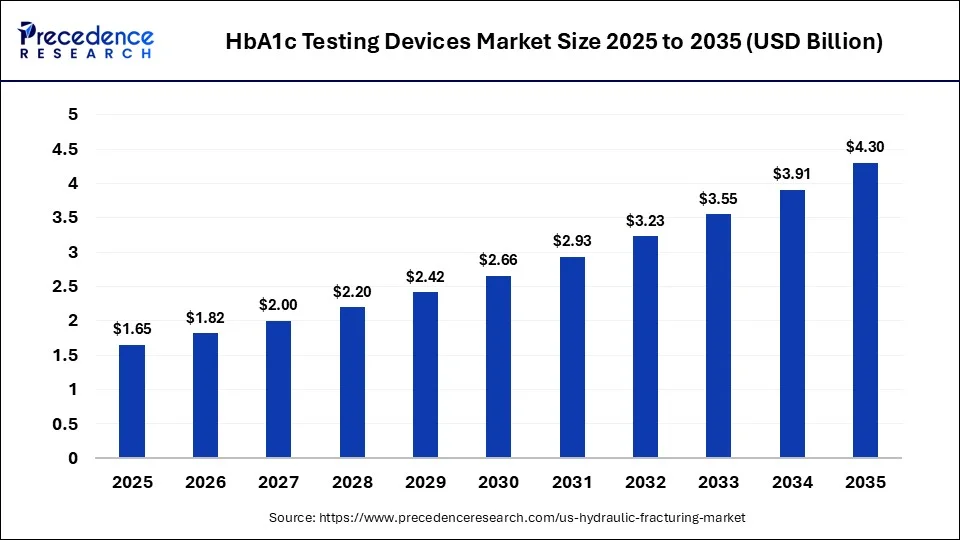
The HbA1c testing devices market reached approximately USD 1.82 billion in 2026. The growth is primarily driven by the increasing incidence of diabetes, high demand for point-of-care diagnostics, and changing regulatory environments. This report benefits major stakeholders involved in the entire value chain, including medical device manufacturers, CROs, software & data integration vendors, and distributors.
Source: https://www.precedenceresearch.com/hbaic-testing-devices-market
 Get a Sample
 Table Of Content


HbA1c Testing Devices Market Trends, Share, and Growth Analysis 2035
The HbA1c testing devices market is forecasted to expand from USD 1.82 billion in 2026 to USD 4.30 billion by 2035, growing at a CAGR of 10.06% from 2026 to 2035.
 Key Takeaways
- By device type, the laboratory-based testing devices segment held the largest market share of 55.2% in 2025.
- By technology, the ion exchange chromatography segment accounted for the highest market share of 34.8% in 2025.
- By end-use, the hospitals and clinics segment led the market with a share of 58.1% in 2025.
- HbA1c device pricing depends on total cost per test and lifetime installed-base economics, along with the type of analyzer used.
- The value chain for HbA1c testing devices involves calibration and control, manufacture of analyzers, software and connectivity, distribution, installation in lab/clinic, testing, maintenance, and replacement supplies.
- Automation of ion exchange chromatography, HPLC, miniaturization, and integrated connectivity are some technological advancements of HbA1c testing devices.
How is the HbA1c Testing Devices Market Evolving Through 2035?
The increasing diabetic population, growing demand for early diagnosis, higher frequency of glycemic monitoring and the expansion of primary care testing drive the market. According to the International Diabetes Federation, approximately 589 million individuals were living with diabetes in 2024, and it is projected that 853 million people will have diabetes by 2050.
The market is therefore evaluated using both device revenue and recurring testing economics. An economically designed analyzer can generate income for life if purchased it via use of cartridges, attachment of reagents, service agreements, and the retention of installed base. In contrast, premium laboratory analyzers generate value due to high throughput, automation, connectivity, analytical accuracy, and laboratory workflow integration.
Coverage Highlights
- Historical market trajectory and 2025 baseline
- 2026 to 2035 revenue forecast
- Incremental revenue opportunity
- Regional contribution
- Device replacement cycles
- Installed base economics
- Base/upside/downside scenarios
- Revenue contribution from recurring consumables
Segmentation Analysis
Which Device Type and Technology Segments Dominated the HbA1c Testing Devices Market?
The device type segment is categorized into laboratory-based testing devices and point-of-care devices. Laboratory-based testing devices held the largest market share of 55.2% in 2025, due to their widespread adoption in hospitals, diagnostic laboratories, reference laboratories, and high-throughput testing environments. In the coming years, point-of-care (POC) devices are emerging due to their ability to generate faster results and enable decentralized diabetes management.
By technology, the ion exchange chromatography segment dominated the market with a share of 34.8% in 2025. The Ion Exchange Chromatography (IEC) technique is one that helps to separate and precisely determine HbA1c from regular hemoglobin using physical means. Other possible techniques include immunoassay, boronate affinity chromatography, enzymatic assays, and capillary electrophoresis.
By end-use, hospitals and clinics had a market share of around 58.1%, owing to the presence of skilled professionals, advanced equipment, and positive reimbursement policies. Homecare is the fastest-growing segment as patients can benefit from high-quality care from the comfort of their homes.
Coverage Highlights
- By device type
- By technology
- By end use
- By testing setting
- By sample type
- By throughput
- By connectivity
- By geography
Largest, fastest-growing, emerging, and declining segments
What are the Major Growth Factors and Challenges of the HbA1c Testing Devices Market?
The major demand drivers of the market include the rising diabetes population. This population is a major concern, primarily in low- and middle-income countries (LMICs). About 81% of the total diabetes population lives in LMICs, where improved diagnosis and decentralized testing can materially increase future testing demand.
The growing demand for same-visit clinical decision-making also drives the market. POC devices enable decision-making for patients and clinicians that helps prevent delays inherent in standard lab processes. Some available POC devices can provide HbA1c results within six minutes from a 1 µL fingerstick sample.
There are many kinds of obstacles in the market such as a technical obstacle for accurate analysis. It is impacted by variations in hemoglobin and reasons of red cell lifespan. Standardization through NGSP/IFCC traceability therefore represents a critical competitive barrier rather than a routine compliance requirement.
The strongest opportunity in the market lies at the intersection of speed, analytical accuracy, workflow integration, automation, and low operating complexity.
What is the Pricing Analysis of HbA1c Testing Devices?
HbA1c device pricing depends on total cost per test and lifetime installed base economics, along with the type of analyzer used. Laboratory systems are generally expensive due to their throughput, automation, connectivity, sample capacity, and broader laboratory functionality. POC tests are cheap because of less complexity in workflow, smaller footprint, quick results, and smaller sample sizes required.
The business model for such systems is becoming more and more subscription-based. Deployment of analyzers generates downstream demand for consumables, service, and connectivity. This produces a strategic distinction between capital equipment suppliers and consumables-anchored platforms.
Publicly disclosed pricing is highly fragmented by geography, purchasing contracts, regulatory configuration, and reagent commitment. The full analysis therefore benchmarks ASP and cost-per-test economics by device category, throughput class, geography, and purchasing model, rather than applying a single global price.
Why is Supply Shifting From Central Laboratories to Decentralized Care?
Additional resource demand is being allocated between two different competing models of large-volume testing and small-volume, rapid testing. Laboratory demand drivers are volume, automation, variant identification, Lis/His integration, and low per-sample cost. The POC test demand drivers are TAT, ease of use, low sample prep, portable/mobile, and clinical utility.
Technology suppliers respond with smaller analyzers and increased workflow integration. Newer product development has focused on small analyzers such as HbA1c at the POC and a shorter measurement time for assays, highlighting the current trend of technological competition toward faster decentralized workflows.
Likewise, supply-side variations evolved from simple HbA1c evaluations to become complex problems such as analytical performance, process automation, interoperability, security, quality controls, and access to consumables.
What Does the Value Chain Analysis of the HbA1c Testing Devices Market Indicate?
The HbA1c testing device value chain covers assay chemistry and reagents up to calibrators and controls, manufacturing of analyzers, software/communication, distribution, laboratory or clinical installation of equipment, testing itself, maintenance, and recurring consumables. Although an analyzer is the first piece of equipment sold, it is the economics of recurring consumption, calibration, quality control, maintenance, and software-driven workflow management that become more and more important. No specific percentages of cost or margin were specified in the source, but it was noted that suppliers able to offer their instruments together with the recurring consumables can claim a bigger chunk of the total customer lifetime value.
The crucial point of competitive advantage is not only placing the analyzer but building the sustainable installed base ecosystem that will be providing the revenues from recurring testing. Laboratories have switching costs since the replacement of the analytical platform may imply validation of the new procedure, training of staff, and other operations.
HbA1c system providers should compete through life cycle economics and not just by pricing their analyzers. Providers who are able to offer analyzers that have good performance along with consumables, calibrations, connectivity, and service are well placed to develop customer loyalty and preserve recurring revenues. This is even more important in light of the importance of standardization; the NGSP paradigm connects manufacturers and labs to the reference system through calibrations and traceability.
The full report further evaluates the end-to-end value chain, value-capture points, supplier relationships, consumables economics, calibration and quality-control requirements, distribution structure, installation base, switching costs, maintenance models, and software/connectivity integration. Furthermore, the analysis identifies areas in which profitability is concentrated in the value chain and the role of controlling recurring consumables and installed systems in shaping competition.
The same intelligence can be structured into a company, product, analyzer, technology, consumable dataset, tracking supplier, device/platform, assay technology, calibration approach, consumables, testing setting, connectivity, geography, installation status, maintenance model, and product lifecycle. Such a dataset can be filtered by company, technology, geography, or product category and benchmarked alongside the strategic analysis to identify recurring-revenue opportunities and installed-base advantages.
What are the Emerging Technological Innovations in the HbA1c Testing Devices Market?
Ion exchange chromatography is still the largest method in terms of revenue, but immunoassay, enzymatic, affinity, and electrophoresis techniques compete on different grounds. High-performance liquid chromatography (HPLC) systems can use their ability to separate hemoglobins. They can also detect any interference that may be present.
The next competitive phase is increasingly focused on miniaturization, cartridge-based testing, automated sample handling, integrated connectivity, shorter turnaround times, smaller sample volumes, and multi-analyte platforms.
The innovation opportunity is therefore broader than assay chemistry. The winning architecture is increasingly one in which the analyzer, consumable, software, quality-control process, and clinical workflow operate as an integrated ecosystem.
How Do the Standardization and Claims Define the Addressable Market?
HbA1c assays have very rigorous analytical and regulatory requirements. NGSP certification ensures that HbA1c assays are traceable to a reference system, while IFCC standardization ensures international traceability of measurements.
Most importantly, the regulatory positioning of HbA1c is not the same for monitoring and diagnosis purposes. The use of HbA1c for diabetes diagnosis in the U.S. healthcare setting is possible when the method is standardized according to regulatory guidelines; POCT assays have special limitations concerning HbA1c diagnosis.
The entire report gives a review of the regulatory pathways, certification, CLIA complexity, distinction between diagnostic and monitoring, regional needs, quality control responsibility, and how all these affect the commercialization process.
Which Competitive Capabilities are Most Critical to Winning Across Laboratory, HbA1c-Specialist, and POC Segments?
The HbA1c testing devices market is shaped by three distinct competitive models: large integrated diagnostics platforms, HbA1c-focused specialists, and POC and decentralized-testing innovators. The competitive landscape is based on scale of installed base, automation capabilities, HPLC technology, accuracy of assays, ease of workflow, and patient proximity. Some examples of product benchmarks are provided to demonstrate the range of performance: some POC systems can provide HbA1c tests within six minutes using a 1 µL sample, while automated HPLC systems can complete about 37 tests per hour with 90-second turnarounds.
Competitive advantage is no longer defined solely in terms of performance, economics, and scale of installed base but depends on all three parameters. Even with strong accuracy and certification of the system, it may not be adopted due to insufficient reagent availability, higher cost per test, poor integration possibilities, or lack of distributor support.
On the other hand, POC systems can increase their target customer base by offering fast turnaround, minimal sample size, ease of use, approval, and good economics of test repetition. Reagent attachment, installed analyzer base, throughput, turnaround time, and cost per test are becoming particularly important indicators of commercial traction because they connect technical performance directly with recurring testing economics.
Suppliers should aim to optimize for the whole value proposition, and not just the price of the instrument or its analytical precision. Laboratory-focused solutions are well poised to protect their high-throughput business through automation and networking capabilities, while POC solutions can take advantage of decentralization, in which speed and access are key factors.
The ability to maintain NGSP/IFCC certification, broad diagnostic claims, appropriate CLIA complexity, Lis/His connectivity, geographic and distributor coverage, and reliable reagent supply can therefore influence both market access and long-term customer retention. This opens up an opportunity for vendors who can provide solutions which can blend the performance of central analytical systems with decentralization and cost per test economics.
The complete report provides further competitive analysis based on HbA1c specific revenues exposure, analyzer base, unit shipments, testing capacity, turn-around-time, sample volume, cost per test, reagent attachment, certifications, diagnostics claims, CLIA complexity, geographic presence, distribution presence, connectivity, product line, R&D spend, partnership, and M&A activity. The analysis also compares the KPis on a business model basis, i.e., laboratory, specialty, and POCT models.
Tentative Leading Company Universe
| Company | Headquarters | Market Position | Core Strength |
| Abbott | U.S. | Global leader | POC diagnostics |
| Siemens Healthineers | Germany | Global leader | POC + laboratory |
| Roche Diagnostics | Switzerland | Global leader | Integrated diagnostics |
| Bio-Rad Laboratories | U.S. | HbA1c specialist | HPLC/diagnostics |
| ARKRAY | Japan | HbA1c specialist | HPLC analyzers |
| Tosoh | Japan | Technology leader | HPLC HbA1c |
| Trinity Biotech | Ireland | HbA1c specialist | HbA1c platforms |
| Danaher / Beckman Coulter | U.S. | Laboratory leader | Automation |
| QuidelOrtho | U.S. | Diagnostics player | POC diagnostics |
| PTS Diagnostics | U.S. | POC specialist | A1CNow |
| EKF Diagnostics | U.K. | POC specialist | Diabetes testing |
| Menarini Diagnostics | Italy | Regional/global player | Diabetes diagnostics |
| HUMAN | Germany | Diagnostics specialist | HbA1c analyzers |
| SEKISUI Medical | Japan | Diagnostics specialist | HbA1c testing |
| Sysmex | Japan | Laboratory leader | Automated diagnostics |
| HORIBA | Japan | Analytical specialist | HbA1c analyzers |
| Erba Mannheim | Germany/India | Regional player | Clinical diagnostics |
| Mindray | China | Emerging scale player | Integrated laboratory systems |
| Snibe | China | Emerging player | Clinical chemistry |
| Randox Laboratories | U.K. | Diagnostics specialist | Assays/clinical diagnostics |
| Diazyme Laboratories | U.S. | Assay specialist | Enzymatic diagnostics |
| Ceragem Medisys | South Korea | HbA1c specialist | POC/laboratory |
| SAKAE | Japan | Specialist | HbA1c analyzers |
| i-SENS | South Korea | Diabetes diagnostics | Diabetes monitoring |
| Werfen | Spain | Diagnostics leader | Specialized diagnostics |
How Do Scale, Installed Base, and Recurring Consumables Determine Revenue Capture?
Market-share analysis evaluates the leading suppliers using HbA1c-specific revenue exposure rather than total corporate diagnostics revenue. This distinction is important because several large diagnostics groups generate substantial revenue outside HbA1c testing.
The competitive assessment therefore separates:
- Top 5 revenue contributors
- Top 10 market participants
- Remaining market
- Laboratory versus POC share
- Global versus regional suppliers
- HbA1c-specialist versus diversified diagnostics companies
The full report comprises estimated company-level shares, share gains/losses, revenue exposure, installed-base indicators, geographic penetration, and competitive concentration without overstating precision where HbA1c-specific financial disclosure is unavailable.
What is the Competitive Benchmarking of the HbA1c Testing Devices Market?
The top companies are benchmarked on parameters such as revenues, HbA1c exposure, product line, analyzer capacity, sample volume, turnaround time, technology, certification, networking, distribution, install base, consumables economics, R&D, and geography.
One established POC platform, for example, supports NGSP- and IFCC-certified HbA1c testing, a 1 µL whole-blood sample, six-minute results, automated calibration, QC controls, and connectivity to laboratory information systems.
Laboratory-focused platforms compete differently. Automated HPLC systems put much emphasis on high throughput capability, efficient chromatography, accuracy, differentiation of variants, sample processing capacity, and automation integration. The most recent HPLC system has a processing time of 90 seconds and 37 tests per hour.
What Does the Product Portfolio Benchmarking Indicate?
Portfolio benchmarking identifies:
- Full laboratory-platform leaders
- Dedicated HbA1c specialists
- POC leaders
- HPLC specialists
- Multi-analyte diabetes-testing providers
- Compact analyzer challengers
- Home/self-testing specialists
A major source of competitive differentiation is portfolio adjacency. The use of platforms that integrate HbA1c with glucose, albumin, creatinine, ACR, hematology, and more extensive chemistry will improve client retention through the integration of HbA1c into a wider testing process. Current integrated systems demonstrate this strategy by combining HbA1c with kidney-function testing and data-management capabilities.
How is Global Scale Giving Way to Regionalized Diagnostic Supply?
The manufacturing analysis looks at the manufacturing of analyzers, production of assays, reagents, capacity of cartridges, localization, contract manufacturing, regional distribution centers, and service capabilities.
When we are talking about HbA1c analyzers, it is critical to consider the supply robustness due to the fact that customers will become dependent on the ongoing supply of the reagents and consumables after purchasing the analyzer. This will be an additional competitive advantage for the manufacturers with localized manufacturing and a wide distribution network.
Who are the Major Customers of HbA1c Testing Devices?
Hospitals and clinics make up the majority of the customer revenue pool. The customer structure nevertheless varies substantially.
- Hospitals: throughput, automation, integration
- Laboratories: cost per test and workflow efficiency
- General practice clinics: speed and ease of use
- Community pharmacies/other community venues: compact POC platforms
- Home healthcare: convenience and simplified operation
- Diabetes clinics: frequent testing and clinical workflow integration
Channel benchmarking looks at direct sales, distribution, group purchasing, laboratory networks, pharmacy, service, and online channels.
How is Consolidation Increasing Access to Decentralized Diagnostic Technology?
There has been an increased interest in decentralized diagnostics from recent strategic developments. An interesting strategic deal was the acquisition of LumiraDx's point-of-care technology platform worth USD 295 million, with up to USD 55 million reserved for supporting the platform until the deal closes.
Strategic development assessment includes:
- Acquisitions of POC technologies
- Release of analyzers
- Update of HPLC platforms
- Diagnostic partnerships
- Distribution deals
- Expansion into new geographies
- Connectivity strategies
- Home testing programs
- Localizing manufacturing
The main strategic trend is the convergence of lab-quality performance with decentralization.
Which Untapped HbA1c Testing Opportunities Offer the Strongest Potential for Incremental Market Expansion?
The major areas where white spaces exist are around decentralization, affordability, streamlined workflow, and inadequate testing environments. Key opportunities include low-cost POC HbA1c systems, primary-care and pharmacy-based testing, emerging-market diagnostics, compact HPLC platforms, connected analyzers, multi-analyte diabetes platforms, home testing, low-volume laboratories, and localized reagent manufacturing.
These aspects address multiple adoption barriers, including tools beyond laboratory infrastructure and testing, workflow issues, and ongoing consumables expense. Strongest opportunities are likely to emerge where device portability, simplified operation, reliable analytical performance, and lower testing economics can be combined.
India provides a clear illustration of the addressable white space. The development of the market in India shows that besides the potential for replacement demand from existing laboratory networks, there is also the possibility of growth in diagnosis through the provision of new testing environments. Emerging markets with expanding diagnostic infrastructure offer particularly attractive opportunities for suppliers capable of adapting product cost, form factor, distribution, and reagent models to local requirements.
Market share in these years will thus become more and more dependent on gaining access to testing locations that do not fit the current centralized lab offerings. Primary care centers, pharmacies, low-volume labs, decentralized environments, and possibly even home testing are white-space growth opportunities, where connectivity of analyzers and localized manufacturing of reagents can improve the economic and scalability benefits of such models. Suppliers that are capable of making testing affordable and accessible without sacrificing accuracy have a better chance of turning under-serviced demand into regular volumes of tests.
Further analysis of white-space opportunities in the full report considers the following factors: addressable market size, technology requirements, customer environment, testing economics, infrastructure needs, adoption barriers, scalability, regulation, and geographical attractiveness. It also assesses the relative opportunity across POC, compact laboratory systems, connected platforms, multi-analyte solutions, home testing, and localized manufacturing to identify the most commercially actionable growth pockets.
What are the Moderate-to-High Entry Barriers in the HbA1c Testing Devices Market?
| Force | Assessment | Strategic Rationale |
| Supplier Power | Medium | Specialized assay inputs and calibration requirements |
| Buyer Power | Medium–High | Large laboratories and hospital groups negotiate heavily |
| New Entrants | Medium–Low | Regulatory, validation, quality and certification barriers |
| Substitutes | Low–Medium | HbA1c remains a distinct longitudinal glycemic marker |
| Rivalry | High | Established platforms compete on accuracy, cost, speed and installed base |
Which Market Attractiveness Parameters are Associated with HbA1c Testing Devices?
- Highly Attractive: POC HbA1c, integrated diagnostics, developing markets, deployment in primary care
- Attractive: Laboratory analyzers, HPLC systems, hospital/clinic-based testing
- Moderate: Mature centralized laboratory replacement business
- Challenging: Low-cost products that lack regulatory positioning or availability of consumables
Market attractiveness is backed up by a recurring need, increased number of diabetics, reimbursement framework in developed markets, and the trend toward decentralization of testing.
Which will be the Defining Elements of the Future HbA1c Testing Devices Market?
These are swifter implementation of POC, smaller analyzers, lower sample volume, improved connectivity, more automated QC/calibration, and increased integration into pharmacies and primary care centers.
At the same time, emerging market localization and greater emphasis on cost per test are likely to influence product design and commercial models. The market is gradually moving beyond standalone HbA1c measurement toward more accessible, connected, and workflow-integrated diabetes diagnostics.
The more significant long-term opportunity is the pairing of analytical performance with wider clinical and workflow utility. The expansion of integrated HbA1c/kidney testing, increasingly sophisticated home/self-testing models, and connected analyzers could extend HbA1c testing beyond conventional laboratory environments and support more frequent clinical decision-making.
Faster POC adoption is particularly important because it can reduce the time between testing and clinical action. Such an evolution will certainly create a situation where the ability to give accurate results using small samples, easy use, automation, connectivity, but at reduced costs per test becomes more important.
The future competition will be less about measurement capabilities and more about accessibility and economics. Upside potential to the 2035 base case would be strengthened by faster POC penetration, broader regulatory diagnostic claims, and greater adoption across emerging markets.
However, the risk of reimbursement pressures, commoditization of the device, tighter regulations, supply chain disruptions, and competition from other diabetes management technologies constitute some of the major downside risks. Suppliers with scalable solutions, unique workflows, and cost-per-test advantage will be more likely to take advantage of additional opportunities for testing.
The full report further evaluates the 2025 to 2035 market outlook, base-case and upside/downside scenarios, POC penetration, analyzer miniaturization, sample-volume trends, connectivity, automated QC and calibration, integrated testing, home/self-testing, pharmacy and primary-care deployment, emerging-market localization, cost-per-test dynamics, regulatory developments, reimbursement risks, and competitive threats from alternative diabetes-monitoring technologies. This study highlights the structural forces that will determine future market expansion along with the strategies needed to capitalize on them.
Key Strategic Questions
- How large is the global HbA1c Testing Devices Market in 2025, and how quickly will it expand through 2035?
- Which device category will capture the largest incremental revenue, laboratory-based or POC?
- Why is laboratory testing the revenue driver when point-of-care has better growth prospects?
- How will the 589 million global adult diabetes population translate into testing-device demand?
- What HbA1c technologies provide the best balance of precision, speed and efficiency?
- How are HPLC and immunoassay platforms competing across laboratory and decentralized settings?
- How much worth economically do recurring reagents, cartridges, calibration and services carry?
- Which customer segments have the most growth potential?
- What impact will standardization regulations have on competitive entry?
- Which 20-25 companies have the strongest HbA1c-specific competitive positioning?
- Which suppliers possess the strongest combination of installed base, technology, geography, and recurring consumables?
- Where are the largest geographic white spaces, particularly across Asia Pacific and emerging markets?
- How does decentralization at POC alter the economics of HbA1c testing?
- What are the most promising areas where products and technology gaps exist?
- Which organizations are poised to benefit most from the next wave of expansion in HbA1c testing?
HbA1c Testing Devices Market Segments
By Product Type
- Laboratory-Based HbA1c Testing Devices
- Point-of-Care (POC) HbA1c Testing Devices
- Home/Self-Testing HbA1c Devices
By Technology
- Ion-Exchange High-Performance Liquid Chromatography (HPLC)
- Boronate Affinity Chromatography
- Immunoassay
- Enzymatic Assay
- Capillary Electrophoresis
- Other Technologies
By Sample Type
- Whole Blood
- Capillary Blood
- Venous Blood
By End User
- Hospitals & Clinics
- Diagnostic Laboratories
- Physician Offices/Primary Care Centers
- Pharmacies
- Diabetes & Specialty Care Centers
- Home Care Settings
- Research & Academic Institutions
By Application
- Diabetes Diagnosis
- Diabetes Monitoring & Management
- Prediabetes Screening
- Gestational Diabetes Monitoring
- Other Applications
By Test Setting
- Centralized Laboratory Testing
- Point-of-Care Testing
- Decentralized/Near-Patient Testing
- Home Testing
By Throughput
- Low-Throughput Devices
- Medium-Throughput Devices
- High-Throughput Devices
By Connectivity
- Standalone Devices
- Connected HbA1c Analyzers
- Lis/His-Integrated Devices
- Cloud-Connected/Remote-Data Devices
By Region
- North America
- Europe
- Asia Pacific
- Latin America
- Middle East & Africa
For inquiries regarding discounts, bulk purchases, or customization requests, please contact us at sales@precedenceresearch.com
Frequently Asked Questions





Ask For Sample
No cookie-cutter, only authentic analysis – take the 1st step to become a Precedence Research client
 Get a Sample
.webp)



 sales@precedenceresearch.com
 Schedule a Meeting