



High-Resolution Melting Analysis Market Size, Companies, Share, Patient Volume, Treatment Adoption Rates, Pricing Analysis, Regulatory Landscape, Competitive Positioning, and Demand Forecast
High-Resolution Melting Analysis Market (By Product and Service: Reagents and Consumables, Instruments, Software and Services; By Application: SNP Genotyping, Mutation Discovery, Pathogen Identification, Methylation Analysis, Other Applications; By End-User: Research Laboratories and Academic Institutes, Pharmaceutical and Biotechnology Companies, Hospitals and Diagnostic Centers, Other) - Global Industry Analysis, Size, Trends, Leading Companies, Regional Outlook, and Forecast 2026 to 2035
Source: https://www.precedenceresearch.com/high-resolution-melting-analysis-market
 Get a Sample
 Table Of Content


What is the High-Resolution Melting Analysis Market Size in 2026?
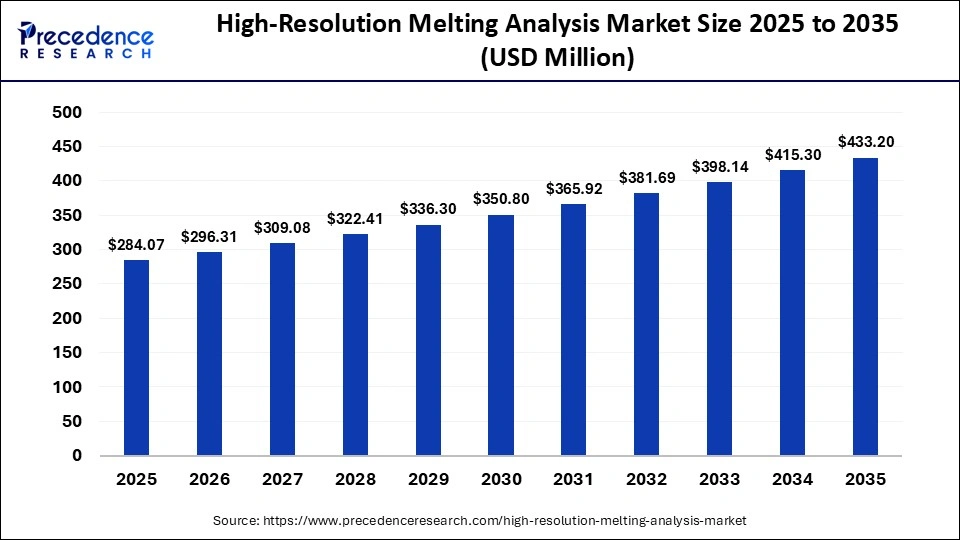
The global high-resolution melting analysis market size accounted for USD 284.07 million in 2025 and is predicted to increase from USD 296.31 million in 2026 to approximately USD 433.20 million by 2035, expanding at a CAGR of 4.31% from 2026 to 2035. The market is expanding rapidly due to increasing demand for fast, accurate genetic mutation detection and cost-effective genotyping solutions.
Key Takeaways
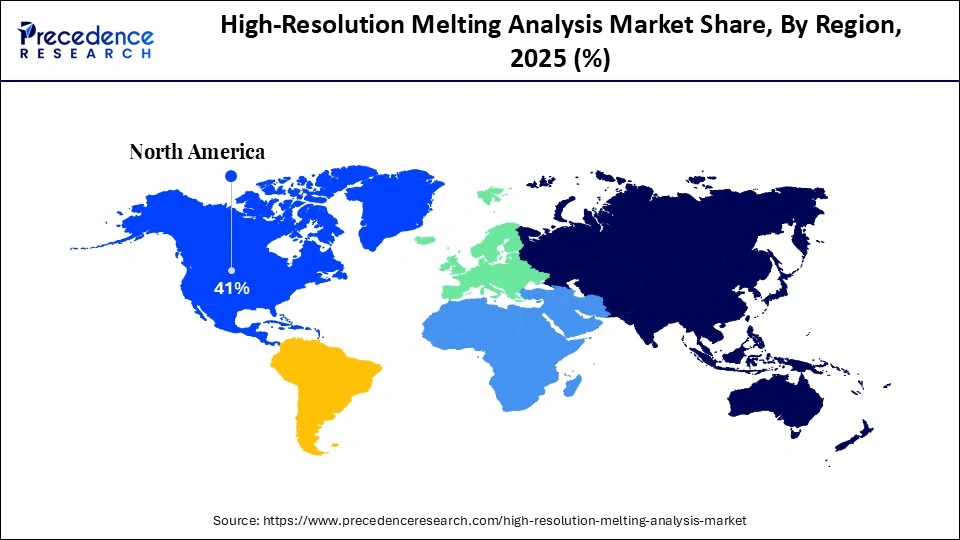
- North America dominated the global market with the largest market share of 41% in 2025.
- Asia-Pacific is expected to grow at the fastest CAGR in the market during the forecast period.
- By product and service, the reagents and consumables segment held a major market share of 50% in 2025.
- By product and service, the instruments segment is expected to grow at the fastest CAGR in the market between 2026 and 2035.
- By application, the SNP genotyping segment contributed the highest market share of 39% in 2025.
- By application, the pathogen identification segment is expected to grow with the highest CAGR in the market during the studied years.
- By end-user, the research laboratories and academic institutes segment held the biggest market share of 47% in 2025.
- By end-user, the hospitals and diagnostic centers segment is expected to expand rapidly in the market in the coming years.
What is High-Resolution Melting Analysis?
The high-resolution melting analysis market encompasses technologies that use PCR amplicon melting curves to sequence DNA. It is a popular tool for mutation scanning, genotyping, and methylation analysis because of its simplicity and high sensitivity. It has low reagent usage, high turnaround, and a closed-tube format, which curtails contamination risks and costs in labs. The growth of genomics studies, infectious disease screening, and pharmacogenomics also contributes to demand in the market.
What is the Role of AI in High-Resolution Melting Analysis?
Artificial intelligence (AI) is being applied to high-resolution platforms to augment data collection and pattern recognition. AI algorithms help distinguish small differences in melt curves by analyzing them, resulting in higher accuracy. Machine learning (ML) modules support predictive genotype clustering and automated anomaly detection. AI-based robotics help in the worldwide framework to improve the pace of diagnostic processes, minimizing the time spent on menial tasks. AI and ML enhance the efficiency and accuracy of experiments and aid in data analysis.
High-Resolution Melting Analysis Market Trends
- Clinical Diagnosis Integration: The adoption of the high-resolution platform worldwide is increasing the viability of diagnosis integration. Ongoing research provides a very useful result to detect DNA sequencing at an early stage for many people.
- Increasing Use in Mutation Detection: It can be predicted that an advanced use of high-resolution platforms in cancer mutation diagnosis provides targeted therapeutic decisions across the board. This consistent practice has resulted in rising cancer prevalence and precision oncology programs to boost the global high-resolution melting platforms.
- Advancements in High-Throughput Workflows: Investment in automation for a multi-sample high-resolution melting platform helps to intensify the throughput proficiency of labs. This brings efficiency and scalability, supporting large research and screening programs.
- Expansion in Veterinary and Agricultural Genetics: The increasing use of this platform is enabling developed contributions in the veterinary and agricultural sector, producing a higher demand for animal genomics and crop trait screening. The amplified interest in agricultural biology is encouraging economists to expand the market reach.
Market Scope
| Report Coverage | Details |
| Market Size in 2025 | USD 284.07 Million |
| Market Size in 2026 | USD 296.31 Million |
| Market Size by 2035 | USD 433.20 Million |
| Market Growth Rate from 2026 to 2035 | CAGR of 4.31% |
| Dominating Region | North America |
| Fastest Growing Region | Asia Pacific |
| Base Year | 2025 |
| Forecast Period | 2026 to 2035 |
| Segments Covered | Product and Service, Application, End-User, and Region |
| Regions Covered | North America, Europe, Asia-Pacific, Latin America, and Middle East & Africa |
Segmental Insights
Product and Service Insights
Which Product and Service Segment Dominated the High-Resolution Melting Analysis Market?
The reagents and consumables segment dominated the market in 2025, driven by their need in all analyses that are to be conducted to replenish them constantly. A proper melting profile is obtained by the requirement to investigate the qualities of dyes, primers, master mixes, and plates essential for the implementation in high-resolution melting assays. Recurrent and repeated demands for such supplies are generated by labs that conduct regular genetic testing. The segmental growth is attributed to consecutive investments in both research and clinical environments.
The instruments segment is expected to show the fastest growth with a CAGR over the forecast period, followed by an increased demand for high-resolution melting capable of implementing real-time PCR. Newer platforms are more sensitive, multi-channel, and have the capability to support automated workflows. This is being adopted by research laboratories to help with more complicated gene typing and mutation analysis. Instrument sales increase due to technological advancements and improvements in performance functionality.
Application Insights
How the SNP Genotyping Segment Dominated the High-Resolution Melting Analysis Market?
The SNP genotyping segment held the largest revenue share of the market in 2025, due to growing research activities related to genetic variations and disease associations. High-resolution melting analysis is another fast and cost-efficient way of detecting single nucleotide polymorphism without the use of labeled probes. It is sensitive to sequence variations, making it applicable in population analysis and pharmacogenomics. The general applicability of SNP genotyping, both in academic and business research, fosters the segment's growth.
The pathogen identification segment is expected to gain the highest market share between 2026 and 2035, due to the increasing drug discovery research and the rising prevalence of infectious disorders. High-resolution melting analysis can differentiate microbial species and subspecies with high specificity. It identifies variations in nucleic acid sequences of pathogens. This helps researchers to study pathogenic mutations and develop novel drugs based on pathogen identification. The growing awareness of screening and early disease diagnosis promotes the use of high-resolution melting analysis for pathogen identification.
End-User Insights
Which End-User Segment Led the High-Resolution Melting Analysis Market?
The research laboratories and academic institutes segment led the market in 2025, since these are the first to embrace high-resolution melting analysis technology both in research and teaching. These institutes carry out vast genetic research, the development of methods, and pilot disease research. Adaptable budgeting and the requirement to investigate innovative molecular approaches facilitate continuity in using this technology. Research output and discoveries require a high demand for reagents and instruments.
The hospitals and diagnostic centers segment is expected to witness the fastest growth in the market over the forecast period, because high-resolution melting analysis is becoming widespread in regular testing and disease screening processes. The need to carry out quick and precise diagnosis to the best of their abilities is shown in its increased uptake by hospitals and diagnostic centers. The diagnostic efficiency and confidence are improved by the fact that the technique can identify those clinically significant variants. The segmental growth is also encouraged by the expansion of personalized medicine and genetic testing programs.
Regional Insights
North America High-Resolution Melting Analysis Market Size and Growth 2026 to 2035
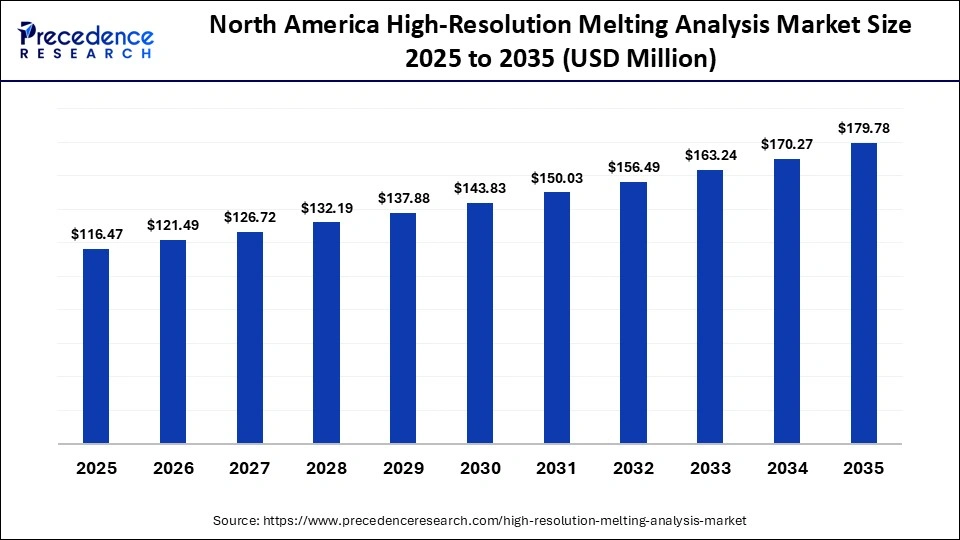
The North America high-resolution melting analysis market size is estimated at USD 116.47 million in 2025 and is projected to reach approximately USD 179.68 million by 2035, with a 4.44% CAGR from 2026 to 2035.
Why North America Dominated the High-Resolution Melting Analysis Market?
North America held a major revenue share of the market in 2025 because it has an advanced system of genomics infrastructural development and significant investment in the field of molecular techniques for diagnostics and research. The region enjoys a high level of R&D rate, a high level of clinical research, and early applications of new screening and genotyping technologies. An established network of research organizations, pharmaceutical firms, and biotechnology firms keeps on pushing the need for HRM platforms.
Favorable regulatory measures and reimbursement systems also promote the inclusion of HRM within the clinical and research processes. Also, high levels of genetic disease research and precision medicine initiatives can continue to drive market growth. There are also powerful commercialization pipelines and mature healthcare systems that cement the dominant position of North America.
U.S. High-Resolution Melting Analysis Market Size and Growth 2026 to 2035
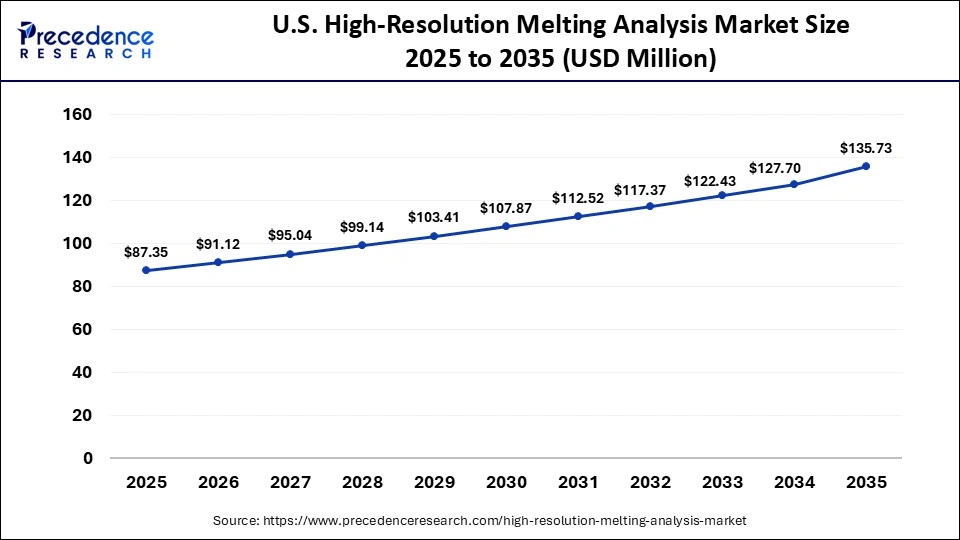
The U.S. high-resolution melting analysis market size is calculated at USD 87.35 million in 2025 and is expected to reach nearly USD 135.73 million in 2035, accelerating at a strong CAGR of 4.51% between 2026 and 2035.
U.S. Country-Level Analysis
On a country level, the U.S. has a strong biotechnology and life sciences ecosystem. The extensive deployment of HRM in academic, clinical, and commercial labs is backed by high investment in research and heavy activity in clinical diagnosis. Canada is also making a consistent contribution to increasing funding in genomics research and diagnostic resources. The U.S. has also enjoyed the advantage of having huge surveillance and screening programs that have accommodated this technology.
Good partnerships between industry and academia promote innovations and the adoption of products. In general, the infrastructure and long-standing experience in North America ensure its leading position in the market.
Why is Asia-Pacific the Fastest-Growing Region in the High-Resolution Melting Analysis Market?
Asia-Pacific is expected to witness the fastest growth during the predicted timeframe, due to rising investments in medical facilities and molecular diagnostic equipment. The dynamic growth rate of economies in countries of the region and the growing research spending are increasing the need to use the best genetic analysis tools. The growing understanding of genetic diseases and personalized medicine is promoting further use of HRM platforms.
The increase in government efforts to boost the development of biotechnology further fosters market growth. Further, an increase in clinical and academic research programs is one of the reasons behind the increasing HRM use. Enhancements in healthcare accessibility and higher rates in diagnostic testing are also beneficial in expanding the region.
Country-Level Analysis
China is a primary growth driver, which has heavily invested in the spheres of genomics research and modernization of the healthcare sector and biotechnology production. The high population density and increased incidence of chronic illnesses are driving the need for effective diagnostic technologies.
India is not an exception, as it is growing rapidly, being backed by developing genomics programs and the increasing number of clinical laboratories.
The adoption in Japan is predictable because of the developed healthcare ecosystem and emphasis on precision medicine. Southeast Asian countries and South Korea are becoming increasingly active in research funding and molecular diagnostic capacities. All these nations make Asia-Pacific one of the high-moving growth markets.
Will Europe Grow in the High-Resolution Melting Analysis Market?
Europe is expected to grow at a considerable CAGR in the upcoming period, facilitated by the high level of scientific research and supportive policy provisions in favor of genomic medicine. Most European countries are developing precise healthcare measures and programs that encompass genetic testing and mutation analysis. Growth of state and corporate research centers, along with growing clinical genomics implementation, is the basis for HRM solution demand.
Coordinated regulatory standards in the European Union foster the use of technology in the clinical environment. Biotechnology innovation and partnering research programs further increase maturity in the market. Also, the increasing knowledge in the field of genetic risk profiling in preventive healthcare leads to a stable increase.
Country-Level Analysis
Germany is at the forefront in terms of its developed healthcare ecosystem and massive investment in life sciences at the country level. The market growth in the UK is characterized by ongoing genomics research and screening programs in the clinical setting. France plays a crucial role in increasing precision medicine programs and national laboratory networks.
Nordic nations focus on genomic innovation and early adoption of technology. Southern and Eastern European countries are significantly increasing molecular diagnostics capacities, contributing to the momentum in regional markets. In general, the integrated research environment and healthcare policies in Europe favor its impressive growth curve in the market.
High-Resolution Melting Analysis Market Companies
- Thermo Fisher Scientific Inc
- Bio-Rad Laboratories, Inc
- F. Hoffman-La Roche Ltd.
- Bio Farma
- QIAGEN
- Illumina, Inc
- Agilent Technologies, Inc
- BIOMÉRIEUX
- Meridian Bioscience, Inc
- Novacyt; PREMIER Biosoft
- Azura Genomics Inc
- Canon Medical Systems Corporation.
Recent Developments
- In November 2025, researchers from Hebrew University of Jerusalem developed a new method of high-resolution melting (HRM) PCR to monitor the epidemiology of a parasitic disease, Leishmaniasis. This method identified 12 species of sand flies, four species of Leishmania, as well as 25 species of host animals in Israel and demonstrated complicated patterns of transmission.(Source: https://www.news-medical.net)
- In November 2025, researchers at Cornell University developed a high-resolution tool to monitor kinase activity in living cells, enabling more precise mapping of cellular signaling pathways. The innovation uses advanced molecular sensors to reveal dynamic enzymatic change with unprecedented clarity. This technology promises to enhance drug discovery and deepen understanding of disease mechanisms at the cellular level.(Source: https://www.news-medical.net)
- In February 2024, scientists from the University of California, San Diego, invented a digital melting technique of DNA analysis that can identify blood-borne pathogens within less than six hours, fourfold quicker than the standard blood cultures. This method employs the highest resolution melt curves and ML to detect and measure microbial DNA with a reduced number of false positives.(Source: https://www.genengnews.com)
Segments Covered in the Report
By Product and Service
- Reagents and Consumables
- Intercalating Dyes
- Master Mixes
- DNA Standards and Controls
- Instruments
- Real-time PCR Systems
- Digital PCR Systems (HRM-enabled)
- Compact POC Devices
- Software and Services
- Melt-curve Analysis Software
- Cloud-based Analytics & AI Services
- Validation & Training Services
By Application
- SNP Genotyping
- Mutation Discovery
- Pathogen Identification
- Methylation Analysis
- Other Applications
By End-User
- Research Laboratories and Academic Institutes
- Pharmaceutical and Biotechnology Companies
- Hospitals and Diagnostic Centers
- Other
By Region
- North America
- Europe
- Asia-Pacific
- Latin America
- Middle East & Africa
For inquiries regarding discounts, bulk purchases, or customization requests, please contact us at sales@precedenceresearch.com
Frequently Asked Questions





Ask For Sample
No cookie-cutter, only authentic analysis – take the 1st step to become a Precedence Research client
 Get a Sample




 sales@precedenceresearch.com
 Schedule a Meeting
