



RNA Analysis Market Size, Companies, Share, Patient Volume, Treatment Adoption Rates, Pricing Analysis, Regulatory Landscape, Competitive Positioning, and Demand Forecast
RNA Analysis Market (By Product Type: Kits & Reagents, Software & Bioinformatics, Instruments, Services; By Technology: qPCR/PCR-based, Sequencing (NGS/RNA-seq), Microarray, RNA Interference, Others; By Application: Clinical Diagnostics, Drug Discovery & Development, Toxicogenomics, Comparative Transcriptomics, Biomarker Discovery/Epigenetics, Others; By End User: Pharmaceutical & Biotechnology Companies, Academic & Research Institutes, Hospitals & Diagnostic Labs, Contract Research Organizations (CROs), Others) - Global Industry Analysis, Size, Trends, Leading Companies, Regional Outlook, and Forecast 2026 to 2035
Source: https://www.precedenceresearch.com/rna-analysis-market
 Get a Sample
 Table Of Content


What is the RNA Analysis Market Size?
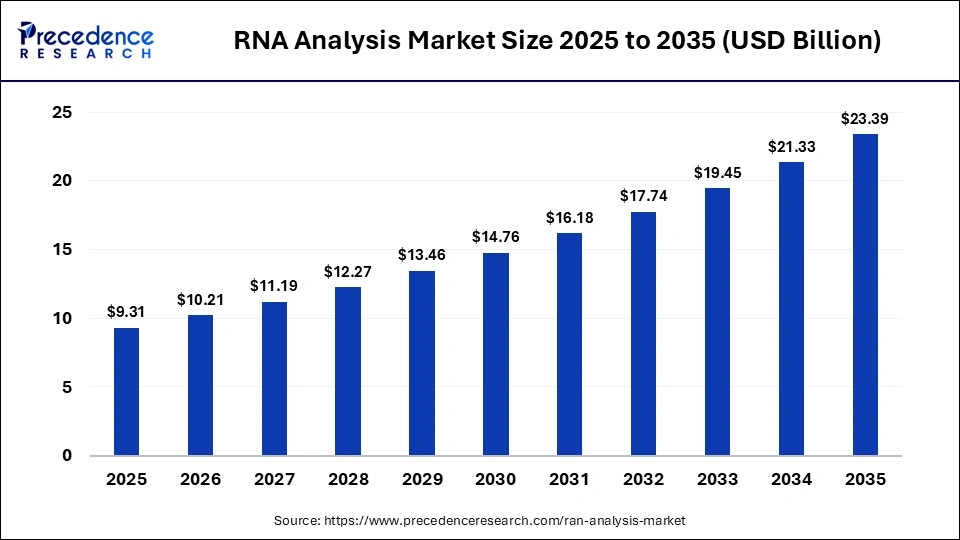
The global RNA analysis market size is predicted to increase from USD 10.21 billion in 2026 to approximately USD 23.39 billion by 2035, expanding at a CAGR of 9.65% from 2026 to 2035. This market is experiencing tremendous growth as there is a rise in the demand for personalized medicine, a rise in the incidence of chronic diseases, and an expansion of the biotechnological sector.
Market Highlights
- North America held a major revenue share of approximately 45% in the market in 2026.
- Asia-Pacific is expected to witness the fastest growth with a CAGR of 10.0% during the predicted timeframe.
- By product type, the kits & reagents segment held a dominant position in the RNA analysis market with a share of approximately 58% in 2026.
- By product type, the software and bioinformatics segment is expected to grow at the fastest CAGR of 8.6% in the market between 2026 and 2035.
- By technology, the sequencing segment led the global market with a share of approximately 40% in 2026.
- By application, the clinical diagnostics segment dominated the global RNA analysis market with a share of approximately 35% in 2026.
- By application, the biomarker discovery/epigenetics segment is expected to expand rapidly in the market with a CAGR of 8.5% in the coming years.
- By end-user, the pharmaceutical & biotechnological companies segment held the largest revenue share of approximately 36% in the market in 2026.
- By end-user, the hospitals & diagnostic labs segment is expected to witness the fastest growth in the market with a CAGR of 8.8% over the forecast period.
What is RNA Analysis?
The RNA analysis market includes technologies and tools used to study RNA molecules, such as expression levels, sequences, and functions, to support genomics research, drug discovery, diagnostics, and therapeutic development. This market encompasses products like reagents, instruments, software, and services across PCR, sequencing, microarrays, and other technologies. It enables insights into gene regulation, disease mechanisms, and biomarker identification, fueling personalized medicine, infectious disease analysis, and transcriptomics research globally.
This market is governed by analyzing RNA for its diagnostic, research, and therapeutic purposes. The growing demand for precision medicine, the rising prevalence of chronic disorders, higher funding for R&D ecosystems, and the expansion of the pharmaceutical industry has propelled the market to another level. The RNA analysis technology has enhanced the speed & adaptability, ensuring quicker updates than traditional measures.
RNA Analysis Market Trends
- Single-Cell RNA (scRNA): As the name suggests, it is basically an isolation of a single cell from RNA to identify rare cell types and provide a resolution to complex biological systems. This market is booming primarily due to innovation in sequencing, an increase in cancer incidence, and the growing adoption of personalized medicine.
- RNA Biomarkers: They show real-time cellular activity for diagnosis, treatment monitoring & prognosis of chronic diseases. They are especially useful in diseases like cancer. The recent paradigm shift in the healthcare system has led to more tailored therapies and individual profiling, leading to the rise of biomarkers.
- Point-of-Care Diagnostics: RNA analysis is essentially useful for clinical purposes to identify various chronic conditions. Point-of-care diagnostics offer portability and cost-effectiveness, eliminating the need for patients to visit any healthcare organization for testing.
How Is AI Impacting the RNA Analysis Market?
Artificial Intelligence has a positive impact on the market, as it can read and analyze a huge data set, enabling researchers to predict an optimal RNA sequence, reduce trial & error, find new RNA targets, and enhance drug discovery. It simplifies the identification of biomarkers, thereby enabling the early detection and monitoring of disease progression & even predicting treatment response. AI and machine learning (ML) algorithms introduce automation in analysis, enhancing efficiency, accuracy, and precision. AI is transforming the industry to a data-driven & automated processing.
Segmental Insights
Product Type Insights
Which Product Type Segment Dominated the RNA Analysis Market?
The kits & reagents segment held a major revenue share of approximately 58% in the market in 2026, as they are user-friendly and cost-effective, providing consistent and reliable results. In today's modernized lab, researchers prefer a kit that is compatible with automation, which reduces physical manipulation and processing time. The surge in various research and development activities has led to the rise in demand for reagents. Researchers can fulfil their experimental requirements, eliminating the need to purchase expensive equipment.
The software & bioinformatics segment is expected to show the fastest growth with a CAGR of 8.6% over the forecast period, due to the increase in the volume of raw data produced by sequencing, leading to the need for advanced tools that can handle complex transcriptomic information. The lack of trained professionals has led to an increase in the demand for automated bioinformatics platforms. The availability of easy-to-use software tools makes them a suitable choice for researchers.
Technology Insights
How Did the Sequencing Segment Dominate the RNA Analysis Market?
The sequencing segment dominated the RNA analysis industry in 2026 with 40% of market share, owing to its high precision, scalability, and productivity, leading to advancements in personalized medicine, drug development, and early diagnosis integration. Next-generation sequencing (NGS) is an advanced technique that enables an unbiased approach to multiple omics. NGS offers numerous advantages over traditional PCR techniques, such as high data resolution, high-throughput, and speed. AI and bioinformatics have further propelled the use of this technology.
The qPCR/PCR-based segment is expected to grow at a notable rate during the forecast period, due to its cost-effectiveness, high sensitivity, and speed. The qPCR/PCR-based technology offers rapid disease diagnosis, gene expression studies, and its hypersensitivity while detecting rare transcripts. It enables real-time quantification, making it suitable for gene expression and for the detection of infectious diseases. It enables high-throughput analysis through automation and multiplexing.
Application Insights
Why Did the Clinical Diagnostics Segment Dominate the RNA Analysis Market?
The clinical diagnostics segment contributed the biggest revenue share of approximately 35% in the market in 2026, due to its crucial role in personalized medicine, disease tracking, early diagnosis of genetic disorders. The growing demand for non-invasive testing options potentiates the need for clinical diagnostics. Advances in technologies revolutionize the identification of precise biomarkers & targeted treatment.
The biomarker discovery/epigenetics segment is expected to grow with the highest CAGR of 8.5% in the market during the studied years. People are becoming aware of screening and early diagnosis of chronic disorders, necessitating biomarker detection. RNA analysis is an essential technique for biomarker discovery through which researchers can determine disease progression. Biomaker discovery/epigenetics are increasingly used in various fields, including drug discovery & development, toxicogenomic studies, and comparative transcriptomics.
End User Insights
Which End-User Segment Led the RNA Analysis Market?
The pharmaceutical & biotechnology companies segment led the market with a share of approximately 36% in 2026, due to the presence of favorable infrastructure and suitable capital investments. They focus more on discovering novel drugs for diseases using precise analysis tools, driving immense R&D investments for rapid innovation and targeted therapies. The increasing competition among pharma & biotech companies encourages them to expand their product pipeline, strengthening their market positions.
The hospitals & diagnostic labs segment is expected to grow at the fastest CAGR of 8.8% in the market between 2026 and 2035, due to the rising prevalence of chronic disorders, increasing number of patient admissions, and the growing adoption of advanced technologies. Hospitals & diagnostic labs have skilled professionals who provide personalized treatment and care to patients. They also have sufficient infrastructure to adopt novel and innovative diagnostics and medical devices.
Regional Insights
How Big is the North America RNA Analysis Market Size?
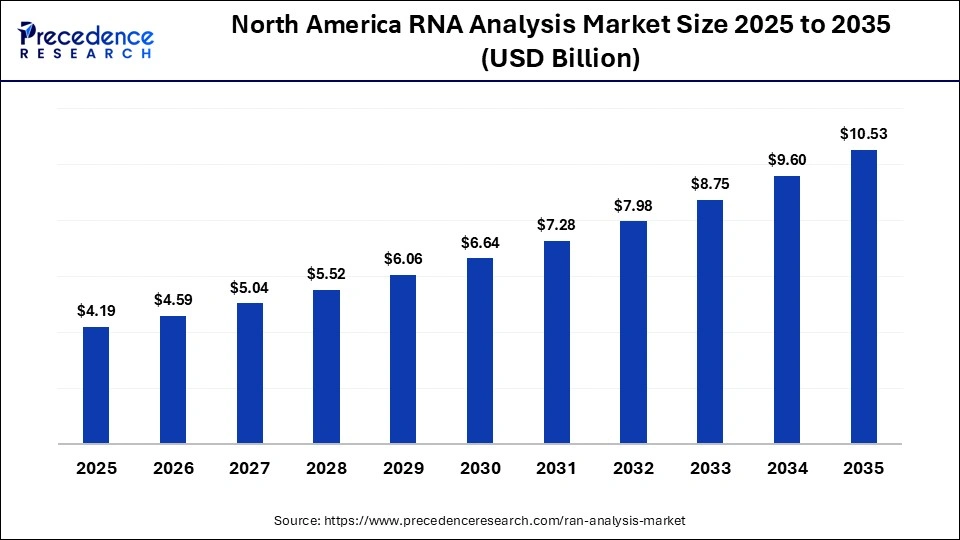
The North America RNA analysis market size is estimated at USD 4.59 billion in 2026 and is projected to reach approximately USD 10.53 billion by 2035, with a 9.77% CAGR from 2026 to 2035.
Why North America Dominated the RNA Analysis Market?
North America dominated the market with a share of approximately 45% in 2026, due to diverse factors such as massive government funds, the presence of strong biopharmaceutical companies, a supportive regulatory board, well-established academic centres, and high adaptability to new technology. As of early 2026, more than 300 active RNA-based clinical trials were conducted, of which 131 were held in the U.S. itself. Another reason for its dominance is various strategic collaborations among key players, such as Skyhawk Therapeutics, Merck KGaA, and Bio-Rad Laboratories.
What is the Size of the U.S. RNA Analysis Market?
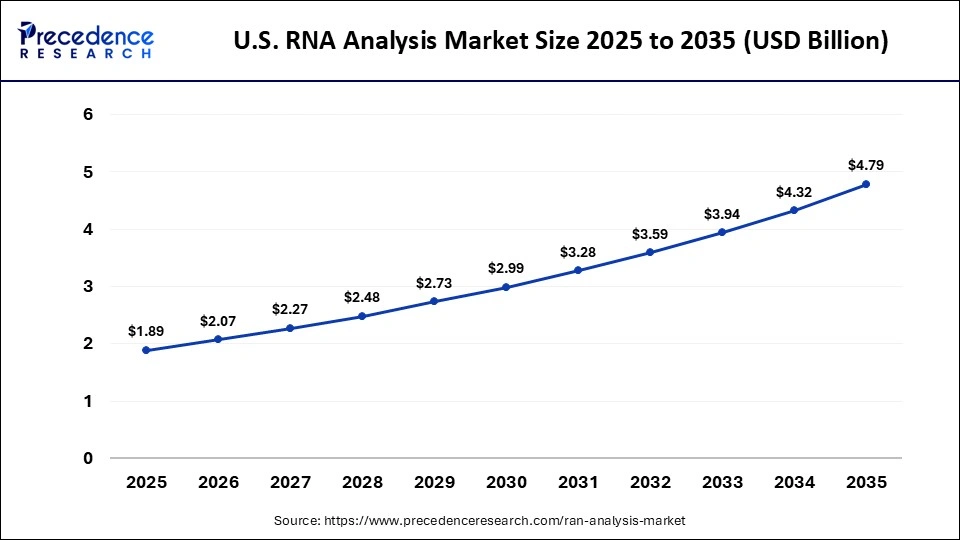
The U.S. RNA analysis market size is calculated at USD 2.07 billion in 2026 and is expected to reach nearly USD 4.79 billion in 2035, accelerating at a strong CAGR of 9.86% between 2026 and 2035.
U.S. RNA Analysis Market Trends
The U.S. dominated the North American market primarily due to the presence of strong biopharma companies, a well-established R&D ecosystem, advanced research institutes, and a huge patient population. Technologies such as eVerse are key trends in the U.S., wherein multidimensional RNA datasets are used for AI training. Various government initiatives support market growth, such as the RNA Biology Initiative by the National Cancer Institute.
How is Asia-Pacific Growing in the RNA Analysis Market?
Asia-Pacific is expected to grow at the fastest CAGR of 10.0% in the market during the forecast period. Its growth is driven by expanding healthcare infrastructure, a rise in the incidence of chronic disease, high demand for precision medicine, and low-cost manufacturing. Government initiatives like the Anusandhan National Research Foundation by India and Daiichi Sankyo, an initiative by Japan for a homegrown mRNA vaccine, boost the market. The Asia-Pacific market is showing a transformational shift from research-oriented to clinical application.
Is China Showing Massive Growth in the RNA Analysis Market?
China is experiencing immense growth in this market as the Chinese government is heavily investing in biotechnology, increasing the local R&D sector, and heavily adopting technology. China has established itself as a leader in self-amplifying RNA synthesis. The market is also driven by various government initiatives, such as the National Key R&D Program, which focuses on AI-driven diagnostic analysis of complex RNA sequencing, and Free Trade Zone (FTZ) Incentives, wherein various cities of China are inviting foreign investment in mRNA technologies and advanced genetic research.
Will Europe Grow in the RNA Analysis Market?
Europe is expected to grow at a notable CAGR in the foreseeable future. The European market is booming, due to strong government backing, a well-established research sector, thriving pharmaceutical industries, an increased disease burden, and a growing demand for personalized treatment. Key R&D activities include advanced delivery systems, GenAI4EU (an AI RNA analysis), and nanoparticle-based biosensing for pathogen detection.
Government initiatives, such as the RACE Project of Poland, Marie Skłodowska-Curie Actions, and the National Centre for Gene Therapy and RNA Drugs, an initiative funded by the Italian National Recovery and Resilience Plan and Horizon Europe, a 7.3-billion-euro investment, are further propelling market growth in Europe.
Germany RNA Analysis Market Trends
Germany is leading in the European region due to various reasons, primarily due to its leadership in biotechnology, government investment post-pandemic, and well-established research and development infrastructure. Germany is leading in the development of mRNA vaccines & therapeutics for non-infectious diseases. The German government heavily invested around 300 million euros in CureVac for local mRNA production. It has also funded another research project named the Cluster for Nucleic Acid Therapeutics Munich.
Value Chain Analysis RNA Analysis Market
- Research & Development: The current R&D ecosystem focuses on advanced sequencing, CRISPR-based tools for precision RNA editing, and AI integration for complex data.
Key Players: Moderna, Inc., Roche Diagnostics, and Alnylam Pharmaceuticals, Inc. - Clinical Trial & Regulatory Approval: Diagnostics related to RNA analysis undergo clinical trials to assess their safety and effectiveness in humans and are subsequently approved by regulatory agencies.
Key Players: IQVIA, Inc., BioNTech, Labcorp, FDA, EMA, NMPA. - Patient Support & Services: It pivots more on patient adherence, enhancing clinical prognosis, and navigating the complexities of precision medicines.
Who are the Major Players in the Global RNA Analysis Market?
The major players in the RNA analysis market include Thermo Fisher Scientific, Inc., Illumina, Inc., Agilent Technologies, Inc., QIAGEN N.V., F. Hoffmann-La Roche AG, Bio-Rad Laboratories, Inc., Eurofins Scientific, Merck KGaA, Pacific Bioscience of California, Inc, Danaher Corporation, Promega Corporation, Lexogen GmbH, New England Biolabs, Inc., Takara Bio Inc., and Oxford Nanopore Technologies Ltd.
Recent Developments in the RNA Analysis Market
- In August 2025, 10x Genomics launched Xenium Protein, an addition to its Xenium Spatial Platform. The platform enables simultaneous RNA and protein detection in the same cell and tissue section in a single automated run. It empowers researchers to generate deeper biological insights without the need for multiple technologies. (Source: https://www.biospace.com)
- In January 2025, Argobio and the University of Southern Denmark launch Inverna Therapeutics, a new Denmark-based biotech company. The company was launched to focus on RNA therapeutics by enabling precise, sequence-based, and allele-specific targeting with minimal off-target effects. (Source: https://www.biopharminternational.com)
- In September 2025, Tempus AI, Inc., a Chicago-based company, received 510(k) clearance from the Food and Drug Administration for its RNA-based Tempus xR IVD device. The qualitative next-generation sequencing-based in vitro diagnostic device was designed as a life science tool to support the drug development program. (Source: https://www.businesswire.com)
RNA Analysis Market Segments
By Product Type
- Kits & Reagents
- Software & Bioinformatics
- Instruments
- Services
By Technology
- qPCR/PCR-based
- Sequencing (NGS/RNA-seq)
- Microarray
- RNA Interference
- Others
By Application
- Clinical Diagnostics
- Drug Discovery & Development
- Toxicogenomics
- Comparative Transcriptomics
- Biomarker Discovery/Epigenetics
- Others
By End User
- Pharmaceutical & Biotechnology Companies
- Academic & Research Institutes
- Hospitals & Diagnostic Labs
- Contract Research Organizations (CROs)
- Others
By Region
- North America
- Europe
- Asia-Pacific
- Latin America
- Middle East & Africa
For inquiries regarding discounts, bulk purchases, or customization requests, please contact us at sales@precedenceresearch.com
Frequently Asked Questions
Tags





Ask For Sample
No cookie-cutter, only authentic analysis – take the 1st step to become a Precedence Research client
 Get a Sample
.webp)



 sales@precedenceresearch.com
 Schedule a Meeting
