



High Speed Data Converter Market Trends, Companies, Revenue / Sales Performance, Manufacturing Yield, Fab Capacity, Export & Import Dynamics, Supply Chain Analysis, Competitive Landscape, and Growth Forecast
High Speed Data Converter Market (By Converter Type: Analog-to-Digital Converters, Digital-to-Analog Converters; By Sampling Rate: Below 100 MSPS, 1 GSPS to 10 GSPS, Above 10 GSPS; By Resolution: 8-bit, 10-bit, 14-bit, 16-bit, Above 16-bit; By End Use Industry: Telecommunications, Aerospace and defense, Healthcare, Research laboratories; By Integration Type: Standalone data converter ICs, Converter integrated system-on-chip, Converter modules and subsystems) - Global Industry Analysis, Size, Trends, Leading Companies, Regional Outlook, and Forecast 2026 to 2035
Source: https://www.precedenceresearch.com/high-speed-data-converter-market
 Get a Sample
 Table Of Content


What is the High Speed Data Converter Market Size in 2026?
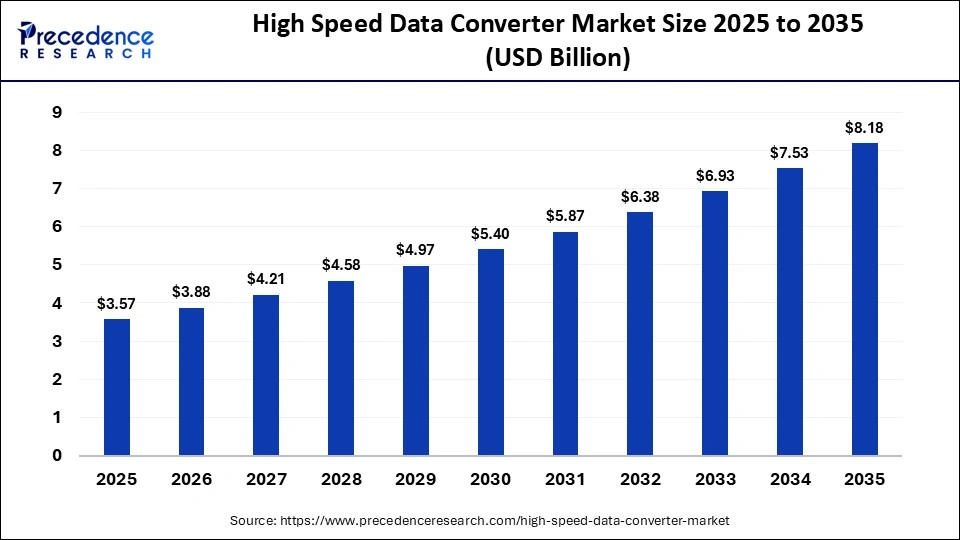
The global high speed data converter market size was calculated at USD 3.57 billion in 2025 and is predicted to increase from USD 3.88 billion in 2026 to approximately USD 8.18 billion by 2035, expanding at a CAGR of 8.64% from 2026 to 2035. The market is primarily driven by the increasing integration of AI/ML, growing digitalization, and the rollout of 5G automation.
Key Takeaways
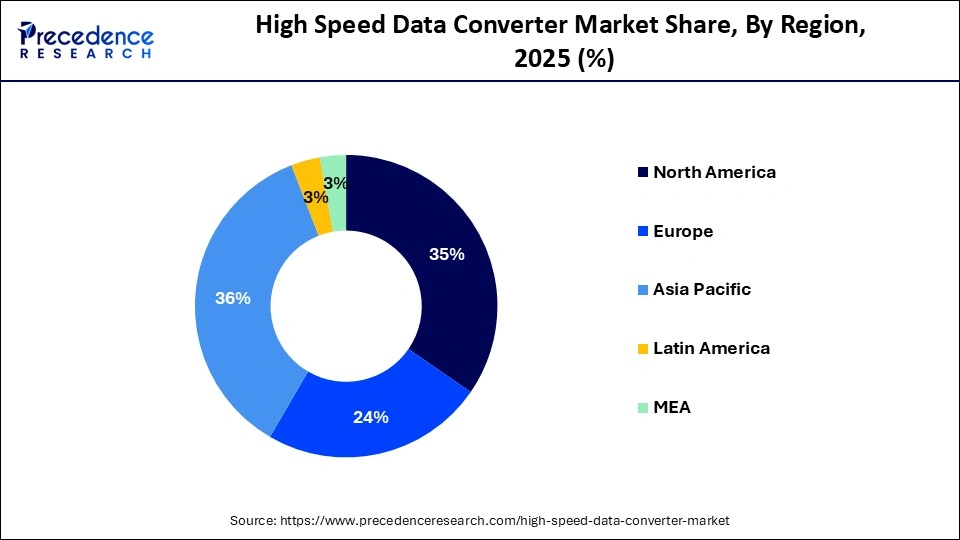
- Asia Pacific led the global high speed data converter market in 2025 with approximately 35.70% share and is projected to continue its upward trajectory in the coming years.
- By converter type, the analog-to-digital converters segment led the market with approximately 56.80% share in 2025.
- By converter type, the digital-to-analog converters segment is expected to grow at the fastest CAGR of 9.10% during the forecast period.
- By sampling rate, the 100 MSPS to 500 MSPS segment led the global market with approximately 28.70% share in 2025.
- By sampling rate, the above 10 GSPS segment is expected to grow at the highest CAGR of 12.80% in the coming years.
- By resolution, the 12-bit segment dominated the market with approximately 26.30% share in 2025.
- By resolution, the above 16-bit segment is observed to grow at a 11.90% CAGR between 2026 and 2035.
- By end use industry, the telecommunications segment held approximately 35.70% share in 2025 and is expected to grow at a 10.30% CAGR in the coming years.
- By integration type, the standalone data converter ICs segment led the global market with approximately 52.60% share in 2025.
- By integration type, the integrated system-on-chip converters segment is expected to grow at a robust CAGR of 10.80% during the projection period.
Market Overview
The high speed data converter market comprises integrated circuits that convert analog signals into digital data and digital signals into analog outputs at very high sampling rates and bandwidths. These devices include high-speed analog-to-digital converters and digital-to-analog converters used in communication infrastructure, radar systems, test equipment, medical imaging, and high-performance computing. The market includes standalone converters, integrated converter modules, and converter subsystems embedded within system-on-chip platforms supplied to semiconductor manufacturers, telecom operators, defense contractors, and electronic equipment producers.
How is Artificial Intelligence Impacting the High Speed Data Converter Market?
Artificial intelligence is accelerating growth across industries and improving monitoring capabilities in high-speed data converters. In edge computing, machine learning, and autonomous systems, AI-driven applications require highly accurate and rapid data processing, which significantly increases the need for advanced data converters. Moreover, a key focus is the integration of AI algorithms directly into converter architectures, enabling smarter, more adaptive signal processing using machine learning (ML) techniques, particularly neural networks, to enhance analog-to-digital converter (ADC) performance. Emerging innovations include AI-enabled smart converters, quantum and photonic integration, ultra-low-power designs, and monolithic integration approaches.
High Speed Data Converter Market Trends
- The integration of IoT, artificial intelligence, and machine learning in signal processing systems is accelerating, driving the demand for high-speed data converters that enable faster data analysis and real-time processing.
- The expansion of 5G networks, along with the widespread adoption of smart electronics, gaming, and streaming devices, is further increasing the need for high-speed data conversion and efficient signal processing.
- There is a strong push toward energy efficient high speed converters for edge AI, IoT devices, drones, and wearables, enabling long battery life without sacrificing performance. Techniques include dynamic power scaling and intelligent sampling control.
- The proliferation of IoT devices and edge computing is driving demand for real time data conversion and processing. High speed converters enable fast, accurate front end signal digitization, critical in industrial automation, smart cities, and sensor driven systems.
- As data traffic increases globally, with AI workloads, cloud computing, and real time analytics, high speed converters are increasingly required in data centers, enabling efficient analog to digital conversion for high performance networking equipment.
Market Scope
| Report Coverage | Details |
| Market Size in 2025 | USD 3.57 Billion |
| Market Size in 2026 | USD 3.88 Billion |
| Market Size by 2035 | USD 8.18 Billion |
| Market Growth Rate from 2026 to 2035 | CAGR of 8.64% |
| Dominating Region | Asia Pacific |
| Base Year | 2025 |
| Forecast Period | 2026 to 2035 |
| Segments Covered | Converter Type, Sampling Rate, Resolution, End Use Industry, Integration Type, and region |
| Regions Covered | North America, Europe, Asia-Pacific, Latin America, and Middle East & Africa |
Segment Insights
Converter Type Insights
High Speed Data Converter Market Share, By Converter Type, 2025-2035 (%)
| Converter Type | 2025 | 2035 | CAGR 2025 to 2035 |
| Analog-to-Digital Converters | 56.80% | 53.40% | 8.40% |
| Digital-to-Analog Converters | 43.20% | 46.60% | 9.10% |
How Does the Analog-to-Digital Converters Segment Dominate the Market in 2025?
The analog-to-digital converters segment dominated the high speed data converter market in 2025, accounting for about 56.80% share. This dominance is primarily attributed to the growing demand for high resolution, high speed data conversion in consumer electronics. As smartphones, digital cameras, and wearable devices become more advanced, manufacturers increasingly require ADCs that convert analog signals into digital data with greater precision and faster processing. ADCs function by periodically sampling an analog signal at a specific rate, known as the sampling rate or sampling frequency. By converting continuous analog inputs into discrete digital values, ADCs significantly influence the overall performance and efficiency of numerous electronic systems.
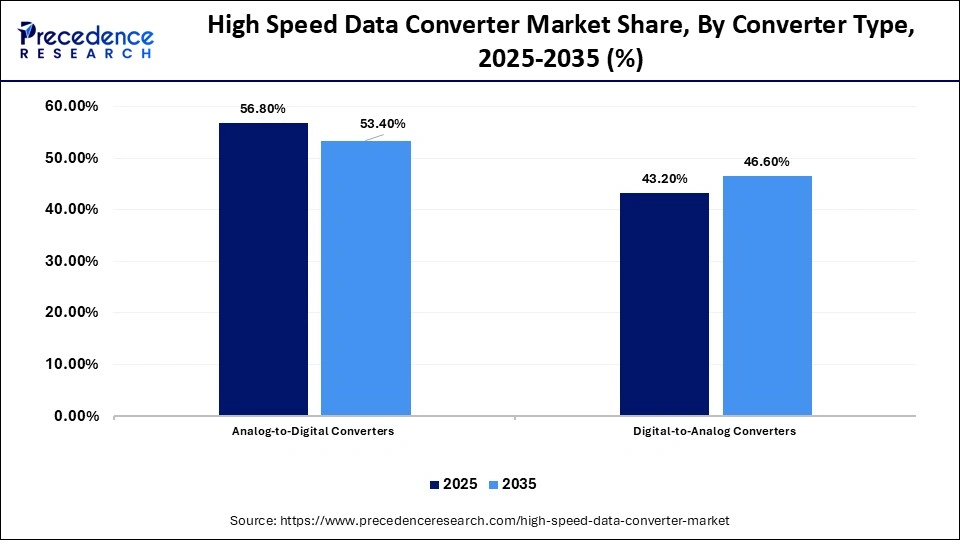
The digital-to-analog converters segment is expected to grow at a robust CAGR of about 9.10% in the coming years. This is primarily due to advances in telecommunications, including the rollout of 5G networks and the expansion of data centers, which together increase the demand for high-speed data processing. DACs convert digital signals into accurate analog signals, minimizing distortion and delivering a clearer frequency response. Many DACs also offer programmable features that can be customized to user preferences. When used to replace an internal converter, a digital-to-analog converter can significantly enhance the efficiency and quality of sound signal conversion, thereby supporting market growth.
Sampling Rate Insights
High Speed Data Converter Market Share, By Sampling Rate, 2025-2035 (%)
| Sampling Rate | 2025 | 2035 | CAGR 2025 to 2035 |
| Below 100 MSPS | 21.60% | 16.20% | 6.40% |
| 100 MSPS to 500 MSPS | 28.70% | 24.10% | 7.10% |
| 500 MSPS to 1 GSPS | 19.80% | 20.40% | 8.70% |
| 1 GSPS to 10 GSPS | 20.60% | 26.70% | 10.60% |
| Above 10 GSPS | 9.30% | 12.60% | 12.80% |
Why Did the 100 MSPS to 500 MSPS Segment Lead the Market in 2025?
The 100 MSPS to 500 MSPS segment led the high speed data converter market with approximately 28.70% share in 2025. This leadership is driven by its suitability for wideband, high resolution digital storage oscilloscopes. Converters in this range support high speed conversion applications across aerospace, defense, wireless communications, industrial systems, and test equipment, enabling system designs with industry leading high speed, high performance, and low power device options. Additionally, this range meets the requirements of many high volume applications that need accurate and reliable signal conversion, making it the preferred choice.
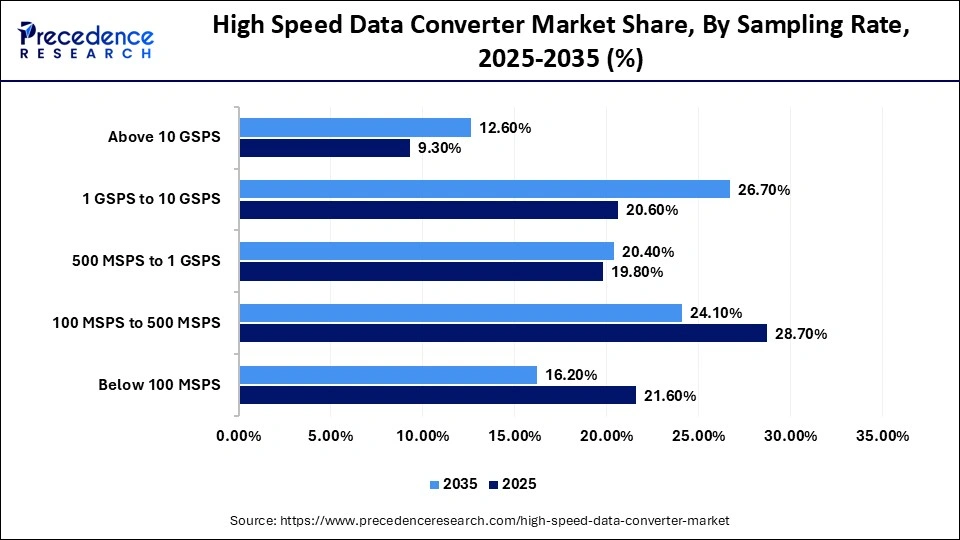
The above 10 GSPS segment is expected to grow at the fastest CAGR of 12.80% in the coming years, driven by the increasing demand for ultra-high-speed signal processing in advanced applications. This includes radar and electronic warfare systems, high-frequency communications (like mmWave and 5G/6G), high-speed instrumentation, and high-performance test and measurement equipment, where extremely fast sampling rates are critical to capture wideband signals accurately. Growth is also supported by advances in semiconductor technology, such as SiGe and advanced CMOS processes, which enable higher speeds without compromising resolution, and by the need for real-time data conversion in AI, defense, and next-generation communication systems.
Resolution Insights
High Speed Data Converter Market Share, By Resolution, 2025-2035 (%)
| Resolution | 2025 | 2035 | CAGR 2025 to 2035 |
| 8-bit | 17.60% | 14.30% | 6.40% |
| 10-bit | 20.40% | 18.60% | 7.10% |
| 12-bit | 26.30% | 24.70% | 8.70% |
| 14-bit | 19.20% | 21.80% | 10.60% |
| 16-bit | 11.60% | 14.10% | 12.80% |
| Above 16-bit | 4.90% | 6.50% | 11.90% |
What Made 12-bit the Leading Segment in the High Speed Data Converter Market?
The 12-bit segment led the market in 2025, holding approximately 26.30% share. The dominance of this segment is driven by the increasing demand for sophisticated data conversion capabilities in numerous high-performance applications. A 12-bit resolution provides sufficient accuracy for most communications, industrial, and instrumentation systems while supporting high sampling rates without excessive complexity or cost. Additionally, 12-bit converters are widely adopted in telecommunications, radar, medical imaging, and test & measurement equipment, where precise signal representation is essential but ultra-high resolution (14–16 bits) is not always necessary.
The above 16-bit segment is projected to grow at a CAGR of about 11.90% in the coming years, driven by its ability to address larger memory spaces and perform more complex calculations. Above 16-bit systems feature a wider data bus, enabling them to handle greater data volumes simultaneously. Rising demand for superior image quality in applications such as medical imaging, industrial inspection, and scientific research is further accelerating advances in high resolution imaging technologies. In addition, above 16 bit architectures have been used in gaming consoles like the Super Nintendo Entertainment System (SNES) and Sega Genesis, and today, above 16 bit processors are widely adopted in embedded systems due to their enhanced processing power and performance.
End Use Industry Insights
High Speed Data Converter Market Share, By End Use Industry, 2025-2035 (%)
| End Use Industry | 2025 | 2035 | CAGR 2025 to 2035 |
| Telecommunications | 35.70% | 39.80% | 10.30% |
| Aerospace and defense | 23.40% | 22.60% | 8.70% |
| Healthcare | 11.80% | 10.30% | 7.40% |
| Semiconductor manufacturing | 10.20% | 11.70% | 9.80% |
| Industrial electronics | 13.60% | 11.80% | 7.20% |
| Research laboratories | 5.30% | 3.80% | 6.30% |
Why is the Telecommunications Segment Dominating the Market?
The telecommunications segment dominated the high speed data converter market with a share of approximately 35.70% in 2025 and is projected to grow at a CAGR of around 10.30% throughout the forecast period. This is because telecom infrastructure, especially 5G, fiber-optic networks, and next-generation wireless systems, requires high-speed, high-accuracy ADCs and DACs to handle wideband signals and massive data throughput. High-speed converters enable real-time signal digitization, low-latency processing, and efficient transmission, which are critical for base stations, network equipment, and mobile devices. Additionally, the rapid global rollout of 5G networks and ongoing investments in high-speed broadband and wireless communication systems continue to drive strong demand for high-speed data converters in the telecommunications industry.
Integration Type Insights
High Speed Data Converter Market Share, By Integration Type, 2025-2035 (%)
| Integration Type | 2025 | 2035 | CAGR 2025 to 2035 |
| Standalone Data Converter Ics | 52.60% | 46.30% | 7.90% |
| Converter Integrated System-On-Chip | 31.70% | 38.60% | 10.80% |
| Converter Modules And Subsystems | 15.70% | 15.10% | 8.40% |
How Does the Standalone Data Converter ICs Segment Lead the Market in 2025?
The standalone data converter ICs segment led the market in 2025 with approximately 52.60% share. This is because these ICs offer flexibility, ease of integration, and broad applicability across multiple systems. Unlike integrated or co-packaged solutions, standalone converters can be customized for specific signal chains and performance requirements, making them ideal for telecommunications, industrial instrumentation, test & measurement, and medical imaging applications. Additionally, their proven reliability, availability in a wide range of sampling rates and resolutions, and compatibility with existing system architectures make them the preferred choice for high-volume adoption, contributing to their dominant market position.
The integrated system-on-chip converters segment is expected to grow at a CAGR of approximately 10.80% over the forecast period. This growth is fueled by their enhanced performance, decreased power consumption, and minimized space requirements. They consolidate all essential components of a system onto a single silicon chip, thereby removing the necessity for separate, cumbersome parts. This integration streamlines circuit board design and enhances power efficiency and speed while maintaining functionality. With features that support next-generation solutions, this segment is anticipated to experience significant growth.
Regional Insights
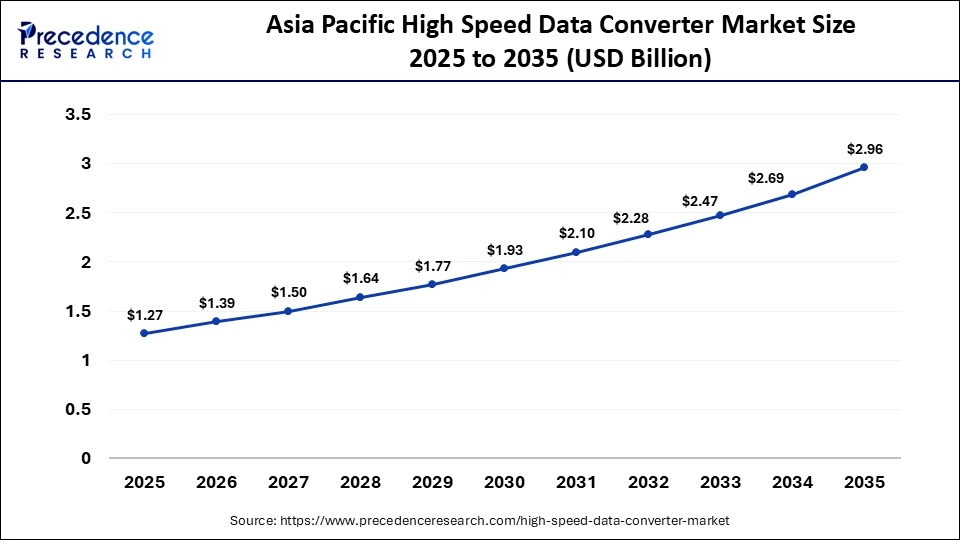
Asia Pacific High Speed Data Converter Market Size and Growth 2026 to 2035
The Asia Pacific high speed data converter market size is estimated at USD 1.27 billion in 2025 and is projected to reach approximately USD 2.96 billion by 2035, with a CAGR of 8.83% from 2026 to 2035.
What Makes Asia Pacific the Leading Region in the High Speed Data Converter Market?
Asia Pacific led the high speed data converter market in 2025, holding approximately 35.70%, and is anticipated to grow at the fastest rate during the forecast period. This is mainly due to the robust presence of industries such as telecommunications, consumer electronics, and automotive electronics, and a focus on industrial automation. The rising adoption of smartphones, tablets, smart TVs, and other connected devices necessitates advanced data converters for effective signal processing, thereby contributing to market expansion.
The rapid expansion of the consumer electronics industry in nations like China, Japan, South Korea, and India further contributes to market growth. China and India are at the forefront of the telecommunications industry. China is actively enhancing its telecommunications infrastructure, including a significant rollout of 5G technology, while India is witnessing the rise of local companies specializing in data converter technology. Continuous advancements in semiconductor fabrication technology, including the implementation of cutting-edge processes such as FinFET (fin field-effect transistor) technology, are facilitating the creation of more power-efficient and compact converters.
How is the Opportunistic Rise of North America in the High Speed Data Converter Market?
North America is expected to grow at a significant rate during the forecast period, driven by several strategic factors. The region benefits from a well-established telecommunications infrastructure, rapid 5G rollout, and advanced data center networks, which create strong demand for high-speed ADCs and DACs. Additionally, heavy investments in defense, aerospace, and industrial automation, along with leading semiconductor R&D and technology innovation, enable North American companies to develop cutting-edge, high-performance converters. Favorable regulatory support, strong intellectual property protection, and high adoption of AI and IoT technologies further reinforce the region's market leadership and growth opportunities.
U.S. High Speed Data Converter Market Trends
The U.S. market is driven by the increasing number of outpatient procedures, strict clinical guidelines, and the rising use of alcohol–chlorhexidine combination products. Hospitals are investing heavily in infection control initiatives to reduce readmission rates and lower healthcare costs. The growing focus on value-based care models is further promoting the adoption of effective preoperative skin preparation practices.
High Speed Data Converter Market Value Chain Analysis
- Raw Material Sourcing
Entails a sophisticated supply chain of semiconductor materials, advanced dielectric components, and high-performance packaging substrates worldwide.
Key Players: Shin-Etsu Chemical, SUMCO Corporation, GlobalWafers
- Component Fabrication and Machining
Incorporate cutting-edge semiconductor fabrication for silicon dies and precise mechanical processing for housings and interconnects.
Key Players: Cosmos, Zetwerk, STMicroelectronics
- Testing and Certification
Entail stringent performance validation to dynamic specs and standards, ensuring consistent reliability in high-bandwidth operations.
Key Players: Advantest Corporation, TÜV Rheinland, UL Solutions
- Installation and Commissioning
Prioritize signal integrity with optimized PCB layouts and thorough verification of timing-aligned digital interface synchronization.
Key Players: Texas Instruments (TI), Analog Devices (ADI)
- Distribution
Operate a layered B2B semiconductor distribution model serving large-scale industrial buyers and specialized prototyping requirements.
Key Players: DigiKey, Mouser Electronics, Arrow Electronic
- Maintenance
Emphasizes preserving environmental stability and optimizing firmware performance, instead of performing traditional mechanical repair activities.
Key Players: Synopsys, PLC System Repair Services
- Product Lifecycle Management
Implements cradle-to-grave lifecycle strategies for complex silicon design, enduring supply stability, and unavoidable obsolescence management.
Key Players: Analog Devices, Inc. (ADI), Texas Instruments (TI), Microchip Technology
High Speed Data Converter Market Companies
- Analog Devices
- Texas Instruments
- Infineon Technologies
- Renesas Electronics
- STMicroelectronics
- NXP Semiconductors
- Microchip Technology
- Broadcom
- Intel
- Qualcomm
- ROHM Semiconductor
- Skyworks Solutions
- Marvell Technology
- ON Semiconductor
- Cirrus Logic
Recent Developments
- In October 2024, Flex Power Modules launched new Intermediate Bus Converters (IBC) for data centers supporting AI, machine learning, and cloud applications, expanding its portfolio of digital, non-isolated, unregulated IBCs to enhance operational efficiency and design flexibility.(Source: https://flex.com)
- In 2025, Consistent Infosystems, a security, surveillance, and consumer electronics brand, expanded its networking portfolio with the launch of its latest innovation, the Ethernet Media Converter, a versatile, high-performance solution designed to ensure seamless data transmission across diverse network media types.(Source: https://www.itvoice.in)
Segments Covered in the Report
By Converter Type
- Analog-to-Digital Converters
- Digital-to-Analog Converters
By Sampling Rate
- Below 100 MSPS
- 100 MSPS to 500 MSPS
- 500 MSPS to 1 GSPS
- 1 GSPS to 10 GSPS
- Above 10 GSPS
By Resolution
- 8-bit
- 10-bit
- 12-bit
- 14-bit
- 16-bit
- Above 16-bit
By End Use Industry
- Telecommunications
- Aerospace and defense
- Healthcare
- Semiconductor manufacturing
- Industrial electronics
- Research laboratories
By Integration Type
- Standalone data converter ICs
- Converter integrated system-on-chip
- Converter modules and subsystems
By Region
- North America
- Latin America
- Europe
- Asia-pacific
- Middle and East Africa
For inquiries regarding discounts, bulk purchases, or customization requests, please contact us at sales@precedenceresearch.com
Frequently Asked Questions





Ask For Sample
No cookie-cutter, only authentic analysis – take the 1st step to become a Precedence Research client
 Get a Sample




 sales@precedenceresearch.com
 Schedule a Meeting
