



Hypothermic Machine Perfusion Market Size, Key Companies, Company Market Share, Organ Transplant Volume, Technology Adoption, Pricing Analysis, Regulatory Landscape, Competitive Positioning, and Demand Forecast
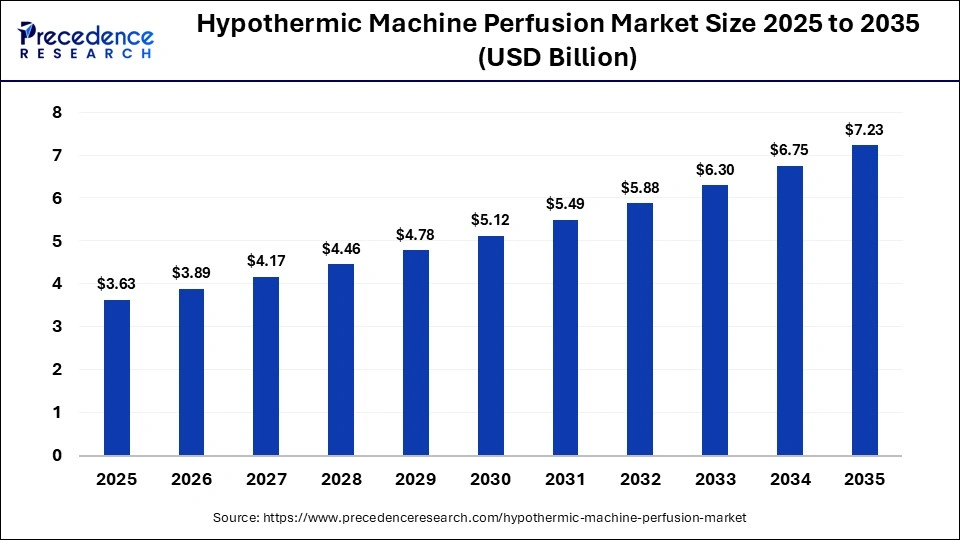
Deepa Pandey, a Healthcare Industry Expert, highlights that the hypothermic machine perfusion market has reached USD 3.89 billion in 2026 and is on track to reach USD 7.23 billion by 2035, advancing at a CAGR of 7.14%. Key hypothermic machine perfusion market companies shaping the market include Organ Recovery Systems, XVIVO Perfusion AB, Paragonix Technologies, while major growth segments span by type, by application, by end user, and region.
Source: https://www.precedenceresearch.com/hypothermic-machine-perfusion-market
 Get a Sample
 Table Of Content


What is the Hypothermic Machine Perfusion Market Size?
The global hypothermic machine perfusion market size accounted for USD 3.63 billion in 2025 and is predicted to increase from USD 3.89 billion in 2026 to approximately USD 7.23 billion by 2035, expanding at a CAGR of 7.14% from 2026 to 2035. The hypothermic machine perfusion market is driven by rising organ transplant demand and the need to improve donor organ preservation and outcomes.
Market Highlights
- North America accounted for the largest market share in 2025.
- The Asia Pacific is expected to grow at the fastest CAGR between 2026 and 2035.
- By type, the product segment held the major market share in 2025.
- By type, the services segment is growing at a CAGR between 2026 and 2035
- By application, the liver transplant segment contributed the significant share in 2025.
- By application, the kidney transplant segment is poised to grow at a notable CAGR between 2026 and 2035
- By end-user, the hospitals segment held a significant share in 2025.
- By end-user, the transplantation centers segment is anticipated to show considerable CAGR between 2026 and 2035
Redefining Organ Preservation: How Innovation is Transforming the Hypothermic Machine Perfusion Market
The hypothermic machine perfusion market is transforming organ preservation by allowing the organ to be kept continuously and under controlled conditions at low temperatures, greatly increasing the viability of the grafts over the previous, common, cold-based storage of organs. HMP systems pump oxygenated preservation fluids into organs, permitting metabolic and waste transport over organs as well as real-time evaluation of organ activities before transplantation. This technology has been more critical with transplant programs depending more on marginal and extended-criteria organs of the donor to overcome the global organ shortage.
Hypothermic machine perfusion is increasingly acceptable in liver, kidney, and other solid organ transplants by alleviating ischemia-reperfusion injury and enhancing the post-transplant outcome. The market has been experiencing stable growth as a result of the growth in the transplantation levels and the growth in awareness of the clinicians, as well as the fast rate of technological development in the form of portable perfusion machines, integrated sensors, and digital monitoring systems, which have improved the clinical decision-making and operational efficiency. Also, positive reimbursement policies in the developed markets and increasing government programs to enhance organ donation and transplantation are expediting adoption.
Key AI Integration in the Hypothermic Machine Perfusion Market
The hypothermic machine perfusion market is being changed by the introduction of AI to the hypothermic machine, which allows more intelligent decisions to be made based on data. Clinicians can use AI models to make informed decisions with respect to acceptance because they predict graft function, the risk of ischemia-reperfusion injury, and post-transplant outcomes. High-tech analytics help to control the perfusion automatically by creating the best conditions for various types of organs and preventing human error. Also, the AI is used to enable individualized preservation regimes, depending on the nature of the donor and organ state. With the move toward the digital platform by transplant centers, AI-based dashboards and data sharing on the cloud contribute to standardization and clinical cooperation.
Hypothermic Machine Perfusion Market Outlook
- Industry Growth Overview: The increasing cases of end-stage organ failure and lack of viable donor organs are the stimulating factors of growth. More hospitals and transplant centers are embracing the use of hypothermic machine perfusion to enhance the survival rates of grafts.
- Global Expansion: North America and Europe are the most adopted because of well-developed transplant infrastructure and reimbursement. The Asia-Pacific region is developing at a high rate and is backed by the spread of healthcare systems and transplant programs.
- Major Investors: The major investors are such established medtech firms as OrganOx, XVIVO Perfusion, and TransMedics. Investments are also on the rise to aid innovation and commercialization by venture capital and strategic healthcare funds as well.
- Startup Ecosystem: New companies such as Organ Assist and Bridge to Life are working on the next-generation perfusion systems and consumables. Biotech startups and academic spin-offs are increasingly becoming vital when it comes to the development of preservation methods.
Market Scope
| Report Coverage | Details |
| Market Size in 2025 | USD 3.63 Billion |
| Market Size in 2026 | USD 3.89 Billion |
| Market Size by 2035 | USD 7.23 Billion |
| Market Growth Rate from 2026 to 2035 | CAGR of 7.14% |
| Dominating Region | North America |
| Fastest Growing Region | Asia Pacific |
| Base Year | 2025 |
| Forecast Period | 2026 to 2035 |
| Segments Covered | Type, Application, End User and Region |
| Regions Covered | North America, Europe, Asia-Pacific, Latin America, and Middle East & Africa |
Segments Insights
Type Insights
Why Does the Product Segment Lead the Hypothermic Machine Perfusion Market?
The product segment dominated the largest market share in 2025, due to the need for physical equipment and consumables in preserving organs. High-value capital equipment, like portable and stationary perfusion machines, is necessary in the process of maintaining the viability of organs during the storage and transportation process. Also, the development of technology, automated flow control, in-built sensors, and data analytics has contributed to even more uptake of systems. Reagents and consumable items play an important role with recurrent demand; preservatives, tubing, and cartridges are needed with every perfusion procedure. The products have a maximum inhibition and reduction in the metabolism and ischemic damage, which in turn influences the success of transplantations directly.
The services segment of the hypothermic machine perfusion market is expected to achieve a considerable CAGR during the forecast period due to the increasing complexity of the perfusion technologies and the necessity to possess special knowledge. With newer HMP systems being implemented at transplant centers, there is an increasing demand for installation, maintenance services, calibration, and technical support services to keep the operations flowing without any interruption and being compliant. Moreover, training and education services are becoming increasingly significant because surgeons, transplant coordinators, and technicians need practical instruction to be able to use perfusion systems correctly and interpret perfusion data properly. The growth of organ transplant institutions in the developing economies, where there can be a shortage in expertise, can further increase the urge to outsource.
Application Insights
Why Did Liver Transplant Contribute the Most Revenue in 2025?
The liver transplant constituted the largest revenue share in the hypothermic machine perfusion market during 2025, because the liver is very sensitive to ischemic damage and can be kept at temperatures below 40°C. Compared to other organs, livers are more susceptible to ischemia-reperfusion injury, particularly marginal and extended-criteria donor organs, and therefore, novel preservation methods are necessary. Hypothermic machine perfusion is associated with preserving cellular integrity, minimizing metabolic stress, and improving post-transplantation graft, and it is highly adopted in liver transplantation. Also, liver diseases like cirrhosis, hepatitis, and non-alcoholic fatty liver disease have burdened the world greatly, further stressing the need to have liver transplants. HMP is also being increasingly used to enlarge the donor pool in transplant centers, as it preserves more donor organs that are considered risky.
The kidney transplant segment is expected to grow substantially in the hypothermic machine perfusion market, owing to the escalating prevalence of end-stage renal disease (ESRD) in the world. The rising prevalence of diabetes and hypertension has greatly promoted the number of patients undergoing kidney transplants, scrambling and forcing healthcare systems to maximize the use of organs. Improved preservation of kidneys, especially those of elderly or donation-after-circulatory-death (DCD) donors, is possible through hypothermic machine perfusion by decreasing delayed graft function. HMP offers continuous perfusion and real-time evaluation of renal viability as compared to the use of cold storage, enhancing the success of transplantation and decreasing postoperative morbidity. Since the transplant programs seek to ensure more successes with reduced costs of installing dialysis in the long term, the use of HMP in preserving kidneys is soaring.
End-user Insights
Why Did the Hospitals Segment Lead the Hypothermic Machine Perfusion Market in 2025?
The hospital market dominated the hypothermic machine perfusion market during 2025 and contributed the highest share of revenues in 2025. Having transplant units, intensive care units, and competent multidisciplinary teams that may be required to sustain organs and transplant the patient is a common feature of large multi-specialty and tertiary care hospitals. These hospitals can more readily afford hypothermic machine perfusion systems, which are costly, and reagents and consumables. The presence of diagnostic, surgical, and postoperative care facilities within the hospital also contributes to the implementation of HMP technologies into hospital processes. The presence of favorable reimbursement systems in the developed markets and growing governmental assistance to the transplant programs have also boosted hospital-based adoption, strengthening the market.
The transplantation centers segment is expected to grow at a significant CAGR over the forecast period, since organ transplantation will be more centralized in specialized centers. Specialized transplant centers are also specialized in organ procurement, preservation, and transplantation and allow a greater efficiency of the procedure and clinical outcomes. An increase in investments in free-standing transplant institutions, especially in the developing economies, as governments and the private sectors are consolidating specialized healthcare facilities, also supports growth. Highly trained staff and standardized procedures are also an advantage to the transplant centers, making them the ideal place to use HMP regularly. Additionally, device makers together with transplant centers are working together to train, conduct clinical trials, and upgrade devices to speed up adoption.
Regional Insights
Why Did North America Lead the Global Hypothermic Machine Perfusion Market in 2025?
North America held the dominating share of the hypothermic machine perfusion market in 2025, due to a highly developed transplantation ecosystem and early use of revolutionary organ preservation technologies. The region has a strong flow of organ transplantation procedures that are caused by the growth of end-stage renal, liver, and cardiac diseases. The clinical evidence on the effectiveness of hypothermic machine perfusion over the use of static cold storage has increased its use in larger transplant centers. Also, North America has some of the major manufacturers of medical devices and technology innovators that are investing in R&D and clinical trials. Growth in collaboration between hospitals, research institutions, and industry players has enhanced clinical adoption to make North America the best-developed and most commercial HMP market in the world.
U.S Hypothermic Machine Perfusion Market Analysis
The U.S. is the biggest market contributor to hypothermic machine perfusion in North America, and this is facilitated by its strong transplant infrastructure and high organ use rates. An increase in the scarcity of donor organs has compelled transplant centers to consider implementing the use of HMP systems to increase the organ viability and increase the pool of donors, including marginal and extended-criteria donors. The development of a better understanding of enhanced graft survival and minimized delayed graft function among clinicians has increased its adoption. The market is also reinforced by the existence of major manufacturers, good venture capital investment, and sustained innovation in perfusion technology. Also, the adoption of digital monitoring and AI-driven analytics of perfusion devices is becoming popular within the U.S. market.
Why is Asia Pacific undergoing the Fastest Growth in the Hypothermic Machine Perfusion Market?
Asia Pacific is estimated to grow at the fastest CAGR during the forecast period, due to the swift healthcare growth and increasing transplantation demand. Adoption is being driven by rising cases of chronic kidney and liver diseases, as well as the availability of more sophisticated medical technologies. The governments of the region are spending much on organ transplant programs, health facilities, and enlightenment programs. China, Japan, South Korea, and India are among the nations where the transplant procedures are becoming steadily more frequent and require effective organ preservation solutions. Besides, the increased medical tourism and collaborations with other international medtech companies are hastening the transfer of technology.
China Hypothermic Machine Perfusion Market Trends
China is becoming one of the main growth drivers in the hypothermic machine perfusion market in the Asia Pacific due to its fast-growing infrastructure of transplantation and government-sponsored programs. Policies and reforms in the field of organ donation and the creation of a national system of allocating organs have increased the transplant volumes significantly. The increase in investments in advanced transplantation hospitals and centers across tertiary hospitals is fueling the demand for advanced technologies of organ preservation. The awareness creation among the surgeons on quality improvement of grafts and the mitigation of post-transplant complications is also favoring uptake. With the ongoing modernization in the Chinese healthcare system, the use of hypothermic machines in the perfusion process will increase over time.
Hypothermic Machine Perfusion Market Value Chain Analysis
Recent Developments
- In November 2025, Organ Recovery Systems revealed that 10-year follow-up data in a clinical trial of 672 kidney transplant recipients conducted by Moers et al. in 2009 had been published by the New England Journal of Medicine. The results added to the long-term effectiveness of hypothermic machine perfusion with the help of the LifePort Kidney Transporter in enhancing transplant results. (Source: https://finance.yahoo.com)
- In January 2025, Paragonix Technologies stated the completion of the first human cases to use its FDA-approved KidneyVault Portable Renal Perfusion System. This is a major step towards carrying out a kidney preservation on a portable and perfusion basis. (Source: https://paragonixtechnologies.com)
Who are the Major Players in the Global Hypothermic Machine Perfusion Market?
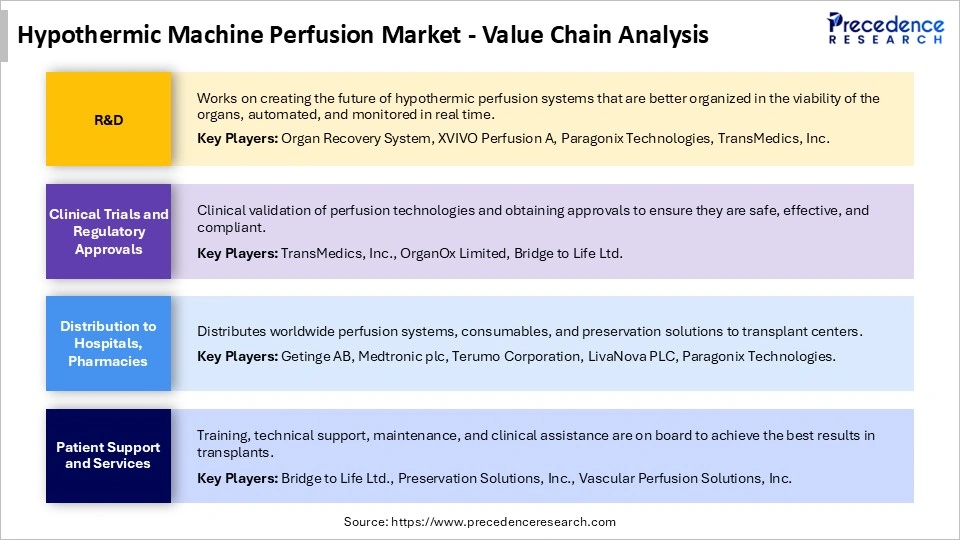
The major players in the hypothermic machine perfusion market include Organ Recovery Systems, XVIVO Perfusion AB, Paragonix Technologies, TransMedics, Inc., Bridge to Life Ltd., Institut Georges Lopez (IGL), Vascular Perfusion Solutions, Inc., Getinge AB, Medtronic plc, LivaNova PLC, Terumo Corporation, Preservation Solutions, Inc., OrganOx Limited, Waters Medical Systems LLC, and Preservation Sciences Inc.
Segments Covered in the Report
By Type
- Product
- Systems
- Reagents & Consumables
- Services
By Application
- Liver Transplant
- Heart Transplant
- Kidney Transplant
- Others
By End-user
- Hospitals
- Transplantation Centers
- Others
By Region
- North America
- Europe
- Asia-Pacific
- Latin America
- Middle East & Africa
For inquiries regarding discounts, bulk purchases, or customization requests, please contact us at sales@precedenceresearch.com
Frequently Asked Questions





Ask For Sample
No cookie-cutter, only authentic analysis – take the 1st step to become a Precedence Research client
 Get a Sample
.webp)



 sales@precedenceresearch.com
 Schedule a Meeting
