



In-Mold Electronics Market Size, Key Companies, Company Market Share, Chip Production Volume, Wafer Capacity, Technology Adoption, Pricing Trends, Competitive Positioning, and Demand Analysis
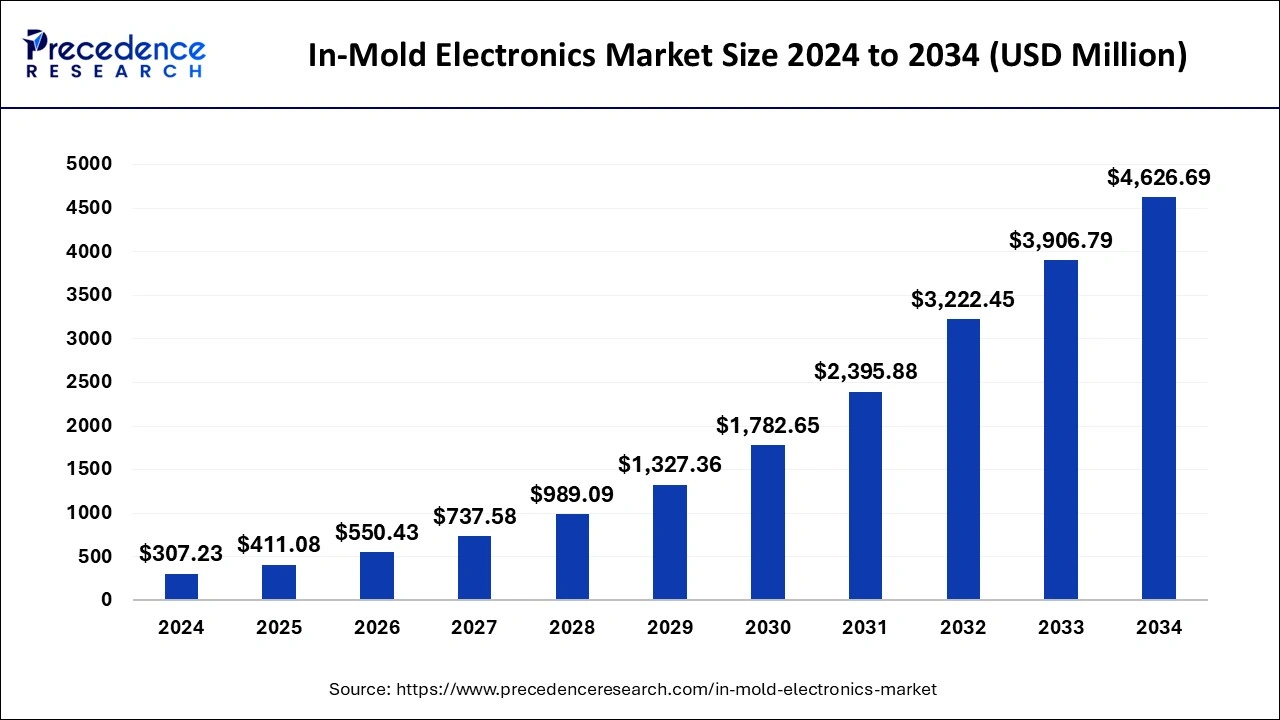
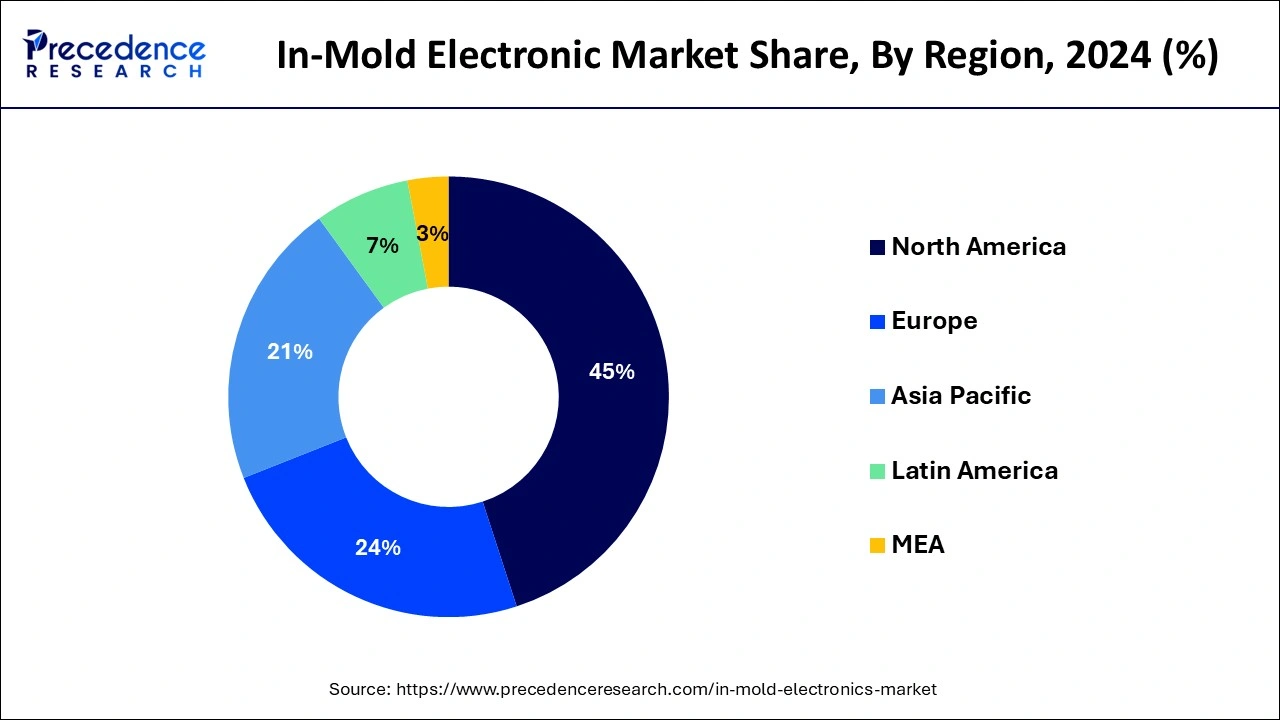
The global in-mold electronics market is projected to grow from USD 550.43 million in 2026 to USD 4,626.69 million by 2034, registering a CAGR of 29.19%. Growth is driven by rising demand for lightweight and flexible electronics, advanced human-machine interfaces, increasing adoption across automotive, consumer electronics, healthcare, and aerospace, and AI-powered manufacturing that improves quality control, predictive maintenance, and production efficiency. North America dominated the market in 2025 with a 45% share, supported by strong adoption of innovative technologies, while Asia Pacific is expected to witness solid growth due to its large electronics manufacturing base, rising consumer electronics demand, expanding automotive sector, and favorable government policies.
Source: https://www.precedenceresearch.com/in-mold-electronics-market
 Get a Sample
 Table Of Content


What is Driving the Growth of the In-Mold Electronics Market?
The global in-mold electronics market size was estimated at USD 411.08 million in 2025 and is anticipated to reach around USD 4,626.69 million by 2034, expanding at a CAGR of 29.19% from 2024 to 2034. The increasing production of electronic devices is a major factor boosting the growth of the market during the forecast period.
In-Mold Electronics Market Key Takeaways
- North America dominated the global in-Mold electronic market with the largest market share of 45% in 2025.
- Asia Pacific is expected to expand at a solid CAGR during the forecast period.
- By ink type, the silver conductive segment dominated the market in 2025.
- By ink type, the carbon segment is projected to grow at a notable CAGR during the forecast period.
- By application, the consumer products segment generated the highest market share in 2025.
- By application, the automotive segment is expected to expand at the fastest CAGR during the forecast period.
Market Overview
In-mold electronics is a part of the manufacturing process involving touch sensors and electronics insertion in the molded plastic component. This is a crucial connective part of electronic gadgets, appliances and cars that highly relies on the right indication for smooth operations. The role of the inks highlights the printing efforts of the technical team to ensure the readability and navigation spots meet the customers' needs. The sensitive printing, mounting, shaping and molding process promotes the compact yet effective innovation mandatory in the advanced electrifying products. This compact circuit embedding works effective to the systems already operating with other high-voltage batteries and system integration. This molding idea is a space-saving innovation with sustainable grades and durability promises. This innovation requires less space and material as well, which eventually promotes eco-friendly approaches. The automotive industry is a fundamental contributor to the market.
Impact of AI on the In-Mold Electronics Market
Artificial intelligence (AI) is revolutionizing the in-mold electronics market. AI improves the manufacturing processes of in-mold electronics by automating and monitoring processes in real-time. It also helps in quality control and predictive maintenance. Manufacturers of in-mold electronics are increasingly leveraging AI to optimize processes, improve product quality, and boost productivity. AI also assists in detecting any potential defects in in-mold electronics and ensures better quality while reducing wastage during production.
In-Mold Electronics Market Trends
- AI in Electronic Production: The production procedure can be streamlined by using automation to manage constant work, such as testing and assembling. Generally, it is time-consuming and needs repeated work. Industrial automation is a necessary revolution that has occurred in recent years. By just automating the manufacturing procedure, time can be effectively tracked, and the complete quality can be ensured.
- Internet of Things (IoT): By linking the sensors and devices, IoT develops predictive maintenance on the flow. It assists in lowering system breakdowns and thus regulates the constant work. Data analytics procedures need to analyze and collect excessive amounts of data in order to update data-driven decision-making with high accuracy and updated manufacturing.
- 3D Printing: The 3D printing technology has additive production, in which objects are constructed in a 3D structure to create digital designs by adding various surfaces to construct the design of the respective objects. By passing the regular methods, 3D printing technology has developed complex textures by using fewer materials.
- Miniature Electronics: Miniature electronics are constantly building the demand for production and designing compact machines that are optimized for the hand. They also manage the functionality and effectiveness of the device. System-in-package (SIP) and Integrated circuits (ICs) solutions are the semiconductors utilized in the current period.
- Organic Electronics: Carbon-dependent compounds are utilized to create electronic devices that generate sensors and solar cells, and such are the allowed uses of organic electronics. The materials that use different characteristics to deliver complete current solutions are present in a variety of sectors, including healthcare and consumer electronics. The application of environmentally friendly materials and lower energy is quite prevalent among sustainable production practices. Organic electronics always gives priority to sustainable products.
In-Mold Electronics Market Growth Factors
- The rising demand for flexible and lightweight products significantly boosts the growth of the market. In-mold electronics (IME) reduce the weight and dimensions of the final product. IMEs are nearly 50% lighter than standard electronics due to the absence of mechanical switches and buttons.
- The rise in per capita income of individuals and rising consumer inclination toward cutting-edge electronic devices are expected to drive market growth.
- The rising popularity of human-machine interface (HMI) applications in automotive, aerospace, and medical equipment positively impact the market.
Market Outlook
- Industry Growth Overview: The in-mold electronics market is experiencing constant growth due to commendable advancements in the automotive and manufacturing sectors. 3D molded plastic marks an incredible footprint in printed circuit boards. The reach of wearable medical devices has doubled the production of the molded solutions, which are allowing circuit and sensor advances to fit in the mechanical switches.
- Sustainability Trends: The sustainability criteria for this market is with the co-existing efforts of the material experts. The repairing process of the encapsulated circuits is contributing to the environment, which encourages the market leaders to practice green initiatives for the market's progressive development.
- Global Expansion: The global expansion of the molding solution is visibly impactful in EV innovation and consumer goods. The different techniques in a molding perfection, involving design preferences promotes range of remarkable flexible innovations. The miniaturized development is a best-in-class progress in the consumer electronics portfolio that promotes market intensity.
Strategic Growth Opportunities
- High Growth Commercial Opportunities
The commercial opportunities of the market lie in the interconnected advances in popular industries like healthcare, automotive and consumer goods. The molding specialization is a part of the robust manufacturing operations that highlights the perfection of the embedded modernization to the ready molded plastic parts. - Technology Investment Opportunities
The technology investment is a hype to the mechanism dynamics of the market that brings momentum into the electrifying limelight. Following this, the existing integrated technologies are unlocking the next-generation tech solution in the market mission and vision. - Geographic Expansion Opportunities
The geographic expansion is boosted by the range of electronic products and vehicle craze across the regional population. This demand accelerates the adoption of the molding innovation to complete the high-performance manufacturing process.
Market Report Coverage and Key Metrics
| Report Coverage | Details |
| Market Size in 2025 | USD 411.08 Million |
| Market Size in 2026 | USD 550.43 Million |
| Market Size by 2035 | USD 4,626.69 Million |
| Growth Rate From 2026 to 2035 | CAGR of 29.19% |
| Largest Market | North America |
| Base Year | 2025 |
| Forecast Period | 2026 to 2035 |
| Segments Covered | Ink Type, Application, Region |
| Regions Covered | North America, Europe, Asia-Pacific, Latin America, and Middle East & Africa |
Market Dynamics
Driver
Increasing demand from various industries
There is a high demand for in-mold electronics (IME) in various industries, such as automotive, aerospace, consumer electronics, and healthcare, which is expected to drive the growth of the in-mold electronics market in the coming years. IME technology is widely used to design advanced HMIs, such as touch-sensitive dashboards, control panels, and integrated lighting. It eliminates the need for traditional mechanical buttons, connectors, and wires and provides a button-free interface. The rising production of consumer electronics such as smartphones, tablets, and laptops further contributes to market growth. Traditionally, the assembling of electronics was a time-consuming process. However, with the introduction of the in-mold electronics, the excess time consumed has been reduced significantly that improves the output of the manufacturing or the assembly units. The in-mold electronic technologies are increasingly used in consumer electronic devices such as dryers, washing machines, dishwashers, automotive consoles, and smartphones.
The growing popularity of touchscreen switches due to the increased safety and elimination of frail or torn mechanical switches is another major factor boosting the market's growth. The adoption of in-mold electronics is rising in various end-use applications as it offers benefits like reduction of weight and facilitates the convenient processing of molding operations. The use of in-mold electronics offers cost reduction and design flexibility. It improves productivity, which is a major factor behind the increasing demand for in-mold electronics among various industry players.
Restraint
High production cost
Producing in-mold electronics requires specialized equipment and materials, which significantly increases the production cost. Moreover, complexities in integrating electronics into molded structures lead to slower adoption in various industries, hampering the market's growth.
Opportunity
Technological advancements
Rising technological advancement in in-mold electronics creates lucrative opportunities in the in-mold electronics market. In-mold electronics (IMEs) involve the process of incorporating electronic elements into molded plastic objects. IME technology can transform the way 3D objects are manufactured for home appliances, aerospace, consumer electronics, automotive, and other applications. Technological advancement can result in the development of flexible and lightweight products, cost savings, and achieving lighter, functional, and visually appealing pieces. Moreover, technological advancements in the capacitive touch sensors in various consumer electronic devices are fostering the market's growth.
Market Segmentation Analysis
Ink Type Insights
How the Silver Conductive Segment Dominated the In-Mold Electronics Market?
The silver conductive segment dominated the market in 2025. This is driven by eco-friendly options, which are prevalently used in biomedical electronics. Such effective outcomes and their potential to receive various sensitivity and resistance surfaces by adjusting their respective ratios make them particularly ideal for or in-Bosu uses such as patches, health monitoring, and sensors. The general applications where silver conductive inks are used are alternative energy solutions, aerospace electronics, automotive sensors, and RFID tags.
The carbon conductive segment is expected to witness the fastest CAGR during the forecast period due to its chemical inertness, a reason behind printing conductors and resistors printed on non-conductive materials like ceramics, plastics, and paper. Carbon-dependent inks are applicable for uses such as resistors, windshield defrosters, capacitive sensors, and computer keyboards in which stability and conductivity are needed.
Application Insights
How the Consumer Products Segment Dominated the In-Mold Electronics Market?
The consumer products segment dominated the market in 2025 due to the application of blow molds that are prevalently used. They are necessary for the manufacturing of lightweight plastic elements such as housings and bottles. The development of the urge for sustainable products is driving the invention of the blow molding procedure. Furthermore, smart plastic components filled with embedded electronics show a major step towards product manufacturing and design. By lowering the dependency on regular PCBA, it allows refined and adjustable designs, which have revealed advanced working, and thus serves both durability and cost advantages.
The automotive segment is expected to witness the fastest CAGR during the forecast period, which is driven by insert molding encapsulating metal factors that are directly present inside during the injection cycle. Engineers keep threaded electronic contacts pr inserts into a mold even before the resin flows. Such procedures are absolutely complicated for Advanced Driver Assistance Systems (ADAS) and EV battery connectors. It creates a strong and smooth bond between insulating plastics and conductors.
Market Regional Analysis: North America, Europe, Asia-Pacific
Why Did North America Dominate the In-Mold Electronics Market in North America?
Based on region, North America dominated the global in-Mold electronic market with the largest market share of 45% in 2025 in terms of revenue and is estimated to sustain its dominance during the forecast period. This is due to the increased adoption of the latest and innovative technologies in the industries of North America. The countries like US and Canada are capital intensive economies, where the demand for automation and adoption of innovative technologies is higher. Moreover, the increased demand for various luxury consumer, healthcare, wearables, and automotive products is higher in the region that propels the adoption of the in-mold electronics among the manufacturing units of various products. The increased disposable income, higher demand for luxury electronic products, and increased demand for the automotive vehicles among the population of North America has fostered the growth of the in-mold electronics market in this region.
North America dominated the market in 2025. This has mainly been driven by various end-user sectors and current technological developments. Companies are concentrating on providing higher value to users and developing operational effectiveness. The strategic partnerships and the industry expansion programs are making further development possibilities while developing industry competitiveness.
U.S. In-Mold Electronics Market Size and Growth 2026 to 2035
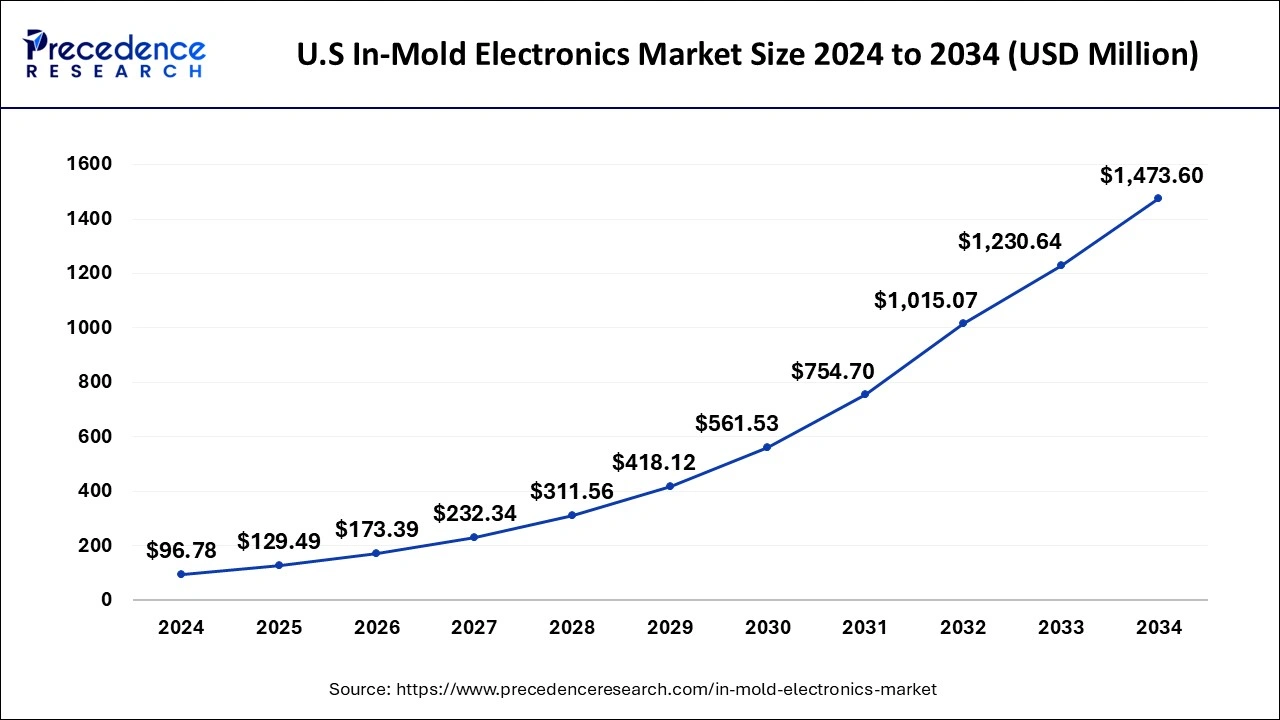
The U.S. in-mold electronics market size was evaluated at USD 129.49 million in 2025 and is predicted to be worth around USD 1,698.30 million by 2035, rising at a CAGR of 29.35% from 2026 to 2035.
U.S. Market Trends
The U.S. is a main contributor to the North American market, which is driven by rapidly updating user choices, as the brands are excessively investing in smart technology integration and sustainable practices, such as IoT potential, which have led to eco-conscious users. Additionally, companies are developing their direct-to-consumer sales channels and online presence, which gives feedback on moves for buying behavior developed during the pandemic.
Asia-Pacific: The Fastest-Growing Market
On the other hand, Asia Pacific is estimated to be the most opportunistic market during the forecast period. This is attributable to the increased presence of the world's top electronic manufacturers in the nations like China, India, Japan, South Korea, and Taiwan. The enormous demand for the consumer electronics in this region is one of the most significant factors that is expected to rapidly drive the growth of the in-mold electronics market in the Asia Pacific region during the forecast period. Moreover, rising disposable income, growing healthcare infrastructure, rapidly growing automotive sectors, and rising demand for the home improvement products is significantly driving the growth of the market. The favorable government policies is attracting various top electronic manufacturer to expand their manufacturing facilities in this region which is estimated to the most crucial factor that would augment the market growth in this region.
Asia Pacific is expected to experience the fastest growth during the predicted timeframe. It is driven by worldwide supply chain classification, government programs, competitive labor costs, and multinational corporations are moving to Southeast Asia for manufacturing. Countries like Thailand, Vietnam, Indonesia, and Malaysia are quickly developing their respective production potential. Such moves make a developing demand for high-accuracy molds and dies personalized for production volumes, product designs, and material needs.
India Market Trends
The market in India is being driven by Indian auto producers and the worldwide companies, such as huge funding by Renault and Nissan in India, which are accepting IME in order to make touch-sensitive control panels, smart dashboards, and ambient lighting to lower the overall EV series and vehicle weight. Sweeping government initiatives have aimed to stretch the domestic electronics industry by manufacturing the necessary baseline ecosystem.
Why is Europe Considered a Notably Developing Region in the In-Mold Electronics Market?
Europe is expected to grow significantly due to the European Chips Act, which is a regulation that establishes a framework for developing the semiconductor industry in Europe. They are setting the stage to classify and to assist integrated manufacturing facilities and open the complete EU foundries, which are primary-of-a-type facilities that develop the security of supply and dependency of the Union's semiconductor system.
Germany Market Trends
The market in Germany is growing due to the European Union Commission, which has given the green light to approximately EUR 300 million with the help of a pair of current semiconductor factories. The Zeiss company will officially receive EUR 222 million for its current manufacturing facility in the southwestern German town of Oberkochen. At the same time, Zadient is ready to receive EUR 66 million for a factory in the German city of Bitterfeld. The Bitter Feld plant will create microchips by using a current procedure that employs ultra-pure silicon carbide.
Why is the In-Mold Electronics Market Receiving Momentum in Latin America?
The market in Latin America is growing notably, which is assisted by global supply chain integration, as the region is becoming complicated for de-risking the worldwide technology pipelines. Latin America is shifting beyond the foundation assembly into a normal back-end testing, assembly, and Packaging (ATP) for the semiconductor sector, which is assisted by regional programs in Brazil, Costa Rica, and Paraguay.
Brazil Market Trends
Brazil has remained the most dominant industry in the region. The country gets advantages from its mature digital economy, large population, rising renewable energy potential, and expanded fiber connectivity. São Paulo has come up as Latin America's top data center hub, supporting main facilities being run by Ascent, Equinix, ODATA, and Scala Data Centers, and various hyperscale cloud providers.
How is the Opportunistic Rise of the Middle East and Africa in the In-Mold Electronics Market?
The Middle East and Africa region is expected to show lucrative growth in the coming years. By funding Africa's developing electronics industry, Middle Eastern countries can develop extensive raw materials, as Africa carries the main resources, such as lithium, cobalt, and rare earth metals, that are necessary for electronics production. By committing to the processing and extraction of these materials, Middle Eastern investors can conveniently protect a relevant supply chain for electronics manufacturing and match the rising demand for high-technology items both globally and locally.
UAE Market Trends
The electronics sector's investment in Abu Dhabi's economy has extended beyond manufacturing imports and values, as the industry plays a major role in employment, creating high-skilled employment space. The sector's constant development is predicted to create job opportunities for skilled workers, which further develops the industry's contribution and competitiveness for the economy.
Supply Chain Analysis - In-Mold Electronics Market
- Raw Material Procurement: The reliability of electronic elements has directly affected the complete integrity of electronic systems, from user devices to industrial controls. The electrical engineers should give importance to suppliers that manage constant quality to totally avoid cascading problems during operation and assembly.
- Doping and Layering Processes: The trace factors such as phosphorus and boron are incorporated into the wafer to adjust the conductivity in particular spaces and create p-type and n-type semiconductors. This allows transistors to behave like switches and enables current flow to be managed and fine-tuned.
- Lifecycle Support and Recycling: Old electrical appliances have a variety of valuable raw materials that can be recycled, such as plastics, metals, or even glass. The newest Electrical and Electronic Equipment Act 9lektroG) has regulated the eco-friendly recycling or disposal of old devices with the aim of developing the recycling of valuable raw materials in terms of electronic waste.
Market Competitive Landscape: Leading Companies and Strategies
The in-mold electronics market is semi-consolidated as leading companies assist in technical DFM, which needs a rigid design for manufacturability (DFM) potential in order to update the part space for quality and quantity before the mold is cut down. A strong system counts on CMM inspection technologies, complete traceability, and PPAP rules to guarantee dimensional precision. Vasantha Groups, which is a top leader in good-quality accuracy automation manufacturing and injection molding, has revealed the complete acquisition of Muller Technology Conty SA, which is officially headquartered in Loveland, USA.
In-Mold Electronics Market Companies
- Butler Technologies
- GenesInk
- DuPont de Numours
- InMold Solutions
- YOMURA
- Golden Valley Products
- DuraTech Industries
- Eastprint Incorporated
- Nissha Co. Ltd.
- TactoTek Oy
Latest announcement by industry leader
- In November 2024, IPC announces the release of IPC-8401, Guidelines for In-Mold Electronics. IPC-8401 addresses in-mold electronics (IME) technology, providing industry consensus on guidelines for manufacturing processes, part structures, material selection, and production test methods to integrate printed electronics and components into 3D smart structures.
Recent Developments in the In-Mold Electronics Market (2025–2026)
- In May 2026, the Ministry of Electronics and Information Technology (MeitY) revealed the IP Catalyst program and its supporting digital stages, whose goal is to develop intellectual property expansion and commercialization in India's cutting-edge ecosystem in IT and Electronics.
(Source: https://www.storyboard18.com) - In July 2025, Napino Tech Ventures Pvt Ltd and Teksun Microsys Pvt Ltd disclosed Rapidise Technology Pvt Ltd, which has USD 4 million in terms of seed funding, whose goal is to shift how AI-allowed and connected devices are engineered, designed, and developed at scale.
(Source: https://www.prnewswire.com) - In February 2026, by staying focused on delivering Nigerians the ideal quality in Consumer electronics products, with 99.9% quality assurance, MyHomeEtal Limited has revealed Microdia Consumer Electronics products located in Nigeria.
(Source: https://www.thisdaylive.com)
Partnerships in the In-Mold Electronics Market
- In March 2026, TactoTek, which is a Finnish dependent company specializing in in-mod structural electronics 9IMSE) technology, revealed a licensing merger with LLurexX Optical GmbH, a German company that is totally professional in optical design and simulation. This partnership will allow LurexX to incorporate IMSE technology into its profile that serves innovative technological ideas.
(Source: https://autotechinsight.spglobal.com) - In May 2026, Applied Materials Inc. revealed that Advanatest Corporation, a top semiconductor test machine supplier, will officially join Applied's EPIC stage as an invention partner.
(Source: https://www.inkworldmagazine.com)
Segments Covered in the Report
By Ink Type
- Silver Conductive
- Carbon Conductive
- Others
By Application
- Building Automation
- Automotive
- Healthcare
- Consumer Products
- Others
By Geography
- North America
- U.S.
- Canada
- Europe
- U.K.
- Germany
- France
- Asia Pacific
- China
- India
- Japan
- South Korea
- Rest of the World
For inquiries regarding discounts, bulk purchases, or customization requests, please contact us at sales@precedenceresearch.com
Frequently Asked Questions
Tags





Ask For Sample
No cookie-cutter, only authentic analysis – take the 1st step to become a Precedence Research client
 Get a Sample




 sales@precedenceresearch.com
 Schedule a Meeting
