






 Request Consultation
Bioengineering applies engineering to biology to create innovative solutions in healthcare, sustainability, and industry, shaping the future of life sciences through precision, technology, and responsible innovation.
Bioengineering represents a transformative convergence of biology, engineering, and computational sciences aimed at understanding, modifying, and designing biological systems. By applying engineering principles to living organisms, bioengineering enables innovations across healthcare, agriculture, materials science, and environmental sustainability. The article explores the conceptual foundations of bioengineering, recent technological paradigms, application domains, and engineering ethical considerations.
Executive Summary
The increasing complexity of global health challenges, environmental stressors, and resource limitations has necessitated approaches that transcend traditional scientific silos. Bioengineering emerged as a response to this need, combining quantitative engineering frameworks with the adaptive and self-organizing properties of biological systems. Unlike classical biology, which focuses on observation and explanation, bioengineering emphasizes design, optimization, and control.
This shift has enabled the development of engineered tissues, synthetic genetic circuits, and intelligent biomedical devices. As biological data becomes more accessible and computational power increases, bioengineering continues to evolve from an experimental discipline into a design-driven science.
What is Bioengineering Market Size?
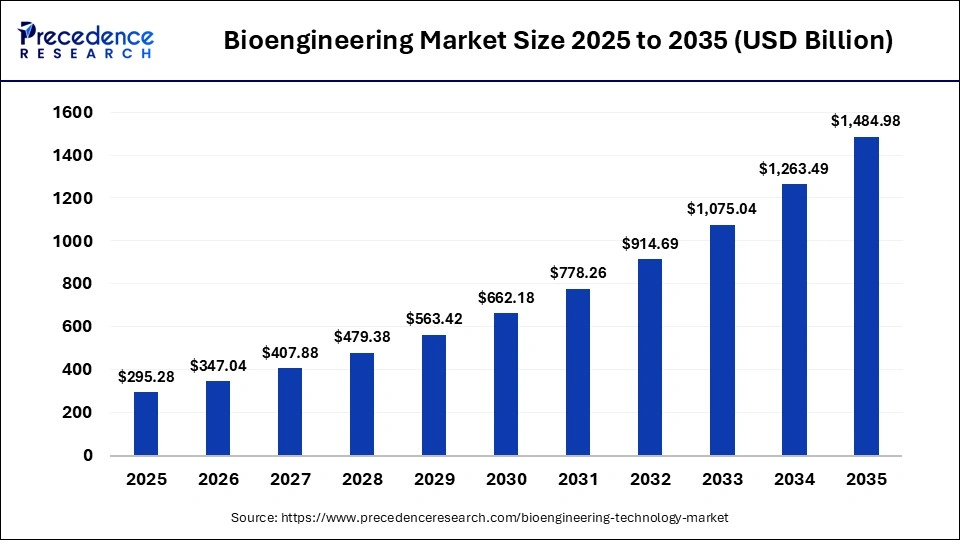
The global bioengineering market size accounted for USD 295.28 billion in 2025 and is predicted to increase from USD 347.04 billion in 2026 to approximately USD 1,484.98 billion by 2035, expanding at a CAGR of 17.53% from 2026 to 2035. The growth of the bioengineering market is driven by advances in synthetic biology, AI integration, precision medicine demand, sustainable bioprocessing, and strong government-backed research and innovation initiatives.
How is the Future of Life Sciences Altered by Bioengineering?
The bioengineering market applies engineering concepts and develops solutions from the integration of biology and engineering. The Bioengineering market is experiencing an explosion of growth. The need for personalized medicines, regenerative medicine, and sustainable manufacturing of bio-based products is increasing the demand for bioengineering products and services. These advancements are leading to faster innovation cycles as a result of the combination of advancements in synthetic biology, tissue engineering, bioprocess optimization, and gene editing platforms, as well as increased use of automation, artificial intelligence, and computer modelling, thereby increasing the precision and scalability of biological research and development.
Increased collaborations between academia and industry, an increase in funding from private investment sources for the biotech industry, and increased emphasis on cost-effectiveness in drug development are only a few of the factors contributing to the growth of the bioengineering industry. Lastly, bioengineering's role in addressing global issues will further enhance its commercial and strategic relevance.
Bioengineering Market Outlook
- Market Overview: Bioengineering combines biology with engineering and provides the basis for medical advancements, agricultural advancements, and sustainability through gene editing, bioprinting, AI assisted design, and bio-based solutions.
- Technology and Innovation Impact: New advancements in CRISPR, artificial intelligence, and synthetic biology have improved the development of personalized medicine and increased the efficiency of bioengineering both through increased research and productivity.
- Workforce and Employment Trends: The US Federal Government's Bureau of Labor Statistics (BLS), in its 2020-2030 projections, has stated that employment for bioengineers will grow approximately 5% by 2034, which is better than average for other occupations due to the continued strong demand for medical devices and therapeutics.
- Government Policy and Growth of the Bioeconomy: The Indian government's initiative with its BioE3 policy to increase the size of India's bioeconomy by almost double by the year 2030 will assist bioengineering through attracting new innovation and job creation and strengthening India's Bio Manufacturing Infrastructure.
- Drivers of Healthcare and Chronic Disease Growth: The increase in chronic disease across the world is increasing the demand for the production, development, and deployment of novel bioengineered diagnostics, therapeutics, and regenerative therapies across all healthcare systems in the world.
Bioengineering’s Ripple Effect: Industries Poised for Transformational Change
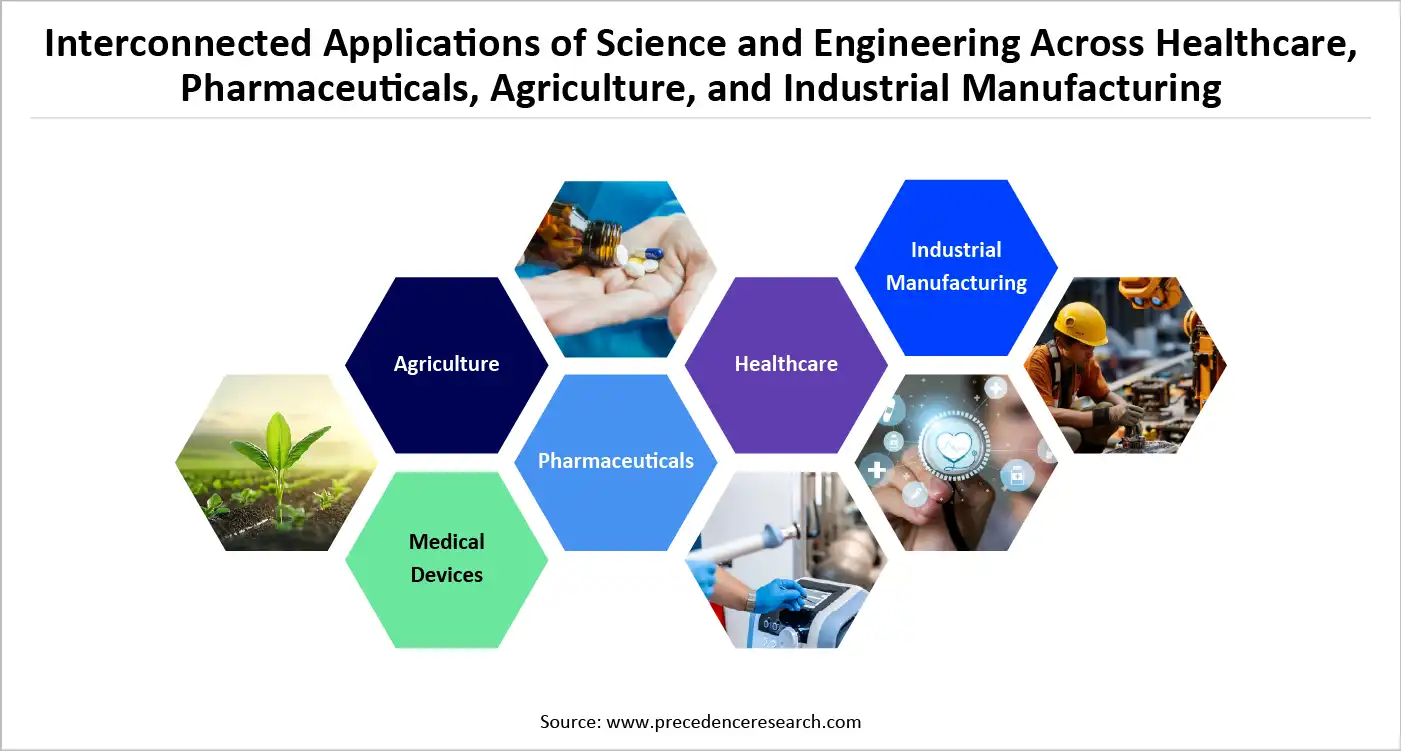
Bioengineering is changing the way companies are designing, producing, and working with biological systems. It is creating huge changes in many industries by combining the precision of engineering with the complexity of biology. Some of the biggest changes are occurring in the following industries:
- Health care and life sciences: Health care is the industry that is most affected by the introduction of bioengineering technologies. Bioengineering is enabling new advancements in the areas of regenerative medicine, tissue engineering, new advanced diagnostic techniques, and Personalized Therapeutics. The development of engineered biomaterials, bio-fabricated tissues, and intelligent delivery systems is changing the way we treat diseases and the way patients respond to treatment. By incorporating bioengineering technology into clinical workflows, we are enabling the transition from reactive care to predictive and precision medicine.
| Projected Benefits of Precision Therapies (Cumulative Over 10 Years) | ||||
| Countries | Australia | China | Japan | South Korea |
| Improved Outcomes | 250k patients | 10.5 million patients | 1.5 million patients | 400k patients |
| Invested in R&D, diagnostics, and manufacturing | $32 billion USD | $200 billion USD | $110 billion USD | $44 billion USD |
| Avoided healthcare costs | $2.6 billion AUD | ¥216 billion RMB | ¥860 billion JYP | â‚©2.2 trillion KRW |
- Pharmaceuticals and biotechnology: The introduction of bioengineering technologies is changing the structure of the pharmaceutical and biotechnology industries through the introduction of bioengineered cell lines, synthetic biology platforms, and optimized bioprocessing. These technologies are helping to improve the efficiency of the drug discovery process, shorten the drug development cycle, and facilitate the production of complex biologics on a large scale. Bioengineering is also enabling improvements in vaccine development and improving the reliability of biologics manufacturing.
- Medical devices and diagnostics: Bioengineering is taking medical devices beyond just mechanical devices and instead creating biologically interactive systems. Smart implants, Biosensors, and Lab-on-a-Chip diagnostic devices are enabling real-time monitoring of patients and the ability to diagnose disease at much earlier stages. Devices designed with a higher level of biocompatibility and adaptability are establishing new standards regarding Safety and Effectiveness.
- Agriculture and food systems: Agriculture is being reshaped through bioengineered crops, microbial soil enhancers, and alternative protein technologies. These advancements improve crop resilience, yield stability, and nutritional profiles while reducing environmental impact. In food systems, bioengineering supports sustainable protein production and enhanced food safety solutions.
- Industrial manufacturing and bioprocessing: Bioengineering is transforming industrial manufacturing by replacing traditional chemical processes with biologically driven production pathways. Engineered microorganisms are increasingly used to produce bio-based chemicals, enzymes, and materials with lower energy requirements and reduced emissions. This shift supports more sustainable and cost-efficient industrial operations.
- Environmental and sustainability solutions: Environmental management is benefiting from bioengineered systems capable of waste remediation, water purification, and resource recovery. Biological solutions are offering scalable and adaptive alternatives to conventional environmental technologies. Bioengineering is emerging as a cornerstone in addressing climate resilience and ecological restoration.
- Digital health and computational biology: The convergence of bioengineering with data science is accelerating innovation in digital health and computational biology. Predictive modelling, biological simulations, and intelligent health platforms are enhancing decision-making across research and clinical environments. This integration is enabling more accurate, data-driven biological design and intervention strategies.
Decision Tree Modelling in Bioengineering: Restructuring Complex Biological Decisions
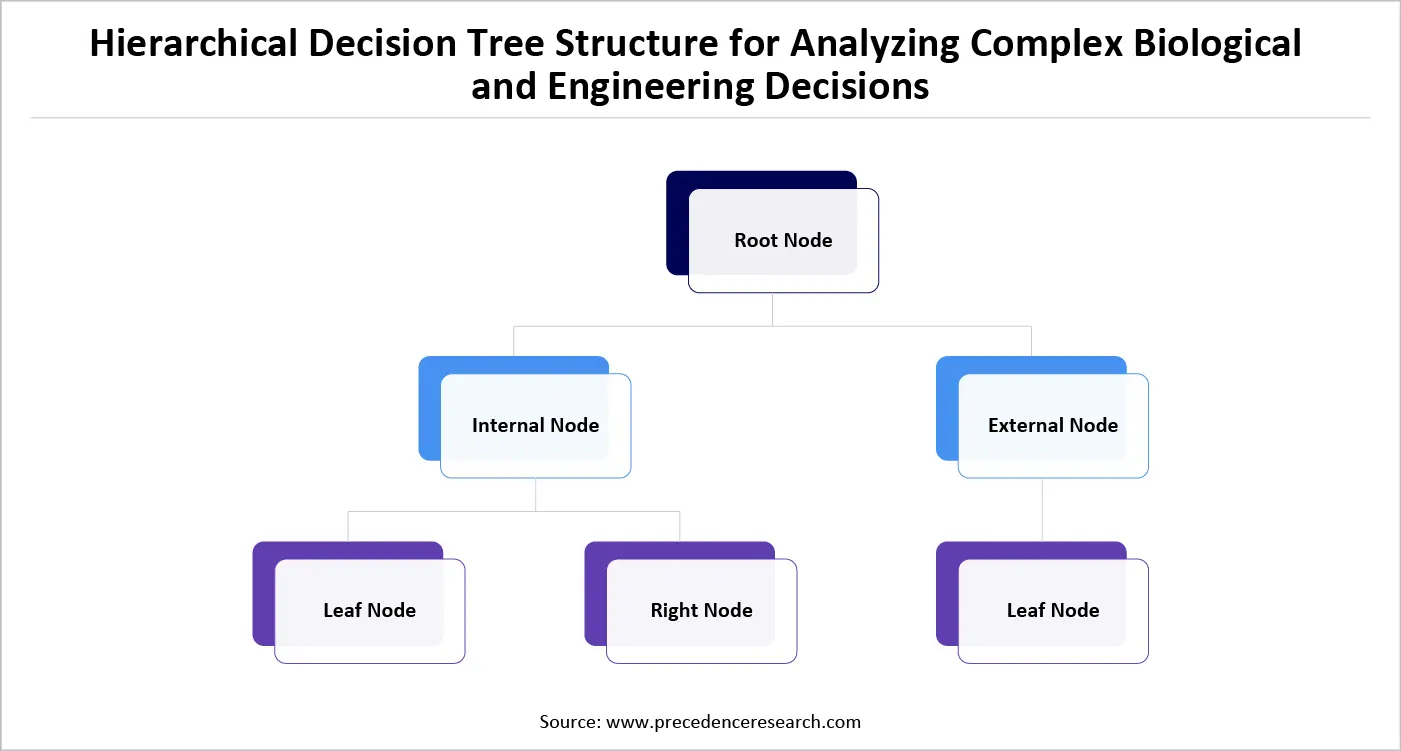
Decision tree making is a powerful analytical and computational approach in bioengineering, used to simplify complex biological systems into structured, interpretable decision pathways. By breaking multifunctional biological problems into sequential, logic-based choices, decision trees support both experimental design and data-driven decision making across bioengineering applications. In bioengineering, decision trees represent biological or engineering decisions as a hierarchy of nodes, branches, and outcomes. Each node corresponds to a biological variable, experimental condition, or design parameter, while branches represent possible states and responses. The terminal leaves define predicted outcomes such as treatment success, cellular behaviour, or system performance.
The decision tree approach is widely applied in diagnostics, where they help classify disease states based on biomarkers, genetic profiles, or imaging data. In bioprocessing engineering, they assist in selecting optimal fermentation conditions, feed strategies, or cell lines based on productivity and quality attributes. In medical device design, decision trees guide material selection, biocompatibility testing, and regulatory pathways. Within systems biology, decision trees help interpret large omics datasets by identifying key biological drivers that influence phenotypic outcomes. In synthetic biology, they are used to choose gene circuits, promoters, or metabolic pathways by balancing efficiency, stability, and safety. This structured logic supports rational biological design rather than trial-and-error experimentation. Modern bioengineering increasingly combines decision trees with machine learning techniques such as random forests and gradient boosting.
These hybrid models improve prediction accuracy while maintaining interpretability, which is critical in regulated biomedical environments. They enable real-time learning from experimental data and adaptive optimization of biological systems. The Decision trees are highly interpretable, making them suitable for multidisciplinary teams that include biologists, engineers, and clinicians. They handle both qualitative and quantitative data effectively and support transparent justification of design or clinical decisions. Their modular structure also allows easy updates as new biological data emerge.
Hierarchical Decision Tree Structure for Analyzing Complex Biological and Engineering Decisions
An Engaging Journey Through Global Insights
The global export-import data delineates the cross-border movement of goods and services and serves as a vital metric for assessing global economic dynamics, trade competitiveness, and supply chain resilience. This data is indispensable for governments, corporations, researchers, and investors in evaluating trade performance, pinpointing market opportunities, and mitigating risks. Typically, the global trade dataset encompasses both the value and volume of goods and services exchanged between nations over specified timeframes.
The Asia-Pacific region leads global merchandise trade, bolstered by robust manufacturing capabilities and export-driven economies. North America is pivotal not only as a substantial consumer market but also as a significant exporter of high-tech goods and services. Europe continues to be a central player in intra-regional trade, characterized by advanced manufacturing sectors and extensive cross-border service exchanges. Meanwhile, emerging markets in Latin America are increasingly carving out their roles within the global trade landscape. Businesses rely on trade data for market entry analysis, supplier identification, demand forecasting, and pricing strategy. Policymakers use it to design trade policies, negotiate agreements, and monitor economic resilience. Analysts and researchers apply the data to study globalization trends, supply chain shifts, and geopolitical impacts on trade.
| Company | USD Value | Shipments |
| SUN PHARMACEUTICAL INDUSTRIES LIMITED | 52.01 | 7562 |
| DIVIS LABORATORIES LIMITED DSN SEZ UNIT | 61.91 | 345 |
| PAR FORMULATIONS PRIVATE LIMITED | 76.41 | 1412 |
| GLAND PHARMA LIMITED | 92.45 | 2473 |
| KERRY INDEV LOGISTICS PRIVATE LIMITED | 2282.22 | 6863 |
From Ancient Ingenuity to Industrial Precision: The Evolution of Bioengineering
Bioengineering, though often perceived as a modern scientific discipline, has roots that extend deep into ancient civilizations where humans first learned to manipulate biological systems for survival and progress. Early practices such as fermentation for food and beverage production, selective breeding of crops and livestock, and herbal medicine laid the foundational principles of biological modification long before formal science existed. These ancient innovations reflected an intuitive understanding of living systems and marked the earliest intersection of biology and engineering.
The transaction from traditional practices to structured science began during the Renaissance and early modern period, when advances in autonomy, microbiology, and chemistry transformed empirical knowledge into systematic inquiry. The discovery of microorganisms, the development of microscopes, and the formulation of biological classification systems enabled humans to observe and experiment with life at unprecedented scales. This era established the scientific framework that would later support engineered biological solutions.
Today, bioengineering stands at the forefront of technological convergence, integrating artificial intelligence, data science, nanotechnology, and advanced materials. From tissue engineering and regenerative medicine to synthetic biology and sustainable bio-manufacturing, the field now drives solutions for global challenges.
Applications in Healthcare and Medicine
One of the most impactful domains of bioengineering is healthcare. Engineered biomaterials are enabling improved drug delivery and implant integration. Tissue engineering approaches aim to restore or replace damaged organs by combining cells, biomaterials, and biochemical signals. In diagnostics, bioengineered sensors provide rapid and sensitive detection of disease makers. Personalized medicine is increasingly influenced by bioengineering through patient-specific models and therapeutic design. These applications collectively shift medicine from reactive treatment to predictive and regenerative care. In industrial and environmental applications beyond medicine, bioengineering plays a critical role in industrial bioprocessing and environmental solutions.
Engineered microorganisms are used to produce chemicals, fuels, and materials with reduced environmental impact. Bioengineered systems support waste treatment and resource recovery through biologically driven processes. In agriculture, engineered traits enhance crop resilience and productivity while reducing dependency on chemical inputs. As bioengineering capabilities expand, ethical considerations become increasingly significant. The ability to modify living systems raises questions related to safety, consent, equity, and long-term ecological impact. Responsible innovation requires transparent design practices, regulatory oversight, and interdisciplinary dialogue involving scientists, policymakers, and the public. Addressing these concerns is essential to ensure that bioengineering advancements align with societal values and global well-being.
Harnessing Nature's Code: How Bioengineering is Shaping the Future of Sustainable Fashion
The fashion industry has long been known for its environmental impact, but a new movement is emerging that combines style and sustainability through bioengineering. Designers and scientists are collaborating to create fabrics and materials that not only look good but also have a minimal ecological footprint. From lab-grown leather to bio-fabricated textiles derived from fungi and algae, this innovative approach is revolutionizing the way we think about fashion. By harnessing nature’s code, the fashion industry can move towards a more sustainable future without sacrificing aesthetics or functionality.
The Role of Bioengineering in Creating Flavorful, Nutritious Food Alternatives
With a growing global population and increasing concerns about food security, bioengineering is stepping in to provide creative solutions. This field is enabling the development of crops that are not only high-yielding but also packed with essential nutrients. Imagine tomatoes that are fortified with vitamin D or rice varieties that are enriched with beta-carotene. These bioengineered foods can help combat malnutrition while offering incredible flavors. By merging nutritional science with agricultural innovation, bioengineering is paving the way for healthier diets across the globe.
Bioengineering's Impact on Urban Wildlife: How Innovation Can Help Balance Nature and City Life
As urban areas expand, the natural habitats of wildlife are often disrupted. However, bioengineering offers pathways to mitigate these impacts and foster a harmonious relationship between urban living and wildlife preservation. Techniques such as green roofs, vertical gardens, and biophilic design can create urban ecosystems that support biodiversity. Furthermore, bioengineered plants can be designed to attract pollinators or provide food for local species, enriching the urban environment. This intersection of technology and ecology can lead to thriving urban wildlife, enhancing both the natural world and human well-being.
From Waste to Resource: The Bioengineered Solutions Transforming Our Garbage into Gold
The concept of turning waste into resources is becoming a reality through the ingenious applications of bioengineering. Innovative processes are emerging that use engineered microorganisms to break down organic waste and convert it into valuable products like bioplastics, biofuels, and fertilizers. This not only reduces landfill waste but also creates a circular economy. By rethinking how we view waste, bioengineering contributes to a more sustainable world, demonstrating that what was once discarded can indeed become gold.
The Future of Bioengineering: Growth or Diversion
Bioengineering's future will be marked by convergence, precision, and responsibility. The merging of biological sciences with artificial intelligence, automation, and advanced computing will lead bioengineering from reactive problem-solving to predictive and design-driven innovation. Personalized medicine, engineered tissues, sustainable bio, manufacturing, and climate, resilient biological systems will be standard applications rather than experimental frontiers. The emphasis will be on biologically programming systems with precision, safety, and scalability instead of just modifying life. Moreover, ethical governance and sustainability will be at the core of the field's evolution. The power of bioengineering to change ecosystems, human health, and food systems at a large scale will make regulatory frameworks and societal accountability necessary.
Responsible innovation will require transparency, interdisciplinary collaboration, and a trade-off between commercial ambition and public welfare. These factors will shape the extent and ways in which bioengineering benefits are distributed. To sum up, bioengineering is one of the most significant scientific transformations of human history, going from the manipulation of biology by intuition to a highly industrialized and data-driven discipline. Its next step is not only in technological progress but also in the integration with social, ethical, and environmental priorities. As a result, bioengineering will remain a pivotal resource for sustainable development as the field advances.
About the Authors

Aditi Shivarkar
Aditi, Vice President at Precedence Research, brings over 15 years of expertise at the intersection of technology, innovation, and strategic market intelligence. A visionary leader, she excels in transforming complex data into actionable insights that empower businesses to thrive in dynamic markets. Her leadership combines analytical precision with forward-thinking strategy, driving measurable growth, competitive advantage, and lasting impact across industries.



Aman Singh
Aman Singh with over 13 years of progressive expertise at the intersection of technology, innovation, and strategic market intelligence, Aman Singh stands as a leading authority in global research and consulting. Renowned for his ability to decode complex technological transformations, he provides forward-looking insights that drive strategic decision-making. At Precedence Research, Aman leads a global team of analysts, fostering a culture of research excellence, analytical precision, and visionary thinking.

Piyush Pawar
Piyush Pawar brings over a decade of experience as Senior Manager, Sales & Business Growth, acting as the essential liaison between clients and our research authors. He translates sophisticated insights into practical strategies, ensuring client objectives are met with precision. Piyush’s expertise in market dynamics, relationship management, and strategic execution enables organizations to leverage intelligence effectively, achieving operational excellence, innovation, and sustained growth.