






 Request Consultation
Introduction to Sharecare Inc. and Its Role in the Digital Health Industry
Sharecare is a leading digital health company that offers a comprehensive platform for virtual health, patient engagement, and even healthcare navigation. It unifies wellness tracking, digital therapeutics, along with data analytics to empower individuals, employers, and healthcare providers to handle health outcomes. It simplifies the process of understanding insurance benefits, finding doctors, and managing care. Systems use standardized protocols such as FHIR and HL7 to securely share patient Electronic Health Records (EHRs) among employers, health plans, and providers.
Automated workflows and advanced analytics enable payers and employers to track utilization trends, proactively manage chronic diseases, and process claims efficiently to lower overall costs.
Sharecare functions as a comprehensive digital health enablement platform that consolidates fragmented healthcare data into a single, personalized profile for users. Moreover, its business strategy drives value by lowering costs and enhancing outcomes across employers, health plans, and life sciences companies.
Company Overview and Evolution of Sharecare Inc.
Sharecare drives its business growth and platform expansion by unifying fragmented healthcare into a centralized, AI-driven B2B2C ecosystem. Through strategic acquisitions, innovative digital tools such as augmented reality (AR) health literacy solutions, and deep partnerships, the firm creates a competitive moat that makes healthcare continuous rather than episodic. The company drives distribution by embedding its platform directly into enterprise systems. Notable partners include health systems such as Wellstar Health System and HCA. It also works alongside major payers such as Elevance Health and government agencies like CMS to deploy conversational AI assistants and even streamline data exchange.
History and Corporate Evolution
Sharecare is an AI-based digital health platform founded in 2010 by WebMD creator Jeff Arnold and Dr. Mehmet Oz. It evolved from a user Q&A and wellness app into a comprehensive enterprise software ecosystem, thus delivering clinical data management, care advocacy, and digital therapeutics to major health systems and employers. It launched in 2010; the firm built early momentum around the scientifically based RealAge test, which aggregated consumer data to determine a consumer's biological age versus their calendar age. The tool scaled to over 50 million users.
Core Business Segments and Service Portfolio
Modern health firms integrate these major business areas by shifting from fragmented services to cohesive, digitally unified care ecosystems. By breaking down silos, these interconnected domains work together to streamline operations and enhance patient outcomes. It connects patients directly to providers. Virtual visits are thus seamlessly paired with navigation and advocacy services, which assist members in understanding benefits, untangling complex medical bills, and finding the right specialists.
Sharecare's Position in the Global Digital Health Market
Sharecare is a comprehensive digital health firm that unifies fragmented healthcare into a single, personalized platform. By connecting individuals, employers, health plans, along with providers, it serves as an intelligent ecosystem that enhances care quality, drives positive behavior change, and lowers systemic healthcare costs. The firm uses augmented reality (AR) and virtual reality (VR) to visualize disease progression, which significantly enhances patient education and care preparation.
Digital Health Market Size and Forecast 2026 to 2035
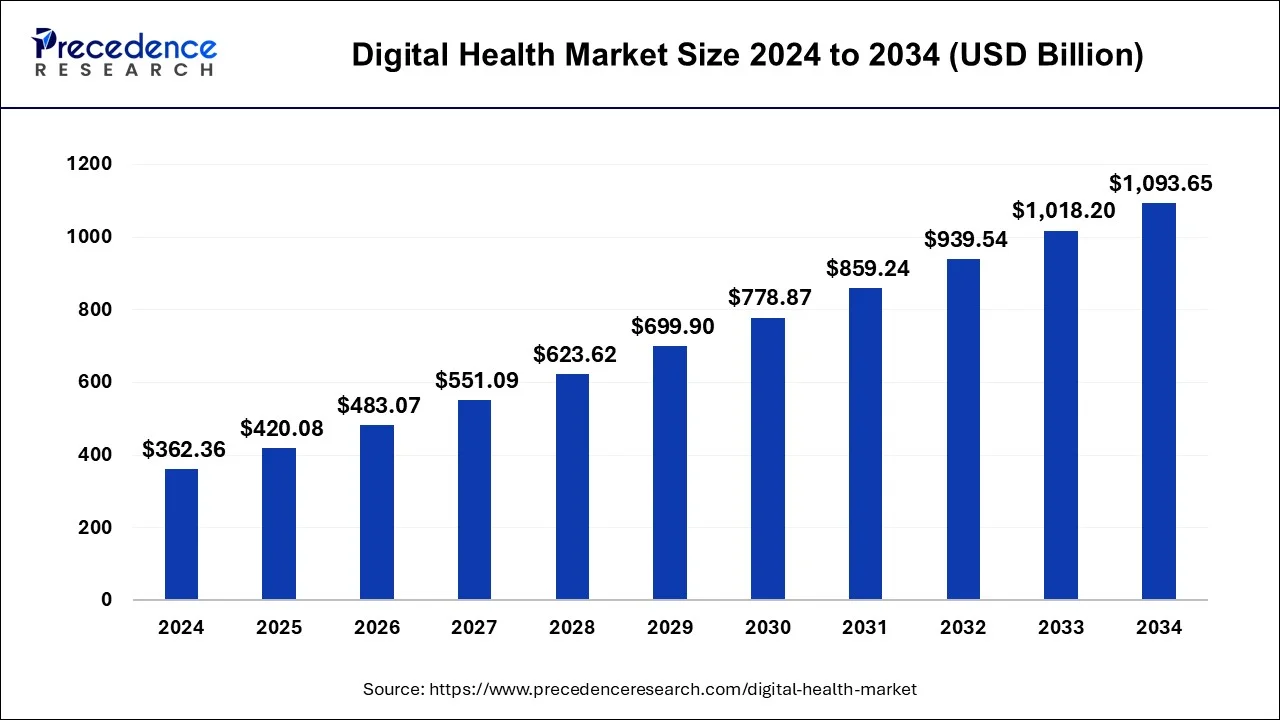
The global digital health market size was valued at USD 420.08 billion in 2025 and is expected to grow from USD 483.07 billion in 2026 to USD 1,171.24 billion by 2035, registering a CAGR of 10.8% during the forecast period from 2026 to 2035. This growth is being fueled by rapid technological advancements, including the integration of artificial intelligence (AI), the expanding use of the Internet of Things (IoT), robotics in healthcare, and the increasing adoption of remote patient monitoring devices.
Get a Free Sample Report with Key Market Trends: https://www.precedenceresearch.com/sample/1145
Business Growth Strategy Driving Sharecare's Market Expansion
Sharecare pursues sustainable expansion by unifying the fragmented healthcare ecosystem into an integrated "digital front door". By working with technology, providers, employers, and payers on a single platform, the firm delivers personalized, continuous care management that improves results and drives long-term scalability. Sharecare has expanded from a wellness app into a comprehensive virtual health platform. It now unifies benefits navigation, care management, pharmacy discount tools, behavioral health, and home care resources into a single user experience. This "stickiness" raises switching costs versus niche competitors along with provides a diversified revenue mix across varied market segments.
Enterprise Customer Expansion
Sharecare’s B2B and B2C strategy aims on unifying a fragmented healthcare ecosystem into a centralized, data-based platform. By consolidating information from wearables, claims, along with medical profiles into a single user-centric app, the firm drives high-value adoption across six key healthcare sectors. Sharecare accelerates care gap closures by offering hospital systems secure Release of Information (ROI), automated medical record archiving, along with telehealth solutions. This stream thus creates high-margin unit economics while directly connecting patients to physicians.
Recurring Revenue and Subscription-Based Business Model
Recurring contracts, SaaS, digital healthcare, and enterprise agreements drive revenue stability by replacing unpredictable one-time sales with steady and compounding cash flow. This predictable model, usually referred to as Deferred Revenue or Annual Recurring Revenue (ARR), transforms business expansion from a reactive hustle into a compounding machine. Investors and markets highly favor predictable revenue. Firms boasting high percentages of recurring revenue usually trade at significantly higher valuation multiples compared to project-based businesses.
Investments Supporting Long-Term Business Growth
To protect sensitive health data across sprawling hybrid along with multi-cloud environments, Sharecare depends on strict adherence to HIPAA guidelines, modernizing the release of Information and then implementing layered digital identity and access management controls. Sharecare partners with CLEAR to power trusted digital. The deployment of agentic AI: Sharecare Teams up with AWS to start an AI-based Health Navigation Platform, which includes the AskMD navigation platform, which offers users with automated symptom checking and real-time, in-network provider connections.
Expansion of Sharecare's Digital Health Platform
Sharecare continually expands its integrated digital health platform by incorporating conversational AI assistants, AR-powered patient education, telehealth, and data analytics. These tools enable the firm to bridge gaps between consumers, providers, and payors, thus driving personalized care coordination and enhancing long-term health outcomes. To boost health literacy, Sharecare utilizes the Sharecare Reality Lab to deliver tools such as the AR Wellness Lens, which superimposes disease progression on a user's internal organs using their mobile camera.
Digital Patient Engagement Solutions
Digital health solutions integrate these elements into comprehensive platforms to encourage behavior change and disease management. Research shows that integrating tools such as personalized coaching, self-monitoring, and even tailored feedback significantly improves clinical and behavioral health results for chronic conditions. Conversational agents and mobile applications guide users via evidence-based behavioral frameworks to enhance diet, physical activity, and mental well-being.
Virtual Healthcare and Care Navigation Services
Sharecare unifies healthcare navigation, virtual care, along with well-being tools into a single, comprehensive digital platform. By integrating artificial intelligence, telehealth, and even personal health advocacy, the firm simplifies how patients and members access and handling in-network care, track medical records, and even coordinate medical services.
Population Health and Data Analytics Platform
Data analytics transforms healthcare from reactive to proactive. By thus, leveraging historical data and real-time clinical variables, organizations change resources to prevent illness, optimize hospital operations, and tailor treatments. This prevents complications and decreases avoidable spending. It evaluates patient-specific variables and even social determinants of health (SDOH) to automatically stratify patient risk. Clinicians receive actionable alerts along with evidence-based recommendations at the point of care, allowing personalized medicine and earlier interventions.
Artificial Intelligence and Personalized Healthcare
Integrating these technologies transforms healthcare by changing it from a reactive, generalized model to a proactive, precision-based approach. This synergy directly addresses clinical burnout by automating administrative workflows along with streamlining early disease detection, while empowering patients via tailored, actionable health management tools. Intelligent automation and personalized recommendation engines enable healthcare providers to deliver custom care plans, medication adherence reminders, and even lifestyle interventions directly to patients. This continuous, tailored communication fosters better self-management and empowers individuals to take an active role in their wellness.
Product and Service Portfolio Supporting Digital Healthcare
Sharecare transforms healthcare by unifying disjointed services into a single, AI-driven platform. By bridging consumers, providers, payers, along with life sciences brands, the company drives value-based care, improves patient satisfaction, along with boosts operational efficiency via personalized digital and high-touch interventions. Products such as AR Wellness Lens, Condition Metamorphosis, and Care Compass utilize augmented reality and personalized, time-based visual pathways to explain complex disease progression and even treatment adherence.
Healthcare Navigation and Advocacy Solutions
Digital healthcare navigation, benefits guidance, along with member support services, centralize and organize a fragmented system. They serve as a single point of entry, translating complex medical jargon, untangling confusing benefits along with out-of-pocket costs, and routing patients to the most appropriate, high-quality care to decrease inefficiencies and delays. Services streamline costs and decrease administrative burdens to eliminate inefficiencies, enabling systems to shift resources from manual paperwork to direct patient care. This empowers individuals to access the right care by decreasing financial barriers, accelerating approvals, and ensuring timely, personalized medical attention.
Employer Health and Wellness Solutions
Workplace wellness and organizational health strategies are important because employee wellbeing is directly tied to a firm’s bottom line, boosting productivity and retention. Investing in holistic health significantly cuts operational expenses, such as absenteeism and burnout-driven turnover, while providing measurable financial returns. Initiatives such as on-site screenings and routine check-ups catch issues early, assisting employees in avoiding acute health emergencies and reducing medical claims.
Provider and Health System Solutions
Integrated solutions supporting hospitals, physician networks, along with Accountable Care Organizations (ACOs) are essential because they change healthcare from a fragmented, volume-based model to a unified, value-based approach. These platforms enhance patient outcomes, reduce operating costs, and thus simplify complex regulatory compliance by connecting clinical and administrative workflows. Interoperable Electronic Health Record (EHR) systems and AI-based pathways eliminate manual tasks, decrease medical errors, and provide actionable insights for decision support.
Life Sciences and Pharmaceutical Solutions
Sharecare collaborates with the life sciences industry to drive patient engagement, improve treatment adherence, and thus generate real-world data. By merging digital health tools with pharmaceutical partnerships, the platform allows life science brands to reach targeted demographics with condition-specific educational experiences. Moreover, the platform equips patients to better partner with their doctors via Interactive Physician Consult Simulations and virtual reality (VR) modules that explore the science of treatments. These interactions make consumers significantly more likely to discuss their care plans with healthcare providers.
Strategic Partnerships Driving Platform Growth
Sharecare partners with diverse healthcare stakeholders to unify medical, behavioral, along with lifestyle data. These partnerships integrate clinical workflows with digital tools, massively scale user acquisition via enterprise channels, and accelerate digital health innovation through data-driven AI, augmented reality, and secure identity verification. Pharma partnerships drive direct-to-consumer educational initiatives along with condition-specific sponsorships, yielding ROI on acquisition campaigns while funding platform resources.
Partnerships with Health Plans and Employers
Collaborations across these areas are essential because they change the focus of healthcare from reactive treatments to proactive, holistic care. By working with employers, health plans, and medical providers, these partnerships lower costs, enhance employee productivity, and ensure long-term workforce sustainability.
Collaborations with Healthcare Providers
Partnerships with health systems, IDNs, along with physician groups are essential because they replace fragmented, reactive care with a coordinated, and continuous experience. Integrating digital delivery across these networks lowers operational expenses, reduces readmissions, and empowers proactive health management through real-time data and multidisciplinary collaboration. It works financial incentives with clinical outcomes and emphasizes preventive, thus, continuous care over fee-for-service volume.
Technology and Cloud Ecosystem Partnerships
Collaborations involving these technologies are essential as they form a mutually dependent ecosystem demanded for modern, secure, and data-driven healthcare. No single technology can function effectively in a silo. This ensures that different hospital systems, medical devices, along with AI algorithms, can communicate seamlessly, breaking down data silos for better patient outcomes.
Acquisitions Strengthening Sharecare's Digital Health Ecosystem
Sharecare's acquisition strategy targets horizontal and vertical consolidation, aiming on healthcare IT, population health, and even disease management. By purchasing specialized health-tech and service startups, Sharecare builds a comprehensive, unified virtual ecosystem that aggregates data to decrease the total cost of care and enhance population health outcomes. To bridge physical and virtual care, Sharecare obtained CareLinx, a tech-enabled home health network which connects members with professional caregivers. This integration enables Sharecare to offer "precision advocacy," combining telephonic care navigators with in-home support for complex or post-acute cases.
Acquisitions are strategic tools that bypass the time and even risk of building capabilities from scratch. They allow firms to rapidly acquire new technologies, enter untapped markets, and even secure unique intellectual property, thus ultimately creating a sustainable competitive advantage and accelerating long-term growth.
Strategic Acquisitions Expanding Healthcare Services
Sharecare's strategy of acquiring firms that broaden its portfolio, strengthen health technology, and access new user segments is designed to create a comprehensive, end-to-end virtual health platform. By integrating diverse capabilities, the firm transforms from a basic wellness app into an indispensable enterprise solution for employers, payers, providers, and life sciences. By purchasing platforms such as CareLinx, Sharecare directly entered the home health and caregiving market, offering high-risk populations with both clinical and non-medical in-home care.
Integration Strategy Following Acquisitions
Sharecare maximizes business value and improves platform functionality via a centralized digital health ecosystem that unifies disparate assets into a single platform. It breaks down traditional silos across enterprise, provider, along with life sciences sectors to create predictive, personalized consumer experiences. The platform continuously breaks down clinical silos to build a comprehensive 360-degree health profile for each consumer. By linking data from wearables, medical claims, and self-reported metrics, like the RealAge health risk assessment, with CMS Aligned Network data, the firm deploys conversational AI and FHIR-based data exchange.
Competitive Landscape of the Digital Health Industry
Sharecare stands out for its consumer-centric, AI-powered centre that unifies health plans, employers, and providers. Leading digital health companies such as Accolade, Teladoc Health, and even Epic Systems compete in this space, each excelling in distinct capabilities ranging from personalized care navigation to vast enterprise EHR integrations. Sharecare is a leading digital health enablement platform that simplifies complex health data into an actionable, single-source user experience. Through data-driven insights alongside AI, it unifies fragmented healthcare systems to enhance care quality, lower costs, and drive positive behavior change across populations.
Comparison Based on Digital Health Platform Capabilities
Companies are heavily investing in these areas to decrease healthcare costs, improve clinical outcomes, and alleviate physician burnout. By uniting these digital technologies, organizations aim to change from reactive treatments to proactive, personalized, and even value-based care models. Moreover, streamlines the patient journey and reduces wait times, reducing confusion and missed appointments by providing digital "front doors" and automated guidance. It breaks down data silos, enabling seamless sharing of Electronic Health Records (EHR) across the care ecosystem so providers can access complete histories, thereby decreasing medical errors.
Comparison Based on Enterprise Healthcare Solutions
Employers sponsor the majority of U.S. healthcare plans. These solutions assist in managing workplace health, reducing absenteeism, along with control annual benefits spending through data analytics. Programs such as Medicare and Medicaid are heavily regulated and demand specialized compliance. These solutions automate risk adjustment, lower administrative burdens, and ensure accurate claims for massive public populations.
Comparison Based on Innovation and Technology Investments
Analyzing the technological investments is essential as they form the foundational pillars of modern healthcare delivery. Together, they empower organizations to combat global workforce shortages, optimize operational expenses, and transition from reactive treatments to proactive, personalized care. It offers the scalable computing power and flexible infrastructure necessary to host large language models, share data securely, and also enable AI deployment at scale.
Market Trends Influencing Sharecare's Growth Strategy
Healthcare industry trends are changing from reactive, provider-centric care to proactive, consumer-driven models. This digital transformation perfectly works with Sharecare's unified platform. The widespread acceptance of telehealth allows remote consultations and accessible care delivery, alongside extending clinical reach beyond physical offices. The integration of wearables and connected devices allows continuous home-based monitoring, supporting proactive rather than reactive medical interventions.
Digital Transformation Across Healthcare Systems
Healthcare organizations invest in digital platforms, integrated care models, along with data-driven decision-making to enhance patient outcomes, reduce operational costs, and ease administrative burdens. These technologies allow highly personalized, proactive care, which assists clinical teams in transitioning toward value-based treatment models while effectively navigating staffing challenges. Big data analytics, along with AI, identifies complex, hidden correlations across massive datasets. This enables organizations to move from reactive treatments to predictive medicine, anticipating patient needs and even optimizing resource allocation.
Growth of Preventive and Personalized Healthcare
The surge in need for these healthcare services is driven by an aging global population, the escalating costs of treating chronic conditions, along with a cultural shift toward proactive, holistic well-being. Furthermore, modern technology empowers patients to seek care that is as tailored and also accessible as their everyday digital retail experiences. Organizations and individuals are aiming for these programs to enhance daily energy, reduce stress, and enhance productivity, which assists prevent the onset of severe, long-term health complications.
Challenges Facing Sharecare Inc.
Sharecare faces a multifaceted web of industry-wide hurdles, thus, ranging from intense competition and tight security threats to complex reimbursements and even policy shifts. The company mitigates these headwinds via platform expansion and continuous digital innovation, transforming its platform from a standalone wellness tracker into an integrated healthcare ecosystem. Moreover, the healthcare landscape is highly fragmented. The lack of seamless data exchange between different Electronic Health Records (EHRs) thus creates data silos that hinder care coordination.
Navigating a Highly Competitive Digital Health Market
Competition in the digital health sector is intensifying because user expectations have shifted toward on-demand, virtual, and continuous care. To capitalize on this, diverse technology along with insurance sectors are expanding into care delivery, ultimately forcing the market to aim on software and analytics as a m competitive advantage. Insurers are acquiring digital health startups and building direct care networks to lower expenses and manage care proactively under value-based care models. Platforms such as Teladoc Health and Amwell are scaling by adding AI-driven Digital Therapeutics and even condition-specific remote monitoring to capture specialized markets.
Managing Regulatory Compliance and Data Privacy
Compliance in healthcare requires a unified approach: map all data flows to standards such as HIPAA or GDPR, enforce strict access controls and encryption, and adopt interoperability frameworks, for example, FHIR, and continuously train staff. It adopts standardized interoperability frameworks such as HL7 FHIR (Fast Healthcare Interoperability Resources) to enable disparate Electronic Health Record (EHR) systems to securely exchange patient data.
Future Outlook for Sharecare Inc.
Sharecare’s growth strategy centers on integrating AI, predictive analytics, along with digital therapeutics into a unified health platform to reduce costs, enhance care adherence, and enable personalized medicine. Going private has offered the operational flexibility to aggressively advance this tech-driven ecosystem. Sharecare develops clinically validated programs for behavior change, like tobacco cessation and anxiety. The company plans to integrate these into a stepped-care model where individuals can be flexibly moved between digital and human interventions.
Sharecare partners directly with major health systems, such as Wellstar, and payers to track quality metrics and results, shifting the industry from reactive treatment to proactive, value-based models. Continued innovation and ecosystem expansion fortify Sharecare's competitive position by transitioning the firm from a standalone app into a consolidated, AI-based infrastructure. By unifying health plans, employers, providers, and life sciences into a single platform, Sharecare offers actionable, personalized health journeys.
Sharecare's platform assists health systems and commercial sponsors in lowering costs and improving outcomes by offering evidence-based, NCQA-accredited programs such as the Diabetes Prevention Program (DPP). These award-winning solutions drive real behavior change and even solidify B2B contract retention
Artificial Intelligence Will Accelerate Personalized Healthcare
AI-driven technologies are changing healthcare from a reactive, one-size-fits-all model to a proactive, highly personalized system. Together, these tools decrease administrative burdens, improve diagnostic accuracy, enable clinicians to preempt health crises, and empower patients to actively manage their own recovery and wellness journeys. By taking over repetitive administrative tasks such as claims processing, billing, and clinical documentation, automation decreases human error and optimizes hospital staffing. This gives care providers more time to aim on direct patient interaction and care.
Platform Expansion Will Drive Long-Term Competitive Growth
Sharecare’s unified digital health enablement platform depends on a B2B2C ecosystem to lower costs, close care gaps, and enhance health outcomes. By aligning technology with clinical services and strategic investments, Sharecare bridges fragmented healthcare stakeholders to drive personalized, value-driven care at scale. By partnering with entities such as HCA and Wellstar Health System, Sharecare embeds its digital patient engagement ecosystems directly into provider workflows. This assists in closing care gaps and generates physician referrals. Sharecare actively works with organizations such as the Centers for Medicare & Medicaid Services (CMS) to build conversational AI assistants and remove paper-based medical histories using FHIR bundles and QR codes.
Conclusion: Sharecare Is Building an Integrated Digital Healthcare Ecosystem
Sharecare strengthens its market position by seamlessly integrating digital navigation, value-based care, along with home health resources to reduce costs and enhance health literacy. Transitioning to a private entity under Altaris, the firm leverages targeted financing and key collaborations to deploy patient-centered, data-driven health solutions across commercial and government sectors. The acquisition of CareLinx enables Sharecare to bridge digital tools with in-home physical care services. Furthermore, investments in conversational AI and data synchronization fund CMS initiatives to streamline medical records and reduce friction.
As healthcare becomes increasingly digital, data-driven, along with personalized, Sharecare's integrated platform, enterprise solutions, and even commitment to innovation position the company for continued expansion in the evolving global digital health market. By unifying health plans, employers, providers, and even life sciences into one connected ecosystem, Sharecare's solutions drive higher care quality and better patient results at scale.
About the Authors

Aditi Shivarkar
Aditi, Vice President at Precedence Research, brings over 15 years of expertise at the intersection of technology, innovation, and strategic market intelligence. A visionary leader, she excels in transforming complex data into actionable insights that empower businesses to thrive in dynamic markets. Her leadership combines analytical precision with forward-thinking strategy, driving measurable growth, competitive advantage, and lasting impact across industries.



Aman Singh
Aman Singh with over 13 years of progressive expertise at the intersection of technology, innovation, and strategic market intelligence, Aman Singh stands as a leading authority in global research and consulting. Renowned for his ability to decode complex technological transformations, he provides forward-looking insights that drive strategic decision-making. At Precedence Research, Aman leads a global team of analysts, fostering a culture of research excellence, analytical precision, and visionary thinking.

Piyush Pawar
Piyush Pawar brings over a decade of experience as Senior Manager, Sales & Business Growth, acting as the essential liaison between clients and our research authors. He translates sophisticated insights into practical strategies, ensuring client objectives are met with precision. Piyush’s expertise in market dynamics, relationship management, and strategic execution enables organizations to leverage intelligence effectively, achieving operational excellence, innovation, and sustained growth.