



Lightweight Conveyor Belting Market Trends, Leading Companies, Company Revenue / Sales Performance, Production Capacity, Equipment Utilization, Pricing Analysis, Distribution Performance, Competitive Landscape, and Demand Forecast
Lightweight Conveyor Belting Market (By Material: Polyurethane (PU), Polyvinyl Chloride (PVC), Silicone, Rubber, Thermoplastic Polyolefins (TPO), Polyester, Others; By Product: Flat Belts, Cleated Belts, Modular Belts, Specialty Belts, Others; By Thickness: Light Duty (Less Than 2MM), Medium Duty (2MM – 4MM), Heavy Duty (Above 4MM); By Application: Logistics, Automotive, Textile, Packaging, Tire, Meat, Poultry, Fish, Bakery & Confectionary, Fruits & Vegetables, Beverages, Wood, Corrugated, Tobacco, Fitness, Airports, Metal, Ceramics & Marble, Others) - Global Industry Analysis, Size, Trends, Leading Companies, Regional Outlook, and Forecast 2026 to 2035
Source: https://www.precedenceresearch.com/lightweight-conveyor-belting-market
 Get a Sample
 Table Of Content


What is the Lightweight Conveyor Belting Market Size?
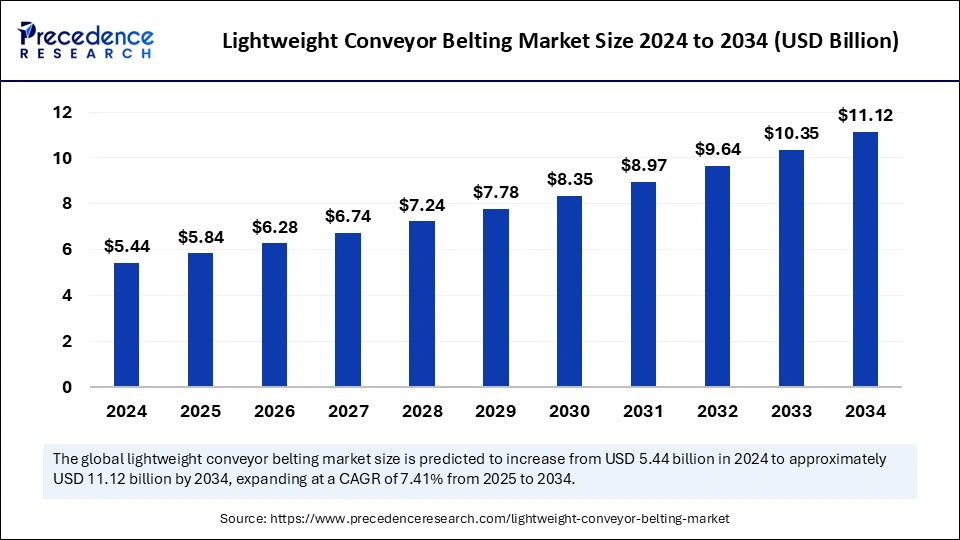
The global lightweight conveyor belting market size was estimated at USD 5.84 billion in 2025 and is predicted to increase from USD 6.28 billion in 2026 to approximately USD 11.85 billion by 2035, expanding at a CAGR of 7.33% from 2026 to 2035. The growth of the lightweight conveyor belting market is expanding rapidly due to the increasing industrialization, along with the growing need for efficient material handling solutions. Furthermore, the growing focus on energy efficiency, speed, and sustainability propels the demand for lightweight conveyor belts.
Lightweight Conveyor Belting Market Key Takeaways
- North America dominated the lightweight conveyor belting market in 2025.
- Asia Pacific segment is expected to grow at a solid CAGR during the forecast period.
- By material, the polyvinyl chloride (PVC) segment led the market in 2025.
- By material, the polyurethane (PU) segment is expected to grow at the fastest CAGR in the coming years.
- By product, the flat belts segment contributed the highest market share in 2025.
- By product, the modular belts segment is projected to grow rapidly during the projection period.
- By thickness, the medium duty (2mm - 4mm) segment captured the biggest market share in 2025.
- By thickness, the light duty (less than 2mm) segment is anticipated to witness the fastest growth over the studied period.
- By application, the logistics segment generated the major market share in 2025.
- By application, the fruits & vegetables segment is projected to be the fastest-growing segment between 2026 and 2035.
What is the Lightweight Conveyor Belting?
The market for lightweight conveyor belting is growing at a significant rate due to the rising demand for conveyor systems from various industries, such as food processing and packaging, e-commerce, warehousing, automotive, electronics, and smart manufacturing. Advances in materials science led to a highly durable belt made of polyurethane and thermoplastic elastomer. Light conveyor belts are more energy efficient, making them suitable for industries that want to reduce operational costs and achieve sustainability goals. These belts streamline transport operations. In addition, the rising focus on industrial automation is further boosting the growth of the lightweight conveyor belting market.
Impact of Artificial Intelligence (AI) on the Lightweight Conveyor Belting Market
The use of Artificial Intelligence in conveyor systems is an ideal approach to improve the reliability of a system. AI technologies are superior to monitoring conveyor belts and conveyor systems. AI algorithms analyze sensor data from conveyor systems to predict potential failures and maintenance. They automatically transport loads. AI-driven conveyor systems minimize human errors and reduce labor costs. AI-driven speed control solutions are promising for improving energy efficiency in conveyor systems.
Lightweight Conveyor Belting Market Growth Factors
- Rising awareness about the environment impacts material choices in conveyor belt production. The rapid shift toward environmentally friendly, recyclable materials will reduce the CO2 footprints of industries. Manufacturers are looking for biodegradable polymers and natural fibers as alternatives to traditional synthetic materials, leading to the growth of the lightweight conveyor belting market.
- Conveyor belts help reduce operational costs by automating the movement of goods in warehouses. This minimizes the need for human workers and associated labor costs. It also improves the accuracy of object handling and reduces errors that can lead to costly returns and lost inventory.
- Increasing government initiatives and funding to support industrial automation contributes to market growth. Moreover, stringent regulations regarding materials that come in contact with manufacturing food products impact the market.
Market Outlook
- Industry Growth Overview: The requirement for automation is on the increase. Growth is favored by e-commerce. Lightweight belts enhance efficiency in logistical, food, and industrial use among different people worldwide.
- Global Expansion: North America and Europe are growing consistently. High-technology materials and robotization reinforce adoption in well-established industrial production industries.
- Major investors: AMMEGA, Intralox, Habasit, Forbo-Siegling, Bando Chemical Industries, and Fenner Group lead in the innovation of conveyor belts around the world.
Market Scope
| Report Coverage | Details |
| Market Size by 2035 | USD 11.85 Billion |
| Market Size in 2025 | USD 5.84 Billion |
| Market Size in 2026 | USD 6.28 Billion |
| Market Growth Rate from 2026 to 2035 | CAGR of 7.33% |
| Dominating Region | North America |
| Fastest Growing Region | Asia Pacific |
| Base Year | 2025 |
| Forecast Period | 2026 to 2035 |
| Segments Covered | Material, Product, Thickness, Application and Regions. |
| Regions Covered | North America, Europe, Asia-Pacific, Latin America, and Middle East & Africa |
Market Dynamics
Drivers
Use of Energy-efficient Systems
The increasing adoption of energy-efficient systems is a major factor driving the growth of the lightweight conveyor belting market. As many industries prioritize cost reduction and sustainability without compromising performance, the adoption of energy-efficient conveyor systems increases. This, in turn, boosts the need for lightweight conveyor belts. The integration of variable speed drives (VSDs) enables conveyor systems to regulate the speed based on load requirements, reducing unnecessary energy consumption.
Additionally, increasing throughput by the use of high-efficiency motors, innovative sensor technology, and automated controls ensure optimal performance and reduce energy waste. As industries look to enhance operational efficiency and comply with environmental regulations, the demand for lightweight, energy-efficient conveyor belting solutions continues to increase.
Restraint
Lower Load Capacity
Lightweight conveyor belts have lower load capacity, affecting the efficiency of conveyor systems. The flexibility of lightweight conveyor belts, particularly those made from rubber or synthetic fabrics, are less and require frequent maintenance due to their lower wear resistance. These conveyor belts may not function constantly or at variable speeds, which affects operational productivity across a variety of sectors. Moreover, lightweight conveyor belts are less durable than heavy-duty belts, hampering the market's growth.
Opportunity
Growing Demand for Food-grade Conveyor Belts
The increasing focus on safe, efficient, and inexpensive food production is expected to boost the demand for specialized food-grade conveyor systems, which creates immense opportunities in the lightweight conveyor belting market. Advances in food processing technologies have led to the adoption of modular conveyors made from food-grade materials featuring cleated surfaces to prevent product slippage and ensure compliance with stringent hygiene standards. Furthermore, the rise of modular conveyor systems, with identical components such as belts, pulleys, and tensioners, enables food processors to customize, reconfigure, and streamline maintenance while minimizing operational costs. As the food sector continues to evolve, the need for adaptable, lightweight, and easily flexible conveyor solutions presents a significant opportunity in the market.
Segment Insights
Material Insights
The polyvinyl chloride segment led the market with the largest share in 2025. This is mainly due to the increased demand for PVC conveyor belts in the food processing, logistics, and packaging sectors. These belts are preferred for their excellent resistance to chemicals, oils, and water, making them ideal for applications with exposure to chemicals. Since PVC is a lightweight, durable, and cost-effective material, it is suitable for lightweight conveyor belts.
The polyurethane (PU) segment is expected to grow at the fastest rate in the coming years. As PU conveyor belts meet food safety standards, they are widely used in the food & beverage industry. Conveyor belts made from PU can be sterilized or sanitized easily. PU is ideal for conveyor systems that require high speeds, tight curves, or complex configurations because of its lightweight and flexibility.
Product Insights
The flat belts segment led the lightweight conveyor belting market in 2025 due to their versatility. These belts are suitable for high-speed drive applications due to their lightweight and smooth surface with a superior grip, which further reduces the chances of product damage. Flat belts feature a flat cross-sectional shape and a trapezoidal profile, which increases the efficiency of a conveyor system.
The modular belts segment is projected to grow at a rapid pace during the forecast period. Modular belts are widely preferred because of their low maintenance, increased efficiency, long lifetimes, and excellent reliability, making them suitable for various applications. These belts are easy to clean and consume less energy.
Thickness Insights
The medium duty (2mm - 4mm) segment registered dominance in the lightweight conveyor belting market in 2025. This is mainly due to the increased adoption of medium-duty conveyor belts in industries requiring moderate load-bearing capacity. These belts are primarily preferred for their good balance between strength and flexibility. They are suitable for transporting products with medium to heavy weight. These belts increase the productivity of manufacturing businesses by efficiently transporting heavy goods.
The light duty (less than 2mm) segment is anticipated to witness the fastest growth over the studied period. The cost-effectiveness of light-duty conveyor belts is a key factor supporting segmental growth. Since these belts require less material during production, they are considered more economical. Light-duty conveyor belts are in high demand in industries like food & beverages and packaging.
Application Insights
The logistics segment accounted for the dominant market share in 2025. This is mainly due to the increased demand for efficient conveyor systems from logistics companies. These companies often deal with large volumes of goods. Thus, they require efficient conveyor systems for the smooth transportation of products. Lightweight conveyor belts enable faster conveyor speed, reducing handling times.
The fruits & vegetables segment is projected to be the fastest-growing segment during the upcoming period as conveyor belts speed up transportation, ensuring that fresh fruits and vegetables reach consumers in fresh condition. They reduce manual handling and decrease contamination risk, enhancing food safety.
Regional Insights
North America's Market Dominance
North America registered dominance in the lightweight conveyor belting market by holding the largest share in 2025. This is mainly due to its robust industrial base and high emphasis on automation, digitization, and efficient manufacturing processes. There is a high adoption of AI-driven conveyor systems in warehouses to drive automation. Several industries in the region have shifted their focus on worker safety, which boosted the adoption of conveyor systems to carry goods.
The U.S. is a major contributor to the North American lightweight conveyor belting market. The country boasts a strong manufacturing sector that relies heavily on material handling solutions, including conveyor systems. There is a rapid expansion of the e-commerce and food processing businesses. The increasing trend of online shopping is further boosting the need for efficient conveyor systems to manage large order volumes, ensure on-time deliveries, and satisfy customer needs, contributing to the growth of the market in the region.
Rapid Industrialization to Boost the Market in Asia Pacific
Asia Pacific is expected to witness the fastest growth during the projection period due to rising industrialization. As industries expand, manufacturing activities increase, and so does the need for conveyor systems to transport goods and streamline operations. Governments across the region are also making efforts to promote industrial automation, which supports market growth. Countries like India and China are expected to lead the Asia Pacific lightweight conveyor belting market over the studied period. This is mainly due to the rapid expansion of the e-commerce and food & beverages industries. There is a high emphasis on warehouse management, boosting the demand for lightweight conveyor belting.
What Are the Driving Factors of the Lightweight Conveyor Belting Industry in Europe?
Europe is expected to grow at a significant rate during the forecast period. Europe is developed because of stringent regulatory requirements and sanitary conditions. The demand increases the need to have safe and clean conveyor solutions. There is an adoption induced by the food processing. Sustainable materials are becoming popular. There is a trend of green logistics, which affects demand. The manufacturers invest in energy-efficient belts. Intelligent surveillance devices facilitate the productivity of businesses.
Germany Lightweight Conveyor Belting Market Trends
Germany develops because of its high sustainability orientation. There is an increase in the demand for recyclable conveyor materials. Industry embraces superior manufacturing. High-performance belts are used in smart factories. Industry 4.0 drives automation. Precision and efficiency are a priority. Firms invest in long-lasting and sanitary solutions for industrial and food purposes.
Lightweight Conveyor Belting Market Companies
- Ammeraal Beltech: Ammeraal Beltech is a provider of lightweight belts. Portfolio has synthetic and modular belts. Still, emphasis is made on hygiene, logistics, and industrial processing applications.
- AA Industrial Belting (Shanghai) Co., Ltd.: AA Industrial is a producer of PVC and PU belts. It provides timing and smooth belts. The center of attention is food processing and airport logistics apps.
- Forbo Holding: Siegling Transilon belts are offered by Forbo. Products have minimal friction and efficiency. Attention is paid to logistics, food processing, and industrial performance applications.
Other Major Key Players
- Habasit Holding
- Hong's Belt
- Intralox
- NYBELT
- Rexnord Corporation
- YONGLI Belting
Recent Developments
- In January 2025, Beltservice Corporation, a leader in value-added wholesale distribution and fabrication of conveyor belting solutions, entered into a acquisition with USA Drives, Inc. The acquisition enables both the companies to expand their capabilities in lightweight and timing belt conveying solutions.
- In January 2025, Belt Power, LLC, a producer and distributor of belting and components for lightweight conveyor systems, announced the acquisition of the U.S. assets of Sparks Belting Company, Inc.
Segments Covered in the Report
By Material
- Polyurethane (PU)
- Polyvinyl Chloride (PVC)
- Silicone
- Rubber
- Thermoplastic Polyolefins (TPO)
- Polyester
- Others
By Product
- Flat Belts
- Cleated Belts
- Modular Belts
- Specialty Belts
- Others
By Thickness
- Light Duty (Less Than 2MM)
- Medium Duty (2MM – 4MM)
- Heavy Duty (Above 4MM)
By Application
- Logistics
- Automotive
- Textile
- Packaging
- Tire
- Meat, Poultry, Fish
- Bakery & Confectionary
- Fruits & Vegetables
- Beverages
- Wood
- Corrugated
- Tobacco
- Fitness
- Airports
- Metal
- Ceramics & Marble
- Others
By Geography
- North America
- Asia Pacific
- Europe
- Latin America
- Middle East & Africa
For inquiries regarding discounts, bulk purchases, or customization requests, please contact us at sales@precedenceresearch.com
Frequently Asked Questions





Ask For Sample
No cookie-cutter, only authentic analysis – take the 1st step to become a Precedence Research client
 Get a Sample




 sales@precedenceresearch.com
 Schedule a Meeting
