



Low Rolling Resistance Tire Market Size, Key Companies, Company Market Share, Vehicle Production Volume, Sales Performance, Export & Import Analysis, Technology Adoption, Competitive Positioning, and Demand Trends
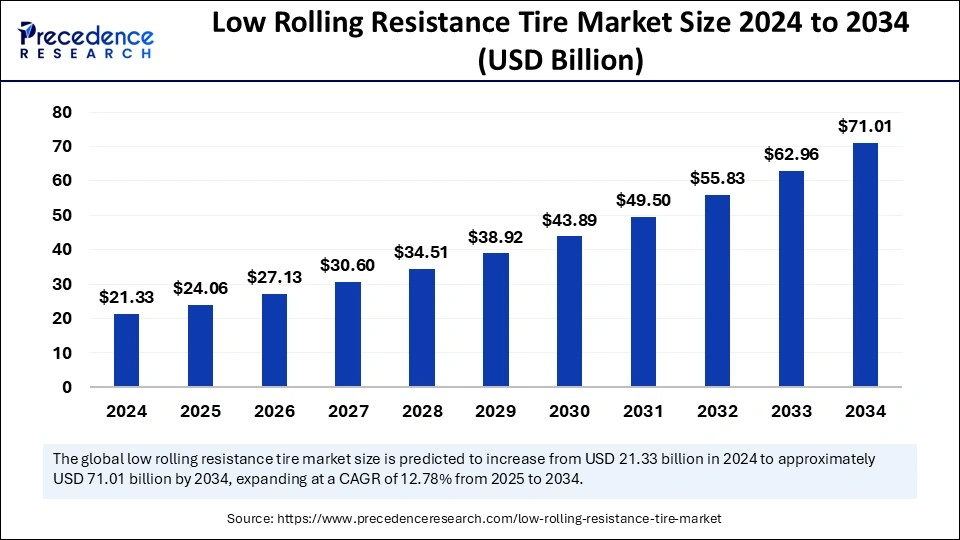
The global low rolling resistance tire market size is calculated at USD 27.13 billion in 2026 and is forecasted to reach around USD 71.01 billion by 2034, accelerating at a CAGR of 12.78% from 2025 to 2034. The North America market size surpassed USD 7.68 billion in 2024 and is expanding at a CAGR of 12.93% during the forecast period. The market sizing and forecasts are revenue-based (USD Million/Billion), with 2024 as the base year.
Source: https://www.precedenceresearch.com/low-rolling-resistance-tire-market
 Get a Sample
 Table Of Content


Low Rolling Resistance Tire Market Size and Forecast 2025 to 2034
The global low rolling resistance tire market size accounted for USD 24.06 billion in 2025 and is predicted to increase from USD 27.13 billion in 2026 to approximately USD 71.01 billion by 2034, expanding at a CAGR of 12.78% from 2025 to 2034. The rising production of vehicles and the increasing focus on improving vehicle performance boost the growth of the low rolling resistance tire market.
Market Highlights
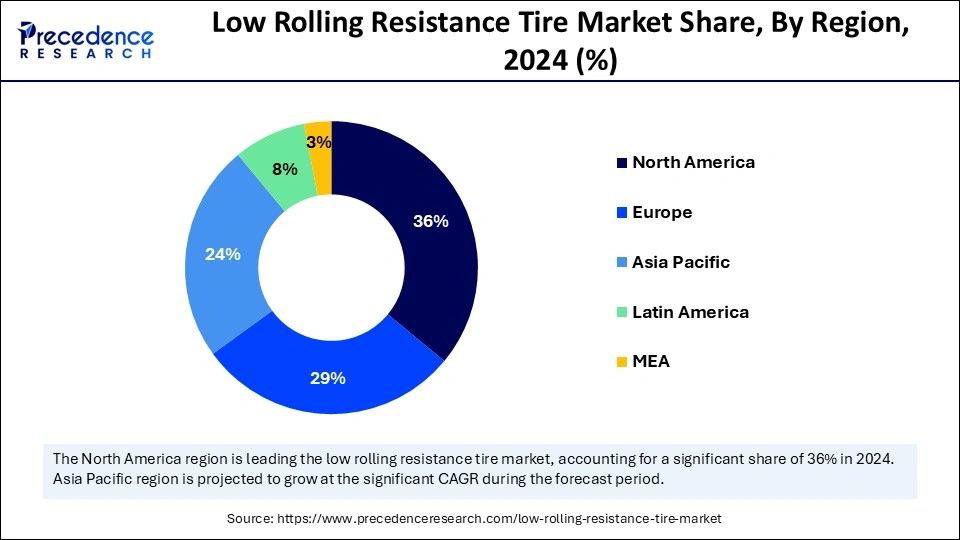
- North America led the low rolling resistance tire market with the largest market share of 36% in 2024.
- Asia Pacific is expected to grow at a notable CAGR of 13.9% in the coming years.
- By vehicle, the passenger cars segment held the major market share of 42% in 2024.
- By vehicle, the electric vehicles segment is projected to grow at the fastest rate during the forecast period.
- By width, the wide band segment dominated the market in 2024.
- By width, the dual width segment is anticipated to grow at a steady growth rate over the studied period.
- By sales channel, the OEMs segment contributed the biggest market share of 61% in 2024.
- By sales channel, the aftermarket segment is expected to expand at a rapid pace in the upcoming period.
Role of AI in Low Rolling Resistance Tire Manufacturing
Artificial intelligence (AI) has changed the landscape of various industries in the last few years. AI technology is utilized to optimize tires' designs, materials, and performance features. With AI and Machine Learning algorithms, manufacturers can optimize tire designs that suit specific characteristics like improving fuel efficiency. AI technology enables manufacturers to create more customized and personalized tire solutions. AI also enables manufacturers to identify new materials with optimal properties for low rolling resistance tires, increasing lifespan, durability, and resistance to wear and tear. In addition, integrating AI in manufacturing significantly enhances production output and tire quality.
- In November 2024, Hankook, a leading tire manufacturer, unveiled its new high-performance tire, Ventus evo. This tire is an AI-enhanced product that offers extraordinary wet grip, low rolling resistance, and high mileage.
Market Overview
Low-rolling resistance tires help reduce energy loss that happens as the tire rolls. This decrease in rolling efforts helps improve the fuel efficiency of the vehicle. The low rolling resistance tire market is witnessing rapid growth because of the rising demand for fuel efficiency. Increased awareness among consumers has led to a substantial increase in demand for vehicles that are fuel-efficient, boosting the need for low-rolling resistance tires. These tires are specifically designed to reduce the energy usage of vehicles. This directly helps in minimizing carbon emissions and reducing fuel consumption.
Governments across the world have implemented stringent regulations in order to reduce carbon emissions and promote sustainability. These efforts have led to the wider adoption of low-rolling resistance tires by automakers and consumers alike. Electric and hybrid vehicles regularly utilize these tires to improve the fuel and energy efficiency of vehicles. The rise in demand for electric and hybrid vehicles is a major factor propelling the market's growth worldwide. The growing focus on environmentally sustainable practices and rising consumer awareness further support market growth. Advancements in tire technology and the rising focus of key players on research and development activities further contribute to market growth.
Low Rolling Resistance Tire Market Growth Factors
- The increasing demand for fuel-efficient vehicles is a key factor driving the growth of the low rolling resistance tire market.
- Rising awareness of environmentally sustainable practices and the need to reduce carbon emissions drive market growth.
- The rapid expansion of the automobile industry and increasing production and sales of vehicles are expected to boost the growth of the market during the forecast period.
- Advancements in technology further support market expansion.
- Governments worldwide have imposed stringent regulations regarding fuel efficiency, influencing the market.
Market Scope
| Report Coverage | Details |
| Market Size by 2034 | USD 71.01 Billion |
| Market Size in 2026 | USD 27.13 Billion |
| Market Size in 2025 | USD 24.06 Billion |
| Market Growth Rate from 2025 to 2034 | CAGR of 12.78% |
| Dominated Region | North America |
| Fastest Growing Market | Asia Pacific |
| Base Year | 2024 |
| Forecast Period | 2025 to 2034 |
| Segments Covered | Vehicle, Width, Sales Channel, and Regions |
| Regions Covered | North America, Europe, Asia-Pacific, Latin America and Middle East & Africa |
Market Dynamics
Drivers
Increasing Demand for Electric Vehicles
The rising awareness among consumers about the importance of reducing carbon emissions has significantly increased the demand for electric vehicles across the world. With consumers prioritizing vehicles that offer fuel efficiency, the adoption of electric vehicles (EVs) has rapidly increased. In 2024, 17.1 million EVs were sold worldwide, which is 25% year-over-year growth. In India alone, the sales of EVs surpassed 2 million units in 2024. As the production of EVs increases, so does the demand for low-rolling resistance tires. EVs benefit from these tires, as they enhance efficiency and range, further reducing fuel consumption. Automakers are utilizing low-rolling-resistance tires in electric vehicles to enhance the efficiency, performance, and fuel efficiency of vehicles.
Restraint
High Initial Costs
Low-rolling resistance tires are costlier compared to traditional tires. This creates barriers for some consumers. The high initial cost of these tires is directly reflected in the selling price of the products. It can deter the consumers that are price sensitive and limit the market's consumer base. Despite many advantages of these tires, including long-term cost savings, the initial investment is too high, which influences the decision of consumers with a fixed budget. In addition, the limited availability of these tires hinders the growth of the market. Key players operating in the market must find solutions that are more affordable.
Opportunity
Technological Advancements
Advancements in technology have opened up new avenues for innovations. Advanced technologies like CAD and 3D printing enable manufacturers for more precise and efficient production of low rolling resistance tires. Moreover, advanced technologies allow researchers to identify new materials. With innovative materials like graphene, manufacturers can enhance the design and features of low-rolling resistance tires. This further enhances the performance of vehicles.
Segments Insights
Vehicle Insights
How does the Passenger Cars Segment Dominate the Low Rolling Resistance Tire Market in 2025?
The passenger cars segment dominated the market in 2025, owing to surging consumer demand for fuel cost savings, electric vehicle adoption, and stringent government carbon emission mandates. The technological advancements in tire manufacturing, rising fuel prices, and consumer cost consciousness are expanding the demand for passenger cars. The growing public environmental awareness, with direct cost savings, has increased the demand for the aftermarket for fuel-efficient passenger car tires.
The electric vehicles segment is expected to grow at the fastest CAGR in the market during the forecast period due to the increased focus on range optimization, battery efficiency, maximizing battery range, and advanced material science. The surging global EV sales and OEM partnerships have also driven the adoption of EVs. The other major growth drivers are strict fuel economy standards and tire labelling mandates.
Width Insights
What made Wide Band the Dominant Segment in the Low Rolling Resistance Tire Market in 2025?
The wide band segment dominated the market in 2025, owing to advanced heat dissipation capabilities in commercial logistics, substantial fuel savings, and operational weight reduction. The vehicle economics are getting transformed by fleet operators to align with stricter global emission standards. Maximized payload is very important for weight-sensitive applications in long-haul logistics and trucking.
The dual-width segment is estimated to grow at the fastest rate in the market during the predicted timeframe due to its cost-effectiveness, versatility, and high demand in urban logistics. The e-commerce boom and the rapidly expanding last-mile delivery networks have increased the number of delivery vans and light commercial vehicles on the road. Dual-type tires feature lower upfront costs, affordability, and cost efficiency.
Sales Channel Insights
How did the OEMs Segment Dominate the Low Rolling Resistance Tire Market in 2025?
The OEMs segment dominated the market in 2025, owing to advancements in sustainable material compounding, battery range optimization, and compliance strategy. Nanotechnology and advanced silica-silane compounding allow manufacturers to lower rolling resistance. The commercial fleet OEMs are enabled to lower the total cost of ownership through fuel savings and premium, specialized tires.
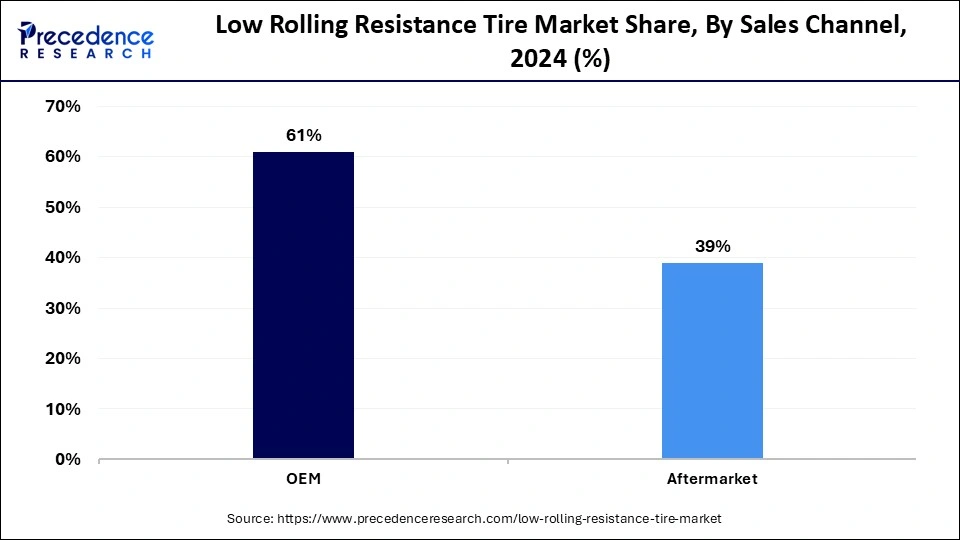
The aftermarket segment is anticipated to grow at a notable rate in the market during the upcoming period due to the expansion of e-commerce logistics and preference for the total cost of ownership. Moreover, the boom in urban delivery networks has increased annual vehicle mileage for heavy and light commercial fleets. The other major driving forces are premium brand accessibility and the availability of advanced rubber compounds.
Regional Insights
How does North America dominate the Low Rolling Resistance Tire Market in 2025?
North America dominated the market in 2025, owing to the integration of smart tire tech, strict emissions and ESG standards, and fleet fuel efficiency. The federal and state-level policy targets focus on fuel economy and vehicle emissions. They encourage tire brands and original equipment manufacturers (OEMs) to adopt advanced energy-efficient tire compounds. The commercial long-haul operators are prioritizing low rolling resistance to cut major operational overload and ensure compliance.
What is the Role of the Low Rolling Resistance Tire Market in the U.S.?
The U.S. advances in the market due to EV-specific engineering, strong aftermarket cycles, fuel economy standards, advanced compounds, smart tire tech, lower operating costs, and battery range optimization. The supply chain legislation, strong EV adoption, and strict federal fuel economy rules are also expanding the U.S.
U.S. Low Rolling Resistance Tire Market Size and Growth 2025 to 2034
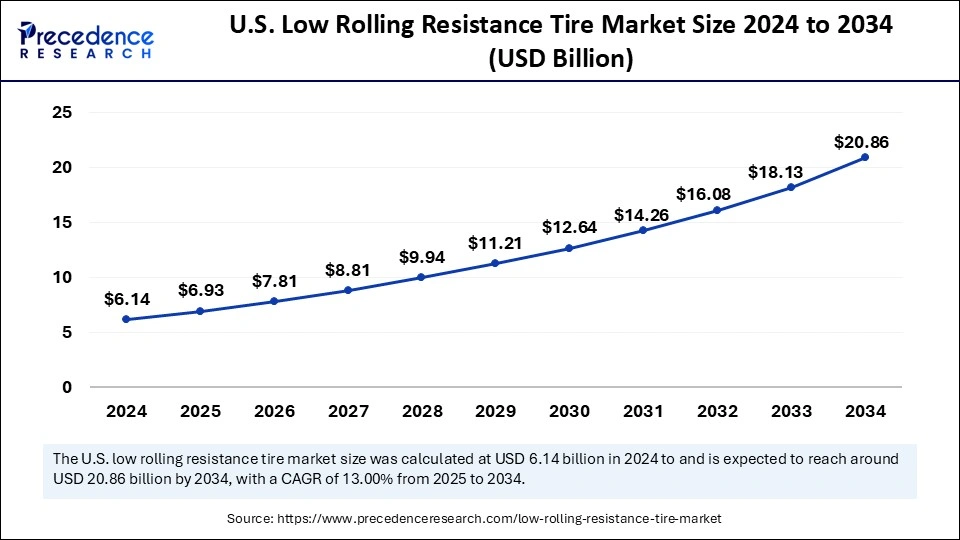
The U.S. low rolling resistance tire market size was exhibited at USD 6.14 billion in 2024 and is projected to be worth around USD 20.86 billion by 2034, growing at a CAGR of 13.00% from 2025 to 2034.
Why is Asia Pacific Considered the Fastest-Growing Region in the Low Rolling Resistance Tire Market?
Asia Pacific is expected to grow at the fastest CAGR in the market during the forecast period due to the rising urban vehicle ownership across major economies like India and China, rising urbanization and vehicle ownership, and commercial fleet focus on operating costs. The regulatory bodies prioritize low rolling resistance tires as critical tools to lower carbon emissions and extend the driving ranges of electric vehicles. These tires reduce energy loss during rotation and hit corporate average fuel consumption targets.
What is the Potential of the Low Rolling Resistance Tire Market in India?
India introduced the government schemes that fuel the domestic demand for EV-compatible tires. The automakers and consumers have strongly adopted electric vehicle and tires. The government of India has introduced structural frameworks and targeted policies to promote high-performance, fuel-efficient, low rolling resistance tires.
Countries like China and India are major contributors to the Asia Pacific low rolling resistance tire market. China is known as the leading automobile manufacturing hub. According to the China Association of Automobile Manufacturers, car sales are predicted to reach 32.4 million units in 2025, with New Energy vehicle sales growing by 24.4%. In addition, the rapid shift toward EVs and the increasing focus on improving vehicle performance support market growth.
How does Europe Grow Notably in the Low Rolling Resistance Tire Market?
Europe is expected to grow at a notable rate in the market in the coming years, driven by an increased focus on commercial fleet cost reduction and the mass transition toward electric mobility. Heavy investments are made in next-generation material science by tire manufacturers. The government initiatives focused on laboratory alignment rules and updating tire energy labelling. The industrial growth in Europe has also been accelerated by the European Green Deal and the need to extend the driving ranges of electric vehicles.
What is the Impact of the Low Rolling Resistance Tire Market in Germany?
Germany is growing and expanding in the market due to heavy commercial fleet electrification, stringent European Union environmental regulations, and EU emissions and fuel efficiency policies. Germany has utilized financial and legislative frameworks to boost the industry toward ‘green' tire adoption.
What is the Key Position of the Low Rolling Resistance Tire Market in Latin America?
Latin America is expected to expand significantly in the market during the studied period, propelled by rising fuel efficiency awareness among consumers, expanding commercial logistics networks, and strict global and regional emissions mandates. There is a rapid transition toward eco-friendly solutions in this region. There is a rising need for lower road noise, specialized tires with reduced friction, and high torque durability to protect driving range and manage heavy battery weights.
How does Brazil lead in the Low Rolling Resistance Tire Market?
Brazil witnesses a massive progress through escalating commercial fleet demands, government-backed automotive incentives, and rapid electrification. The Brazilian manufacturers are encouraged to improve tire compounds to meet vehicle emission targets and strict national energy efficiency. The trade protections aim to promote investments and protect domestic manufacturers in sustainable, local tire development.
How big is the Footprint of the Low Rolling Resistance Tire Market in the MEA?
MEA is expected to grow and expand at a significant rate in the market during the predicted timeframe, accelerated by the rising commercial vehicle usage, fleet cost-optimization, infrastructure development, and government sustainability commitments. The regional governments have introduced strict standards to enforce energy-efficient tire adoption. The strict certification frameworks and structural updates aim to standardize imports of tires and motor vehicles. Many MEA countries are aligning with the updates of the United Nations Economic Commission for Europe (UNECE).
How does Saudi Arabia advance in the Low Rolling Resistance Tire Market?
Saudi Arabia experiences a momentous growth in the market, driven by government-backed localization projects, strict energy efficiency mandates under Vision 2030, and mega joint ventures. The government has built localized technical frameworks for smart tires. These tires are designed with embedded IoT sensors that monitor temperature, real-time pressure, and wear.
Competitive Landscape
The low rolling resistance tire market is dominated by a core group of global manufacturing players such as Michelin, Bridgestone Corporation, Continental AG, the Goodyear Tire & Rubber Company, Pirelli & C. S.p.A., Yokohama Rubber Co., Ltd., Hankook Tire & Technology, Sumitomo Rubber Industries, Ltd., and many others. Some of the leading companies, like Goodtyear, focus on balancing puncture resistance with ultra-lightweight internal architecture. They aim to support regional delivery vehicles and heavier electric vehicles. The R&D focused areas are advanced sustainable chemistry, EV-specific range extension, smart telematics and IoT, and process automation.
Recent Developments
- In September 2025, Continental launched the new Conti Urban HA 5 NXT city bus tire with a high share of renewable and recycled materials. It features high mileage, low rolling resistance, and reduced noise. (Source: https://www.continental.com)
- In March 2025, Continental launched Grand Prix TR, a new road tire, which features performance, versatility, and value in one package. It is designed for cyclists who want an all-around, dependable tire for commuting, training, and long-distance rides. (Source: https://www.continental.com)
Low Rolling Resistance Tire Market Companies
- Bridgestone Corporation
- Michelin
- Goodyear Tire & Rubber Company
- Continental AG
- Pirelli & C. S.p.A.
- Hankook Tire
- Yokohama Rubber Co. Ltd.
- Apollo Tyres Ltd.
- Cheng Shin Rubber Industry Co. (Maxxis)
- Kumho Tire
- Zhongce Rubber Group Co., Ltd. (ZC-Rubber)
- Nokian Tyres plc
- MRF Tyres
- Sumitomo Rubber Industries, Ltd.
- Firestone Tire and Rubber Company
- Cooper Tire & Rubber Company
- Toyo Tire & Rubber Company
Segments Covered in the Report
By Vehicle
- Passenger Vehicles
- Light Commercial Vehicles
- Heavy Commercial Vehicles
- Electric Vehicles
By Width
- Dual Width
- Wide Band
By Sales Channel
- OEM
- Aftermarket
By Regional
- North America
- Europe
- Asia Pacific
- Latin America
- Middle East & Africa
For inquiries regarding discounts, bulk purchases, or customization requests, please contact us at sales@precedenceresearch.com
Frequently Asked Questions





Ask For Sample
No cookie-cutter, only authentic analysis – take the 1st step to become a Precedence Research client
 Get a Sample




 sales@precedenceresearch.com
 Schedule a Meeting
