



Lung Cancer Surgery Market Size, Companies, Share, Patient Volume, Treatment Adoption Rates, Pricing Analysis, Regulatory Landscape, Competitive Positioning, and Demand Forecast
Lung Cancer Surgery Market (By Procedure Type: Lobectomy, Segmentectomy, Pneumonectomy, Other; By Surgical Approach Type: Open surgery, Video-assisted thoracoscopic surgery (VATS), Robotic-assisted thoracic surgery (RATS); By Cancer Type: Non-small cell lung cancer (NSCLC), Small cell lung cancer (SCLC), By Provider Type: Hospitals, Cancer care centers, Other) - Global Industry Analysis, Size, Trends, Leading Companies, Regional Outlook, and Forecast 2026 to 2035
Source: https://www.precedenceresearch.com/lung-cancer-surgery-market
 Get a Sample
 Table Of Content


What is the Lung Cancer Surgery Market Size?
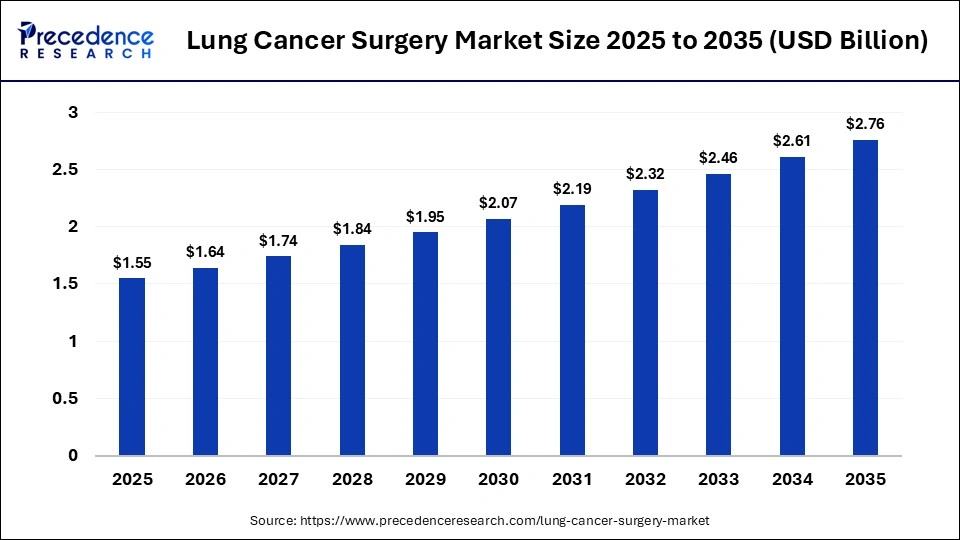
The global lung cancer surgery market size was calculated at USD 1.55 billion in 2025 and is predicted to increase from USD 1.64 billion in 2026 to approximately USD 2.76 billion by 2035, expanding at a CAGR of 5.95% from 2026 to 2035.The market is driven by rising cancer awareness, advancements in early detection, better access to advanced treatment options, and the increasing adoption of minimally invasive surgeries.
Key Takeaways
- By region, North America led the lung cancer surgery market in 2025.
- By region, Asia Pacific is expected to grow at the fastest CAGR in the upcoming period.
- By procedure type, the lobectomy segment led the market with the largest share in 2025.
- By procedure type, the segmentectomy segment is observed to grow at the fastest CGAR during the foreseeable period.
- By surgical approach, the open surgery segment led the global market with a major share in 2025.
- By surgical approach, the video-assisted thoracoscopic surgery segment is expected to grow at the fastest rate in the foreseen period.
- By cancer type, the non-small cell lung cancer segment held the largest share of the market in 2025.
- By cancer type, the small cell lung cancer segment is observed to expand at the fastest rate in the coming years.
- By provider type, the hospitals segment led the market while holding the largest share of 65% in 2025.
- By provider type, the cancer care centers segment is observed to grow at the fastest rate in the foreseen period.
Market Overview
Lung cancer is the leading cause of cancer-related deaths worldwide, accounting for the highest mortality rates among both men and women. The rising prevalence of tobacco smoking has significantly increased the incidence of lung cancer, contributing to more than 1.8 million deaths annually. Growing emphasis on early detection and treatment, given that the disease is often diagnosed at an advanced stage, when therapeutic options are limited, is driving growth in the lung cancer surgery market. However, the high cost of lung cancer surgery remains a key restraint.
Impact of Artificial Intelligence on the Lung Cancer Surgery Market
The era of artificial intelligence in disease management is advancing rapidly. Machine learning, neural networks, deep learning, computer vision, and natural language processing are improving the diagnosis and treatment of lung cancer. AI now enhances lymph node sampling tools, bronchial segment identification, and robotic-assisted tumor resections. Augmented reality overlays generated from AI-analyzed imaging help surgeons visualize tumor margins in real time, reducing incomplete resections and improving outcomes. However, algorithmic bias, data privacy issues, and the need for strong clinical validation remain challenges. AI is being used as a support tool rather than a replacement for specialists, promoting safer adoption and steady market growth.
AI News
- In April 2026, Roswell Park Comprehensive Cancer Center partnered with the University at Buffalo. This partnership was done to develop an AI-enabled platform to assess the risks of lung cancer surgery complications. (Source: https://www.buffalo.edu)
What are the Key Trends Influencing the Lung Cancer Surgery Market?
- Rising adoption of minimally invasive surgeries, including robot assisted and video assisted techniques, is reducing health risks, shortening recovery times, and minimizing hospital stays, thereby driving strong procedural demand.
- Growing government support for healthcare research, a strong regulatory framework, and increasing integration of AI technologies are strengthening innovation and driving sustained growth in the market.
- Increasing awareness of lung cancer and government initiatives supporting early detection are boosting timely surgical intervention, improving the surgery rate, and accelerating market growth.
- Advances in genomic sequencing may allow surgeons to identify genetic aberrations within a patient's tumor and perform more advanced surgery followed by appropriate treatment.
Market Scope
| Report Coverage | Details |
| Market Size in 2025 | USD 1.55 Billion |
| Market Size in 2026 | USD 1.64 Billion |
| Market Size by 2035 | USD 2.76 Billion |
| Market Growth Rate from 2026 to 2035 | CAGR of 5.95% |
| Dominating Region | Asia Pacific |
| Fastest Growing Region | North America |
| Base Year | 2025 |
| Forecast Period | 2026 to 2035 |
| Segments Covered | Procedure Type, Surgical Approach Type, Cancer Type ,Provider Type , and Region |
| Regions Covered | North America, Europe, Asia-Pacific, Latin America, and Middle East & Africa |
Market Dynamics
Driver
Surging Prevalence of Lung Cancer in Different Regions
The cases of adenocarcinoma and squamous cell carcinoma have been increasing rapidly in several nations, such as the U.S., China, and the UK. Due to the growing prevalence of lung cancer, the demand for effective surgeries is rising significantly, which in turn accelerates the market expansion.
- According to the American Cancer Society, around 229,410 new cases of lung cancer are expected to occur in the U.S. during 2026.
(Source: https://www.cancer.org/cancer/types/lung-cancer/about/key-statistics.html)
Restraint
Side Effects of Surgeries
Lung cancer surgeries can cause various side effects, including post-operative pain, shortness of breath, profound fatigue, and temporary loss of appetite. These negative issues of lung cancer surgeries are expected to restrain the industrial growth.
Opportunity
Integration of AR and Popularity of Robotic-Assisted Thoracic Surgery
The surgical centers have started integrating AR-based surgical systems to enhance the surgical procedure for lung cancer. Also, healthcare providers are deploying robots for operating thoracic surgeries to reduce the dependency on doctors. Thus, the above-mentioned factors are anticipated to create numerous growth opportunities for the industry leaders in the upcoming days.
Segment Insights
Procedure Type Insights
How Does the Lobectomy Segment Dominate the Market?
The lobectomy segment dominated the lung cancer surgery market with the largest share in 2025 and is expected to sustain its growth trajectory during the forecast period. This is because it is the standard surgical procedure for treating early-stage non-small cell lung cancer. This procedure was first performed in 1913 and involves the surgical removal of a lung lobe and remains the gold standard for resectable lung cancer, especially when combined with lymph node dissection.
Widely used in early-stage lung malignancies and select benign conditions, the procedure has significantly evolved with advancements in surgical technique, anesthesia, and infection control. Improved safety, precision, and patient outcomes have strengthened clinical acceptance, positioning lobectomy as a preferred choice.
The segmentectomy segment is expected to grow at the fastest CAGR over the forecast period. This is because it offers a lung-sparing alternative to lobectomy, making it ideal for patients with early-stage tumors or limited pulmonary function. This procedure involves resection of a specific portion of a lung lobe and includes procedures such as basal segmentectomy, lingulectomy, and upper division lobectomy.
Compared to more extensive resections, it is associated with significantly lower major morbidity and improved perioperative outcomes. Although frequently performed in larger lobes, it consistently demonstrates favorable clinical results. The growing shift toward lung-preserving and minimally invasive surgical approaches is also contributing to the segment growth.
Surgical Approach Insights
What Made Open Surgery the Dominant Segment in the Market?
The open surgery segment dominated the lung cancer surgery market with the largest share in 2025. This is because it is a traditional surgical method. As a well-established approach, open thoracic surgery continues to be widely performed, particularly in advanced and late-stage lung cancer cases. The procedure involves an incision along the side of the chest following the rib curve, with temporary opening of the ribcage to access the affected lung area. The preference for this surgical approach has been increasing due to the rising incidence of lung cancer and the increasing diagnosis at later stages.
The video-assisted thoracoscopic surgery (VATS) segment is projected to expand at the fastest rate in the foreseeable years due to the rising demand for minimally invasive surgical approach. In this procedure, a tiny camera and surgical instruments are inserted into the chest through one or more small incisions in the chest wall. Video-assisted thoracoscopic surgery has become a leading minimally invasive technique for thoracic procedures, providing benefits such as less postoperative pain, shorter hospitalizations, and faster recovery compared to conventional open thoracotomy. These assistances are driving widespread adoption of this technique and contributing significantly to market growth.
Cancer Type Insights
What Made Non-Small Cell Lung Cancer (NSCLC) the Dominant Segment in the Market?
The non-small cell lung cancer (NSCLC) segment dominated the market with a major share in 2025, as it is the most common type of lung cancer, accounting for about 80% to 85% of all cases. It develops when normal cells in the lungs undergo abnormal changes and begin to grow uncontrollably. NSCLC can spread to other parts of the body before noticeable symptoms appear, and in some cases, it may not cause symptoms at all in its early stages. As a result, early detection and treatment are often delayed. This late diagnosis frequently leads to the need for surgical intervention, contributing to the segment's dominance.
The small cell lung cancer (SCLC) segment is expected to grow at the fastest CAGR during the forecast period. It is more aggressive than non-small cell lung cancer (NSCLC) and is primarily caused by smoking, with higher smoking intensity significantly increasing the risk. It can spread rapidly within the chest and to other parts of the body. As a result, many patients require surgical intervention, which supports the growth of this segment.
Provider Type Insights
How Does the Hospitals Segment Lead the Market in 2025?
The hospitals segment led the lung cancer surgery market by holding the largest share in 2025 due to their comprehensive infrastructure and access to advanced surgical technologies. Hospitals offer a wide range of treatment options, including chemotherapy, hormone therapy, and radiotherapy, along with multidisciplinary medical teams and strong surgical expertise, making them a preferred choice for patients due to their advanced treatment capabilities. Additionally, increasing patient awareness and insurance coverage further drives the preference for hospital-based lung cancer surgeries.
The cancer care centers segment is expected to grow at the fastest rate in the upcoming period. This growth is driven by comprehensive aftercare services offered by these centers and the increasing demand for personalized, cancer-specific treatments. Availability of advanced tools for diagnosis, specialized software for cancer management, and a strong multidisciplinary approach are further supporting this segment's expansion. Rising patient preference for specialized care, early diagnosis programs, and access to cutting-edge treatments are further driving the adoption of cancer care centers for lung cancer surgery.
Regional Insights
What Made North America the Leading Region in the Lung Cancer Surgery Market?
North America dominated the lung cancer surgery market, holding the largest share in 2025. This leadership is driven by advanced healthcare infrastructure and a high rate of technology adoption. The region's strong position is further supported by the high prevalence of lung cancer cases, largely associated with smoking and environmental exposure, which directly increases the demand for surgical interventions. Additionally, favorable reimbursement policies and the widespread adoption of minimally invasive and robotic-assisted surgical technologies are accelerating procedure volumes. The presence of sophisticated systems such as the da Vinci Surgical System enhances surgical precision and clinical outcomes, further strengthening North America's role in the global market.
U.S. Market Analysis
The U.S. lung cancer surgery market is driven by favorable regulatory environments and the pace of technological adoption. The market is experiencing steady expansion, supported by the increasing use of minimally invasive procedures such as VATS and robotic-assisted surgeries, which offer significant growth opportunities. In addition, early detection initiatives, particularly low-dose CT screening programs, are improving the diagnosis of operable tumors at earlier stages, further reinforcing market growth.
How is the Opportunistic Rise of Asia Pacific in the Lung Cancer Surgery Market?
Asia Pacific is projected to grow at the fastest CAGR throughout the forecast period, driven by increasing awareness programs related to lung cancer, supported by both private and public organizations. The region features a dynamic mix of established pharmaceutical companies, innovative biotech firms, and emerging regional players. Leading multinational corporations leverage extensive R&D capabilities, regulatory expertise, and global distribution networks to maintain strong market positions.
China Market Analysis
China is strengthening its efforts to enhance cancer diagnosis and treatment, leading to the adoption of more advanced surgical techniques in lung cancer management. The growing use of minimally invasive procedures is contributing to improved treatment efficiency and expanding market growth.
Japan Market Analysis
Japan's healthcare sector is increasingly integrating AI technologies, significantly influencing the lung cancer surgery equipment market. AI-driven diagnostic tools and advanced surgical planning systems enhance precision, reduce operative time, and improve patient outcomes, thereby accelerating the adoption of advanced surgical equipment.
What Drives the Market in Europe?
The lung cancer surgery market in Europe is driven by increasing awareness of lung cancer, early detection programs, and government initiatives to improve access to advanced healthcare. Rising adoption of minimally invasive and robotic-assisted thoracic surgeries, growing investment in state-of-the-art surgical infrastructure, and the presence of well-established hospitals and cancer care centers further fuel market growth.
UK Market Analysis
The UK has a strong healthcare infrastructure. The demand for lung cancer surgeries is rising due to increased awareness, early detection, and access to advanced surgical techniques. The country's focus on improving patient outcomes through minimally invasive procedures and advanced surgical technologies is contributing to steady market growth.
How will Europe Grow in the Lung Cancer Surgery Market?
Latin America is experiencing significant growth in the global market, primarily driven by the increasing incidence of lung cancer, advancements in minimally invasive surgical techniques, and improvements in healthcare infrastructure. Investments in hospitals, cancer care centers, and centers of excellence in countries like Brazil, Mexico, and Argentina are enhancing access to surgical services. Moreover, improved access to diagnostic tools, such as low-dose computed tomography scans, is facilitating earlier detection, which in turn makes more patients eligible for curative surgeries.
Brazil Market Trends
Brazil is undergoing a major transformation in surgical care, bridging the gap between traditional thoracotomy and modern robotic techniques, despite lingering infrastructural disparities. While the public system manages the majority of cases, the adoption of advanced, minimally invasive technologies is mainly concentrated within private healthcare centers in affluent urban areas, creating a two-tier landscape for innovation.
How will the Middle East and Africa Grow in the Lung Cancer Surgery Market?
In the Middle East and Africa is expected to grow at a considerable CAGR in the upcoming period. This expansion is largely driven by a rise in cancer incidence, enhanced healthcare infrastructure, and the adoption of advanced surgical techniques, particularly in countries like Saudi Arabia and the UAE. The MEA region is witnessing an increase in lung cancer cases due to high smoking rates and escalating air pollution from rapid industrialization. Investments in oncology, the establishment of specialized cancer centers, and improvements in diagnostic facilities in countries like Saudi Arabia are propelling the market forward.
UAE Market Trends
The UAE is revolutionizing lung cancer care through high-tech initiatives and the adoption of robotic-assisted, minimally invasive surgeries, positioning itself as a premier global oncology hub. Supported by significant investments in AI-driven diagnostics and specialized cancer centers, the UAE is accelerating the adoption of personalized, multidisciplinary care, setting new benchmarks for medical tourism in the region.
Value Chain Analysis – Lung Cancer Surgery Market
- Research and Development: This focuses on early detection, staging, and determining surgical feasibility, which is critical as early-stage diagnosis enables curative surgery.
Key Players: Siemens Healthineers, GE Healthcare, and Novartis. - Surgical Device Development and Regulatory Approval: This focuses on manufacturers developing and gaining regulatory approval for robotic-assisted systems, minimally invasive instruments, and VATS tools, notes.
Key Players: Medtronic, Ethicon, Olympus Corporation, and KARL STORZ SE and Co. KG. - Manufacturing and Surgical Technology Production: This involves high-precision manufacturing of surgical instruments, robotic arms, and specialized stapling devices under strict regulatory standards.
Key Players: Intuitive Surgical, Medtronic, Ethicon, Olympus, and Stryker. - Distribution, Installation, and Logistics: This involves the logistical deployment of large robotic systems, specialized instruments, and maintenance teams, often managed directly by the device manufacturers.
Key Players: Intuitive Surgical, Medtronic, UPS Healthcare, and DHL Group.
Operating in the Market Companies
- Johnson & Johnson (Ethicon LLC)
- Medtronic Plc.
- Intuitive Surgical Inc.
- Olympus Corporation
- Siemens Healthineers
- Karl Storz SE & Co. KG
- Accuray Incorporated
- Teleflex Incorporated
- B. Braun Melsungen AG
- AngioDynamics Inc.
- Richard Wolf GmbH
- Stryker Corporation
- KLS Martin Group
- Boston Scientific Corporation
- GE HealthCare
Recent Developments
- In April 2026, Sheffield Teaching Hospitals NHS FT launched a new robotic-assisted surgery system. This robotic-assisted surgery system was designed to operate on numerous types of surgeries, including lung cancer surgeries, colorectal cancer surgeries, and other surgeries. (Source: https://www.digitalhealth.net)
- In March 2026, FV Hospital launched a new da Vinci Robotic Surgery Center in Vietnam. This center was established to enhance surgical procedures related to lung cancer. (Source: https://www.fvhospital.com)
- In March 2026, L&T Technology Services (LTTS) launched an AI-enabled digital-twin platform. This platform was designed to enhance the capabilities of lung navigation, surgical planning, and respiratory diagnostics. (Source: https://www.auntminnie.com)
- In February 2026, Indraprastha Apollo Hospitals unveiled the Varian Edge Radiosurgery System. This radiosurgery system is integrated with Hyperarc Technology to enhance the lung cancer surgical procedure. (Source: https://thewire.in/ptiprnews)
- In February 2026, the European Society of Radiology (ESR) and the European Respiratory Society (ERS) introduced the European Lung Cancer Screening Alliance (ELCSA) at the European Cancer Screening and Early Detection Policy Summit in Brussels. According to ESR and ERS, ELCSA will unite clinical societies, researchers, patient advocates, and policymakers with the shared objective of enhancing early lung cancer detection.(Source: https://www.auntminnieeurope.com)
- In 2025, Winship Cancer Institute of Emory University is strengthening its commitment to reducing lung cancer mortality across Georgia with the launch of the Emory Healthcare Lung Screening and Nodule Program. The program is dedicated to early detection and timely treatment of lung cancer by using low-dose CT lung screening and AI-assisted identification of incidentally detected pulmonary nodules.(Source: https://news.emory.edu)
- In 2025, the world's first clinical trial of a lung cancer vaccine was launched. Supported by Cancer Research UK and the CRIS Cancer Foundation, the LungVax trial is scheduled to run over the next four years, beginning in the summer of 2026. This study represents a crucial first step toward making the vaccine available to people at the highest risk of developing lung cancer.(Source: https://www.ucl.ac.uk)
- In 2025, Glenmark Pharma launched the lung cancer treatment drug Tevimbra in India. Tevimbra was developed by BeiGene (now BeOne Medicines), a global leader in oncology.(Source: https://www.business-standard.com)
Segments Covered in the Report
By Procedure Type
- Lobectomy
- Segmentectomy
- Pneumonectomy
- Other
By Surgical Approach Type
- Open surgery
- Video-assisted thoracoscopic surgery (VATS)
- Robotic-assisted thoracic surgery (RATS)
By Cancer Type
- Non-small cell lung cancer (NSCLC)
- Small cell lung cancer (SCLC)
By Provider Type
- Hospitals
- Cancer care centers
- Other
By Region
- North America
- Europe
- Asia-Pacific
- Latin America
- Middle East & Africa
For inquiries regarding discounts, bulk purchases, or customization requests, please contact us at sales@precedenceresearch.com
Frequently Asked Questions
Tags





Ask For Sample
No cookie-cutter, only authentic analysis – take the 1st step to become a Precedence Research client
 Get a Sample




 sales@precedenceresearch.com
 Schedule a Meeting
