



Medical Device Security Market Size, Companies, Trends, Regulatory Landscape, Competitive Positioning, and Demand Forecast
Medical Device Security Market (By Component: Solutions Services; By Type: Application Security, Endpoint Security, Network Security, Cloud Security; By Device Type: Hospital Medical Devices, Internally Embedded Medical Devices, Wearable and External Medical Devices; By End User: Healthcare Providers, Medical Device Manufacturers, Healthcare Payers) - Global Industry Analysis, Size, Trends, Leading Companies, Regional Outlook, and Forecast 2026 to 2035
Source: https://www.precedenceresearch.com/medical-device-security-market
 Get a Sample
 Table Of Content


What is the Medical Device Security Market Size?
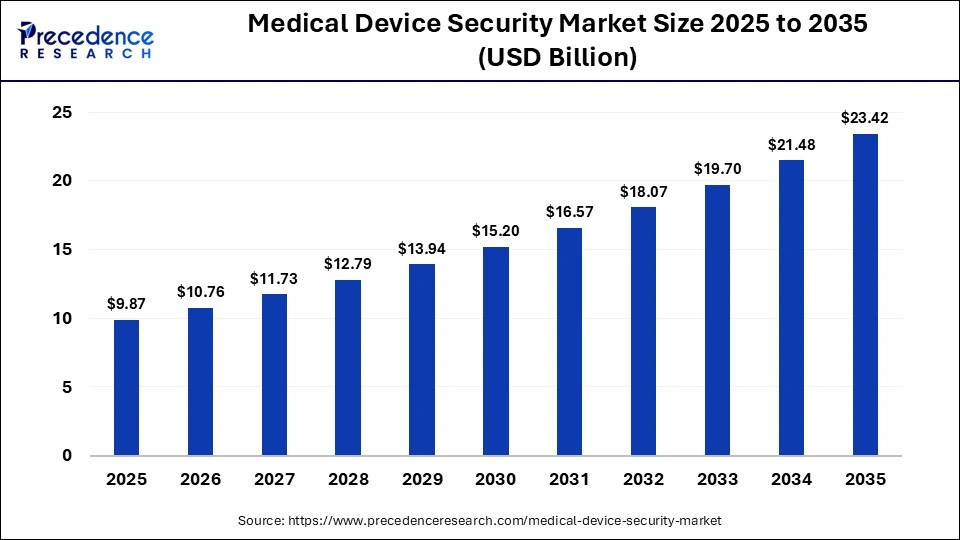
The global medical device security market size is predicted to increase from USD 10.76 billion in 2026 to approximately USD 23.42 billion by 2035, expanding at a CAGR of 9.03% from 2026 to 2035. The medical device security market is experiencing rapid growth due to the increasing demand for products, strategies, and networks that help protect medical devices and patient data from cyber fraud and threats. The market also ensures the safety of patient data, functionality, and accessibility of medical devices from cyber fraud and information processed on various platforms.
With the help of the adoption of technological advancements, hospital networks can track a patient's vitals and other information with the help of wearable trackers, infusion pumps, and imaging systems, which is further helpful for the growth of the market. Computerized services in the form of cloud-based services and the internet allow cyber attackers to leak the essential patient data with the help of system breaches or malware, leading to a higher demand for the medical device security industry.
Market Highlights
- North America dominated the market with the largest market share of 38% in 2026.
- Asia Pacific is observed to be the fastest-growing region with the highest CAGR.
- By component, the solutions segment led the market in 2026.
- By component, the services segment is observed to be the fastest growing in the foreseen period.
- By type, the endpoint security segment led the medical device security market in 2026.
- By type, the cloud security segment is observed to be the fastest-growing in the foreseeable period.
- By device type, the hospital medical devices segment led the market in 2026.
- By device type, the wearable and external medical devices segment is observed to be the fastest growing in the foreseen period.
- By end user, the healthcare providers segment led the medical device security industry in 2026.
- By end user, the healthcare payers segment is observed to be the fastest growing in the foreseen period.
What is the Medical Device Security Market?
The medical device security industry involves the use of networks, strategies, and products helpful to keep the medical devices and patient data safe from any form of cyber fraud and threats. Rising cyber threats connected to medical devices, strict regulations, and higher demand to keep the medical devices protected are some of the major growth drivers of the market.
Higher usage of wearable devices with patients' stats and vitals stored in them can be easily shared with the help of cloud-based systems, creating huge opportunities for cyber attackers to affect the data security. Hence, such situations help to propel the growth of the market due to higher demand for medical device security. The market also focuses on the need to address device confidentiality and the information processed.
Role of AI in the Medical Device Security Market
AI is redefining the market, especially as healthcare systems become more connected and digitally dependent. Modern medical devices are now connected to hospital networks and cloud-based platforms. AI enables the detection of unusual behavior in real time. AI-powered platforms can automatically classify devices, access vulnerabilities, prioritize security risks, and suggest corrective actions. AI can perform predictive threat analysis by analyzing patterns from previous cyber incidents and anticipate potential vulnerabilities before hackers exploit them. AI-powered devices can continuously monitor device performance to generate security reports and help the system to maintain compliance with the regulatory department. AI enables safer software updates and device authentication processes.
Role of Technology in the Growth of Medical Device Security Market
Technological advancements in the form of devices, networks, and systems, to keep a patient's data safe on various platforms, help to fuel the growth of the market. AI and ML help to provide real-time threat detection with essential solutions in the form of encryption, access control, and cloud security, which helps to fuel the growth of the market. The use of wearables, infusion pumps, and monitors provides a huge ground for cyber attackers to access data.
Hence, different forms of technological advancements help in threat hunting, detecting anomalies, and predicting vulnerabilities to keep the data safe. Cloud computing aids scalable data storage and management for secure cloud-based solutions, further propelling the growth of the industry. Big data analytics helps the data security officers to understand the patterns and detect potential risks that can lead to the possibility of data breaches.
Medical Device Security Market Trends
- Internet of Medical Things: the technology allowing different types of medical devices to keep a record of patients' data and vitals, and allowing one to share it with their concerned hospital, increases the surface for cyber-attack. Hence, it leads to higher demand for medical device security networks, further fueling the growth of the market. For instance, in December 2025, a report published by Asimily, a cybersecurity company, stated that persistent visibility gaps and internal process breakdowns are some of the major security challenges faced by hospital chief information security officers due to connected medical devices and equipment.
- Cybersecurity Threats: If a patient's data is not protected properly by hospitals, then it may prove to be an open ground for cybersecurity threats in the form of malware, unauthorized access, data breach, and ransomware, which may exploit vulnerabilities in infusion pumps, pacemakers, and imaging systems, further propelling the growth of the medical device security market.
- Remote Patient Monitoring: It helps to keep the crucial and confidential patient data safe. The data collected from a patient's home through devices like smart scales, BP cuffs, and glucose meters needs security as it travels to providers. Hence, it further leads to higher demand for security, which is helpful for the growth of the market.
Segmental Insights
Component Type Insights
Which Component Segment led the Medical Device Security Market in 2026?
The solutions segment led the market in 2026, due to higher demand for software and hardware solutions to protect the Internet of Medical Things ecosystem. The segment offers key technologies such as antivirus/antimalware, identity and access management, encryption, intrusion detection/prevention (IDS/IPS), and risk and compliance management. Such solutions allow the healthcare systems to keep their data protected on various platforms, fueling the growth of the market. AI-powered real-time threat detection to keep various platforms secured from malware and cybersecurity attacks is another major factor fueling the growth of the market.
The services segment is observed to be the fastest-growing segment in the foreseen period with the highest CAGR. Shortage of specialized and skilled in-house cybersecurity providers in the healthcare domain, leading to outsourcing such services, is one of the major factors propelling the growth of the market. Hence, organizations prefer to outsource cybersecurity solutions, leading to eliminating the major capital expenditure for setting up the security infrastructure, further fueling the growth of the market in the foreseeable period.
- For instance, in October 2025, Thirdwayv Inc., a leader in secure software solutions, partnered with Medcrypt Inc., a provider of medical device cybersecurity and vulnerability management solutions, and signed an agreement to jointly advance cybersecurity and interoperability standards and solutions across the connected medical device ecosystem.
Type Insights
Which Component of the Type Segment led the Medical Device Security Market in 2026?
The endpoint security segment led the market in 2026, due to higher demand for wearables, patient monitors, and infusion pumps, which form a huge and simple base for cyber attackers to breach the data, leading to higher demand for security solutions. The rise of connected healthcare wearables, consisting of patient data, creates more vulnerable endpoints. It further leads to higher chances for malware and ransomware attacks, leading to higher demand for security systems, propelling the growth of the market. Government initiatives and compliance to mitigate the threats from cyberattacks are another major factor fueling the growth of the market.
The cloud security segment is observed to be the fastest-growing segment in the medical device security market in the forecast period. The market observes growth mainly due to increased adoption of cloud-based healthcare systems to manage connected IoT devices. Rising cyber threats and strict regulations also help to fuel the growth of the market in the foreseeable period. Cloud-based solutions help to provide better scalability and flexibility to platforms with patient data vulnerable to cyberattacks. Strict cyber laws help differentiate the healthcare domain to keep its patient data safe, further fueling the growth of the market. Cloud security also helps to enable secure monitoring, patching, and access control for devices, fueling the growth of the market.
Device Type Insights
Which Component of the Device Type led the Market in 2026?
The hospital medical devices segment led the medical device security market in 2026 due to higher demand for healthcare-related machines such as MRI machines, CT scanners, infusion pumps, and ventilators in hospitals. The market also observes growth due to massive device usage, data protection needs, and regulatory compliance. Higher usage of connected devices in hospitals and clinics, leading to higher cybersecurity from malware attacks, is another major factor driving the market's growth. The requirement of robust security to keep the patient data safe on devices like infusion pumps, imaging systems, and monitors further fuels the growth of the market.
The wearable and external medical devices segment is observed to be the fastest-growing in the medical device security market in the forecast period. Wearable healthcare devices have a major role in promoting remote patient monitoring and home healthcare. It is a convenient option for patients who are unable to visit hospitals frequently for checkups. Personal tracking of health vitals, technological advancement in the form of 5G and AI, are other major factors propelling the growth of the market. The segment also observes growth due to higher adoption of IoT, telemedicine, and digital health platforms, for enhanced convenience, further propelling the growth of the market.
End User Insights
Which End User Segment led the Medical Device Security Market in 2026?
The healthcare providers segment led the market in 2026, due to higher usage of medical devices in hospitals and clinics, giving major attention to cyber fraud and data leaks. Such spaces have a higher amount of patient data in different types of medical devices, leading to higher demand for security, further fueling the growth of the market. Significant investment in solutions for endpoint, network, and application security to secure IoT devices also helps to fuel the growth of the market. Issues such as high-profile data breaches, ransomware attacks, and strict compliance mandates are also some of the major factors fueling the demand for the medical device security industry.
The healthcare payers segment is observed to be the fastest-growing segment in the foreseen period, with the highest CAGR due to the major involvement of insurance companies and government programs. The segment helps to invest in securities to protect vast patient data, ensure compliance, manage risks from connected devices, and lower costs associated with breaches, further helping to fuel the growth of the market. The segment also observes growth as it is directly engaged with digital health and increasing financial stakes in data security, which is helpful to propel the market's growth in the foreseeable period.
Regional Insights
How Big is the North America Medical Device Security Market Size?
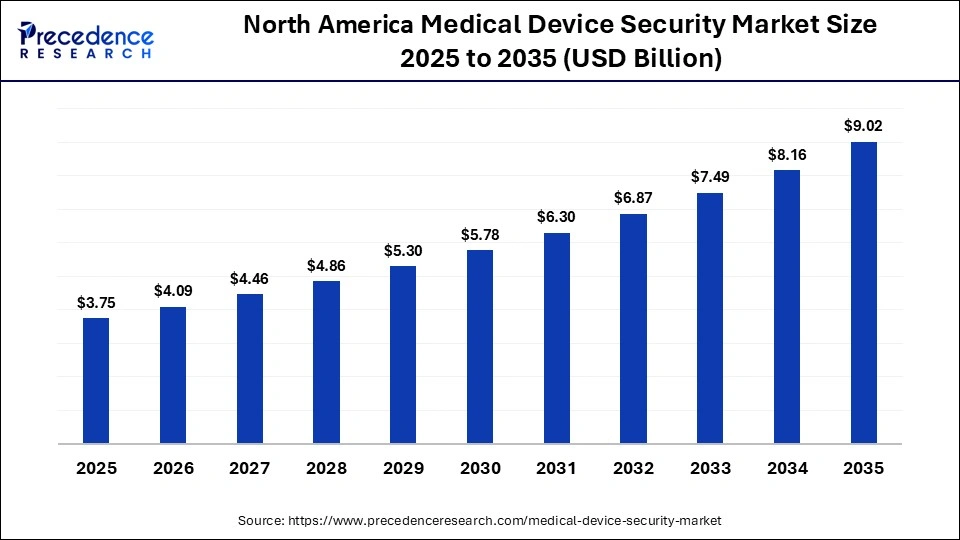
The North America medical device security market size is estimated at USD 4.09 billion in 2026 and is projected to reach approximately USD 9.02 billion by 2035, with a 9.17% CAGR from 2026 to 2035.
How does North America lead the Medical Device Security Market?
North America led the market in 2026 due to factors such as advanced medical infrastructure, high adoption of connected devices, strict regulations, and rising cyber threats, leading to higher demand for medical device security. Higher usage of IoT and connected devices, such as healthcare wearables, infusion pumps, imaging, and monitors, leads to higher demand for patient data security, further fueling the growth of the market. Strict FDA regulations to enhance digital security are another major factor boosting the growth of the market. Higher investment in the healthcare systems of the region is another major factor helpful for the growth of the market.
What is the Size of the U.S. Medical Device Security Market?
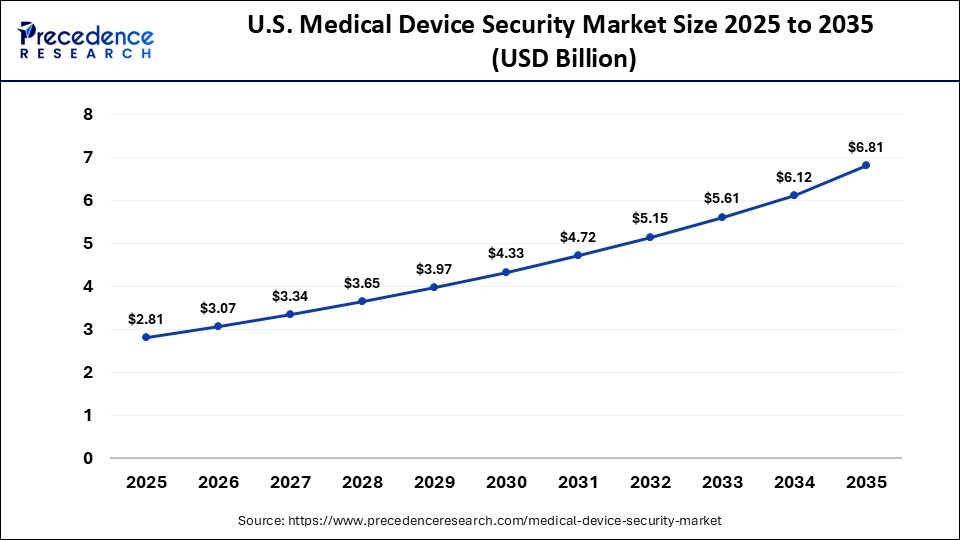
The U.S. medical device security market size is calculated at USD 3.07 billion in 2026 and is expected to reach nearly USD 6.81 billion in 2035, accelerating at a strong CAGR of 9.26% between 2026 and 2035.
The U.S. Medical Device Security Market Trends
The U.S. has a major role in the growth of the market in the region due to the higher usage of IoT and connected devices. Such devices enhance the risk of cyber fraud and threats, leading to higher demand for medical device security in the region, which is helpful for the growth of the market. Government initiatives and compliance needs in the region are another major factor propelling the growth of the market.
Why is the Asia Pacific region observed as the fastest-growing region in the Foreseen Period?
Asia Pacific is observed to be the fastest-growing region in the medical device security market in the foreseeable period due to the strengthening healthcare infrastructure of the region, leading to higher demand for the security of medical devices. Higher usage of IoT and healthcare wearable devices provides a huge base for cyberattacks and phishing. Hence, higher demand for security in the form of cloud-based hardware devices is one of the major factors helpful for the growth of the market in the foreseeable period. Government initiatives to strengthen digital security are another major market driver of the region.
China Medical Device Security Market Trends
China has a major contribution to the growth of the market due to higher IoT, wearable healthcare devices, and other similar factors pushing the growth of the market in the region. The region's inclination towards smart hospitals and digitalization in the form of connected wearable devices requiring digital safety also helps to propel the growth of the market.
How is Europe Growing in the Medical Device Security Market?
Europe is expected to grow at a notable CAGR in the foreseeable future, due to advancements in medical technology, favorable government support, and increasing investments. European government bodies launch initiatives and investments to promote clinical trials in the region. The rising prevalence of chronic disorders and the growing aging population potentiates the demand for advanced medical devices. The rapid digitalization of healthcare systems, increasing adoption of connected medical devices, and stringent regulations drive the market.
Germany Market Trends
Germany's market is driven by its advanced healthcare infrastructure, strong medical device manufacturing sector, and stringent cybersecurity regulations. The German government's Digital Healthcare Act (DVG) initiative is accelerating the adoption of digital tools in Germany, promoting the need for cybersecurity requirements.
Who are the Major Players in the Global Medical Device Security Market?
The major players in the medical device security market include Cisco Systems (US), IBM (US), GE Healthcare (US), Symantec (US), CA Technologies (US), Philips (Netherlands), DXC Technology (US), CloudPassage (US), FireEye (US), and Sophos(UK).
Recent Developments
- In October 2025, the Health Sector Coordinating Council (HSCC), through its Cybersecurity Working Group, released the Systemic Risk Mapping Toolkit. The toolkit helps healthcare organizations track and manage critical third-party services.
- In May 2025, Medcrypt, a leading provider of proactive cybersecurity solutions for medical devices, introduced its new medical device product security intelligence platform, designed to help medical device manufacturers assess their product's security posture, identify gaps, quantify cybersecurity risk in dollar terms, and generate cost-aligned remediation plans in minutes.
Medical Device Security Market Segments
By Component
- Solutions
- Services
By Type
- Application Security
- Endpoint Security
- Network Security
- Cloud Security
By Device Type
- Hospital Medical Devices
- Internally Embedded Medical Devices
- Wearable and External Medical Devices
By End User
- Healthcare Providers
- Medical Device Manufacturers
- Healthcare Payers
By Region
- North America
- Europe
- Asia-Pacific
- Latin America
- Middle East & Africa
For inquiries regarding discounts, bulk purchases, or customization requests, please contact us at sales@precedenceresearch.com
Frequently Asked Questions





Ask For Sample
No cookie-cutter, only authentic analysis – take the 1st step to become a Precedence Research client
 Get a Sample
.webp)



 sales@precedenceresearch.com
 Schedule a Meeting
