



Middle East Refining Market Trends, Leading Companies, Company Revenue / Sales Performance, Installed Capacity, Production Output, Grid Expansion, Market Share, Technology Adoption, and Industry Outlook
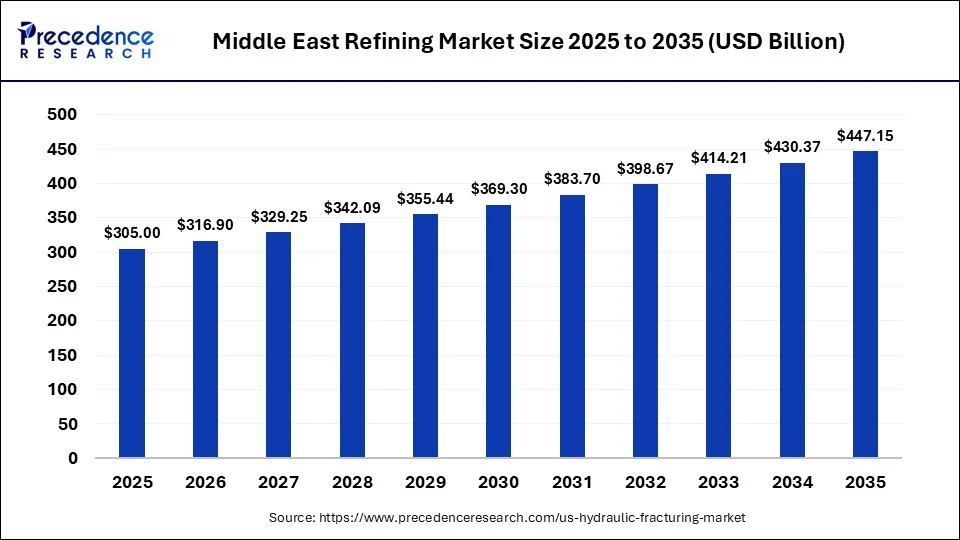
The Middle East refining market was valued at 316.90 billion in 2026 at a CAGR of 3.9%. The market is shifting to a new stage of its downstream growth as key players prepare to take their refining facilities to the next level. Our senior research analyst, Laxmi Narayan, analyzed these trends and curated this report. His insights help assist various refining, petroleum, petrochemicals, and energy infrastructure stakeholders in understanding the reconfiguration of existing refineries, competitive developments, and emerging opportunities.
Source: https://www.precedenceresearch.com/middle-east-refining-market
 Get a Sample
 Table Of Content


Middle East Refining Market Size, Share, Trends, and Growth Forecast 2035
The Middle East refining market is forecasted to expand from USD 316.90 billion in 2026 to USD 447.15 billion by 2035, growing at a CAGR of 3.9% from 2026 to 2035. The refining market in the Middle East is evolving into a complex downstream platform. This is a result of the growing capacity of refineries to convert crude oil and condensate into more valuable products and petrochemical feedstocks. In addition to capacity, there are new investments that are increasingly important for restructuring refinery performance in terms of energy efficiency and process optimization.
For over 5 years, Laxmi Narayan has been involved in energy and power-based market analysis. His analysis pinpoints a fundamental change in the downstream energy landscape of the Middle East. This is driven by the increasing integration of energy refining ecosystems, with major players including refiners, national oil companies, technology providers, EPC contractors, petrochemical companies, and energy infrastructure operators. Saudi Arabia, Kuwait and UAE continue to be substantial refining centres. On the other hand, Oman, Iraq and Bahrain are upgrading their refining resources with capacity expansion, rehabilitation and modernisation facilities. His analysis will include insights into the changing refinery mix, crude-processing capabilities, export connectivity, supplier possibilities, and refiners' investment trends driving the Middle East refining market.
Key Takeaways
- By product, the gasoil/diesel segment led the market with a share of 31.85% in 2025.
- By refinery configuration, the complex conversion refineries segment led the market with a 42.85% share in 2025.
- By feedstock, the medium and sour crude segment captured a major revenue share of 39.65% in 2025.
- By refinery capacity class, the mega refineries>500,000 bpd segment captured the largest market share of 37.85% in 2025.
- By end user, the petrochemical industry segment led the market with a share of 18.85% in 2025.
- The Middle East had approximately 11.9 million bpd of refining capacity in 2025, representing about 13.7% of global refining capacity.
- Saudi Arabia remains the region's largest refining hub, accounting for 27.6% of Middle East refining capacity.
- Kuwait has strengthened its refining position through the 615,000-bpd Al-Zour refinery, giving it around 12.2% regional share.
- The UAE contributes about 10.4% of regional refining capacity, supported by the 922,000-bpd Ruwais refinery and crude flexibility investments.
- Refining capacity across key Middle Eastern markets is expected to continue expanding, with Saudi Arabia, the UAE, and Kuwait leading regional growth.
The Middle East refining market refers to commercial value added through the process of refining crude oil and condensate to other petroleum products in the Middle East. The 2025 value at market is a model estimate of value and is not a directly reported single source of revenue. Rather, it is based on the proximity of refinery capacity, throughput, extent of product mix, and refined product prices. In 2025, there was about 11.9 million bpd of refining capacity in the region; OPEC reported global refining capacity of 86.89 million bpd for 2025.
What is the Middle East Refining Market and Why Is Its Structure Changing?
The Middle East refining market entails crude oil and condensate being refined to gasoline, diesel or gasoil, jet fuel and kerosene, LPG, naphtha, fuel oil, lubricants, base oils, petrochemical feedstocks and other refined products. The area is shifting to a more diverse mix of activities that don't depend primarily on crude-oil exports. The integration of the refining and production of petrochemicals, storage, trading and export facilities is becoming more pronounced to get more value out of hydrocarbons.
Saudi Arabia, Kuwait and the UAE are still the top refining hubs in the region. Saudi Arabia has a capacity of around 3.29 million bpd of gas refining, while Kuwait has a capacity of around 1.45 million bpd, Iraq has around 1.33 million bpd, and the UAE has around 1.23 million bpd.
Refinery modernization projects, increased conversion capacity, the need for cleaner fuels, plans to deepen petrochemical integration, gigascale, export-oriented refinery development efforts, and investment to cater to a wider variety of crude qualities are reshaping the market. OPEC projects that there will be an expansion in the refining capacity of Middle Eastern countries by 1 million bpd in 2030 from existing projects. Furthermore, refinery margins are also volatile depending on prices for crude oil, product-to-product cracks, geopolitical events, shipping limitations, environmental concerns, and a possible prolonged decline in fuel demand.
Which Structural Factors Are Driving Refinery Investment?
Value-added crude distillation is getting more emphasis than basic crude distillation. Regional refiners use technologies like hydrocracking, hydrotreating, residue conversion, and desulfurization that boost middle-distillate production and help them satisfy low-sulfur fuel requirements.
Another major structural trend is an integrated refining and petrochemicals sector. Refineries are again constructed to provide an increasing supply of higher-value chemical products rather than sell more of these products as conventional fuels, such as naphtha, LPG, propylene, and other refinery streams.
The region also has a significant structural advantage with export infrastructure. Large storage facilities, key ports, and international product flows exist for facilities like Duqm, Yanbu, and Kuwait's Al-Zour.
Expert Analyst View: There have been several factors that have been changing the market. At the core were the issues of modernisation of refineries, increased conversion capacity, and demand for clean fuels. Petrochemical integration, processing of more grades of crude, and investments in export-oriented mega-refineries gave it yet another boost. OPEC estimated a total of about 1 million barrels per day of increases in the Middle East's refining capacity from current projects by 2030.
Which Refined Products Generate the Largest Commercial Value and Where Is Demand Moving?
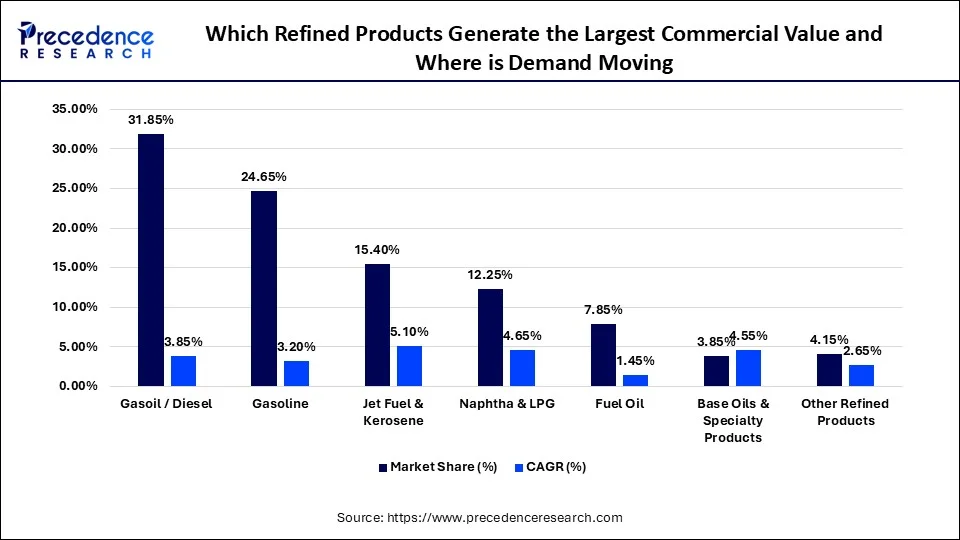
Among the various products, gasoil and diesel occupied an overall share of 31.85% in 2025. The combination of heavy transport and logistics and industrial demand, along with the weight of a significant export scenario for diesel trade, is typical of the region. Continued regional and international diesel trade and growing demand for cleaner middle distillates were expected to drive their CAGR ahead, estimated at 3.85%. The Jet fuel and Kerosene domain recorded a 15.40% share and the highest CAGR value among the group, at 5.10%, respectively. That outlook was boosted by the expansion of aviation activity, along with the resurgence of long-haul travel and air cargo, at busy airports in the Gulf.
Expert Analyst View: The regional product mix is gradually changing to higher-quality, higher-value, and cleaner products. Cleaner fuels like diesel are still significant commercial sources of value, while aviation fuels, petrochemical feedstocks, and specialty refinery products provide new opportunities, instead of traditional fuel oil.
How is Refinery Configuration Shifting Toward Higher Conversion and Product Yield?
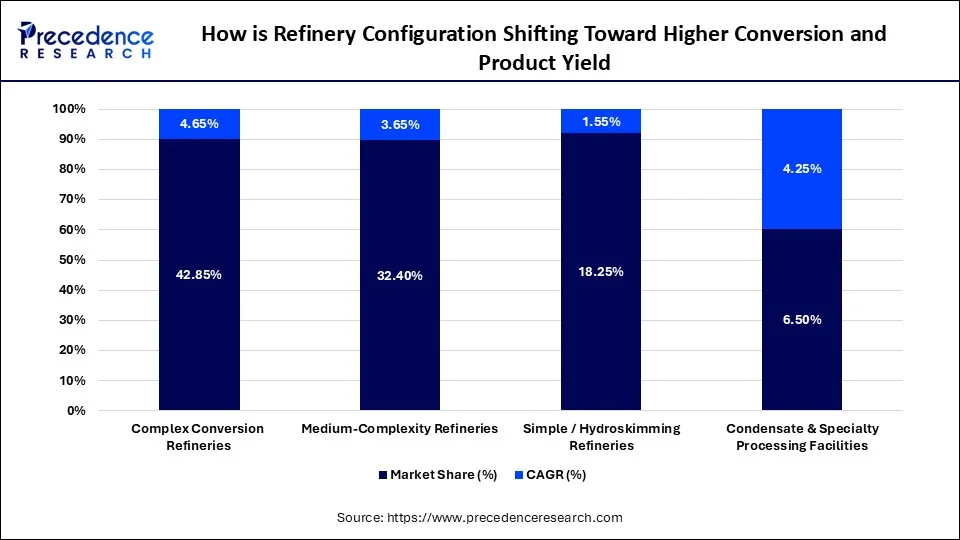
Complex conversion refineries led with a 42.85% market share in 2025. Deep-conversion units were found in the newest and strategically most important infrastructure in the region. Those refineries were most important when handling heavier or sourer feedstocks to produce low-sulphur products. They had the highest CAGR forecast, at 4.65%. High-value yields supported heavier crude runs, achieved by hydrocracking, FCC systems, and coking and residue conversion systems.
Expert Analyst View: As per our senior researcher, Aditi Shivarkar, it would appear that complexity is becoming more of a differentiator among refiners and not just a technical attribute. Units that can more efficiently process a wider spread of crude qualities and maximize production of middle distillates, petrochemical feedstocks, and specialty products are in a better position to cope with changes in crude quality and refined product prices.
Which Feedstocks Are Most Important as Middle Eastern Refineries Expand Crude Flexibility?
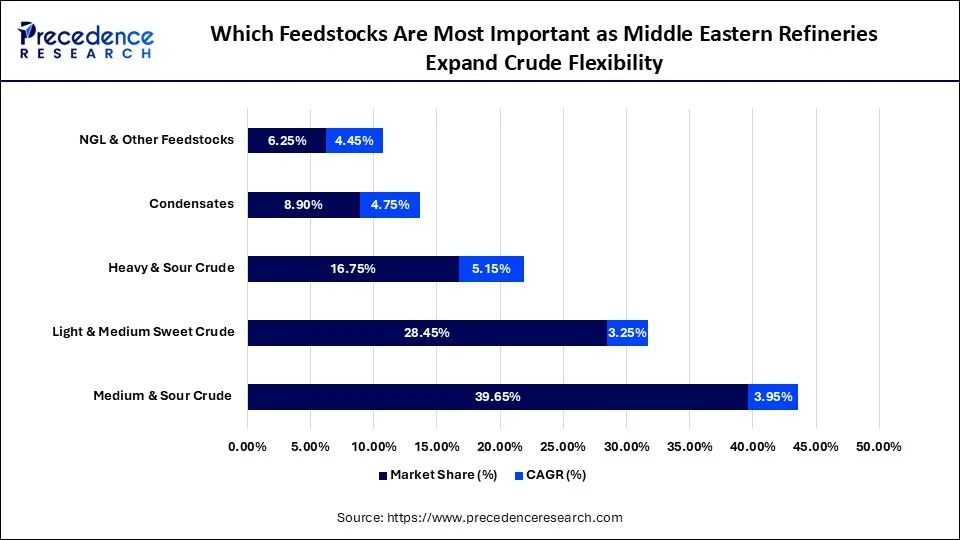
The market share of medium crude and sour crude was 39.65% in 2025. This was because it was plentiful in the region, and refinery capacity was steadily growing to handle higher sulfur grades. It has been predicted to see a CAGR of 3.95%.
Heavy crude use became more economical through investments in residue conversion (RC) and hydroprocessing. Condensate accounted for 8.90% of the market share, and its CAGR was anticipated to be 4.75% with increased production and availability of gas. That demand was further boosted by strong integration with the refining/petrochemicals systems.
Expert Analyst View: Feedstock flexibility and refinery economics are gaining in significance. The flexibility to utilize various regionally sourced crudes while lowering the use of one particular type of crude to reduce the risk of using an incorrect feedstock or lower their margins in the light of crude differentials and refined-product spreads.
How Does Refinery Capacity Scale Shape the Competitive Structure?
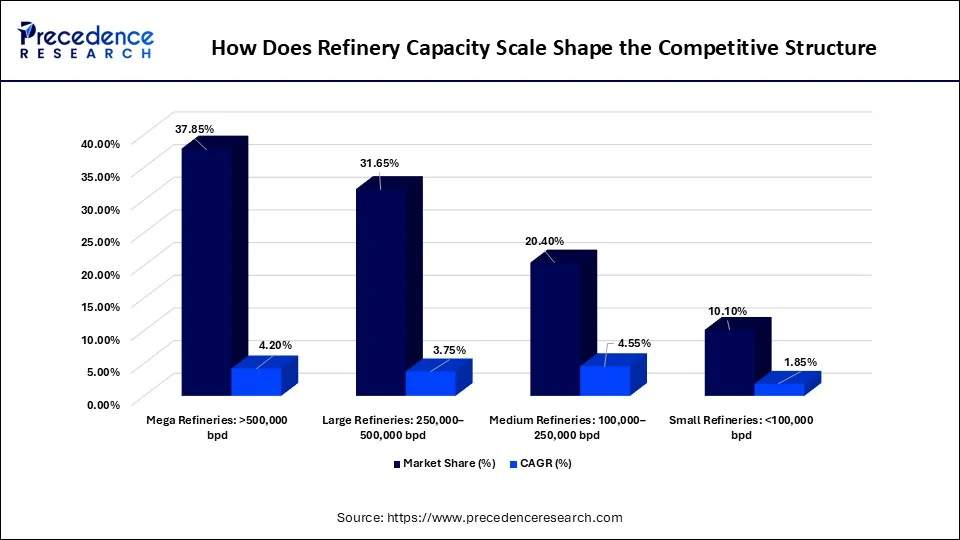
The number of mega-refineries over 500,000 b/d accounted for the highest refinery market share of 37.85% in 2025. The medium refinery segment, with capacity ranging from 100,000 barrels per day to 250,000 bpd, represented 20.40% of the market and recorded the fastest CAGR of 4.55%. That is due to upgrades, debottlenecking, and regional product-demand growth. Small refineries (less than 100,000 bpd) held a 10.10% market share, growing at the paltry rate of 1.85% CAGR. They provided local fuel and specialty processing requirements.
Expert Analyst View: For export-driven refining, the scale factor is gaining importance, but medium-to-midsize refineries play a role through specialization, modernization, and accessing preferred feedstock. The power of the competition is thus oriented more and more by its scale, complexity, and integration than by its capacity.
Which End-Use Industries Consume the Largest Volumes of Refined Products?
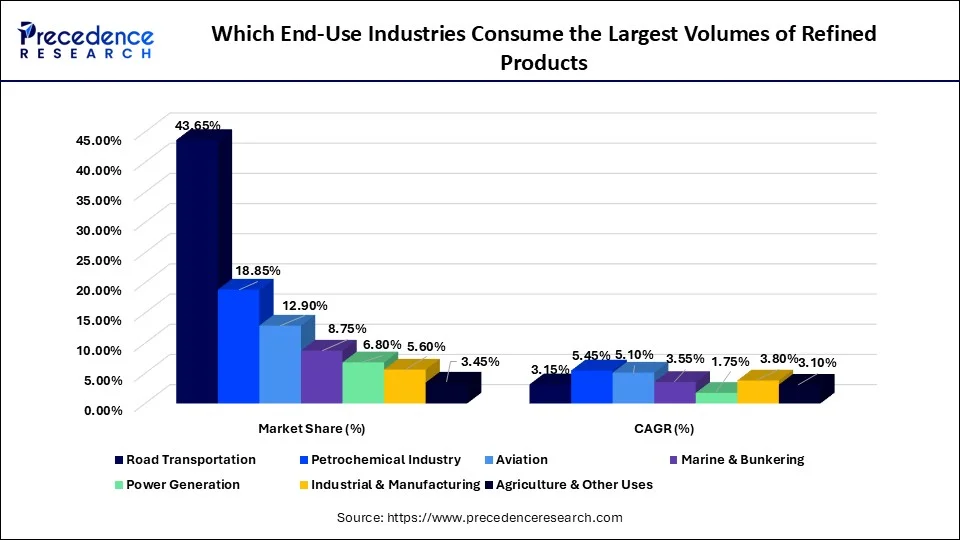
Road transport was the largest end-use segment. It accounted for a 43.95% share of the end-use market in 2025. That share was supported by large-plug volume-production vehicles, freight transport, and high gas and diesel use. Its CAGR is expected to be 3.15%. The petrochemical industry was at 18.85 and saw the highest CAGR of 5.45%. Modern integrated refiners readily adopted streams as chemical feedstocks and harvested more value from these streams while using naphtha, LPG, propylene, and various other streams.
Expert Analyst View: The Middle East refining sector is slowly weaning itself from its dominance. Increasingly, specialty products and aviation fuels, along with petrochemical products, are playing an increasing role in refinery investment decisions.
Which Middle Eastern Markets Account for the Largest Refining Base and Where Is Capacity Expanding?
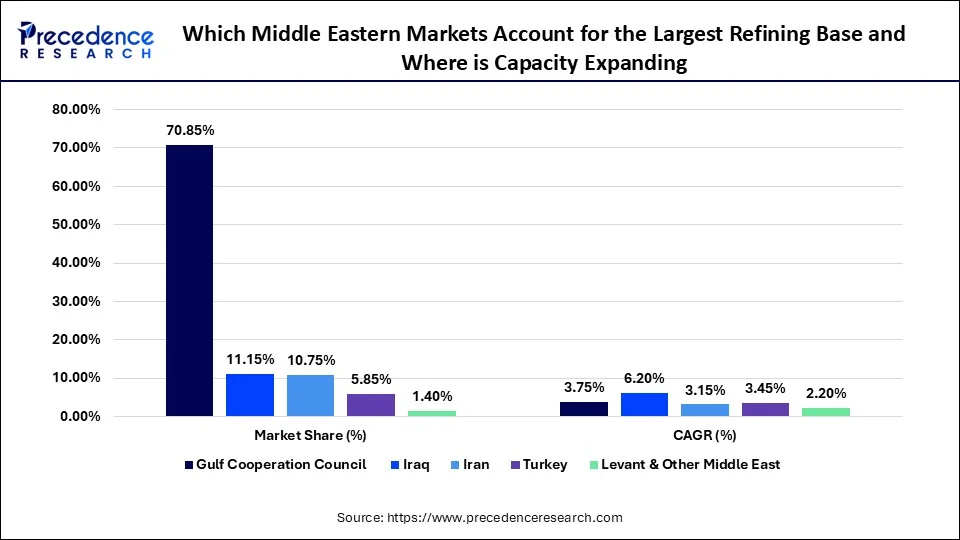
The Gulf Cooperation Council refinery base was mostly the leader in the region, accounting for a 70.85% share in 2025. Saudi Arabia, Kuwait, the UAE, Oman, Qatar, and Bahrain had spent major dollars on massive, export-oriented refining schemes. The country groups included Iraq with 11.15% and the highest CAGR of 6.20%. The goal of rehabbing refinery units and installing new capacity was to lessen the reliance on imported gasoline and diesel.
What Are the Key Country-Level Refining Positions?
- Saudi Arabia: The Middle East refining capacity is around 27.6% and will grow at a CAGR of 3.5%. Still, the area is the biggest refining center in the region. Saudi Aramco's 2025 forecasts are for 7.8 million bpd of gross global refining capacity and 4.2 million bpd of net refining capacity.
- UAE: Approximately 10.4%, with a CAGR of 4.3%. The capacity of Ruwais is over 922,000 bpd, and the area has a huge amount of crude export infrastructure, with investments in crude flexibility infrastructure.
- Kuwait: Approximately 12.2%, with a CAGR of 4.1%. The building of the 615,000-bpd Al-Zour refinery has greatly enhanced Kuwait's role in regional refining markets.
- Oman: Approximately 4.5%, with a CAGR of 6.0%. The 230,000 bpd Duqm refinery has given a boost to Oman, an export-oriented downstream platform.
- Bahrain: About 3.0% with a CAGR of 5.8%. Modifications in Baojiejie made it possible to expand the processing capacity of the Bapco refinery to some 405,000 bpd and to significantly boost the conversion capacity.
- Iraq: Approximately 11.2%, with a CAGR of 6.2%. The development of new capacity and rehabilitation is mainly for the purpose of complementing indigenous product shortages and import reliance.
- Iran: Approximately 10.8%, with a CAGR of 3.2%. Development of refineries is still tied closely to the internal demand for fuels and the supply of raw materials.
- Turkey: Around 5.9% at 3.5% CAGR. It also has a strategic geographical location for its imports and exports of refined products in the region.
- Expert Analyst View: As per our senior researcher, Aman Singh, the Gulf is the prime competitive center of the Middle East refining business, though the proposed expansion in the coming years is getting more geographically diversified. An expansion roadmap without a doubt has significance in Iraq and Oman, and scale, complexity, integration, and export connectivity are emerging competitive differentiators in Saudi Arabia, Kuwait, and the UAE.
Which Companies Are Shaping the Middle East Refining Competitive Landscape?
Saudi Aramco
Saudi Aramco is the largest refining group in the region owing to its Saudi assets as well as its international refining portfolio. The annual 2025 report of its gross global refining capacity was 7.8 million bpd, while its net refining capacity was 4.2 million bpd. It has interests in Saar, Yanbu, Jazan, Ras Tanura, Riyadh, Yanita (Yanbu Ali), Yanbari (Riyadh Ali), SAMREF, SATORP, and YASREF, which are located in Saudi Arabia, and also holds interests in Petro Rabigh.
ADNOC
ADNOC Refining is responsible for the Ruwais complex, which is large, and handles close to 1 million b/d of crude and condensates. The company manufactures LPG, naphtha, gasoline, jet fuel, base oils, petrochemical feedstocks, carbon black, and calcined petroleum coke. In addition, ADNOC is improving the linkage between the refinery and industrial consumers. In 2025, it signed a $500mn deal with EGA to provide up to 1.5 million tonnes of calcined petroleum coke primary feed for EGA over five years.
Kuwait Petroleum Corporation / KIPIC
Al-Zour has had a big impact on KPC's downstream system. The integrated Al-Zour complex is operated by KIPIC and comprises about 615,000 bpd of refinery capacity to meet Kuwait's targets for clean fuel and for exports.
OQ
OQ's downstream investment at OQ8/Duqm has enhanced Oman's position. After the 2023-2024 commissioning, the refinery was engineered to process 230,000 bpd and started processing commercially. On the other hand, total Omani refining capacity at Duqm, Mina Al-Fahal and Sohar is reported by OQ to be about 530,000 bpd.
Bapco Energies
The Bahrain refinery has greatly furthered the modernization program of Bapco to boost its refining capacity. New digital-control, hydrocracking, and distillation capabilities are incorporated into the modernized refinery, which has been boosted to about 405,000 bpd.
Other Relevant Participants
Apart from the mentioned players, other national and private downstream companies face competition from QatarEnergy, KNPC/KIPIC, SOMO, Basrah Oil Company, ENOC, Emarat, NIOC, TPAO, STAR Refinery, and Petkim.
Expert Analyst View: Competition is slowly expanding towards switching crude. Refiners are distinguishing themselves by their conversion depth, the flexibility of their crudes, their petrochemical integration, their export terminals, their product quality, their trading capabilities, their energy efficiency, and by having access to captive feedstock. These aspects are seen to favour big infrastructure development firms and, at the same time, provide opportunities to specialised and strategically placed infrastructure development firms.
What Are Refinery Buyers Prioritizing When Selecting Technology, Equipment and Services?
During refinery procurement, there is a strong tendency to focus on specifications. While the lowest-cost equipment usually isn't the best, buyers tend to pay attention to factors such as the reliability of the process, throughput, product yield, energy efficiency, catalyst efficiency, maintenance needs, and lifecycle costs.
Key criteria for technology and equipment suppliers are project references that have already been proven, guarantees on processes, location of technical support, ready access to spare parts, and compatibility with existing refinery units.
- Key procurement priorities include:
- High conversion and product yield
- Lower energy consumption
- Sulfur and emissions compliance
- Feedstock flexibility
- Digital monitoring and predictive maintenance
- Catalyst life and regeneration performance
- Reliability and turnaround reduction
- Local-content requirements
- Long-term service agreements
- Integration with petrochemical and storage infrastructure
Capital does not pose a challenge for new suppliers alone. Supplier selection can be influenced by a variety of things, such as technical qualification, references from previous clients, familiarity with the local area, EPC integration, and track record of operation.
Where is the Addressable Opportunity for Refining Technology and Services?
Practical TAM/SAM/SOM systems for suppliers for Middle Eastern refineries can be developed based on capital expenditure, maintenance, process technology, catalysts, automation, environmental systems, and digital services in the refinery.
TAM
The total marketable region-wide refining capacity is about 11.9 million bpd. These consist of process equipment, catalyst and chemical supply, maintenance needs, digital and emission control technologies, and engineering services.
SAM
The segment focused on modernization & debottlenecking, hydroprocessing, residue conversion, refinery digitalization, energy efficiency, emissions reduction, water treatment, and new refinery projects is known as SAM.
SOM
Portion of the total availability that has actually been qualified with the supplier due to country approval, installed base, EPC relationship, local service capability, refinery units targeted for use, and technology qualification.
The most promising near-term opportunities are around hydroprocessing, refinery catalysts, Advanced process control, Predictive maintenance, Heat recovery, Sulfur management, Emissions monitoring, Water treatment, Digital twins, and Energy-efficiency solutions.
Which Strategic Questions Should Refiners, Suppliers and Investors Address?
- Which Middle Eastern refineries have the largest upcoming turnaround and modernization requirements?
- Where will additional conversion capacity materially change regional product balances?
- Which refineries can economically process heavier and sourer crude grades?
- How quickly will petrochemical integration reduce dependence on transportation-fuel margins?
- Which countries offer the strongest opportunities for refinery technology suppliers?
- Where are hydrocracking, hydrotreating, and residue-conversion investments accelerating?
- How will aviation-fuel demand influence future refinery product configurations?
- Which facilities have the greatest potential for energy-efficiency improvements?
- How are local-content policies changing supplier selection?
- Which refinery projects have reached FID, and which remain at the announced or conceptual stage?
- How could future crude differentials affect refinery feedstock strategies?
- Which operators are most actively adopting AI, advanced process control, and predictive maintenance?
- How will refinery-petrochemical integration affect product yields and profitability?
- Which regional refineries are best positioned to supply Asian, European, and African markets?
- Where can equipment and service companies establish local partnerships before major projects enter procurement?
Overall Market Expert Analyst View
The Middle East refining market is shifting from expanding refining capacity to a higher value-added downstream phase. The region already had about 11.9 million bpd of refining capacity in 2025, and another ~1 million bpd is projected from projects through 2030.
The key strategic transformation is being made into petrochemicals, export-oriented refineries, and more complex refineries. Saudi Arabia, Kuwait, and the UAE remain highly structural, while Iraq and Oman offer significant expansion opportunities. Newer facilities like Al-Zour, Duqm, and modernization like Bapco's signify a change in the region's emphasis on higher conversion, cleaner fuels, and more sound export economics.
The growth market for modernisation includes crude flexibility, hydroprocessing, emission control, energy efficiency, digitalisation and predictive maintenance. They are increasingly being targeted within the current refinery belt, rather than just within greenfield expansion, by technology providers. Maintaining long-term competitiveness is a growing challenge for refiners as they try to improve their crude selection, maximize yields of middle-distillate and petrochemical products, and realize enhanced value from integrated product streams.
The overall market performance of the refining industry is likely to remain buoyant at a more modest rate, but the level, sophistication, and compatibility of the refining capacity in the region are undergoing a more rapid change than simply the capacity growth reflects.
Expert Insights
The current crude processing paradigm is shifting for refining in the Middle East. This is becoming far more dynamic and integrated and has also become more upscale in terms of value delivered by the downstream part of the business. I think that refineries get to refine the product more and then meet the changed fuel specs and market requirements at that junction of the various aspects.
Factors that I think are going to have a major impact on competition over the next 10 years are the increasing refining capacity in the area, the increased focus on cleaner fuels, and the continued export focus. Furthermore, I believe continued demand for hydroprocessing and predictive maintenance technologies as refiners strive to get the best we can out of every barrel processed.
Our Experts
- The primary market research for this report was led by our senior research analyst, Laxmi Narayan, who was also in charge of developing the methodology for this report, as well as analyzing the refinery capacity, product segments, country-level trends, competition, and market forecasts.
- Aman Singh, a senior researcher, was tasked with gathering and verifying regulatory reports, company financials, refinery capacities, commodity prices, and other data that were collected from independent sources, while enhancing the evidence base for the market estimates.
- Aditi Shivarkar, a senior researcher, checked the entire research paper, performed quality control measures, checked findings, made changes to the research paper, corrected inconsistencies, and finalized the paper to ensure accuracy and clarity in the research paper.
Middle East Refining Market Segments Covered in the Report
By Refined Product
- Gasoil / Diesel
- Gasoline
- Jet Fuel & Kerosene
- Naphtha & LPG
- Fuel Oil
- Base Oils & Specialty Products
- Other Refined Products
By Refinery Configuration
- Complex Conversion Refineries
- Medium-Complexity Refineries
- Simple / Hydroskimming Refineries
- Condensate & Specialty Processing Facilities
By Feedstock
- Medium & Sour Crude
- Light & Medium Sweet Crude
- Heavy & Sour Crude
- Condensates
- NGL & Other Feedstocks
By Refinery Capacity
- Mega Refineries: >500,000 bpd
- Large Refineries: 250,000–500,000 bpd
- Medium Refineries: 100,000–250,000 bpd
- Small Refineries: <100,000 bpd
By End User
- Road Transportation
- Petrochemical Industry
- Aviation
- Marine & Bunkering
- Power Generation
- Industrial & Manufacturing
- Agriculture & Other Uses
By Region
- GCC
- Saudi Arabia
- UAE
- Kuwait
- Oman
- Bahrain
- Qatar
- Iraq
- Baghdad/Central
- Basra
- Kurdistan
- Northern refining centers
- Iran
- South/Central
- Persian Gulf
- Northern refining centers
- Turkey
- Marmara
- Mediterranean
- Aegean
- Levant & Other Middle East
- Jordan
- Syria
- Lebanon
- Yemen
For inquiries regarding discounts, bulk purchases, or customization requests, please contact us at sales@precedenceresearch.com
Frequently Asked Questions
Tags





Ask For Sample
No cookie-cutter, only authentic analysis – take the 1st step to become a Precedence Research client
 Get a Sample




 sales@precedenceresearch.com
 Schedule a Meeting
