



Mobile Middleware Market Trends, Companies, Revenue / Sales Performance, Subscriber Growth, Pricing Strategies, Cloud Adoption, Infrastructure Expansion, Competitive Landscape, and Industry Outlook
Mobile Middleware Market (By Middleware Type: Mobile Integration Middleware, Message Oriented Middleware (MOM); By Deployment Mode: Cloud-based / SaaS, On-premise Hybrid Deployment; By Enterprise Size: Large Enterprises, Small & Medium Enterprises (SMEs); By Vertical / End-User Industry: IT & Telecom, BFSI (Banking, Financial Services & Insurance); By Application: Enterprise Mobility Solutions, Mobile Commerce & Retail Apps) - Global Industry Analysis, Size, Trends, Leading Companies, Regional Outlook, and Forecast 2026 to 2035
Source: https://www.precedenceresearch.com/mobile-middleware-market
 Get a Sample
 Table Of Content


What is Mobile Middleware Market Size?
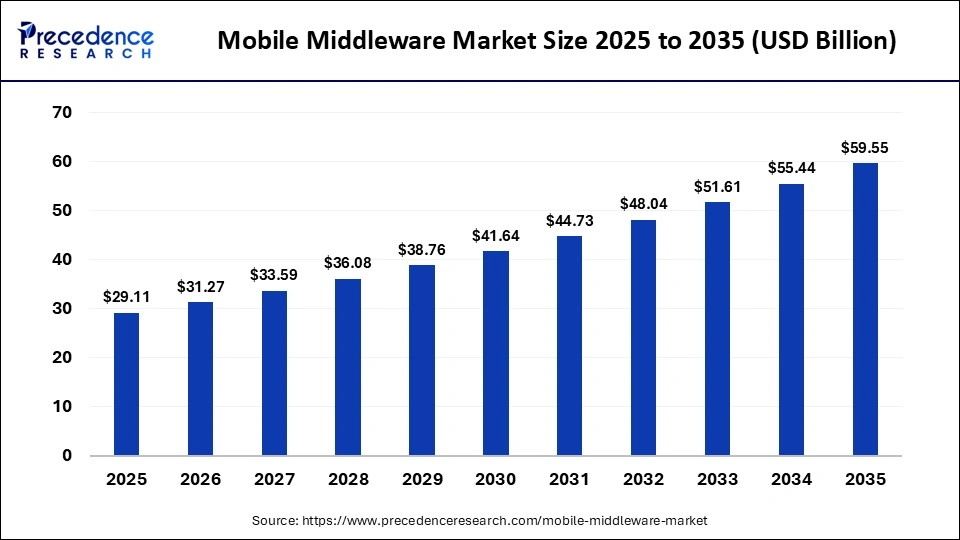
The global mobile middleware market size was calculated at USD 29.11 billion in 2025 and is predicted to increase from USD 31.27 billion in 2026 to approximately USD 59.55 billion by 2035, expanding at a CAGR of 7.42% from 2026 to 2035. The market is growing steadily, driven by the rising adoption of mobile applications, the growth of cloud computing and hybrid architectures, expansions of IoT and connected devices, and digital transformation across industries.
Market Highlights
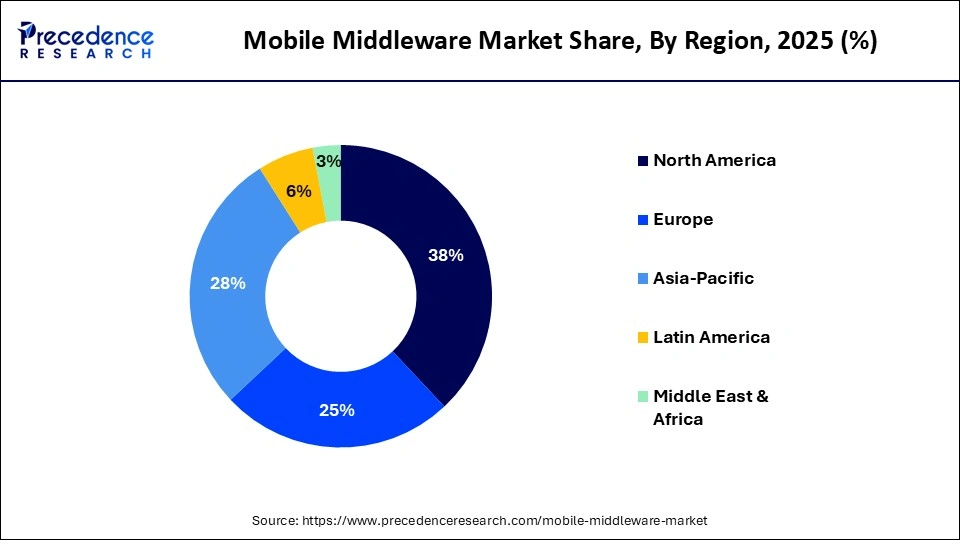
- North America led the mobile middleware market with a share of approximately 38% in 2025.
- Asia-Pacific is expected to expand at the highest CAGR in the market between 2026 and 2035.
- By middleware type, the mobile integration middleware segment held a dominant revenue share of approximately 28% in the market in 2025.
- By middleware type, the mobile backend as a service (MBaaS) segment is expected to grow at the highest CAGR between 2026 and 2035.
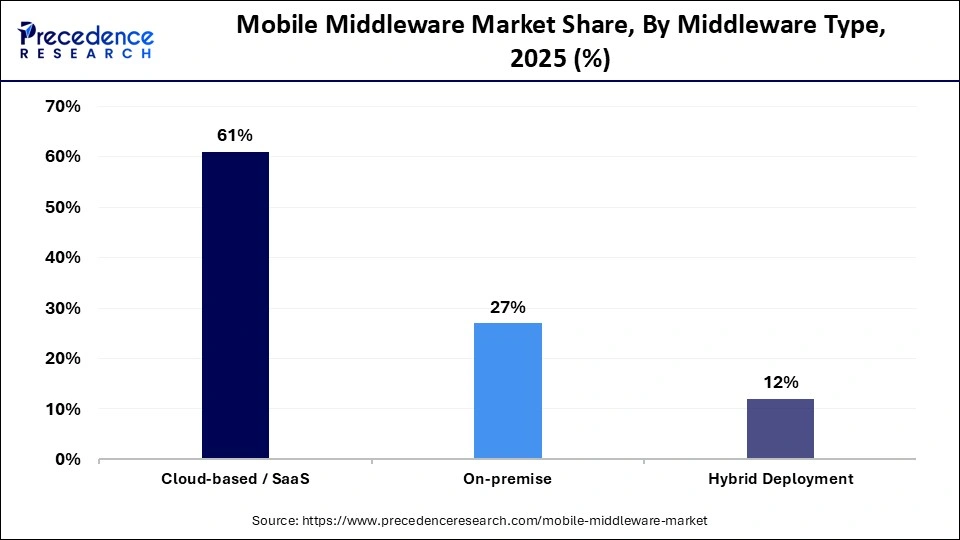
- By deployment mode, the cloud-based/SaaS led the market with a market share of approximately 61% in 2025.
- By deployment mode, the hybrid deployment segment is expected to expand at the fastest CAGR during the forecast period.
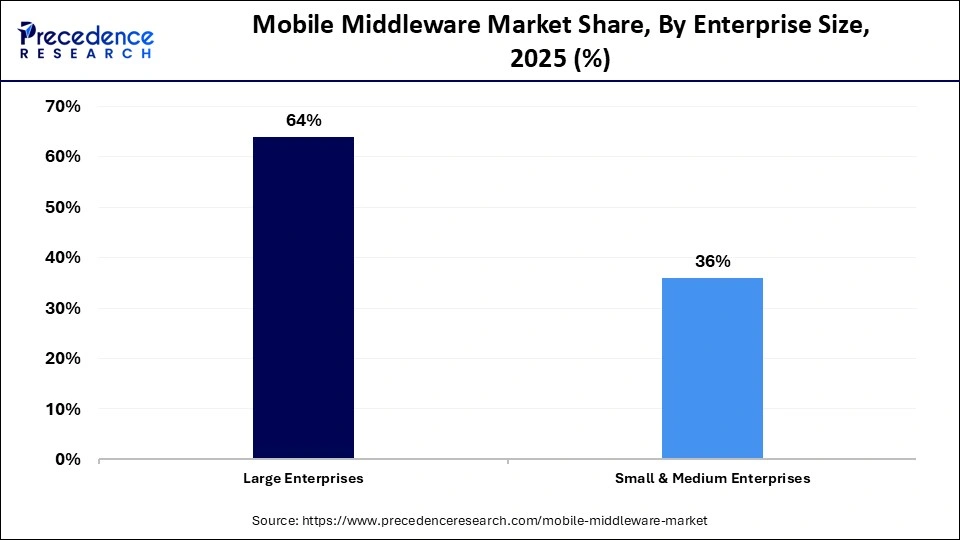
- By enterprise size, the large enterprises segment held a dominant market share of approximately 64% in 2025.
- By enterprise size, the small & medium enterprises (SMEs) segment is expected to grow rapidly in the coming years.
- By vertical/end-user industry, the IT & telecom segment held the largest revenue share of approximately 22% in the market in 2025.
- By vertical/end-user industry, the healthcare & life sciences segment is expected to grow at the highest CAGR over the studied years.
- By application, the enterprise mobility solutions led the market with a share of approximately 34% in 2025.
- By application, the mobile healthcare/telehealth apps segment is expected to expand at the fastest CAGR from 2026 to 2035.
Why is the Mobile Middleware Market Gaining Strategic Importance?
Mobile middleware refers to a software layer that enables communication between mobile applications and backend enterprise systems, databases, and cloud services. The market is gaining strategic importance as organizations adopt mobile-first operations, cloud platforms, and digital services. Rising demand for secure integration, real-time data access, API management, scalability, and support for diverse devices is positioning mobile middleware as a core component of enterprise mobility ecosystems.
How Is AI Reshaping the Mobile Middleware Industry?
Artificial intelligence integration can significantly strengthen the mobile middleware market by turning middleware platforms into intelligent systems that actively optimize performance, security, and data flow. In 2025, several enterprise middleware providers embedded AI-driven analytics to automatically monitor API traffic, predict bottlenecks, and dynamically balance workloads across cloud and edge environments.
AI-powered middleware is also improving security by identifying unusual access patterns and potential threats in real time. Additionally, machine learning algorithms are enabling automated error resolution and smarter data routing, reducing downtime and latency. These advancements are making mobile middleware more adaptive, resilient, and capable of supporting complex, high-volume mobile application ecosystems.
Primary Trends Influencing the Mobile Middleware Market
- Cloud-Native and Hybrid Middleware Solutions: Mobile middleware is shifting toward cloud-native and hybrid architectures that support scalable, flexible deployment across both on-premises and cloud environments. This trend enables organizations to rapidly integrate mobile applications with backend systems, leverage microservices, and manage workloads dynamically while lowering infrastructure complexity and cost. Cloud integration also supports real-time data synchronization and seamless cross-platform connectivity.
- API-Driven Integration and Microservices: APIs and microservices architecture are becoming central to mobile middleware platforms, enabling seamless communication between mobile applications, enterprise systems, and third-party services. API management simplifies integration, enhances interoperability, and allows developers to build modular, maintainable systems. This approach accelerates development cycles, improves scalability, and supports faster delivery of mobile features.
- Enhanced Security and Compliance: With more mobile applications handling sensitive enterprise and consumer data, middleware platforms are embedding advanced security features such as encryption, multi-factor authentication, and secure API gateways. Mobile middleware must also comply with evolving data protection regulations, making robust security increasingly strategic to protect data integrity and prevent breaches while supporting secure communication across distributed mobile environments.
- Edge Computing and Real-Time Processing Support: The rise of edge computing is influencing the mobile middleware market by enabling data processing closer to where it is generated on devices or local edge servers, reducing latency and improving responsiveness. Middleware architectures are evolving to orchestrate data flows between edge and cloud, support real-time analytics, and optimize performance for applications in manufacturing, logistics, and IoT-heavy use cases.
- IoT and Connected Device Support: The proliferation of IoT devices and connected endpoints is expanding the role of mobile middleware as the bridge that manages data communication, device management, and interoperability between mobile apps and distributed networked sensors or machines. Middleware increasingly needs to handle higher volumes of device data and support heterogeneous protocols, driving innovation in mobile middleware solutions.
Market Scope
| Report Coverage | Details |
| Market Size in 2025 | USD 29.11 Billion |
| Market Size in 2026 | USD 31.27 Billion |
| Market Size by 2035 | USD 59.55 Billion |
| Market Growth Rate from 2026 to 2035 | CAGR of 7.42% |
| Fastest Growing Region | North America |
| Base Year | 2025 |
| Forecast Period | 2026 to 2035 |
| Segments Covered | Middleware Type, Deployment Mode, Enterprise Size, Vertical/End-User Industry, Application and region |
| Regions Covered | North America, Europe, Asia-Pacific, Latin America, and Middle East & Africa |
Segmental Outlook
Middleware Type Insights
Which Middleware Type Segment Dominated the Mobile Middleware Market?
The mobile integration middleware segment held a dominant position in the market with a share of approximately 28% in 2025 because it enables seamless connectivity between mobile applications, enterprise systems, cloud platforms, and legacy infrastructure. Its extensive use is driven by the rapid adoption of mobile-first business models, growing reliance on real-time data access, and increasing need for secure API management.
Mobile integration middleware simplifies application development, ensures scalability across diverse devices, supports cross-platform compatibility, and enhances data security. As industries prioritize digital transformation, remote operations, and customer-centric mobile services, mobile integration middleware has emerged as a critical backbone for efficient and reliable enterprise mobility.
The mobile backend as a service (MBaaS) segment is expected to grow at the highest CAGR in the market during the forecast period, because it allows organizations to develop, deploy, and scale mobile applications quickly without building complex backend infrastructure from scratch. One of the key factors driving its widespread adoption is faster application development, as MBaaS provides ready-to-use services such as user authentication, cloud data storage, push notifications, and API management.
Additionally, MBaaS reduces operational costs by eliminating the need for heavy server maintenance and backend management. Its seamless integration with cloud platforms, support for real-time data synchronization, enhanced security features, and scalability make MBaaS a preferred choice for enterprises aiming to deliver reliable, high-performance mobile applications efficiently.
Deployment Mode Insights
Why Did the Cloud-based/SaaS Segment Dominate the Mobile Middleware Market?
The cloud-based/SaaS segment accounted for a considerable revenue share of approximately 61% in the market in 2025 because it offers high scalability, reduced IT maintenance, rapid deployment, automatic updates, and flexible access from anywhere. It also lowers infrastructure costs while supporting real-time data exchange and seamless integration across diverse mobile environments. Cloud-based/SaaS platforms can store large amounts of data without additional data storage requirements or charges.
The hybrid deployment segment is expected to grow with the highest CAGR in the market during the studied years. The hybrid deployment is used extensively for mobile middleware because it enables organizations to balance flexibility, security, and performance. It enables sensitive data and critical applications to remain on-premises while leveraging cloud resources for scalability, analytics, and integration. This approach supports regulatory compliance, reduces latency, and offers smoother integration with existing legacy systems.
Enterprise Size Insights
Which Enterprise Size Segment Led the Mobile Middleware Market?
The large enterprises segment led the global market with a share of approximately 64% in 2025, because they require robust, scalable platforms to support complex application ecosystems, high volumes of mobile traffic, and diverse business operations. These organizations prioritize secure integration with legacy systems, real-time data access, and centralized API management. Their extensive IT resources and commitment to digital transformation drive the adoption of advanced middleware solutions that enhance productivity, streamline workflows, and support cross-departmental mobile initiatives.
The small & medium enterprises (SMEs) segment is expected to expand rapidly in the market in the coming years as they are rapidly adopting mobile-first and cloud-based solutions to improve efficiency and customer engagement. Affordable SaaS models, faster deployment, scalability, and reduced IT complexity allow SMEs to digitize operations and compete effectively without heavy infrastructure investments.
Vertical/End-User Industry Insights
How the IT & Telecom Sector Dominated the Mobile Middleware Market?
The IT & telecom segment held the largest revenue share of approximately 22% in the market in 2025, as the IT and telecom sector relies heavily on mobile applications and connected services. They need strong middleware to handle huge amounts of data, integrate multiple systems, and keep networks secure. Middleware helps them deliver reliable, real-time communication, manage APIs, and support complex digital services. Because IT and telecom constantly innovate and serve many users, they adopt mobile middleware more than other sectors.
The healthcare & life sciences segment is expected to gain the highest share of the market during the predicted timeframe. People increasingly rely on mobile apps for patient care, remote monitoring, and telehealth services. Mobile middleware helps securely connect apps with electronic records, streamline data sharing, and support real-time communication between providers and patients. Its ability to enhance interoperability, improve workflow efficiency, and ensure data privacy makes it highly valuable in this sector.
Application Insights
Which Application Segment Dominated the Mobile Middleware Market?
The enterprise mobility solutions segment dominated the global market with a share of approximately 34% in 2025 because they act as the bridge between mobile apps and enterprise systems. Enterprise mobility solutions help organizations securely manage data, integrate multiple platforms, support real-time access, and ensure smooth performance across devices, making mobile operations reliable, flexible, and easier to scale.
The mobile healthcare/telehealth apps segment is expected to grow at the fastest CAGR in the market between 2026 and 2035 because it securely connects mobile platforms with electronic health records, remote monitoring tools, and clinical systems. Public health guidance from organizations like WHO and CDC emphasizes secure data exchange, interoperability, real-time access, and privacy, all of which mobile middleware enables.
Regional Insights
How Big is the North America Mobile Middleware Market Size?
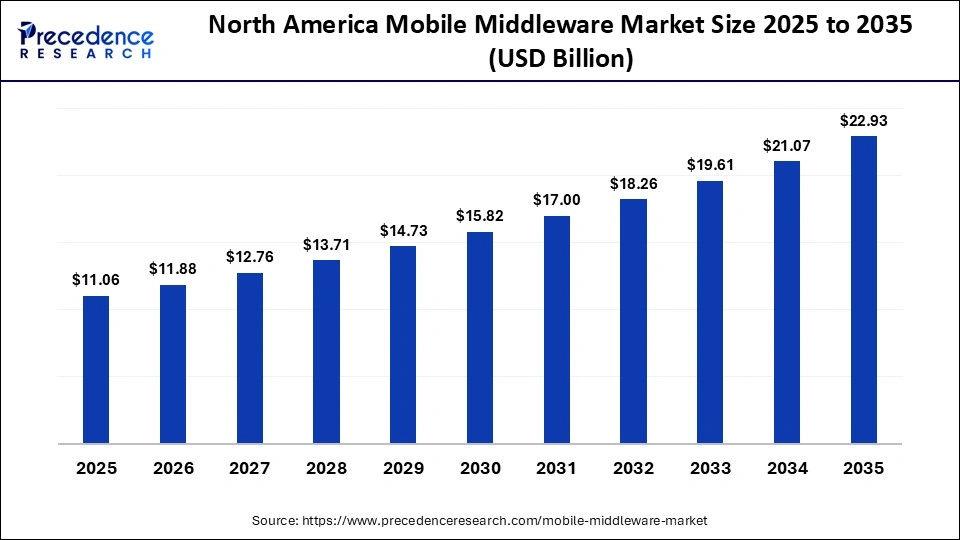
The North America mobile middleware market size is estimated at USD 11.06 billion in 2025 and is projected to reach approximately USD 22.93 billion by 2035, with a 7.56% CAGR from 2026 to 2035.
Which Factors Drive the Mobile Middleware Market in North America?
North America dominated the global market with a share of approximately 38% in 2025 because the region strongly embraces mobile-first work culture, cloud computing, and advanced digital services. Enterprises widely use mobile apps for operations, customer engagement, and remote work, creating constant demand for secure integration platforms.
North America's dominance is also supported by strong 5G rollout, mature IT ecosystems, and high enterprise technology spending. In Canada, government-backed digital health systems, smart city projects, and AI-driven cloud innovation are helping middleware solutions expand by improving secure data exchange, interoperability, and scalable mobile service delivery across industries.
What is the Size of the U.S. Mobile Middleware Market?
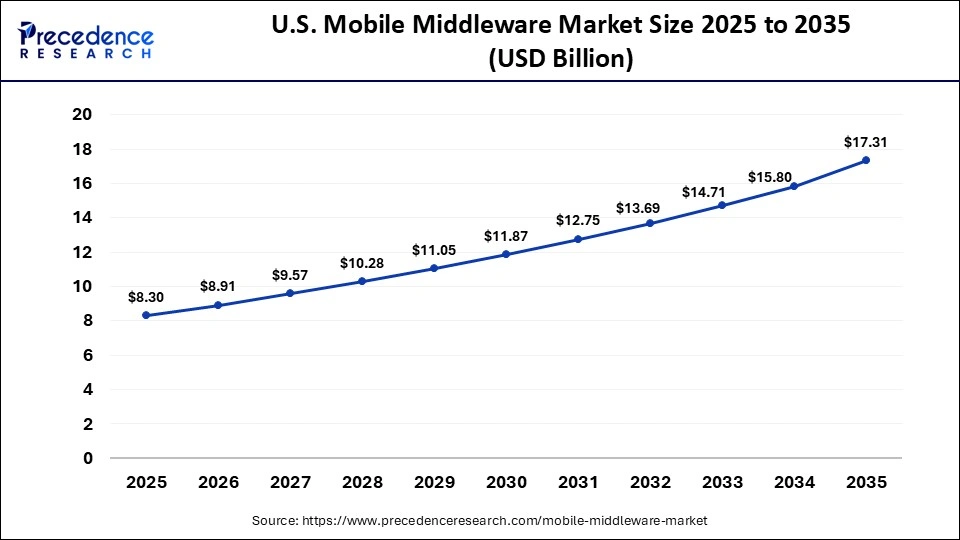
The U.S. mobile middleware market size is calculated at USD 8.30 billion in 2025 and is expected to reach nearly USD 17.31 billion in 2035, accelerating at a strong CAGR of 7.63% between 2026 to 2035.
U.S. Mobile Middleware Market Trends
In the U.S. mobile middleware trends include strong adoption of cloud-native and hybrid middleware that supports secure API integration, real-time data synchronization, and mobile-to-backend connectivity across industries such as healthcare, finance, and logistics. U.S. enterprises increasingly use middleware for mobile device and application management, BYOD policies, and IoT integrations to support scalability, performance, and seamless user experiences. These trends reflect demand for reliable, flexible middleware as mobile applications become central to digital business operations.
How is Asia-Pacific Growing in the Mobile Middleware Market?
Asia-Pacific is expected to grow at the fastest CAGR in the market during the forecast period because of widespread smartphone adoption, expanding mobile internet access, and strong government support for digital services. Many countries are promoting e-health, digital payments, and smart infrastructure, aligning with guidance from global public health and development bodies that emphasize digital connectivity and data sharing. Growing cloud adoption, rising mobile workforce, and increasing demand for secure, real-time application integration across healthcare, manufacturing, and public services are accelerating middleware use across the region.
China Mobile Middleware Market Trends
China plays a leading role in the Asia-Pacific because of its massive mobile user base and deep integration of mobile apps into daily life, business, and public services. Enterprises rely heavily on mobile platforms for payments, healthcare, logistics, and e-commerce, creating strong demand for middleware that connects apps with backend systems.
Rapid 5G expansion, government-supported digital infrastructure, and widespread cloud adoption further strengthen China's dominance. The focus on domestic technology ecosystems and large-scale digital transformation across industries continues to accelerate mobile middleware development and deployment.
Will Europe Grow in the Mobile Middleware Market?
Europe is considered to be a significantly growing area, as businesses and public sectors accelerate digital transformation. Demand for secure, integrated mobile solutions is rising across healthcare, finance, manufacturing, and government services. Strong emphasis on data protection, cross-border interoperability, and 5G deployment further boosts middleware adoption. Additionally, increased investment in cloud infrastructure and support for startups and innovation ecosystems position Europe to expand its use of mobile middleware for scalable, secure, and connected applications.
Who are the major players in the global mobile middleware market?
The major players in the mobile middleware market include IBM, Oracle, SAP, Microsoft, Salesforce, Red Hat, TIBCO Software, Software AG, MuleSoft, VMware, Amazon Web Services (AWS), Google Cloud, Fujitsu, Huawei, HCLTech, Wipro, Infosys, Capgemini, Atos, and NEC Corporation
Recent Developments in the Mobile Middleware Market
- In August 2025, KhushTech Korea introduced the world's first Direct-to-Mobile (D2M) feature phone for Free Stream Technologies in India. Tejas Networks collaborated with KhushTech Korea to make clever optimizations to the demodulator, the operating system, and middleware to work within the resource constraints of a feature phone environment. (Source: https://www.thefastmode.com)
- In February 2025, Intel Corp. and Qualcomm, Inc. collaborated to launch the Ambient IoT Alliance to promote and scale the future ambient IoT ecosystem, AIoTA. The AIoTA enables battery-free, energy-harvesting devices to seamlessly connect with existing wireless infrastructure, enabling real-time data collection and communication across various industries. (Source: https://siliconangle.com)
- In July 2024, Middleware, an observability startup, announced a new iteration of its full-stack cloud observability platform that helps developers monitor applications and infrastructure in real-time, boost operational efficiency, and minimize downtime. The new version provides complete control over telemetry data and costs, new monitoring capabilities, faster root cause analysis, and broader integration support. (Source: https://www.prnewswire.com)
Segments Covered in the Report
By Middleware Type
- Mobile Integration Middleware
- API management
- Enterprise application connectors
- Message Oriented Middleware (MOM)
- Publish/subscribe messaging
- Event streaming
- Mobile Backend as a Service (MBaaS)
- Application Enablement / API Gateways
- Other Mobile Middleware Solutions
By Deployment Mode
- Cloud-based / SaaS
- On-premise
- Hybrid Deployment
By Enterprise Size
- Large Enterprises
- Small & Medium Enterprises (SMEs)
By Vertical / End-User Industry
- IT & Telecom
- BFSI (Banking, Financial Services & Insurance)
- Healthcare & Life Sciences
- Retail & E-commerce
- Government & Public Sector
- Manufacturing & Automotive
- Energy & Utilities
- Other Industries
By Application
- Enterprise Mobility Solutions
- Mobile Commerce & Retail Apps
- Mobile Banking & Payment Solutions
- Mobile Healthcare / Telehealth Apps
- Smart City / Public Services Apps
- Other Mobile Applications
By Region
- North America
- Europe
- Asia-Pacific
- Latin America
- Middle East & Africa
For inquiries regarding discounts, bulk purchases, or customization requests, please contact us at sales@precedenceresearch.com
Frequently Asked Questions
Tags





Ask For Sample
No cookie-cutter, only authentic analysis – take the 1st step to become a Precedence Research client
 Get a Sample




 sales@precedenceresearch.com
 Schedule a Meeting
