



Multichannel Order Management Market Trends, Companies, Revenue / Sales Performance, Subscriber Growth, Pricing Strategies, Cloud Adoption, Infrastructure Expansion, Competitive Landscape, and Industry Outlook
ICT industry specialist Gautam Mahajan estimates the multichannel order management market at USD 4.40 billion in 2026, with continued technology adoption expected to take the market to USD 13.01 billion by 2035 at a CAGR of 12.80%. Leading multichannel order management market providers such as IBM Corporation, Oracle Corporation, SAP SE, Salesforce, Inc. are expanding their capabilities across segments including By Component, By Deployment Mode, By Organization Size, By Industry Vertical, By Application.
Source: https://www.precedenceresearch.com/multichannel-order-management-market
 Get a Sample
 Table Of Content


What is the Multichannel Order Management Market Size in 2026?
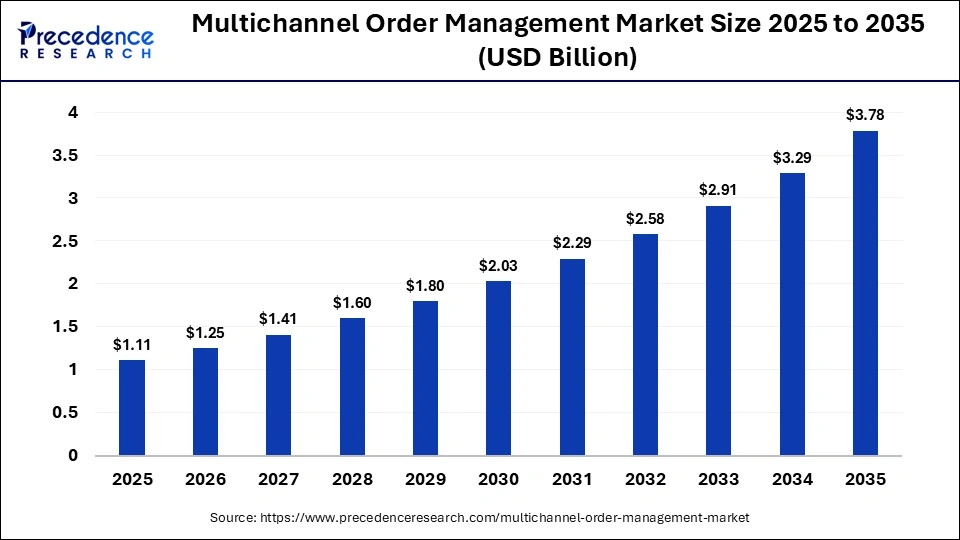
The global multichannel order management market size accounted for USD 3.90 billion in 2025 and is predicted to increase from USD 4.40 billion in 2026 to approximately USD 13.01 billion by 2035, expanding at a CAGR of 12.80% from 2026 to 2035. The market is growing rapidly due to the intense demand for unified, AI-driven, and AI-automated inventory solutions to meet consumer demand for seamless omnichannel shopping experiences.
Key Takeaways
- North America dominated the global multichannel order management market by holding a 38% share in 2025.
- Asia Pacific is anticipated to grow at the fastest CAGR of 15.5% between 2026 and 2035.
- By component, the software platforms segment contributed the highest market share of 70% in 2025.
- By component, the services segment held a 30% share of the market in 2025 and is expected to grow at a 11% CAGR in the coming years.
- By deployment mode, the cloud-based solutions segment held a major market share of 65.00% in 2025 and is expected to grow at the fastest CAGR between 2026 and 2035.
- By organization size, the large enterprises segment captured the highest market share of 65%in 2025.
- By organization size, the small & medium enterprises segment is poised to grow at the highest CAGR of 15.5% between 2026 and 2035.
- By industry vertical, the retail & e-commerce segment held the biggest market share of 40% in 2025.
- By industry vertical, the consumer goods & FMCG segment held the second-largest market share of 15% in 2025.
- By application, the order fulfillment optimization segment accounted for the largest market share of 30% in 2025.
- By application, the omnichannel customer experience management segment is projected to grow at a solid CAGR of 14.5% between 2026 and 2035.
Market Overview
Multichannel order management consolidates orders, inventory, and fulfillment from multiple channels, like online marketplaces, e-commerce sites, and physical stores, into a single platform. Modern, AI-driven, and cloud-based order management systems deliver real-time visibility and automated fulfillment that today's high-speed retail demands. By eliminating manual errors and predicting stock needs, these intelligent solutions prevent stockouts, accelerate delivery, and streamline operations from click to customer.
Impact of AI in the Multichannel Order Management Market
Artificial intelligence (AI) is transforming the multichannel order management market by enabling intelligent, predictive, and automated systems that boost inventory accuracy and on-time delivery. AI evaluates real-time inventory levels, shipping costs, and proximity to route orders to the best fulfillment center. By analyzing historical sales data, market trends, and seasonal changes, AI optimizes inventory levels to minimize stockouts and overstocking. AI automates routine tasks like order entry, address validation, and invoice processing, significantly reducing manual errors by analyzing patterns instantly.
Major Trends in the Multichannel Order Management Market
- Intelligent Automation of Warehouse Operations: Technologies are automating complex, manual processes such as order picking, packing, and inventory updates, increasing operational efficiency.
- AI/ML-Powered Demand Sensing: AI and ML algorithms are shifting forecasting from reactive to proactive, analyzing vast datasets, including social media sentiment and weather, to reduce stockouts and cut lost sales.
- Intelligent Inventory Optimization: AI prevents overstocking and stockouts by dynamically adjusting replenishment recommendations based on real-time inventory signals and SKU-level demand patterns.
- Agentic AI in Supply Chain Workflows: Specialized AI agents are increasingly managing multi-step tasks, such as automated replenishment, procurement, and supplier negotiation, with minimal human intervention.
Market Scope
| Report Coverage | Details |
| Market Size in 2025 | USD 3.90 Billion |
| Market Size in 2026 | USD 4.40 Billion |
| Market Size by 2035 | USD 13.01 Billion |
| Market Growth Rate from 2026 to 2035 | CAGR of 12.80% |
| Dominating Region | North America |
| Fastest Growing Region | Asia Pacific |
| Base Year | 2025 |
| Forecast Period | 2026 to 2035 |
| Segments Covered | Component, Deployment Mode, Organization Size, Industry Vertical, Application, and Region |
| Regions Covered | North America, Europe, Asia-Pacific, Latin America, and Middle East & Africa |
Market Dynamics
Drivers
Integration and Commercialization of AI and Automation
Major market leaders are focusing on integrating AI and machine learning to accelerate the shift toward autonomous order management, enabling real-time inventory synchronization and improved fulfillment accuracy across complex digital channels. This transformation is further supported by the rapid adoption of cloud-based platforms and API-first composable commerce architecture, which enhance operational agility and streamline end-to-end processes.
Restraint
Complexity in Integration and Legacy System Upgrades
These systems require seamless API integration across diverse marketplaces like Amazon, Walmart, Shopify, and existing legacy ERP systems, which creates high operational costs and technical complexity. The high cost of implementing advanced systems limits scalability in price-sensitive, small-to-medium enterprise sectors.
Opportunity
Growing Innovation
The opportunity in the market lies in innovation through generative AI powered chatbots for customer service and automated inventory replenishment. The rapid growth of quick commerce and direct-to-consumer models presents significant potential, as these platforms enhance operational efficiency, accuracy, and reliability in enabling same-day delivery.
Segment Insights
Component Insights
Multichannel Order Management Market Share, By Component, 2025-2035 (%)
| Component | 2025 | 2035 | CAGR (%) |
| Software Platforms | 70.00% | 72.00% | 13.5% |
| Services | 30.00% | 28.00% | 11.0% |
The Software Platforms Segment Dominated the Market With a 70% Share in 2025
The software platforms segment dominated the multichannel order management market with the highest share of 70% in 2025 and is expected to grow at the fastest CAGR of 13.5% over the forecast period. This growth is driven by the increasing demand for centralized, AI-powered, cloud-native tools that manage inventory, orchestrate orders, and integrate sales channels. These platforms offer a single dashboard to oversee orders from websites, marketplaces, and physical stores, enhancing efficiency and reducing errors. The integration of AI for predictive analytics, demand forecasting, and optimized order fulfillment routes is essential for modern, fast-paced retail.
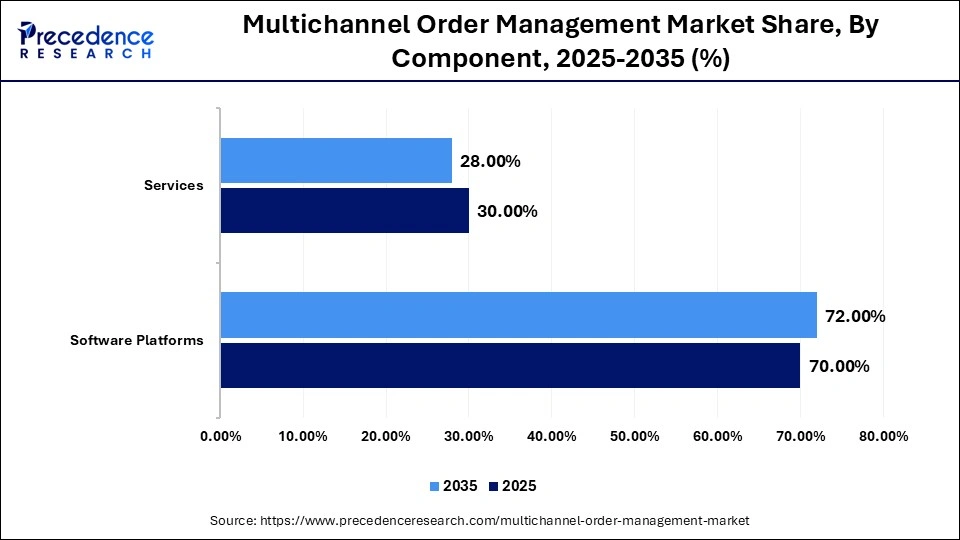
The services segment held a significant share of 30% in 2025, primarily due to the critical need for integrating complex software with existing retail infrastructures, as well as for training and ongoing support. As companies expand their sales across multiple channels, they require professional services to connect their multichannel order management software with ERP, CRM, and logistics systems. Managed services are growing rapidly as businesses seek external support to maintain platforms, analyze data, and optimize inventory processes without increasing internal IT staffing.
Deployment Mode Insights
Multichannel Order Management Market Share, By Deployment Mode, 2025-2035 (%)
| Deployment Mode | 2025 | 2035 | CAGR (%) |
| Cloud-based Solutions | 65.00% | 70.00% | 15.5% |
| On-premise Solutions | 20.00% | 15.00% | 8.0% |
| Hybrid Solutions | 15.00% | 15.00% | 12.0% |
Why Did the Cloud-Based Solutions Segment Dominated the Market in 2025?
The cloud-based solutions segment dominated the multichannel order management market with a 65% share in 2025 and is expected to grow at the fastest CAGR of 15.5% over the forecast period. This dominance is attributed to their cost-effectiveness, rapid deployment, and ability to provide real-time data across channels. Cloud systems enable companies, particularly SMEs, to quickly scale operations up or down. They also easily integrate with third-party tools, which is essential for omni-channel sales, while allowing businesses to reduce capital expenditures and maintenance costs by providing real-time inventory tracking and order fulfillment visibility across global locations.
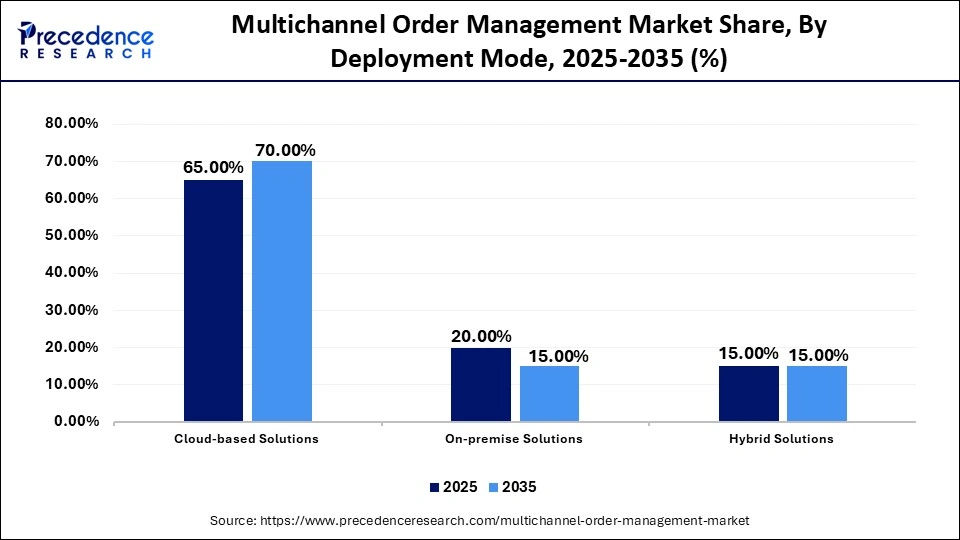
The on-premise solutions segment accounted for a significant market share of 20% in 2025 and is expected to grow at a CAGR of 8% throughout the forecast period. This growth is driven by the need for complete data security, administrative control over inventory, and the ability to customize systems for complex, large-scale enterprise operations. Organizations with sensitive data or intricate inventory management often prefer on-premise solutions because they offer full control and direct administrative access to the software, addressing concerns about data security and privacy. On-premise installations enable businesses to tailor their order management systems to meet the unique needs of large enterprises by dealing with legacy systems.
The hybrid solutions segment held a 15% share of the market in 2025 and is expected to grow at a CAGR of 12% between 2026 and 2035. This growth is attributed to the ability of hybrid models to provide a balance between cloud-based scalability and on-premises data control while ensuring regulatory compliance. Enterprises tend to favor hybrid models to keep sensitive data in-house, leveraging the cloud for analytics and AI-driven demand forecasting. This approach offers a practical transition for businesses reliant on legacy infrastructure to integrate modern order orchestration tools by utilizing the cloud for multi-channel synchronization.
Organization Size Insights
The Large Enterprises Segment Held a 65% market share in 2025
The large enterprises segment dominated the multichannel order management market with a share of 65% in 2025. This dominance is largely due to their high order volumes, complex global supply chains, and the budget necessary for implementing robust, scalable software. These companies handle diverse sales channels and global distribution networks, necessitating advanced software to prevent inventory errors and ensure efficient fulfillment. They allocate substantial IT budgets toward sophisticated AI-driven demand forecasting, real-time inventory tracking, and complex omnichannel integration to achieve high performance and scalability.
Multichannel Order Management Market Share, By Organization Size, 2025-2035 (%)
| Organization Size | 2025 | 2035 | CAGR (%) |
| Large Enterprises | 65.00% | 60.00% | 11.5% |
| Small & Medium Enterprises (SMEs) | 35.00% | 40.00% | 15.5% |
The small & medium enterprises segment is projected to expand at a CAGR of 15.5% during the forecast period. This growth is driven by the urgent need for digital transformation, the rise of e-commerce, and a search for affordable, cloud-based tools to optimize inventory and improve order accuracy. SMEs are increasingly adopting cloud-based multichannel order management systems, which offer low-cost, template-based setups and minimal IT overhead, lowering the barriers to entry.
Industry Vertical Insights
The Retail & E-Commerce Segment Held a 40% Market Share in 2025
The retail & e-commerce segment held a dominant position in the multichannel order management market with a share of 400% in 2025 and is expected to grow at the fastest CAGR of 14.5% over the forecast period. This growth is primarily due to the critical need for real-time, cross-channel inventory synchronization. Retailers must manage inventory and orders across multiple platforms simultaneously. The shift toward same-day or next-day delivery, accelerated by services like Amazon Prime, compels retailers to adopt robust multichannel order management solutions to enhance supply chain efficiency and logistics, providing scalability and flexibility for growing retail operations.
Multichannel Order Management Market Share, By Industry Vertical, 2025-2035 (%)
| Industry Vertical | 2025 | 2035 | CAGR (%) |
| Retail & E-commerce | 40.00% | 42.00% | 14.5% |
| Consumer Goods & FMCG | 15.00% | 14.00% | 12.0% |
| Healthcare & Pharmaceuticals | 10.00% | 11.00% | 13.0% |
| Manufacturing | 10.00% | 9.00% | 11.0% |
| Automotive | 8.00% | 7.00% | 10.0% |
| Electronics & Appliances | 7.00% | 8.00% | 13.5% |
| Others | 10.00% | 9.00% | 11.5% |
The consumer goods & FMCG segment held the second-largest market share of 15% in 2025. This is due to the pressing need to consolidate high-volume, fragmented sales channels. FMCG companies require sophisticated systems to manage inventory across various channels simultaneously, including traditional retail outlets, distributors, modern trade, and online channels. The growth of FMCG e-commerce, encompassing quick commerce and direct-to-consumer initiatives, necessitates integrated platforms to efficiently process high-volume, small-quantity orders and optimize stock availability.
The healthcare & pharmaceuticals segment held a 10% market share in 2025 and is expected to grow at a 13% CAGR throughout the projection period. This is largely due to the rapid digital transformation within the industry and the need for complex, compliant supply chain logistics. The shift toward online pharmacy services, direct-to-patient delivery, and telemedicine demands robust order management systems to seamlessly process orders from various channels. Given the intricate logistics involved, the pharmaceutical industry requires advanced tracking and traceability for specialized systems.
Application Insights
The Order Fulfillment Optimization Segment Led the Market in 2025
The order fulfillment optimization segment led the multichannel order management market with a share of 30% in 2025. This is primarily due to the need for centralizing, automating, and accelerating the processes of order processing, picking, and shipping across various sales channels. Order fulfillment technology automates labor-intensive tasks such as order processing, routing, inventory allocation, and shipping, significantly reducing human errors. As consumer expectations for faster and more transparent delivery grow, fulfillment optimization becomes essential for enhancing operational efficiency and providing real-time visibility.
The omnichannel customer experience management segment is expected to grow at the fastest CAGR of 14.5% during the forecast period. This growth stems from rising demand for seamless, personalized shopping experiences across digital and physical touchpoints. It connects online browsing, social media interactions, and in-store purchases, removing friction and improving satisfaction. It leverages consolidated data to deliver tailored marketing, recommendations, and service across all platforms, providing accurate updates on product availability.
Multichannel Order Management Market Share, By Application, 2025-2035 (%)
| Application | 2025 | 2035 | CAGR (%) |
| Order Fulfillment Optimization | 30.00% | 28.00% | 12.0% |
| Inventory & Warehouse Synchronization | 25.00% | 24.00% | 12.5% |
| Omnichannel Customer Experience Management | 20.00% | 22.00% | 14.5% |
| Returns & Reverse Logistics Management | 15.00% | 16.00% | 13.0% |
| Demand Forecasting & Order Analytics | 10.00% | 10.00% | 13.5% |
The inventory & warehouse synchronization segment held a significant share of 25% in 2025, because it directly addresses the most critical pain points of omnichannel retailing, overselling and inventory inaccuracy. Retailers often hold stock in multiple, geographically dispersed locations. This segment synchronizes inventory across these locations, providing a single source of truth for efficient order allocation. Advanced synchronization tools automate replenishment, set custom reorder points, and manage kitting and bundling.
The returns & reverse logistics management segment held a 15% market share in 2025 and is expected to grow at a CAGR of 13% in the coming years. This growth is driven by high e-commerce return rates and the need to process billions of dollars in returned merchandise efficiently. Retailers are using automated returns management to provide fast refunds and real-time tracking, which improves customer satisfaction and encourages repeat purchases. Integrated systems reduce manual bottlenecks, enabling centralized dashboards to handle high volumes of returns and repairs efficiently.
Regional Insights
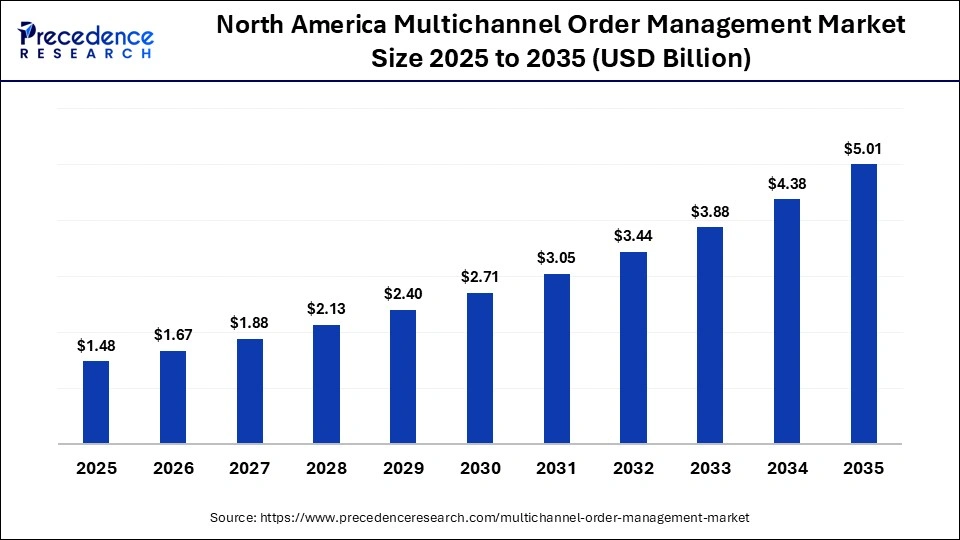
North America Multichannel Order Management Market Size and Growth 2026 to 2035
The North America multichannel order management market size is estimated at USD 1.48 billion in 2025 and is projected to reach approximately USD 5.01 billion by 2035, with a 12.97% CAGR from 2026 to 2035.
North America Led the Global Multichannel Order Management Market in 2025
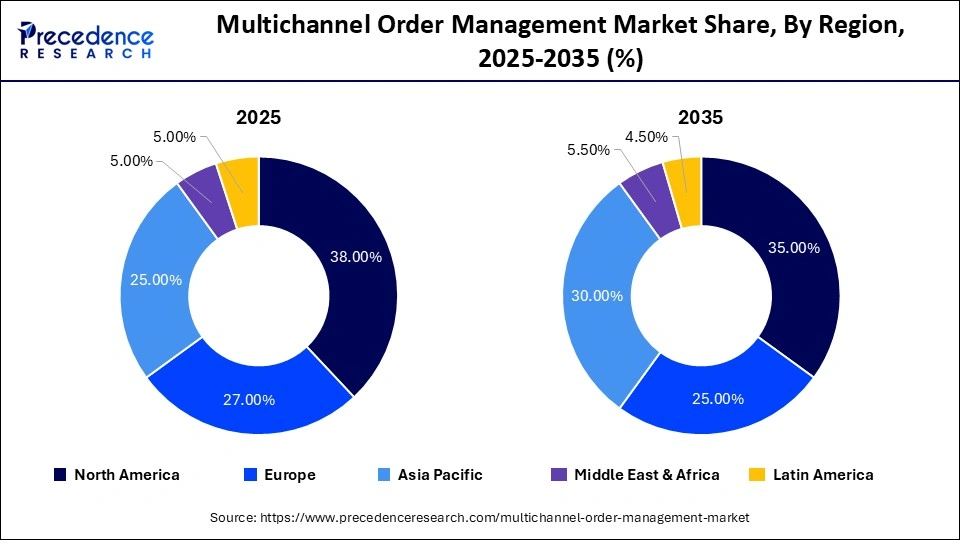
North America held a dominant market share of 38% in 2025, primarily due to its mature e-commerce infrastructure, rapid adoption of AI-driven tools, and the presence of major industry players. The region, particularly the U.S., boasts a well-developed retail ecosystem characterized by high internet penetration and efficient logistics networks that facilitate quick order fulfillment. Many leading multichannel order management software vendors, including IBM Corporation, Oracle Corporation, Salesforce, Inc., and Manhattan Associates, Inc., are headquartered in this region, promoting the adoption of these systems.
U.S. Multichannel Order Management Market Size and Growth 2026 to 2035
The U.S. multichannel order management market size is calculated at USD 1.11 billion in 2025 and is expected to reach nearly USD 3.76 billion in 2035, accelerating at a strong CAGR of 13.04% between 2026 and 2035.
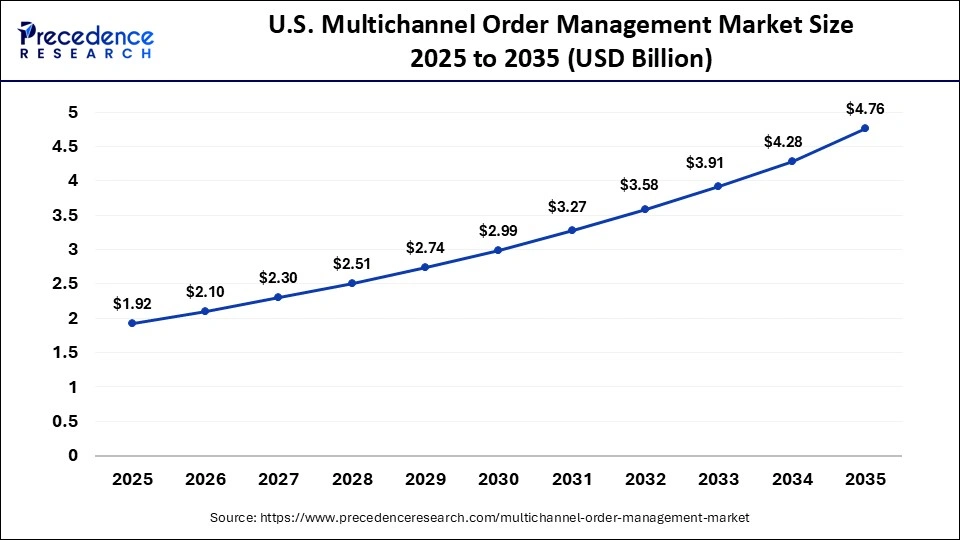
U.S. Market Analysis
The U.S. is a driving force in the market, leveraging AI-powered and real-time technology to meet the high consumer demands for speed and accuracy, positioning itself as the epicenter of e-commerce innovation. With tech giants like Oracle, Salesforce, and IBM at the forefront, the U.S. sets the global standard for advanced unified commerce solutions, from AI-driven inventory management to seamless BOPIS capabilities, paving the way for the future of retail.
Canada Market Analysis
Canada is emerging as a significant player in the market, propelled by major retailers like Loblaw and Canadian Tire, which are accelerating ship-from-store strategies to support e-commerce growth. The integration of high-tech AI and IoT warehousing, along with the influence of the Shopify ecosystem, is helping to create a seamless, high-speed logistics network that meets complex cross-border demands and bridges the digital-physical divide.
How is the Opportunistic Rise of Asia Pacific in the Multichannel Order Management Market?
Asia Pacific is projected to grow at the fastest CAGR of 15.5% throughout the forecast period. This expansion is primarily driven by rapid e-commerce growth, high mobile penetration, and the need to digitize retail operations. E-commerce sales are surging in emerging markets such as India, China, and Southeast Asia, necessitating advanced systems capable of managing high B2C transaction volumes and automated order management. The shift towards cloud-based platforms is offering affordable, scalable, and easy-to-deploy solutions for SMEs, lowering the entry barrier for adopting digital logistics and inventory tools.
India Market Analysis
India is accelerating the global market by leading a logistics-driven revolution focused on delivery integrations with companies like Blinkit and Zepto. Both SMEs and large retailers are demanding localized, flexible SaaS platforms that unify scattered retail operations and manage significant festive volumes across major platforms like Flipkart and Myntra. The combination of warehouse mobility and AI-driven hyperlocal fulfillment is driving innovation in instant commerce.
China Market Analysis
China plays a major role in the region by integrating high-volume manufacturing with AI-driven automated logistics to enhance global e-commerce. By employing advanced robotics and predictive AI on platforms like Taobao and TikTok, Chinese firms ensure rapid fulfillment, precise inventory control, and efficient cross-border delivery.
Multichannel Order Management Market Companies
- IBM Corporation
- Oracle Corporation
- SAP SE
- Salesforce, Inc.
- Manhattan Associates, Inc.
- Blue Yonder Group, Inc.
- Infor Inc.
- HCL Technologies Limited
- Zoho Corporation
- Magento (Adobe Inc.)
- Shopify Inc.
- Brightpearl (Sage Group plc)
- Kibo Commerce
- Orderhive (CIN7)
- Vinculum Solutions Pvt. Ltd.
Recent Developments
- In June 2025, CORRELLINK introduced Shipperfy, a shipping management eCommerce platform that consolidates order processing and shipping for small and medium online retailers across multiple sales channels like eBay, Amazon, and Shopify. This platform connects with existing carrier accounts, provides shipping quotes, and allows users to generate labels, notify sales channels of shipments, and create invoices and packing slips.(Source: https://campaignbrief.com)
- In September 2025, Amazon announced the expansion of its Multi-Channel Fulfillment (MCF) to support merchants on SHEIN, Shopify, and Walmart, building on its success with other platforms. This allows businesses to use a shared inventory pool with Fulfillment by Amazon (FBA), simplifying operations and reducing costs. Peter Larsen, Vice President of the company, emphasized that this initiative helps small and medium-sized businesses grow efficiently across various sales channels.(Source: https://press.aboutamazon.com)
Segments Covered in the Report
By Component
- Software Platforms
- Services
By Deployment Mode
- Cloud-based Solutions
- On-premise Solutions
- Hybrid Solutions
By Organization Size
- Large Enterprises
- Small and Medium Enterprises (SMEs)
By Industry Vertical
- Retail and E-commerce
- Consumer Goods and FMCG
- Healthcare and Pharmaceuticals
- Manufacturing
- Automotive
- Electronics and Appliances
- Others
By Application
- Order Fulfillment Optimization
- Inventory and Warehouse Synchronization
- Omnichannel Customer Experience Management
- Returns and Reverse Logistics Management
- Demand Forecasting and Order Analytics
By Region
- North America
- Latin America
- Europe
- Asia-pacific
- Middle and East Africa
For inquiries regarding discounts, bulk purchases, or customization requests, please contact us at sales@precedenceresearch.com
Frequently Asked Questions





Ask For Sample
No cookie-cutter, only authentic analysis – take the 1st step to become a Precedence Research client
 Get a Sample




 sales@precedenceresearch.com
 Schedule a Meeting
