



Network API Market Size, Key Companies, Company Market Share, User Adoption, Technology Deployment, Revenue Growth, Competitive Positioning, and Demand Forecast
Network API Market (By Type: Device Monitoring APIs, Messaging / Communication APIs, Edge APIs, Location APIs, Identity APIs, Access Control APIs, Network Performance APIs, Others; By application: IoT, Business IT Solutions, Fraud Detection / Security, Priority Communication, Autonomous Vehicles, Media & Entertainment, Others; By End Use: IT & Telecommunications, BFSI, Manufacturing, Government, Healthcare, Transport & Logistics, Automotive, Media & Entertainment, Others) - Global Industry Analysis, Size, Trends, Leading Companies, Regional Outlook, and Forecast 2026 to 2035
Source: https://www.precedenceresearch.com/network-api-market
 Get a Sample
 Table Of Content


What is the Network API Market Size?
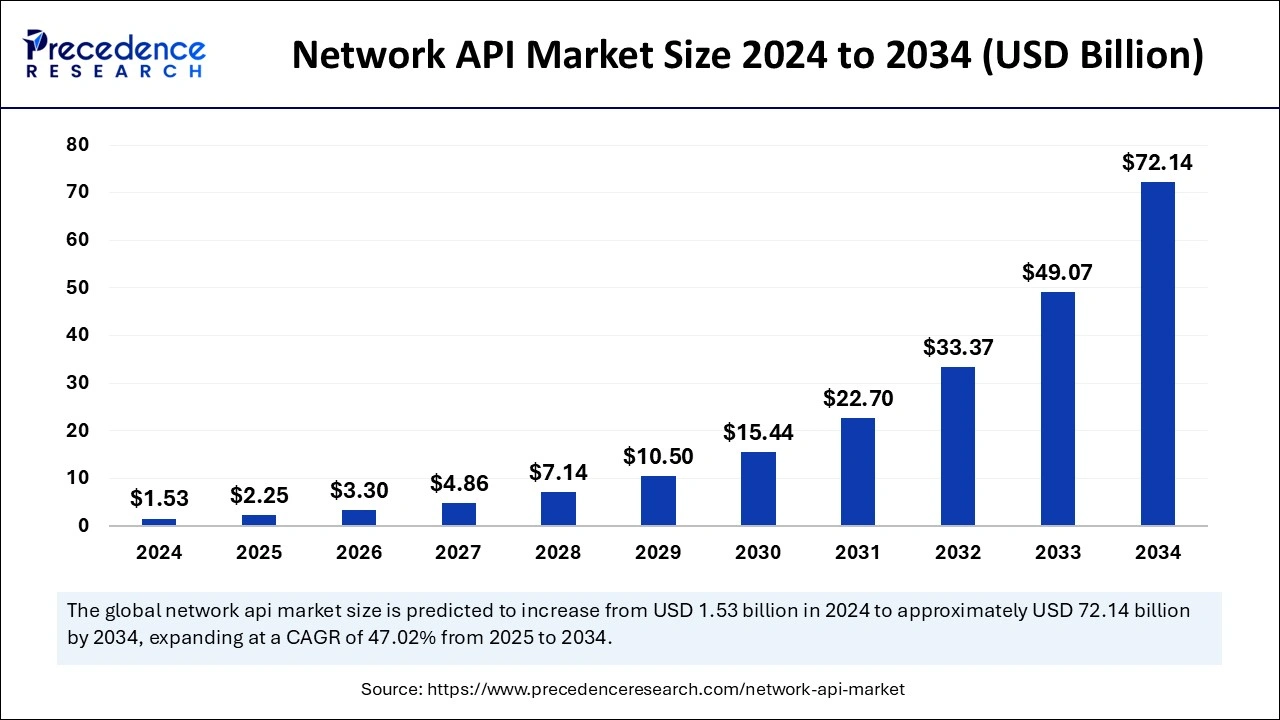
The global network API market size accounted for USD 3.30 billion in 2026 and is expected to exceed around USD 90.30 billion by 2035, growing at a CAGR of 44.66% from 2026 to 2035. The rising demand for the network API is attributed to allowing developers to access network capabilities and build apps that have the ability to communicate across networks.
Key Takeaways
- North America dominated the global network API market in 2025.
- Asia Pacific is the second largest shareholder and is expected to grow at a significant rate between 2025 and 2026.
- By type, the messaging/communication APIs segment dominated the market with a 29.4% share in 2025.
- By type, the devices segment is the second-largest shareholder and is expected to grow at a significant rate between 2026 and 2035.
- By application, the IoT segment dominated the market with a 37% share in 2025.
- By application, the businesses' IT solutions segment is the second-largest shareholder and is expected to grow at a significant rate between 2026 and 2035.
- By end use, the IT & telecommunications segment dominated the market with a 33% share in 2025.
- By end use, the BFSI segment is the second-largest shareholder and is expected to grow at a significant rate between 2026 and 2035.
Market Overview
Network API (Application Programming Interface) is an interface that allows various applications to communicate with each other using a particular mechanism and protocols. It provides a standardized way for applications to withdraw analytics and statistical information from network components to meet customer demand based on technology use cases. The demand for network API was projected when the world's largest operators, such as Ericsson, Telefonica, Orange, Reliance Jio, and many more, declared a new venture to sell network API on the global market. The network API market allows developers to access 5G networks to strengthen the telecom network capabilities, which leads to high speed, low latency, and security.
How Artificial Intelligence (AI) is Changing the Network API Industry?
Integration of artificial intelligence into the network API market has a critical role to play in telecommunications, ensuring the security of vital infrastructure, providing data protection, and ethical considerations. According to Gartner, by 2026, there will be more than a 30% increase in demand for API will come from artificial intelligence and tools such as large language models. The involvement of GenAI as an algorithm in telecommunication enables computers to create new content from existing data.
- In January 2025, Mira Network, a provider of decentralized AI infrastructure for trustless verified intelligence, launched its test net adjacent to the next-generation suite of API marketing, a major milestone in securing the safety and efficiency of on-chain autonomous AI-driven transactions.
Network API Market Growth Factors
- Network API has the potential to adapt and create new revenue models by monetizing data when businesses sell access to their data sets, insights, or analytics, developers use API to drive to the company's platform with the help of an app which increases usage, or sharing ad revenue by leveraging marketing efforts to a broader userbase.
- By controlling network components such as SDN controllers, network management systems, and network analytics, API helps with Software Define Networking (SDN). Additionally, API directs network traffic over the company's hardware which boosts SDN.
- API enables network function virtualization (NFV) by facilitating the decoupling of network functions such as balancing and encryption from physical hardware. This helps in creating a more adaptable and programmable connectivity service.
Market Scope
| Report Coverage | Details |
| Market Size by 2025 | USD 2.25 Billion |
| Market Size in 2026 | USD 3.30 Billion |
| Market Size in 2035 | USD 90.30 Billion |
| Market Growth Rate from 2026 to 2035 | CAGR of 44.66% |
| Dominating Region | North America |
| Fastest Growing Region | Asia Pacific |
| Base Year | 2025 |
| Forecast Period | 2026 to 2035 |
| Regions Covered | North America, Europe, Asia-Pacific, Latin America, and Middle East & Africa |
Market Dynamics
Drivers
5G deployment
Telecom operators have greatly emerged with telcos monetizing their 5G investment and meeting customer needs. 5G deployment in the network API market allows developers to access 5G network capabilities that deliver new services and applications. Any service providers and enterprises are able to activate new possibilities and expose them through 5G API, which boosts the programmability and adaptability of connectivity services to cater to various needs.
5G-equipped devices such as mobile phones are making use of network API for certain applications to boost functions and enable high-speed connectivity tiers. With the help of network API, developers have easy access to 5G capabilities received through service providers, this creates pathways for opportunities to develop an enhanced application and services, drive revenue, and benefit developers, service providers, and enterprises.
Restraint
Security framework
API is designed with security standards and protocols containing rules and guidelines to protect the integrity, confidentiality, and availability of data exchanged between two systems through API. There are various aspects of security involved in API, including authentication, authorization, encryption, access control, and session management. The security protocols and standards secure API communication, offering an organization safe exposure to digital services to external developers. However, a poorly implemented security protocol has the potential to hinder the market growth.
Opportunity
Collaborative ventures
There are several growing factors to be witnessed in the coming future in the market. The factor with high venture and investment expectations is the collaboration between major service providers expanding the API capabilities through strategic partnerships. Greater collaboration creates tools that allow applications to interact directly with network infrastructure and control bandwidth allocation for security aspects.
The integration of communication service providers (CSPs) is currently facilitating the rapid deployment of comprehensive GSMA Open Gateway based on the platform through the increasing involvement of pre-integrated solutions. Partnerships among leading enterprises are accelerating digital transformation for CSPs, helping them evolve in a rapidly advancing telecommunication landscape and seize opportunities in the growing network API market.
Segmental Insights
By Type
The messaging/communication APIs segment dominated the market with a 29.4% market share because of the increase in digital interactions in real time across industries. These APIs support customer engagement and collaboration tools by facilitating the smooth integration of voice, video, and messaging services into applications. Demand is being further strengthened by the increasing use of chatbots, OTT platforms, and omnichannel communication techniques. Furthermore, businesses are depending more and more on these APIs to improve the scalability and user experience of digital services. Startups and businesses are adopting CPaaS models more quickly as a result of their expansion.
Devices monitoring APIs are the fastest growing with a 24.9% market share propelled by the quick growth of connected devices and IoT ecosystems. These APIs enable real-time device tracking, diagnostics, and performance management in a variety of industries, including smart infrastructure, manufacturing, and healthcare. Businesses are adopting monitoring solutions due to the necessity of predictive maintenance and operational efficiency. Furthermore, the need for these APIs is growing as more sensors and edge devices are deployed. The capacity to identify anomalies and maximize performance is being further improved through integration with AI-based analytics.
Edge APIs hold a 12% market share in 2025 because more popular businesses use edge computing to handle data nearer to the source. These APIs aid in lowering latency, speeding up response times, and improving overall application performance. Use cases like autonomous systems, smart cities, and industrial automation are where they are especially useful. The significance of edge APIs in supporting decentralized architectures is anticipated to increase gradually as data generation at the edge keeps expanding.
By application
The IoT segment dominated the market with a 37% market share in 2025, encouraged by the growing use of networked devices in industries like smart homes, healthcare, and automobiles. Within IoT ecosystem networks, APIs are essential for facilitating data exchange, communication, and device interoperability. Demand is being further increased by the growth of industrial IoT and smart infrastructure. Furthermore, the scalability and efficiency of IoT-based applications are being improved by developments in 5G connectivity.
Businesses' IT solutions are growing fastest with a 26% market share, motivated by the speed at which digital transformation is occurring in businesses. For increased operational efficiency, businesses are utilizing APIs to integrate cloud platforms, enterprise software, and data analytics tools. Adoption is being accelerated by the increasing demand for automation, remote working options, and systems interoperability. APIs also make it possible for companies to provide personalized digital experiences and innovate more quickly.
Fraud detection/security holds a 12% market share in 2025, demonstrating how crucial cybersecurity is becoming in digital environments. To facilitate real-time authentication, transaction monitoring, and threat detection, network APIs are frequently utilized. Organizations are making significant investments in API-driven security solutions due to an increase in cyberattacks and data breaches. These APIs improve industry-wide trust, compliance, and sensitive data protection.
By End Use
IT & telecommunications dominated the market with a 33% market share in 2025 because of its widespread use of APIs for digital service enablement, network management, and service delivery. In this industry APIs are crucial for enabling technologies like software-defined networking, cloud computing, and 5G. To generate new revenue streams, telecom operators are increasingly revealing network capabilities through APIs. API adoption is also being driven by the increasing need for digital services and seamless connectivity.
The BFSI segment is growing rapidly with a 16% market share driven by the growing use of open banking frameworks, fintech solutions, and digital banking. Real-time payments, safe data sharing, and smooth platform integration of financial services are all made possible by APIs. Using API-driven innovations, financial institutions are concentrating on improving the customer experience.
The manufacturing segment holds a 12% market share in 2025, encouraged by the expanding use of smart manufacturing techniques and Industry 4.0. Real-time production process monitoring and automation are made possible by the use of APIs to link devices, systems, and applications. Decision-making is improved, downtime is decreased, and operational efficiency is increased. The use of APIs in manufacturing settings is increasing due to the integration of analytics and IoT platforms.
Regional Insights
Asia Pacific: A Hub for 5G Revolution
Asia Pacific held a significant share of the network API market. The expansion of the market in this region is attributed to the substantial investment in 5G infrastructures and services. 5G technology is transforming industries and enhancing user experience in many regions, particularly in Asia Pacific. It is estimated that USD 227 billion will be invested by mobile operators by the year 2025.
Countries such as China, South Korea, Japan, Singapore, and Hong Kong are the majority driving the deployment of 5G, which has resulted in significant advancement in multiple sectors. Hong Kong has improved its operational efficiency in maritime communication and enhanced safety. Thailand and Malaysia are dominant in digital transformation in manufacturing, achieving extensive levels of automation and efficiency.
Significantly Established North American Market: GSMA Program
North America is observed to witness robust growth in the network API market. The growth of this region is experienced majorly due to the United States being the largest mobile operator. North American industry players have an emerged emphasis on the GSMA initiative to bring the full potential of 5G connectivity. With the help of the GSMA Open Gateway program, the business is bringing new 5G services and use cases to the industry.
There is a collaborative partnership in North America. The growing GSMA Open Gateway is greatly expanding in the U.S. The leading Operators in the United States, such as AT&T, T-Mobile, and Verizon, are developing immersive uses of API in their applications. About 67 mobile operators have committed to the Open Gateway API Program; those operators account for around 75% of the world's mobile by connection.
Network API Market Companies
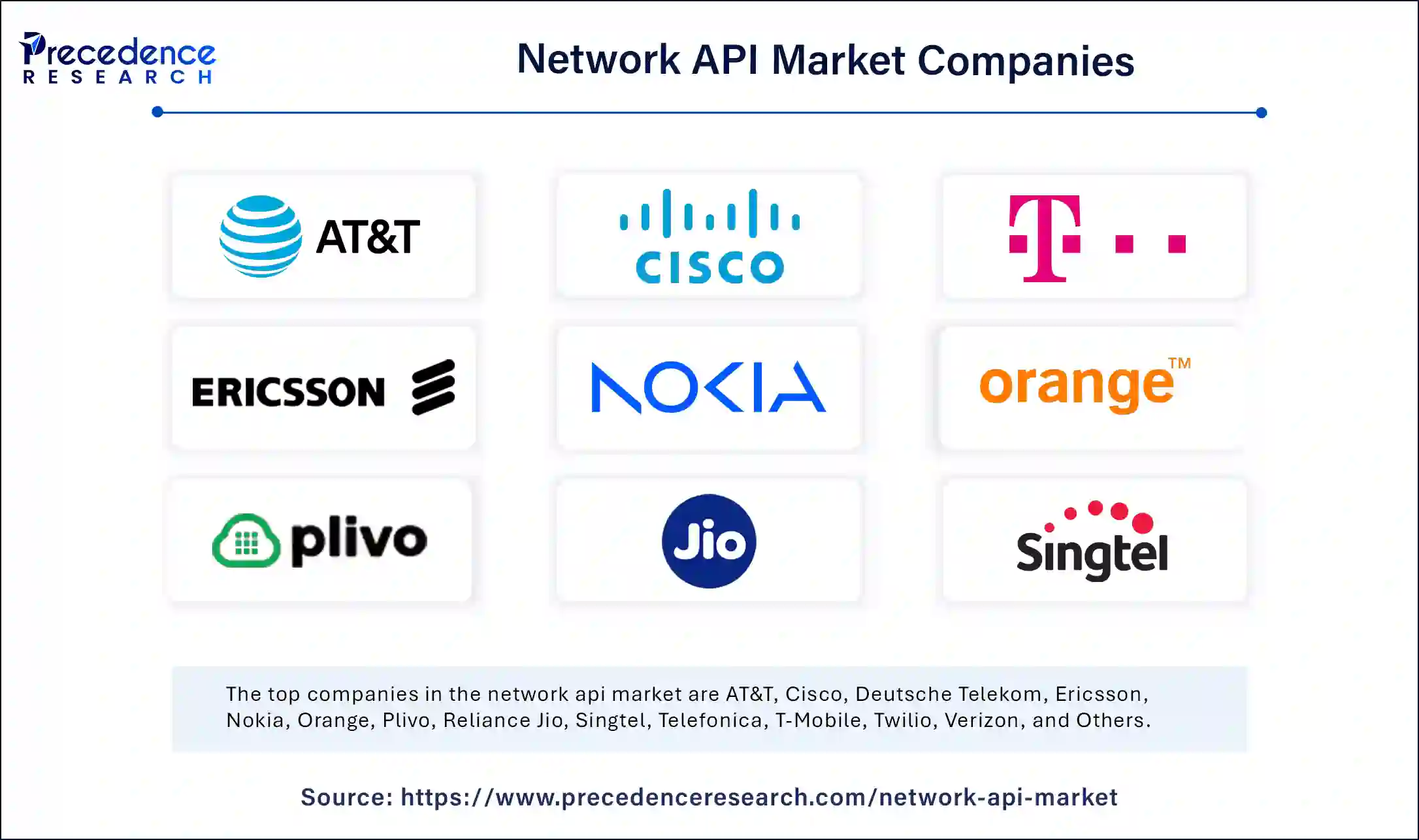
- Ericsson
- Nokia
- Cisco
- Huawei
- Microsoft
- Google Cloud
- AWS
- Twilio
- Vonage
- Infobip
- Sinch
- Bandwidth
- Boku
- Syniverse
- AT&T
- Deutsche Telekom
- Orange
- Plivo
- Reliance Jio
- Singtel
- Telefonica
- Telstra Bharti Airtel
- T-Mobile
- Twilio
- Verizon
- Vodafone
Latest Announcements by Industry Leaders
- In September 2024, Yigal Elbaz, Senior Vice President, Network CTO, AT&T, said: “AT&T has been on a network transformation journey for many years, and our network has become a powerful platform for innovation.” He further adds, “We look forward to working with application service providers across developer ecosystems that can build innovative new solutions and co-create new areas of value for our customers through AT&T's network.”
- Mr Yuen Kuan Moon, Group Chief Executive Officer, Singtel, said, “This unified platform and global eco-system will enable even more developers and businesses to leverage 5G quality networks to exploit API opportunities using GSMA's open gateway principles. We look forward to helping even more enterprises and organizations in Asia to use network API solutions to drive growth and innovation through this timely collaboration.”
Recent Developments
- In February 2026, AT&T announced the deployment of standardized 5G network APIs as part of the Aduna initiative, enabling developers to directly access telecom network capabilities. This marks a major step toward programmable networks and supports enterprise use cases such as fraud detection, authentication, and quality-on-demand services. The launch reflects the shift toward API monetization in telecom ecosystems. (Source: https://www.sdxcentral.com )
- In January 2026, AT&T introduced its IoT Network Intelligence solution to provide enterprises with enhanced visibility and control over connected devices. The platform leverages APIs to deliver real-time insights, improving device performance monitoring and operational efficiency across industries. This reflects the increasing importance of API-enabled IoT ecosystems in enterprise digital transformation. (Source: https://www.telecomtv.com )
- In January 2026, Totogi announced that a Tier-1 telecom operator in Southeast Asia selected its AI-powered BSS Magic platform to support large-scale digital and API-driven transformation. The solution integrates AI with telecom operations, enabling more efficient service delivery and API-based monetization strategies. This move underlines the growing role of AI-native platforms in telecom ecosystems. (Source: https://totogi.com )
- In September 2024, 12 leading telecom operators joined Ericsson to create a new company aimed at bringing common network APIs. The leading telecom operators include América Móvil, AT&T, Bharti Airtel, Deutsche Telekom, Orange, Reliance Jio, Singtel, Telefonica, Telstra, T-Mobile, Verizon, and Vodafone. The venture will drive implementation and access to common APIs from multiple telecom service providers to a broader ecosystem of developer platforms.
- In June 2024, Nokia launched Network Exposure Platform (NEP), a new software offering that will expand and simplify the number of operator network APIs available to developers. NEP is the first implementation of the GSMA Operator Platform, a common platform exposing operator service and capabilities to developers in a ‘connect once, connect to many' model.
- In February 2024, Verizon and Vonage collaborated to bring advanced 5G network APIs to developers. This joint innovation sets the way for future API development and distribution efforts between these two industry-leading companies. The aim is to offer seamless integration with business applications and productivity tools.
Segments Covered in the Report
By Type
- Device Monitoring APIs
- Messaging / Communication APIs
- Edge APIs
- Location APIs
- Identity APIs
- Access Control APIs
- Network Performance APIs
- Others
By application
- IoT
- Business IT Solutions
- Fraud Detection / Security
- Priority Communication
- Autonomous Vehicles
- Media & Entertainment
- Others
By End Use
- IT & Telecommunications
- BFSI
- Manufacturing
- Government
- Healthcare
- Transport & Logistics
- Automotive
- Media & Entertainment
- Others
By Geography
- North America
- United States
- Canada
- Mexico
- Rest of North America
- Europe
- Western Europe
- Western Europe
- Germany
- France
- UK
- Others
- Western Europe
- Eastern Europe
- Russia & Belarus
- Others
- Western Europe
- Asia Pacific
- China
- India
- Japan
- Australia & New Zealand
- ASEAN Countries
- South Korea
- Rest of APAC
- China
- Middle East & Africa
- GCC Countries
- Saudi Arabia
- UAE
- Qatar
- Others
- Saudi Arabia
- Rest of MEA
- GCC Countries
- Latin America
- Brazil
- Argentina
- Rest of Latin America
For inquiries regarding discounts, bulk purchases, or customization requests, please contact us at sales@precedenceresearch.com
Frequently Asked Questions
Tags





Ask For Sample
No cookie-cutter, only authentic analysis – take the 1st step to become a Precedence Research client
 Get a Sample




 sales@precedenceresearch.com
 Schedule a Meeting
