



Neuroimmunology Market Size, Share, Trends, Companies, and Forecast 2026-2035
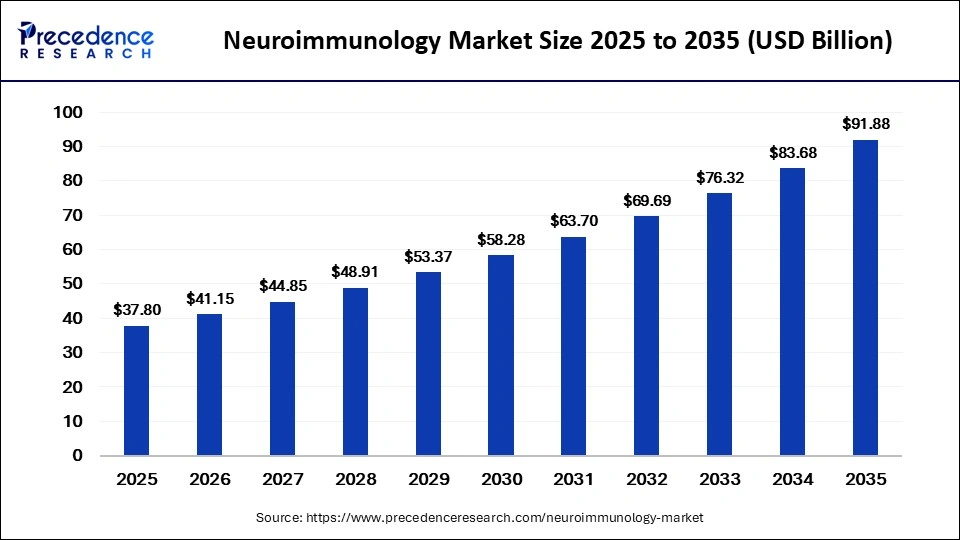
Deepa Pandey, a Healthcare Industry Expert, highlights that the neuroimmunology market has reached USD 41.15 billion in 2026 and is on track to reach USD 91.88 billion by 2035, advancing at a CAGR of 8.90%. Key neuroimmunology market companies shaping the market include Biogen Inc, F. Hoffmann-La Roche Ltd, Novartis AG, Sanofi S.A., while major growth segments span By Disease Type, By Treatment Type, By Mechanism of Action, By Route of Administration, By End-User.
Source: https://www.precedenceresearch.com/neuroimmunology-market
 Get a Sample
 Table Of Content


Neuroimmunology Market Size and Forecast: 2026 to 2035
The global neuroimmunology market size is predicted to increase from USD 41.15 billion in 2026 to approximately USD 91.88 billion by 2035, expanding at a CAGR of 8.90% from 2026 to 2035. The market is driven by the surging global incidence of neurological and autoimmune disorders, such as multiple sclerosis, Alzheimer's, and Parkinson's, combined with breakthroughs in targeted drug discovery and advanced diagnostic imaging.
Key Takeaways
- North America dominated the global neuroimmunology market with a share of 39% in 2026.
- Asia-Pacific is expected to grow at the fastest CAGR of 13.5% during the forecast period.
- By disease type, the multiple sclerosis segment led the global market with a share of 36% in 2026.
- By disease type, the neuroinflammatory disorders segment held 9% of the market share in 2026 and is expected to grow at the fastest CAGR of 12.5% between 2026 and 2035.
- By treatment type, the monoclonal antibodies segment accounted for a revenue share of 30% in the market in 2026.
- By treatment type, the cell-based therapies segment is expected to grow at the highest CAGR of 18.5% between 2026 and 2035.
- By mechanism of action, the B-cell targeting therapies segment accounted for the highest revenue share of 28% in the market in 2026.
- By mechanism of action, the complement inhibition segment is expected to grow at the fastest CAGR of 14.5% between 2026 and 2035.
Global Market Overview and Key Metrics
The neuroimmunology industry refers to the global pharmaceutical, biotechnology, and diagnostic sectors aimed at treating conditions that arise from complex interactions between the nervous system and the immune system. It mainly covers drugs and medical tests for neuroinflammatory and autoimmune disorders. The primary driving factor for the market is the rapidly growing global incidence of neurological and autoimmune disorders, like multiple sclerosis (MS), Alzheimer's, and autoimmune encephalitis.
How is AI Influencing the Neuroimmunology Market?
Artificial intelligence (AI) is profoundly changing the neuroimmunology industry by accelerating drug discovery, enabling highly accurate differential diagnostics, and paving the way for personalized therapeutic strategies. By decoding complex neuroimmune interactions, AI is assisting researchers and clinicians in tackling previously intractable brain diseases. AI systems and predictive models harmonize large-scale longitudinal datasets, electronic health records (EHR), and multi-omics information. This enables healthcare providers to simulate diverse treatment scenarios and forecast the exact course of an individual's disease.
Key Neuroimmunology Market Trends 2026: Biologics, AI Drug Discovery & Precision Medicine
- The market is rapidly moving toward targeted biologic therapies, like monoclonal antibodies, which provide more precise immune modulation for complex neuro-autoimmune conditions.
- Pharmaceutical firms are leveraging AI to screen compounds, repurpose existing drugs, and forecast drug-target interactions, which accelerates the discovery of new disease-modifying treatments.
- Advancements in pharmacogenomics, next-generation sequencing, and biomarker integration are allowing customized treatment plans, minimizing adverse side effects, and thus reducing trial-and-error prescribing.
Market Dynamics and Growth Drivers
Drivers
Increased Awareness of Neuroimmunological Disorders
Increased awareness of neuroimmunological disorders is the essential driver of the neuroimmunology market. It expands the actionable patient pool, drives early and accurate diagnoses using advanced biomarkers, and even accelerates R&D investments into targeted biologic and monoclonal antibody therapies. Patient and physician advocacy has accelerated funding into targeted immunotherapies, specifically monoclonal antibodies, programmed to modify disease progression rather than just manage symptoms.
Restraint
High Cost of Therapies and Testing
The high cost of therapies and testing is a primary restraint in the market because it drives severe financial toxicity and even creates access barriers for patients. These expenses restrict widespread adoption, limit availability in developing regions, and lead to prescription abandonment or delayed diagnoses. In developing and low-to-middle-income countries, the shortage of robust universal healthcare coverage and low patient affordability severely curtail market penetration.
Opportunity
Emergence of CAR T-Cell & Targeted Biologic Therapies
The emergence of CAR T-cell and targeted biologic therapies is the primary growth engine for the market. These breakthroughs enable deep immune reprogramming and targeted destruction of autoreactive cells, changing treatment paradigms from lifelong, broad immunosuppression to highly precise, thus curative interventions for severe, treatment-refractory neurological diseases.
Market Segmentation Analysis
Neuroimmunology Market by Disease Type 2026 Share & Size
| Segments | 2026 Share | 2026 Market Value (USD Billion) |
| Multiple Sclerosis | 36% | 14.814 |
| Neuromyelitis Optica Spectrum Disorder (NMOSD) | 8% | 3.292 |
| Myasthenia Gravis | 11% | 4.527 |
| Autoimmune Encephalitis | 6% | 2.469 |
| Guillain-Barré Syndrome (GBS) | 7% | 2.881 |
| Chronic Inflammatory Demyelinating Polyneuropathy | 10% | 4.115 |
| Neuroinflammatory Disorders | 9% | 3.704 |
| Other Neuroimmune Disorders | 13% | 5.35 |
Sources: Expert Interview, Secondary Sources, Precedence Research Database, Precedence Research Analysts and Researcher.
Multiple Sclerosis leads the disease segment because of its established treatment market, long-term disease management needs, and extensive use of disease-modifying therapies. Myasthenia Gravis and chronic inflammatory demyelinating polyneuropathy also contribute meaningfully through growing use of targeted immunotherapies and biologic treatments.
Neuroimmunology Market by Treatment Type 2026 Share & Size
| Segments | 2026 Share | 2026 Market Value (USD Billion) |
| Immunomodulators | 16% | 6.584 |
| Immunosuppressants | 12% | 4.938 |
| Monoclonal Antibodies | 30% | 12.345 |
| Corticosteroids | 9% | 3.704 |
| Intravenous Immunoglobulin (IVIG) | 13% | 5.35 |
| Plasma Exchange (PLEX) | 5% | 2.058 |
| Cell-based Therapies | 5% | 2.058 |
| Other Biologic Therapies | 10% | 4.115 |
Sources: Expert Interview, Secondary Sources, Precedence Research Database, Precedence Research Analysts and Researcher.
Monoclonal Antibodies lead because targeted biologics have become important in treating multiple sclerosis and several antibody-mediated neurological disorders. IVIG and immunomodulators maintain substantial demand, while cell-based therapies represent an emerging area with potential for faster growth as clinical evidence and treatment applications develop.
Mechanism of Action Insights
| Segments | 2026 Share | 2026 Market Value (USD Billion) |
| B-cell Targeting Therapies | 28% | 11.522 |
| T-cell Modulation | 17% | 6.996 |
| Complement Inhibition | 12% | 4.938 |
| Cytokine Inhibition | 14% | 5.761 |
| Neuroprotection | 10% | 4.115 |
| Anti-inflammatory Therapy | 19% | 7.819 |
Sources: Expert Interview, Secondary Sources, Precedence Research Database, Precedence Research Analysts and Researcher.
B-cell Targeting Therapies lead because B-cell-directed treatments play an important role in multiple sclerosis and selected antibody-mediated neurological diseases. Complement Inhibition is positioned for faster growth as complement-targeted treatments expand in indications such as neuromyelitis optica spectrum disorder and myasthenia gravis.
Neuroimmunology Market by Route of Administration 2026 Share & Size
| Segments | 2026 Share | 2026 Market Value (USD Billion) |
| Oral | 25% | 10.288 |
| Injectable | 15% | 6.173 |
| Intravenous (IV) | 38% | 15.637 |
| Subcutaneous | 22% | 9.053 |
Sources: Expert Interview, Secondary Sources, Precedence Research Database, Precedence Research Analysts and Researcher.
Intravenous administration is estimated to lead because several established neuroimmunology treatments, including IVIG and certain monoclonal antibodies, require infusion-based delivery. Oral therapies remain important for chronic disease management, while subcutaneous administration can improve convenience and reduce the need for infusion-center visits for eligible treatments.
Neuroimmunology Market by End-user 2026 Share & Size
| Segments | 2026 Share | 2026 Market Value (USD Billion) |
| Hospitals | 48% | 19.752 |
| Specialty Neurology Clinics | 27% | 11.111 |
| Research & Academic Institutes | 10% | 4.115 |
| Homecare Settings | 10% | 4.115 |
| Rehabilitation Centers | 5% | 2.058 |
Sources: Expert Interview, Secondary Sources, Precedence Research Database, Precedence Research Analysts and Researcher.
Hospitals lead because severe neuroimmune conditions often require specialist diagnosis, infusion therapies, acute treatment, and multidisciplinary care. Specialty Neurology Clinics also account for a substantial share through ongoing disease monitoring and the management of chronic conditions, while homecare is supported by suitable self-administered and home-infusion therapies.
Market Regional Analysis: North America, Europe, Asia-Pacific
Neuroimmunology Market by Region 2026 Share & Size
| Segments | 2026 Share | 2026 Market Value (USD Billion) |
| North America | 39% | 16.049 |
| Latin America | 6% | 2.469 |
| Europe | 28% | 11.522 |
| Asia-Pacific | 21% | 8.642 |
| Middle East and Africa | 6% | 2.469 |
Sources: Expert Interview, Secondary Sources, Precedence Research Database, Precedence Research Analysts and Researcher.
North America leads with the supplied 39% share, supported by advanced neurological care infrastructure, access to biologic therapies, established diagnostic capabilities, and substantial pharmaceutical research activity. Asia-Pacific is expected to grow fastest as diagnosis improves, healthcare access expands, and demand for advanced treatments rises across major markets.
Which Factors Supported North America's Dominance in the Neuroimmunology Market?
North America dominated the market with a major share of 39% in 2026. This dominance is supported by the high prevalence of neuroimmune and autoimmune neurological disorders and the strong acceptance of biologics and monoclonal antibody therapies. Innovations in biomarker detection, the integration of AI-enabled neuroimaging, and next-generation sequencing enable earlier and more accurate diagnoses.
U.S. Neuroimmunology Market Size and Growth 2026 to 2035
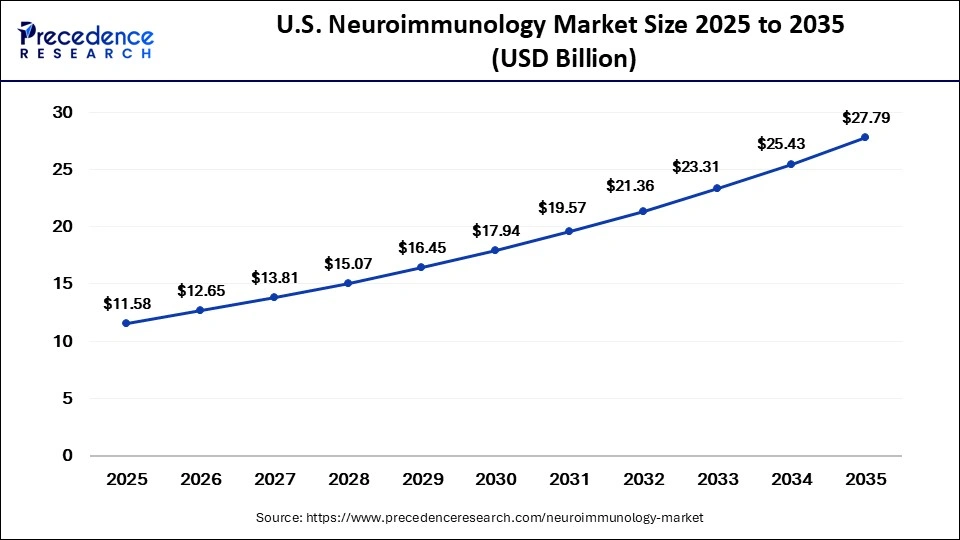
The U.S. neuroimmunology market size was evaluated at USD 12.65 billion in 2026 and is projected to reach around USD 27.79 billion by 2035, growing at a CAGR of 7.85% from 2026 to 2035.
U.S. Market Analysis
The U.S. market is driven by the increasing prevalence of autoimmune neurological disorders, increased R&D investments, and regulatory approvals for targeted therapies, for instance, monoclonal antibodies and biologics. Favorable government initiatives, strong healthcare reimbursement frameworks, and continuous clinical trials sponsored by major biopharma firms ensure a robust drug pipeline.
How is Europe Growing in the Neuroimmunology Market?
Europe held the second-largest market share of 30% in 2026 and is expected to grow at a notable CAGR of 7.5% during the projection period, driven primarily by strong public healthcare systems supporting neuroimmune treatments and increasing focus on precision neurology and biologics. Progress in biologicals and small-molecule drug discovery, coupled with the expanded usage of biologics and targeted therapies, has revolutionized patient care pathways.
UK Market Analysis
The UK market is mainly driven by an aging population, the rising prevalence of autoimmune and neurological conditions, and heavy investments in neurological drug and biomarker research. A robust healthcare infrastructure and strategic government backing have further accelerated expansion in this specialized medical sector.
Will Asia-Pacific Grow in the Neuroimmunology Market?
Asia-Pacific held a 22% share of the market in 2026 and is expected to grow at the fastest CAGR of 13.5% during the projection period, driven by the rapidly expanding healthcare infrastructure in China and India, increasing awareness, and diagnosis of neuroimmune disorders. Increased patient knowledge regarding neurological health and the push for early disease detection have directly led to higher diagnostic testing rates along with clinical trial activities across the region.
China Market Analysis
China's market is mainly driven by supportive government reforms for innovative drugs, enhanced early diagnostic capabilities, and greater inclusion of rare, autoimmune conditions, like multiple sclerosis, in national medical reimbursement lists. Massive increases in venture capital and even domestic research have led to breakthroughs in biological and small-molecule drug discoveries. Moreover, next-generation sequencing and genomic studies are driving personalized medicine, enabling therapies to target specific gene mutations linked with complex neurological conditions.
What Drives the Neuroimmunology Market in Latin America?
Latin America held a 6% share of the market in 2026 and is expected to grow at a CAGR of 6.5% in the upcoming period. This is mainly due to the rising prevalence of neurological and autoimmune disorders such as multiple sclerosis, myocarditis, and encephalitis, along with improving disease awareness among healthcare professionals. Strengthening diagnostic capabilities, expanding healthcare infrastructure, and increasing access to advanced immunotherapies and neurology treatments are further supporting regional growth.
Brazil Market Trends
Brazil is emerging as a major contributor to the Latin American neuroimmunology market due to its large patient base and rapidly expanding healthcare system. The country is witnessing growth in specialized neurology and immunology centers, supported by rising expertise in autoimmune neurological diseases and broader access to advanced treatments. In addition, public health initiatives and increasing investment in biologic therapies are accelerating the adoption of modern neuroimmunology care.
How is the Opportunistic Rise of the Middle East & Africa in the Neuroimmunology Market?
The Middle East & Africa held a 3% share of the market in 2026 and is expected to grow at a significant CAGR of 8.2% in the upcoming years, driven by the increasing incidence of autoimmune and neurological disorders, improvements in healthcare infrastructure, and rising investments in advanced diagnostic and treatment solutions. Expansion of neurology departments, greater availability of biomarker testing and MRI diagnostics, and increasing awareness of conditions such as multiple sclerosis are further contributing to market development.
Saudi Arabia Market Trends
Saudi Arabia is witnessing strong growth due to rising neurological disease prevalence and ongoing healthcare modernization initiatives. The country is investing in advanced diagnostic technologies, specialized neurology hospitals, and immunology research centers to strengthen disease detection and treatment capabilities. Furthermore, increasing adoption of biologic drugs and targeted immunomodulatory therapies within both public and private healthcare systems is supporting continued market expansion.
Market Competitive Landscape: Leading Companies and Strategies
The neuroimmunology market is highly competitive and innovation-driven, with leading pharmaceutical and biotechnology companies such as Sanofi, Roche, Novartis, Biogen, and Johnson & Johnson actively advancing research through collaborations, R&D investments, and development of next-generation biologics. These companies are focusing on innovative therapeutic modalities, particularly bispecific antibodies and advanced biologic platforms, to address complex autoimmune and inflammatory neurological conditions.
- For instance, Sanofi's collaboration with Earendil Labs ahead of JP Morgan 2026 reflects its strategic emphasis on developing bispecific antibodies for autoimmune and inflammatory diseases, highlighting the industry's shift toward highly targeted immunotherapies.
Technological innovation is reshaping competitive dynamics in the market, with artificial intelligence playing a key role in accelerating drug discovery, single-cell and gene profiling, next-generation biologics development, and precision medicine approaches. The increasing adoption of AI-driven platforms is improving disease understanding, enabling more personalized treatment strategies, and enhancing clinical outcomes in autoimmune neurological and central nervous system inflammatory disorders. As a result, companies that effectively integrate biologic innovation with AI-enabled research capabilities are expected to gain a significant competitive advantage in the evolving neuroimmunology landscape.
Neuroimmunology Market Leading Companies
- Biogen Inc
- F. Hoffmann-La Roche Ltd
- Novartis AG
- Sanofi S.A.
- Bristol Myers Squibb
- Merck KGaA
- Alexion Pharmaceuticals
- AbbVie Inc.
- UCB Pharma
- Eli Lilly and Company
- Teva Pharmaceutical Industries Ltd.
- Mitsubishi Tanabe Pharma Corporation
- Takeda Pharmaceutical Company Limited
- AstraZeneca PLC
- Johnson & Johnson
Recent Developments
- In February 2026, researchers from WashU Medicine and Weizmann Institute of Science engineered CAR-T cells to target amyloid beta plaques in the brain, offering a promising approach to treating the condition. The study showed positive results in mice, reducing harmful amyloid plaques and improving the overall brain tissue health. (Source: https://medicine.washu.edu/)
- In October 2025, Nilo Therapeutics announced the completion of its Series A funding round worth $101 million to support the establishment of Nilo's research labs in New York City, expand its interdisciplinary R&D team, and accelerate the development of its preclinical programs. (Source: https://pulse2.com)
Segments Covered in the Report
By Disease Type
- Multiple Sclerosis
- Neuromyelitis Optica Spectrum Disorder (NMOSD)
- Myasthenia Gravis
- Autoimmune Encephalitis
- Guillain-Barré Syndrome (GBS)
- Chronic Inflammatory Demyelinating Polyneuropathy
- Neuroinflammatory Disorders
- Other Neuroimmune Disorders
By Treatment Type
- Immunomodulators
- Immunosuppressants
- Monoclonal Antibodies
- Corticosteroids
- Intravenous Immunoglobulin (IVIG)
- Plasma Exchange (PLEX)
- Cell-based Therapies
- Other Biologic Therapies
By Mechanism of Action
- B-cell Targeting Therapies
- T-cell Modulation
- Complement Inhibition
- Cytokine Inhibition
- Neuroprotection
- Anti-inflammatory Therapy
By Route of Administration
- Oral
- Injectable
- Intravenous (IV)
- Subcutaneous
By End-user
- Hospitals
- Specialty Neurology Clinics
- Research & Academic Institutes
- Homecare Settings
- Rehabilitation Centers
By Region
- North America
- Latin America
- Europe
- Asia-Pacific
- Middle East and Africa
For inquiries regarding discounts, bulk purchases, or customization requests, please contact us at sales@precedenceresearch.com
Frequently Asked Questions
Tags





Ask For Sample
No cookie-cutter, only authentic analysis – take the 1st step to become a Precedence Research client
 Get a Sample
.webp)



 sales@precedenceresearch.com
 Schedule a Meeting
