



Neurorehabilitation Devices Market Size, Companies, Share, Patient Volume, Treatment Adoption Rates, Pricing Analysis, Regulatory Landscape, Competitive Positioning, and Demand Forecast
Neurorehabilitation Devices Market (By Product: Neurorobotic Systems, Brain Computer Interface, Wearable Devices, Brain Stimulators; By Application: Stroke, Parkinson's Disease, Brain and Spinal Cord Injury, Cerebral Palsy, Multiple Sclerosis; By End-User: Rehabilitation Centers, Hospitals and Clinics, Home Care) - Global Industry Analysis, Size, Trends, Leading Companies, Regional Outlook, and Forecast 2026 to 2035
Source: https://www.precedenceresearch.com/neurorehabilitation-devices-market
 Get a Sample
 Table Of Content


What is the Neurorehabilitation Devices Market Size in 2026?
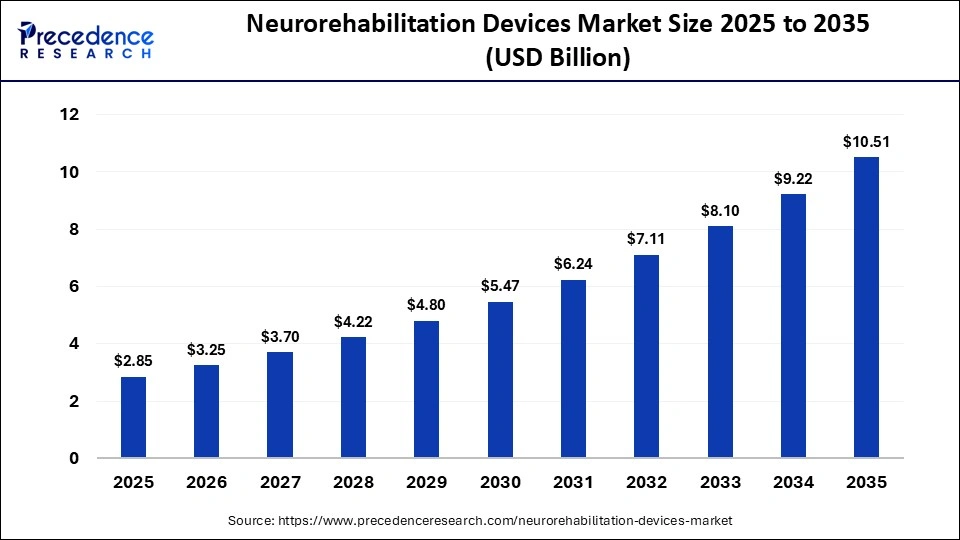
The global neurorehabilitation devices market size was calculated at USD 2.85 billion in 2025 and is predicted to increase from USD 3.25 billion in 2026 to approximately USD 10.51 billion by 2035, expanding at a CAGR of 13.94% from 2026 to 2035. The market is expanding continuously because of the increased cases of stroke, traumatic brain injuries, spinal cord injuries, and neurodegenerative disorders. The growing awareness of early rehabilitation is driving the adoption of neurorehabilitation devices in hospitals and home care environments due to the growth of technology in robotics and digital health.
Key Takeaways
- North America dominated the global neurorehabilitation devices market in 2025.
- Asia-Pacific is expected to grow at the fastest CAGR in the market during the forecast period.
- By product, the neurorobotic systems segment held a dominant position in the market in 2025.
- By product, the wearable devices segment is expected to grow at the fastest CAGR in the market between 2026 and 2035.
- By application, the stroke segment led the global market in 2025.
- By application, the Parkinson's disease segment is expected to grow with the highest CAGR in the market during the studied years
- By end-user, the hospital and clinics segment dominated the global market in 2025.
- By end-user, the rehabilitation centers segment is expected to expand rapidly in the market in the coming years.
Neurorehabilitation Devices: Rehabilitate and Recover with New Neurotechnology
The neurorehabilitation devices market is experiencing strong growth due to rising cases of neurological disorders and the aging population worldwide. Hospitals and rehabilitation centers are investing in state-of-the-art robotic therapy machines and stimulating devices to improve patient outcomes. Demand for minimally invasive and non-invasive rehabilitation solutions is increasing in both developed and emerging economies. Moreover, the market is expanding through reimbursement support and an increased focus on long-term functional recovery.
Impact of AI on Neurorehabilitation Devices
The market is being transformed by artificial intelligence (AI) through real-time motion tracking, adaptive therapy, and predictive recovery modelling. The AI-based equipment can adjust the treatment level based on the patient's progress and neurological response. Machine learning (ML) improves motor recovery through the analysis of gait patterns and neuromuscular signals. AI and ML analyze patient performance and improvement and suggest appropriate treatment patterns accordingly. The combination of AI and robotics with wearable sensors is enhancing the accuracy of therapy and engagement between patients.
Neurorehabilitation Devices Market Trends
- Emergence of Wearables and Home-based Gadgets: Remote therapy and continuous monitoring are made possible by portable neurostimulators and sensor-based rehabilitation equipment. Home rehabilitation solutions are highly preferred by patients as they minimize hospital visits and enhance adherence.
- Neurorobotics and Exoskeletons: The powered exoskeletons and robot-aided gait training are increasing mobility restoration. The devices enhance repetitive motion therapy protocol and speed up the process of regaining motor functions.
- AI and Individualized Technology: Individualized rehabilitation models optimize treatment processes. Evidence-based changes in therapy improve clinical outcomes. Tele-rehabilitation services are being made available by cloud-based systems and remote monitoring systems. Rural and underserved areas are getting access to virtual therapy sessions.
Market Scope
| Report Coverage | Details |
| Market Size in 2025 | USD 2.85 Billion |
| Market Size in 2026 | USD 3.25 Billion |
| Market Size by 2035 | USD 10.51 Billion |
| Market Growth Rate from 2026 to 2035 | CAGR of 13.94% |
| Dominating Region | North America |
| Fastest Growing Region | Asia Pacific |
| Base Year | 2025 |
| Forecast Period | 2026 to 2035 |
| Segments Covered | Product, Application, End-User, and Region |
| Regions Covered | North America, Europe, Asia-Pacific, Latin America, and Middle East & Africa |
Segmental Insights
Product Insights
Which Product Segment Dominated the Neurorehabilitation Devices Market?
The neurorobotic systems segment dominated the market in 2025 because they can provide high-intensity, repetitive, and precision-based therapy. These systems enhance the recovery of the motor by using robotic-assisted gait training and upper-limb rehabilitation. Neurorobotics is more popular in hospitals as it allows them to improve the consistency of therapy and decrease the workload of the therapist. High-end products, such as motion sensors and adaptive feedback, enhance patient care. Additional clinical validation and increased adoption in developed healthcare systems further give them a top position.
The wearable devices segment is expected to be the fastest-growing segment in the forecast period because they are portable and convenient. Wearable devices enable therapy and monitoring to occur continuously outside hospitals with these devices. Wearable devices and sensor rehabilitation tools are the preferred choices of patients at home. Battery life, comfort, and connectivity have been enhanced by technological development. The increase in the need to use remote and customizable therapy options is driving the growth of this segment.
Application Insights
Why Did the Stroke Segment Dominate the Neurorehabilitation Devices Market?
The stroke segment held a dominant revenue share of the market in 2025 because of the rising prevalence of stroke and the need for prolonged recovery. This may take a long time to restore a patient to functional independence through motor and cognitive therapy. Neuro-rehabilitation equipment is used to re-establish mobility, balance, and muscle coordination. Robotics and stimulation technology lead to better recovery processes at the early intervention stage. The awareness of post-stroke rehabilitation also fosters the segment's growth.
The Parkinson's disease segment is expected to witness the fastest growth in the market over the forecast period, because the number of elderly people is on the rise. Patients need constant therapy to control tremors, rigidity, and gait disturbances. Competent neurostimulation and wearable mobility devices help in managing the symptoms. Increasing evidence on neuromodulation technologies enhances treatment opportunities. The segmental growth is driven by higher diagnosis rates and high therapy needs.
End-User Insights
Which End-User Segment Led the Neurorehabilitation Devices Market?
The hospitals and clinics segment led the market in 2025 because of the availability of innovative robotic systems and skilled professionals. Hospitals and clinics are the main acute neurological and early rehabilitation centers. The increasing number of patient admissions and favorable infrastructure boost the segment's growth. Powerful reimbursement models in developed countries give preference to hospital-based methods. Their dominance is also enhanced in terms of the incorporation of multidisciplinary care models.
The rehabilitation centers segment is expected to expand rapidly in the market in the coming years, since there is a demand of specialize long-term therapy. Rehabilitation centers focus only on recovery and functional improvement. They are adopting robotic and wearable technologies increasingly to improve patient outcomes. Affordable bundled treatment plans appeal to many more patients. Their development is driven by the increasing demand for outpatient and specialized rehab centers.
Regional Insights
North America Neurorehabilitation Devices Market Size and Growth 2026 to 2035
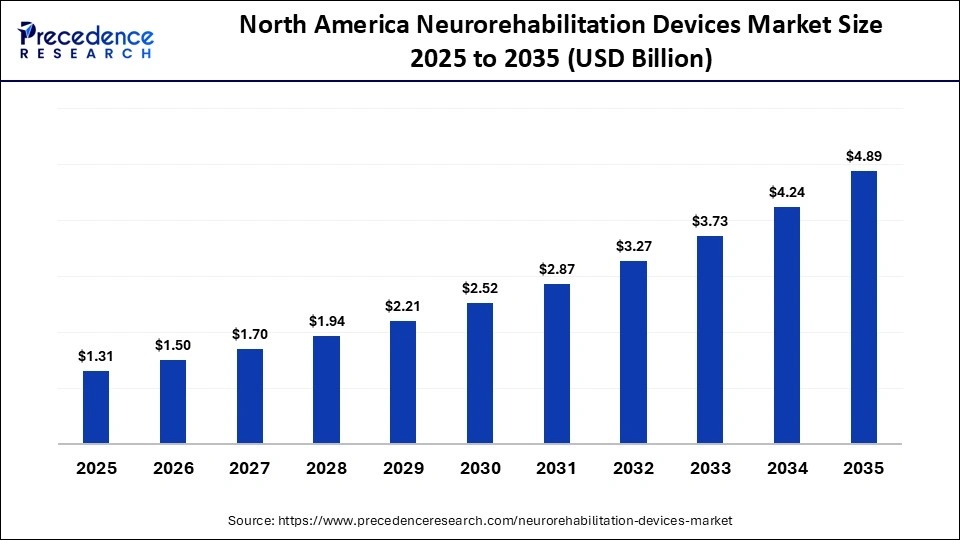
The North America neurorehabilitation devices market size is estimated at USD 1.31 billion in 2025 and is projected to reach approximately USD 4.89 billion by 2035, with a 10.97% CAGR from 2026 to 2035.
Why North America Dominated the Neurorehabilitation Devices Market?
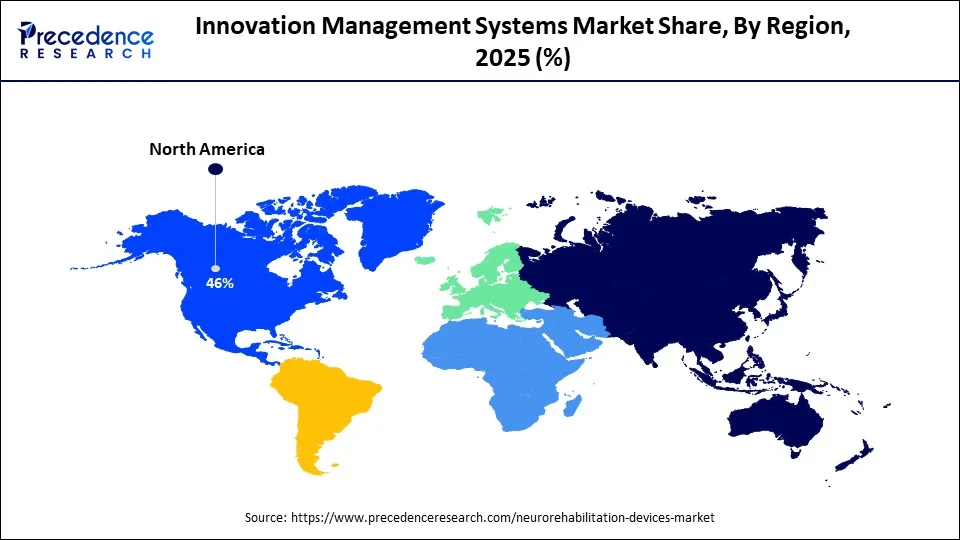
North America held a major revenue share of the market in 2025 because of a well-developed health care infrastructure and a high rate of technology uptake. There is a high prevalence of neurological disorders and rehabilitation solutions. The area enjoys a high spending on healthcare and reimbursement policies. The existence of main device manufacturers promotes innovation and timely product releases. Increased awareness of early intervention also increases adoption. Good research partnerships between academic institutions and players in the industry enhance technology.
U.S. Neurorehabilitation Devices Market Size and Growth 2026 to 2035
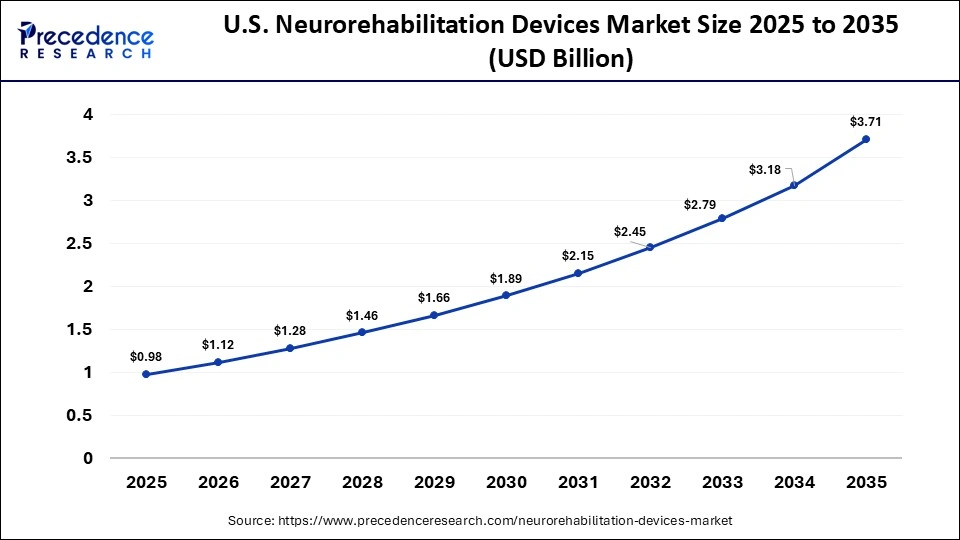
The U.S. neurorehabilitation devices market size is calculated at USD 0.98 billion in 2025 and is expected to reach nearly USD 3.71 billion in 2035, accelerating at a strong CAGR of 14.24% between 2026 and 2035.
U.S. Country-Level Analysis
The U.S. holds the largest regional share because of its well-established rehabilitation ecosystem. Long-term therapy is perpetuated by high stroke incidence and an ageing population. Canada also maintains consistent growth with the coverage of healthcare to the population and rehabilitation efforts. Innovation pipelines are reinforced in the case of government investment in neurological research. Advanced integration in clinical practice is common. All in all, good institutional backing maintains regional leadership.
According to the American Parkinson Disease Association, approximately 1 out of every 336 people is living with Parkinson's disease in the U.S. In Canada, about 153,000 people were suffering from Parkinson's disease, and this number is projected to rise by 69%, reaching 259,000 by 2050.
How is Asia-Pacific Growing in the Neurorehabilitation Devices Market?
Asia-Pacific is expected to host the fastest-growing market in the coming years because of advancements in healthcare facilities and the increasing awareness about neurorehabilitation. The rising prevalence of stroke and Parkinson's disease, along with the increasing adoption of advanced technologies, fosters market growth.
Government organizations are allocating funds to new rehabilitation centers and electronic medical systems. The increase in the size of the middle-class population is enhancing the availability of sophisticated treatment. Medical tourism also facilitates technology adoption in the specific countries. Hurried urbanization and technological infiltration are also factors that speed up growth.
Country-Level Analysis
China and India are the key drivers of growth at the country level because of their large patient populations. Japan is the leader in automation and elder care. South Korea is now growing in terms of superior rehabilitation technology. The trend of growing investments in hospitals is boosting the infrastructure in the region. The increase in insurance coverage increases the affordability of rehabilitative therapies. All these culminate to make Asia-Pacific a high-growth market.
Will Europe Grow in the Neurorehabilitation Devices Market?
Europe is expected to grow at a notable CAGR in the foreseeable future. The aging population in the area is rising, putting pressure on cases of neurological disorders. Health care services are supported by government-funded programs to access the latest rehabilitation technologies. The focus on a patient-centric recovery model increases the uptake of the device. The innovation in neurorobotics comes through collaborative research activities. Regulatory systems provide a high level of safety and effectiveness of the devices.
Country-Level Analysis
Germany is the leader in terms of manufacturing medical devices and robotic rehabilitation at the country level. The UK is experiencing a gradual development because of systematic rehabilitation programs. France and Italy are putting money into specialized neuro-recovery centers. Scandinavian countries focus on the integration of digital health and tele-rehabilitation. Neurological research financed by the public is a strength in the market. In general, Europe has a steady and innovative growth.
How is Latin America Growing in the Neurorehabilitation Devices Market?
Latin America is expected to grow at a notable CAGR in the foreseeable future, driven by improving rehabilitation infrastructure and increasing awareness of neurological recovery technologies in Latin America. More and more healthcare facilities are beginning to adopt robotic physiotherapy systems and wearables to rehabilitate stroke patients and to help with mobility problems after a stroke. There is a growing demand for more affordable home-based rehabilitation devices as access to the required treatments improves in urban hospitals throughout the region.
Brazil Market Trends
As Brazil is expanding its rehabilitation system and making more investments in advanced neurological treatment services, the country has a leadership role in the market. More hospitals and rehabilitation facilities are purchasing robotic physiotherapy systems and wearables to improve outcomes for patients with stroke recovery and spinal cord injury. Increased awareness of healthcare, demand for more customized rehabilitation treatments, and increased use of advanced technology will help stimulate continued interest in such devices and will propel their adoption.
What are the Factors Driving the Neurorehabilitation Devices Market in the Middle East and Africa?
The Middle East and Africa region is considered to be a significantly growing area, due to growing healthcare environments, an increasing number of people suffering from neurological disorders, and awareness of rehabilitation therapies. Across the region, hospitals and rehabilitation centers are beginning to use robotic physiotherapy systems, wearable rehabilitation devices, and AI-assisted therapies to enhance the patient's ability to recover. Governments are investing in healthcare modernization and increasing access to neurological rehabilitation services in response to an increasing workload of stroke and spinal cord injuries.
Saudi Arabia Market Trends
Saudi Arabia is the leading country in the Middle East and Africa as a result of an increasing commitment to expanding rehabilitation programs, as well as increased investment in healthcare technology through national healthcare transformation initiatives. To improve patient outcomes, hospitals and neurorehabilitation centers are using robotic gait training systems, digital physiotherapy devices, and AI-assisted rehabilitation products. As demand for advanced neurological treatment increases, more people will be aware of rehabilitation, and more partnerships with outside medical device manufacturers will exist, increasing the use of advanced rehabilitation technologies in the region.
Trade Analysis - Neurorehabilitation Devices Market
- According to Volza Global Export Data statistics, there have been 209 exports of nerve stimulation devices globally from April 2024 to March 2025.
- 6 verified exporters and 6 buyers participated in global nerve stimulation exports, which grew by 130% annually.
- India, Colombia, and Mexico were the top importing countries in the world.
- Chinese exporters held first place with 84 shipments, whereas the U.S. and Malaysian shipments amounted to 37 and 19 shipments, respectively.
- Growing needs in neurological treatments and rehabilitation equipment increased the number of exports globally.
(https://www.volza.com)
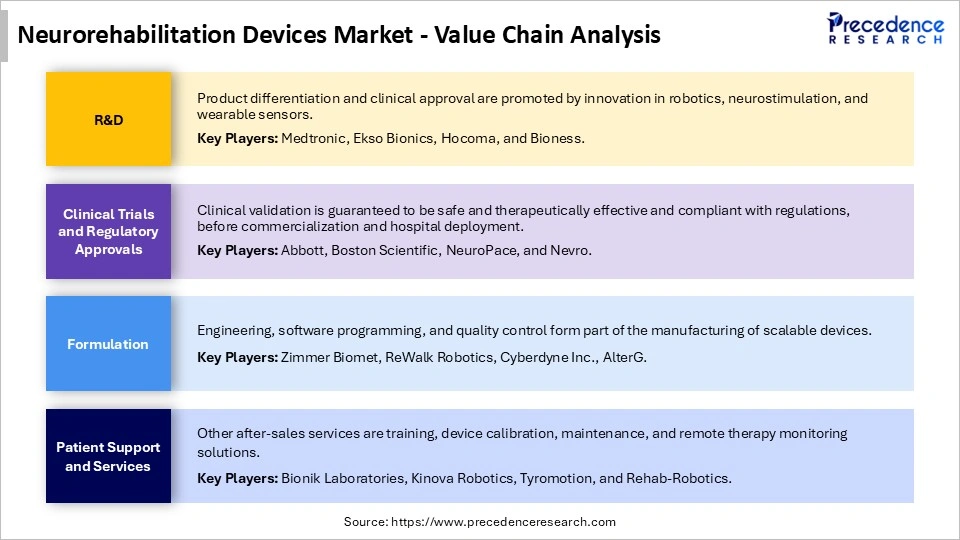
Neurorehabilitation Devices Market Value Chain Analysis
Neurorehabilitation Devices Market Companies
- Bionik Labs – Provides robotic rehabilitation systems for gait training, upper limb therapy, and mobility recovery after neurological injuries.
- Ectron Ltd. – Develops neurostimulation and rehabilitation devices supporting muscle recovery, mobility improvement, and neurological disorder treatment.
- REHABTRONICS INC. – Offers wearable neurorehabilitation devices and brain-computer interface solutions for stroke and spinal cord injury recovery.
- DIH International Limited (Hocoma AG) – Provides robotic gait training, balance assessment, and functional movement rehabilitation systems for neurological patients.
- Abbott Laboratories (St. Jude Medical Inc.) – Offers neuromodulation and neurostimulation devices for chronic pain management and neurological rehabilitation support.
Other Major Key Players
- MagVenture A/S
- Helius Medical Technologies
- Ekso Bionics
- Rehab-Robotics Company Limited
- Neurodan
- Rex Bionics
- Ottobock SE & Co. KGaA
- NeuroMetrix, Inc.
Recent Developments
- In April 2026, Epia Neuro launched a device for brain-computer interface technology that uses artificial intelligence to assist stroke victims in regaining their motor functions. The platform combines minimally-invasive, long-lifetime read/write BCI with assistive devices and AI-driven support. (Source: https://www.fiercebiotech.com)
- In January 2026, P. D. Hinduja Hospital launched an Neuro Rehabilitation Center featuring high-tech robotic rehabilitation devices such as LOKOMAT, AMADEO, DIEGO, and TYMO. (Source: https://medicaldialogues.in)
- In July 2025, Active Care Group launched Active Neuro to offer a transformative rehabilitation through technology-enhanced clinical pathways for adults within the UK with neurological conditions resulting from injury, illness, or disease. This provides patients with access to upper limb, lower limb, and movement and balance rehabilitation technology. (Source: https://nrtimes.co.uk)
- In March 2025, MedRhythms announced the launch of its MR-005, a neurorehabilitation system, to support gait rehabilitation and motor function in adults with Parkinson's disease. The system named Movive leverages well-researched power of rhythmic auditory stimulation (RAS) for people with Parkinson's disease. (Source: https://www.prnewswire.com)
- In February 2025, Neuvotion, Inc. announced that it received approval from the U.S. FDA for its first product, NeuroStim, a non-invasive, surgery-free wearable that electrically stimulates muscles dynamically and with high-precision. The device supports hand movement recovery after stroke or spinal cord injury, allowing clinicians to quickly scan and pinpoint stimulation targets through an innovative touch-screen interface. (Source: https://www.biospace.com)
Segments Covered in the Report
By Product
- Neurorobotic Systems
- Brain Computer Interface
- Wearable Devices
- Brain Stimulators
By Application
- Stroke
- Parkinson's Disease
- Brain and Spinal Cord Injury
- Cerebral Palsy
- Multiple Sclerosis
By End-User
- Rehabilitation Centers
- Hospitals and Clinics
- Home Care
By Region
- North America
- Europe
- Asia-Pacific
- Latin America
- Middle East & Africa
For inquiries regarding discounts, bulk purchases, or customization requests, please contact us at sales@precedenceresearch.com
Frequently Asked Questions





Ask For Sample
No cookie-cutter, only authentic analysis – take the 1st step to become a Precedence Research client
 Get a Sample




 sales@precedenceresearch.com
 Schedule a Meeting
