



WeRide begins international testing of end-to-end AV system
Published: 15 Jul 2026
Author: Laxminarayan



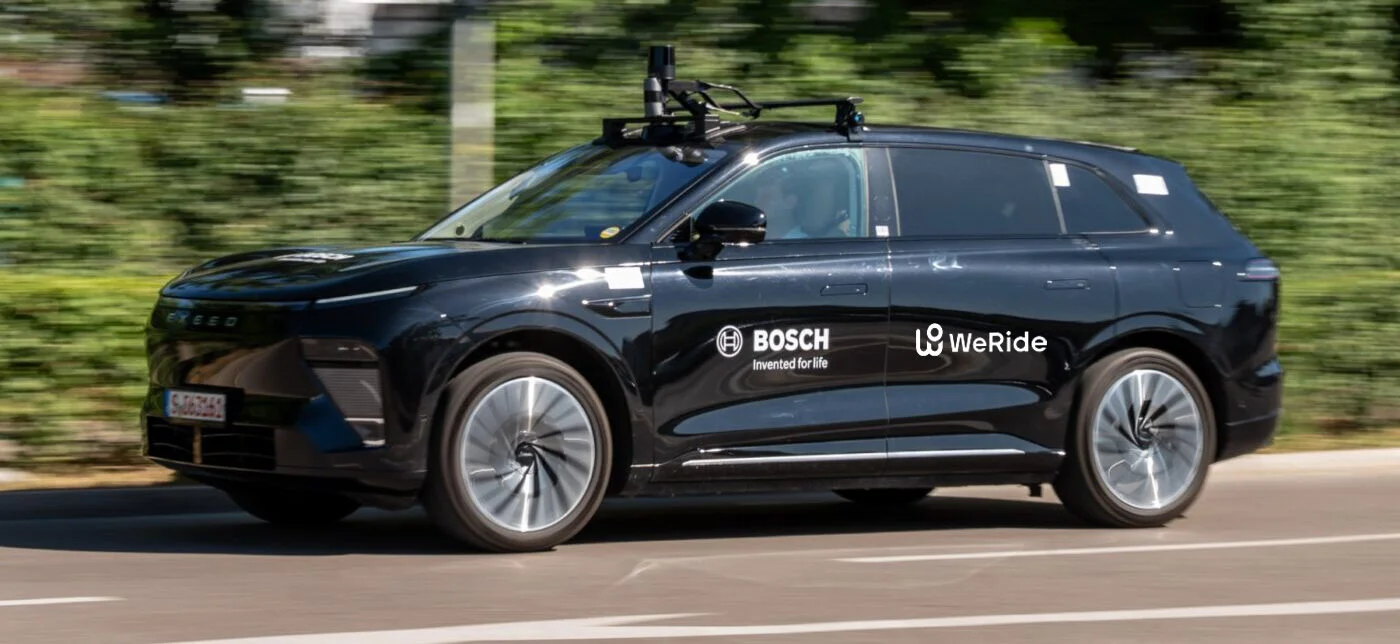
In July 2026, WeRide began on-road testing and localization validation of its one-stage end-to-end intelligent driving solution in Germany, France, Japan, and other international markets. The system is built on WeRide’s proprietary end-to-end driving algorithm and integrated with Bosch’s automotive-grade domain controller platform, combining the two companies’ respective software and hardware expertise.
The international testing program is designed to build out WeRide’s engineering and validation capabilities across diverse regulatory frameworks, road infrastructures, and driving environments. The company says its unified end-to-end AI architecture, which integrates perception, prediction, planning, and control within a single model, enables faster adaptation across varied conditions, from Germany’s unrestricted motorways and France’s dense roundabout networks to right-hand-drive markets in Japan and extreme climate conditions in the Middle East.
WeRide is also working with multiple automakers to incorporate regional driving behaviors and customer preferences into product development. The company has accumulated commercial traction in China, where Chery Exeed models equipped with WRD 3.0 have taken six consecutive victories at the China Intelligent Driving Challenge over the past six months. The system has secured design wins across more than 30 production vehicle programs with Chery and GAC Group.
Impact on the Automotive Market
Digital transformation has been driving advancements across the automotive market. Connected vehicles now feature real-time diagnostics, smartphone integration, and over-the-air (OTA) updates, while autonomous driving technologies leverage AI and advanced sensors for enhanced navigation. There is also a growing expectation for vehicles that are able to seamlessly integrate with our digital lifestyles. Features like real-time navigation, voice-activated controls, and advanced infotainment systems are no longer optional but have now become essential.
Integrating artificial intelligence (AI) in the automotive industry enables manufacturers and service providers to streamline operations and reduce costs. AI-driven systems significantly reduce human errors and traffic accidents. They can also analyze vehicle telemetry to detect early signs of component wear and potential failures. This helps in reducing unexpected breakdowns and also extends vehicle lifespan.
Impact of 5G in Automotive and Smart Transportation Market
The global 5G in automotive and smart transportation market size was calculated at USD 3.31 billion in 2025 and is predicted to reach around USD 35.95 billion by 2035, expanding at a healthy CAGR of 26.94% from 2025 to 2035.
According to Precedence Research, the market has witnessed to fuel with the requirement of increased connectivity, the development of autonomous car, and safety provisions. Artificial intelligence in the 5G automotive and smart transportation market involves integrating fifth-generation wireless technology into vehicle transportation systems to enhance communication and connectivity, supporting functions such as autonomous driving and smart transportation systems.
The application of artificial intelligence (AI) in automotive manufacturing companies, as well as machine learning (ML), is also rapidly changing the manufacturing process since it allows maintenance and process predictions. In transportation, it can be used to power self-driving cars that can exchange information with the environment in real time to reduce accidents and congestion.
Impact in the Automotive Artificial Intelligence (AI) Market
The global automotive artificial intelligence (AI) market size is estimated at USD 4.71 billion in 2025 and is predicted to increase from USD 5.80 billion in 2026 to approximately USD 58.99 billion by 2035, expanding at a CAGR of 28.76% from 2026 to 2035.
According to Precedence Research, market growth is due to the increase in R&D development in the automobile industry within the forecast period. Data science and machine learning technology help keep automobile organizations competitive by improving everything from research to design to manufacturing to marketing processes, and automobile data analytics is not limited to self-driving cars. For instance, it is equipped with cameras, multiple sensors, radars, and lidar, which help in path planning and a better understanding of the surroundings, and are the factors that positively affect the market.
Furthermore, for car manufacturers, the main goal of research and development on alternative fuels is to decrease reliance on fossil fuels by switching to the use of primary energy sources that are renewable, secure, adequately abundant, and more ecologically friendly. These factors significantly drive the global automotive artificial intelligence market during the forecast period.
About WeRide
WeRide is a leading global commercial-stage company that develops autonomous driving technologies from Level 2 to Level 4. Our autonomous vehicles have been deployed in over 40 cities across 12 countries. We are also the first and only technology company whose products have received autonomous driving permits in eight markets: China, the UAE, Singapore, France, Switzerland, Saudi Arabia, Belgium, and the US.
Established in 2017, WeRide has operated an autonomous vehicle fleet for more than 2,500 days, and is the world's first Robotaxi and autonomous driving company to be dual primary listed in both the US and Hong Kong.
WeRide develops safe and reliable driverless solutions to make mobility safer, more affordable, and accessible. Our product portfolio includes Robotaxi, Robobus, Robovan, Robosweeper, and an advanced driver-assistance system (ADAS), spanning smart mobility, smart logistics, and smart sanitation applications. We work with renowned global OEMs and Tier 1 companies, including Renault-Nissan-Mitsubishi Alliance, Uber, Grab, GAC Group, and Bosch.