



Next-Generation Sequencing Technologies Market Size, Companies, Share, Patient Volume, Treatment Adoption Rates, Pricing Analysis, Regulatory Landscape, Competitive Positioning, and Demand Forecast
Next-Generation Sequencing Technologies Market (By Technology: WGS, Whole Exome Sequencing, Targeted Sequencing & Resequencing, Others; By Application: Oncology, Clinical Investigation, Reproductive Health, HLA Typing/Immune System Monitoring, Metagenomics, Epidemiology & Drug Development, Agrigenomics & Forensics, Consumer Genomics; By Workflow: Pre-Sequencing, Sequencing, NGS Data Analysis; By End Use: Academic Research, Clinical Research, Hospitals & Clinics, Pharma & Biotech Companies, Other Users) - Global Industry Analysis, Size, Trends, Leading Companies, Regional Outlook, and Forecast 2026 to 2035
Source: https://www.precedenceresearch.com/next-generation-sequencing-technologies-market
 Get a Sample
 Table Of Content


What is Next-Generation Sequencing Technologies Market Size?
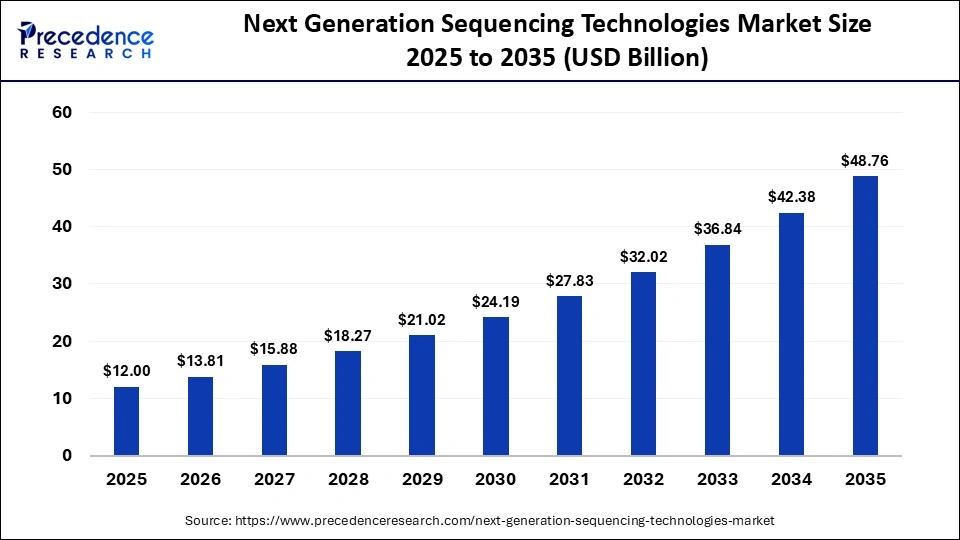
The global next-generation sequencing technologies market size was calculated at USD 12.00 billion in 2025 and is predicted to increase from USD 13.81 billion in 2026 to approximately USD 48.76 billion by 2035, expanding at a CAGR of 15.05% from 2026 to 2035. The growth of the market is driven by the increasing demand for advanced genomic research, rising applications of NGS in clinical diagnostics, and ongoing technological advancements in sequencing platforms.
Key Takeaways
- By region, North America dominated the market with the largest share in 2025.
- By region, Asia Pacific is expected to grow at the fastest CAGR during the forecast period.
- By technology type, the targeted sequencing & resequencing segment dominated the market with the largest share in 2025.
- By technology type, the whole genome sequencing (WGS) segment is expected to grow at a significant CAGR during the forecast period.
- By application, the oncology segment dominated the market with the largest share in 2025.
- By application, the consumer genomics segment is expected to grow at the fastest CAGR during the forecast period.
- By workflow, the sequencing segment dominated the market with the highest share in 2025.
- By workflow, the NGS data analysis segment is expected to grow at the fastest CAGR during the forecast period.
- By end use, the academic research segment dominated the market with the highest share in 2025.
- By end use, the clinical research segment is expected to grow at the fastest CAGR during the forecast period.
Market Overview
The next-generation sequencing technologies market comprises instruments and software services used to rapidly sequence DNA and RNA. Unlike traditional sequencing methods, next-generation sequencing enables simultaneous analysis of millions of genetic fragments, delivering comprehensive insights into mutations, gene expression, and complex biological pathways. This capability has transformed genomics research and clinical diagnostics by enabling faster, more accurate, and cost-effective genetic analysis. The market is growing due to the rising applications across oncology, rare and inherited disorders, infectious disease detection, reproductive health, agriculture, and increasing demand for precision medicine biomarker identification and personalized treatment strategies.
How is AI Influencing the Next-Generation Sequencing Technologies Market?
Artificial intelligence is significantly enhancing the value of next-generation sequencing technology by improving data interpretation speed and accuracy. AI-driven algorithms support advanced variants, mutation prioritization, genomic annotation, and biomarker discovery, reducing turnaround time and analytical errors. Machine learning models are increasingly used for predictive analytics, drug response modelling, and multi-omics data integration. Cloud computing and high-performance computing infrastructures are further enabling scalable genomic analysis. AI-enabled automation in sequencing workflows and clinical reporting is transforming next-generation sequencing technology into a powerful decision support platform for precision healthcare.
Next-Generation Sequencing Technologies Market Trends
- Expanding Role in Disease Diagnosis: Next-generation sequencing technology is transforming disease diagnosis by enabling rapid sequencing of entire genomes and large gene panels. Its high throughput capability helps detect mutations accurately, supporting early diagnosis, prognosis assessment, patient monitoring, and informed treatment decisions. The technology is becoming central to precision-driven healthcare strategies.
- Adoption of Precision Medicine: Next-generation sequencing technologies are rapidly integrating into oncology workflows through companion diagnostics linked to targeted therapies. Regulatory support and reimbursement expansion are strengthening its shift from research use to routine clinical practice. By analyzing large genomic data sets quickly and accurately, next-generation sequencing technology enables personalized treatment selection, ensuring the right therapy and dose for each patient.
- Treatment of Rare Diseases: With millions affected globally, rare diseases present major diagnostic challenges. Next-generation sequencing technology improves diagnostic accuracy by identifying complex mutation variations and multi-gene inheritance patterns. Faster and more affordable genomic analysis is reducing the diagnostic an enabling the development of targeted therapies for rare and inherited disorders.
- Sustainability & Efficiency Trends: Environmental responsibility is influencing platform development across the next-generation sequencing technology industry. Companies are designing energy-efficient sequencers, optimizing reagent usage, and introducing eco-friendly consumables to minimize laboratory waste.
- Startup Ecosystem: Emerging next-generation sequencing technology startups are driving cost reduction, automation, portability, and high-throughput sequencing solutions. Advances in hardware chemistry and bioinformatics are improving accuracy and scalability. Strategic collaborations with established sequencing companies and research institutions are accelerating commercialization and global market expansion.
Market Scope
| Report Coverage | Details |
| Market Size in 2025 | USD 12.00 Billion |
| Market Size in 2026 | USD 13.81 Billion |
| Market Size by 2035 | USD 48.76 Billion |
| Market Growth Rate from 2026 to 2035 | CAGR of 15.05% |
| Dominating Region | North America |
| Fastest Growing Region | Asia Pacific |
| Base Year | 2025 |
| Forecast Period | 2026 to 2035 |
| Segments Covered | Technology, Application, Workflow,End Use, and region |
| Regions Covered | North America, Europe, Asia-Pacific, Latin America, and Middle East & Africa |
Segment Analysis
Technology Insights
Which Technology Segment Dominates the Next-Generation Sequencing Technologies Market?
The targeted sequencing & resequencing segment dominated the market with the highest share in 2025. This is mainly due to its ability to focus on specific genes and regions of interest, enabling researchers to optimize time, resources, and analytical efforts. Targeted next-generation sequencing approaches provide deeper coverage, improving the detection of rare mutations that may be missed by whole-genome or traditional Sanger sequencing methods. Additionally, its cost-effectiveness has strengthened adoption across both research and clinical applications.
The whole genome sequencing (WGS) segment is expected to grow rapidly during the forecast period. This is because of its ability to provide a complete view of an organism's genetic makeup. It enables detailed genome assembly and captures both coding and non-coding regions with high resolution. This broad genetic insight makes WGS highly valuable in oncology research, rare disease investigation, epidemiology studies, and advanced genotyping applications. Its ability to generate holistic genomic data is expected to drive its expanding demand.
Application Insights
Why Did the Oncology Segment Dominate the Next-Generation Sequencing Technologies Market?
The oncology segment dominated the market, accounting for the largest share in 2025. This is primarily due to the increased global burden of cancer and a strong emphasis on early detection and precision treatment. With millions of new cancer cases reported each year, the demand for advanced genomic tools continues to grow. Next-generation sequencing technology plays a critical role in oncology by identifying genetic mutations within tumors, supporting targeted therapy development and enabling liquid biopsies to monitor disease progression. It also helps detect rare and inherited cancer mutations, making personalized cancer treatment more accurate and effective.
The consumer genomics segment is projected to witness the fastest growth during the forecast period due to increasing public interest in personal health, ancestry, and lifestyle insights. Advances in affordable sequencing technologies and direct-to-consumer testing kits have made genomic information more accessible, enabling individuals to explore genetic predispositions, personalized nutrition, and fitness plans. Additionally, rising awareness of preventive healthcare and the expansion of digital platforms for genetic reporting are driving the adoption of consumer genomics applications worldwide.
Workflow Insights
Which Workflow Segment Dominated the Next-Generation Sequencing Technologies Market in 2025?
The sequencing segment holds a dominant position in the market by holding a major share in 2025. This is because sequencing represents the core and most critical steps in the next-generation sequencing process, directly influencing data accuracy and clinical relevance. The growing use of DNA sequencing in diagnostics, early disease detection, prognosis, and treatment customization has strengthened its importance. Modern sequencing systems offer high precision, efficient liquid handling, and automated functions such as tube and microplate management, which streamline laboratory operations. These advantages continue to position sequencing as the leading workflow segment in the market.
The NGS data analysis segment is expected to register the fastest CAGR throughout the forecast period. The growth of the segment is driven by the increasing volume and complexity of sequencing data generated across research and clinical applications. Advanced bioinformatics tools and computational workflows are essential for interpreting raw sequence data, identifying variants, and deriving meaningful insights for diagnostics, drug development, and personalized medicine. The rising demand for precision medicine, along with investments in AI and cloud-based analysis platforms, is further driving the adoption of robust NGS data analysis solutions.
End Use Insights
How Did the Academic Research Segment Dominate the Next-Generation Sequencing Technologies Market?
The academic research segment holds a dominant position in the market, driven by the widespread adoption of next-generation sequencing technologies across universities and research institutions. Next-generation sequencing has become a powerful tool in academic settings, enabling rapid and detailed analysis of genetic material for both basic and applied research. Increasing institutional funding, research grants, and scholarships, particularly for PhD programs focused on genomics, have further supported segment growth. In addition, universities are offering bioinformatics training programs and hands on workshops on strengthening practical expertise, sequencing, and data analysis. This continues to reinforce the segment's dominance in this market.
The clinical research segment is projected to grow at the fastest rate over the forecast period, driven by the expanding role of next-generation sequencing (NGS) technologies in oncology research, including the identification of novel cancer-related genes, analysis of tumor heterogeneity, and detection of mutations associated with disease progression. Beyond oncology, NGS is increasingly applied in clinical research to support the development of innovative therapies, diagnostics, and preventive healthcare strategies, further fueling the growth of this segment.
Regional Insights
What Made North America the Dominant region in the Market?
North America dominated the next-generation sequencing technologies market in 2025, driven by its advanced healthcare infrastructure and strong presence of leading genomics companies such as Illumina and Thermo Fisher Scientific. The region benefits from substantial government and private funding for genomic research, along with favorable regulatory frameworks that encourage the integration of next-generation sequencing technologies into clinical diagnostics. The rising burden of chronic diseases, particularly cancer, and the growing demand for precision medicine have significantly accelerated the adoption of sequencing technologies. In addition, easy access to advanced genomic tools and continuous research advancements strengthen North America's dominant position in the market.
U.S. Market Analysis
The U.S. is the major contributor to the North American next-generation sequencing market, driven largely by increasing federal funding through institutions such as the National Institutes of Health (NIH), which has significantly expanded genomic research initiatives. Advances in sequencing technologies that reduce costs and improve accuracy have made NGS more accessible across research and clinical settings. The technology is widely applied in oncology for tumor profiling and personalized treatment selection, with growing use in pharmacogenomics, infectious disease research, and rare genetic disorder studies.
How is the Opportunistic Rise of Asia Pacific in the Next-Generation Sequencing Technologies Market?
Asia Pacific is projected to witness the fastest growth during the forecast period, driven by declining sequencing costs, increasing cancer prevalence, and expanding adoption of next-generation sequencing technologies in research and clinical practice. Emerging economies such as China, Japan, and India are rapidly integrating advanced sequencing technologies into their healthcare and research systems. Strong government investments in genomic infrastructure, growing public-private partnerships, and the emergence of domestic biotechnology firms are accelerating innovation and regional competition. Overall, the region's focus on precision oncology and large-scale genomic initiatives highlights its growth influence in the global next-generation sequencing technologies market.
China Market Analysis
China's next-generation sequencing technologies market is expanding rapidly, supported by continuous advancements in sequencing technologies and the growing demand for precision medicine. The country is increasingly integrating next-generation sequencing into clinical areas such as oncology, genetic disorders, and infectious disease management, particularly for early diagnosis and personalized treatment strategies. The rise of domestic genomic companies, including BGI Genomics, has strengthened global manufacturing capabilities and reduced dependence on imported technologies. Strategic collaboration, such as partnerships aimed at establishing advanced next-generation sequencing technology laboratories and integrating CT DNA and PCR-based diagnostics to further demonstrate China's commitment to improving cancer detection and expanding access to molecular testing.
India Market Analysis
India's next-generation sequencing technologies market is witnessing steady growth driven by supportive government initiatives and expanding research capabilities. Programs such as the Genome India project, which focuses on mapping genetic data from thousands of individuals, are significantly strengthening the country's genomic research foundation and supporting personalized medicine efforts. The sequencing costs are reducing, and technology improvements have made next-generation sequencing technology more accessible across both clinical and academic settings. The large-scale genomic Initiative led by research institutions, including national genome mapping programs are further enhancing India's position in the genomic landscape and contributing to market expansion.
What Drives the Next-Generation Sequencing Technologies Market in Europe?
The market in Europe is expected to grow at a considerable rate in the coming years, supported by strong governmental commitment to genomics and precision medicine. Well-established healthcare systems and a robust academic research environment are accelerating the clinical integration of advanced sequencing technologies. Several national screening and early diagnosis initiatives are further promoting the use of next-generation sequencing technologies in healthcare. Regulatory oversight from agencies such as the European medicine agency ensure the safe approval of innovative diagnostic tools, strengthening market confidence.
Germany Market Trends
The region is witnessing significant growth driven by increasing investments in genomics research, advancements in healthcare technologies, and supportive regulatory frameworks. The European Union's initiatives to promote genomic research and personalized medicine play a vital role in shaping the market landscape.
What are the Key Trends in the Next-Generation Sequencing Technologies Market in Latin America?
Latin America is expected to witness substantial growth in the market. This growth and development are driven by various factors such as increasing investments in healthcare infrastructure, rising awareness of genomics, and government initiatives promoting biotechnology. Countries like Brazil and Mexico are leading players, with substantial funding initiatives being made towards genomic research and applications in the healthcare domain.
Brazil Market Trends
The country is seen increasingly focusing on affordable sequencing technologies and applications in agriculture and healthcare. The region's potential is further enhanced by collaborations between governments and the private sector in order to boost research and development.
How is the Middle East and Africa Region Growing in the Next-Generation Sequencing Technologies Market?
The Middle East and Africa region is expected to have lucrative growth in the market, driven by increasing investments in healthcare and biotechnology, along with rising awareness of genomics applications. Countries like South Africa and the UAE are leading players in the region as they are increasingly focusing on enhancing their healthcare systems through advanced genomic technologies.
South Africa Market Trends
The country's market landscape is still in its developing stages, with a mix of local and international players entering the market. The region's potential is significant, as governments are increasingly recognizing the importance of genomics in addressing healthcare challenges.
Top Companies Operating in the Market
- Illumina
- BGI
- Eurofins GATC Biotech GmbH
- Perkin Elmer, Inc.
- DNASTAR, Inc.
- Genomatix GmbH
- PierianDx
- Oxford Nanopore Technologies
- Bio-Rad Laboratories, Inc.
- QIAGEN
- F. Hoffman-La Roche Ltd.
- Thermo Fisher Scientific, Inc.
Recent Developments
- In April 2025, Gene Solutions and Element Biosciences formed a strategic collaboration to advance global Sequencing technology by combining Element's sequencing platforms with Gene Solutions' genomic solutions, expanding access and resource performance.
- In June 2025, Avance Biosciences launches an NGS center of excellence in Houston to expand sequencing capabilities for biologics, cell, and gene therapy development using Illumina, Element, Oxford Nanopore, and PacBio platforms, strengthening service offerings across discovery and clinical stages.
- In October 2025, Integrated DNA Technologies partnered with Hamilton to automate customizable NGS workflows, enabling scalable, user-friendly profiling for cancer Research applications.
- In January 2026, Metropolis Healthcare launched its center of genomics in India, equipped with Illumina NovaSeq X systems to scale precision oncology and advanced genomic diagnosis.
- In February 2026, Volta Labs debuted with new PCR-free whole genome sequencing kits and expanded platform integrations at the AGBT 2026 meeting, signaling advancements in automated genomics workflows.
Segments Covered in the Report
By Technology
- WGS
- Whole Exome Sequencing
- Targeted Sequencing & Resequencing
- DNA-based
- RNA-based
- Others
By Application
- Oncology
- Diagnostics and Screening
- Oncology Screening
- Sporadic Cancer
- Inherited Cancer
- Companion Diagnostics
- Other Diagnostics
- Oncology Screening
- Research Studies
- Diagnostics and Screening
- Clinical Investigation
- Infectious Diseases
- Inherited Diseases
- Idiopathic Diseases
- Non-Communicable/Other Diseases
- Reproductive Health
- NIPT
- Aneuploidy
- Microdeletions
- PGT
- Newborn Genetic Screening
- Single Gene Analysis
- NIPT
- HLA Typing/Immune System Monitoring
- Metagenomics, Epidemiology & Drug Development
- Agrigenomics & Forensics
- Consumer Genomics
By Workflow
- Pre-Sequencing
- Nucleic Acid Extraction
- Library Preparation
- Sequencing
- NGS Data Analysis
- NGS Primary Data Analysis
- NGS Secondary Data Analysis
- NGS Tertiary Data Analysis
By End Use
- Academic Research
- Clinical Research
- Hospitals & Clinics
- Pharma & Biotech Companies
- Other Users
By Region
- North America
- Asia Pacific
- Europe
- Latin America
- Middle East & Africa
For inquiries regarding discounts, bulk purchases, or customization requests, please contact us at sales@precedenceresearch.com
Frequently Asked Questions





Ask For Sample
No cookie-cutter, only authentic analysis – take the 1st step to become a Precedence Research client
 Get a Sample
.webp)



 sales@precedenceresearch.com
 Schedule a Meeting
