


North America Medical Plastic Devices Market Size, Key Companies, Company Production Capacity, Healthcare Infrastructure Growth, Product Utilization, Regulatory Compliance, Company Expansion Strategies, Company Investment Strategies, and Market Outlook
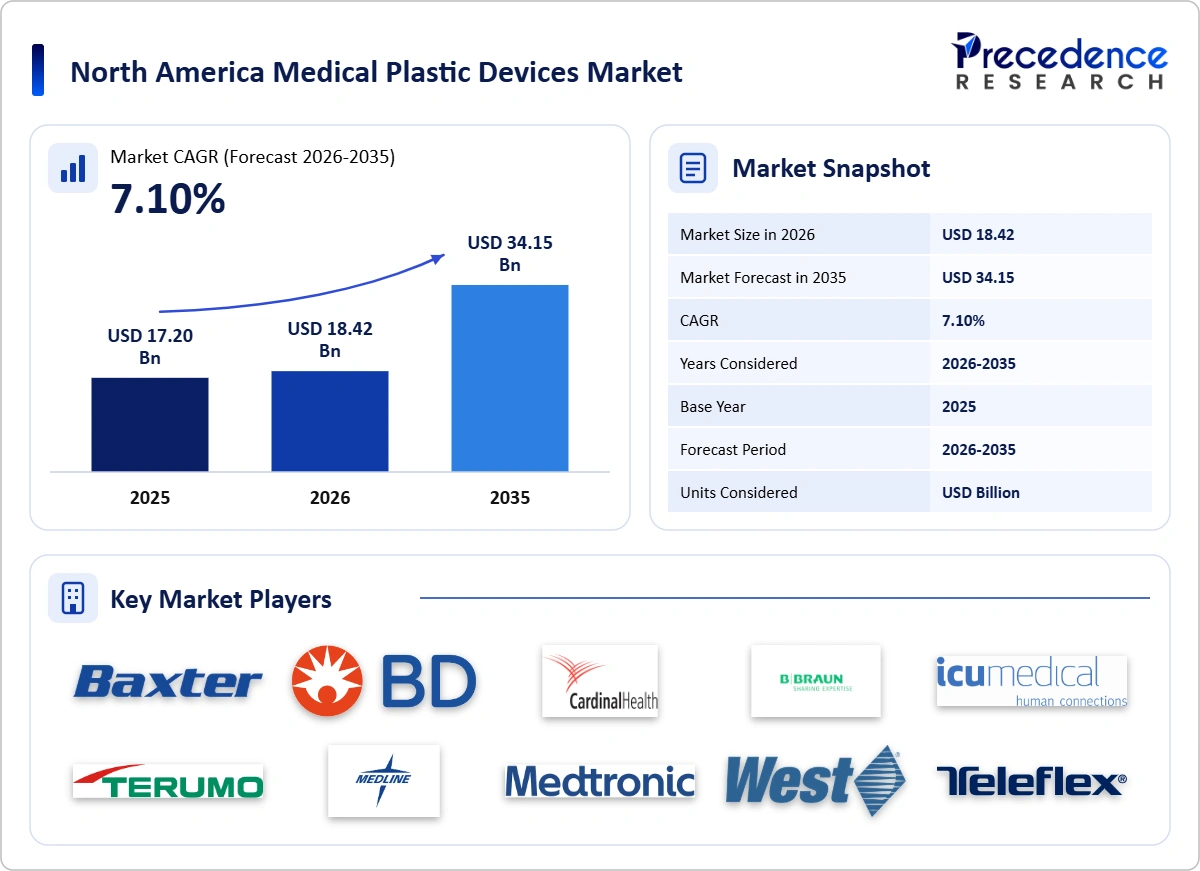
Payal Rabde, a Healthcare Industry Expert, highlights that the North America medical plastic devices market has reached USD 18.42 billion in 2026 and is on track to reach USD 34.15 billion by 2035, advancing at a CAGR of 7.10%. Key North America medical plastic devices market companies shaping the market include Becton, Dickinson and Company, Baxter International, while major growth segments span product, material, end user and region.
Source: https://www.precedenceresearch.com/north-america-medical-plastic-devices-market
 Get a Sample
 Table Of Content
Key Takeaways
Market Size & Growth Outlook
- Market size in 2025: USD 17.20 billion
- Estimated market size in 2026: USD 18.42 billion
- Projected market size by 2035: USD 34.15 billion
- CAGR (2026-2035): 7.10%
Regional Market Spotlight
- U.S. dominates the market with an 83.00% market share in 2025.
- Mexico held 11.00% of the market in 2025 and is projected to be the fastest-growing country, at a CAGR of 8.49% from 2026 to 2035.
- Canada accounted for 6.00% of the market share in 2025.
Segmental Spotlight
- By product, Disposables & Single-Use Devices accounted for the largest share of 36.00% in 2025.
- By material, Polypropylene & Polyethylene segment captured 34.00% market share in 2025.
- By end user, the Hospitals segment contributed 52.00% of the market share in 2025.
North America Medical Plastic Devices Market Size and Forecast, 2025-2035 (USD Billion)
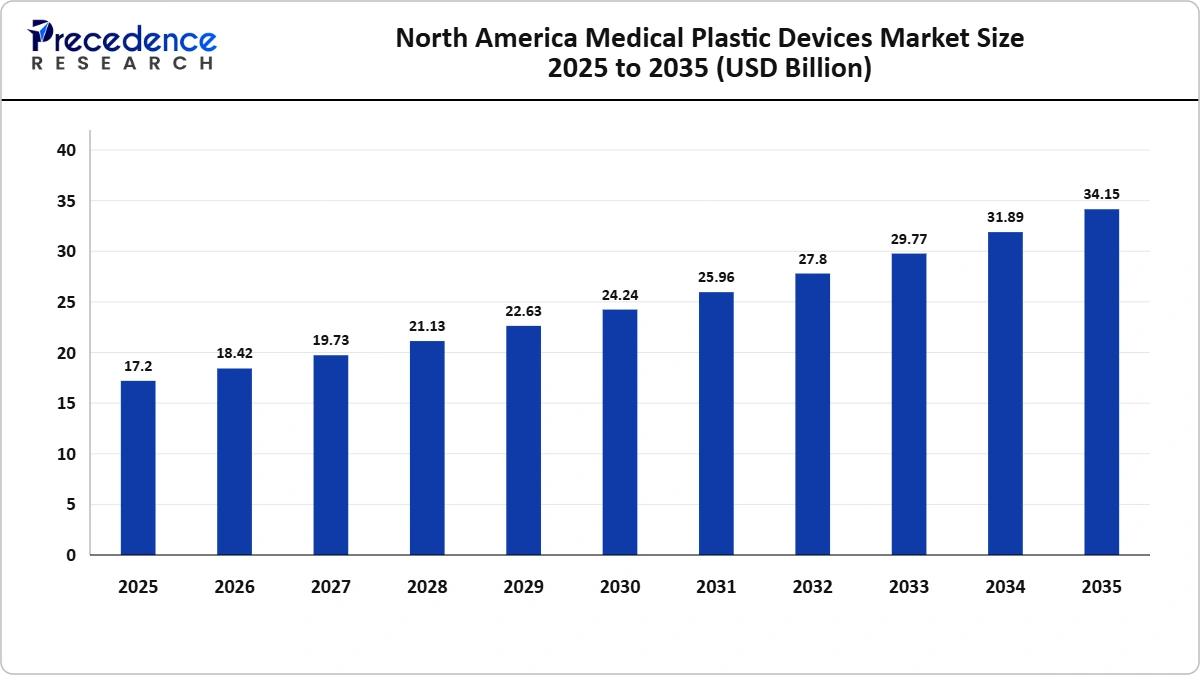
Note: 2025 is the base year; 2026-2035 values are forecasts.
Sources: Expert interviews, secondary sources, Precedence Research database, and Precedence Research analysts.
The North America medical plastic devices market is projected to grow from USD 17.20 billion in 2025 to USD 34.15 billion by 2035 because plastics make devices light, sterile, low-cost, and disposable, so most single-use and drug delivery devices in North America are plastic. Procedure growth, self-injection, infection control, home care, and nearshoring support steady growth, lifting the market to USD 24.24 billion by 2030 and sustaining a CAGR of 7.10% from 2026 to 2035. Plastic injection molding makes most housings, syringes, and connectors, while infusion pump sets and orthopedic device components also use medical-grade plastics.
Analyst View: The North America medical plastic devices market is driven by the growing adoption of lightweight, cost-effective, and disposable medical products. Demand is being supported by an increase in surgical operations, self-injection, the need for infection control, home healthcare, and nearshoring. Plastic injection molding is still a crucial production method, especially for infusion components, connectors, syringes, and device housings.
Market Trends
- The growing adoption of GLP-1 drugs is driving demand for autoinjectors and injection pens.
- Nearshoring of medical plastic molding operations to Mexico is gaining momentum.
- Manufacturers are increasingly adopting alternatives to PVC and DEHP to meet safety and regulatory requirements.
- High-performance polymers are gaining traction in the production of advanced medical implants.
- Demand for recyclable and lower-carbon resins is increasing as manufacturers focus on sustainability.
- Automation and cleanroom molding technologies are being adopted to improve production efficiency and product quality.
Drivers, Restraints, and Opportunities
Driver
Rising procedure volumes, driven by ageing populations and increasing healthcare needs, are driving demand for medical plastic devices. Also the market is expanding due to the increasing use of self-injection and the inclination for single-use items to enhance infection control. Regional manufacturing capability is being further strengthened by nearshoring.
Restraint
The market faces challenges from fluctuating resin prices, which can increase manufacturing costs and affect profit margins. Long regulatory approval procedures can also cause product launches to be delayed, and increased medical waste concerns and inspection of PVC and plasticizers make compliance even more difficult.
Opportunity
Growing demand for drug delivery devices, including autoinjectors, presents significant opportunities for manufacturers. Further growth potential is provided by the development of bio-based and recycled resins, as well as the growth of medical molding operations in Mexico. Additionally, new opportunities for market expansion are being created by the growing use of PEEK implants and home care devices.
Market Drivers - Impact & CAGR Contribution (2026-2035)
| Driver | Impact | ≈ CAGR Contribution | Time Horizon | Key Regions |
| Procedure volumes rise | High | +2.77 pp | Short to long term | North America-wide, strongest in U.S. |
| Ageing populations need more care | Medium | +2.34 pp | Medium to long term | North America-wide, fastest uptake in Mexico |
| Self-injection grows | Medium | +1.99 pp | Short to medium term | North America-wide |
| Infection control favors single-use | Low | +1.56 pp | Long term | U.S. and Mexico |
Note: Contributions are indicative estimates of each factor's effect on annual growth.
Sources: Expert interviews, secondary sources, Precedence Research database, and Precedence Research analysts.
Taken together, these drivers add about 8.66 percentage points to the annual growth of the North America medical plastic devices market, with procedure volumes rise having the largest effect. Their influence is strongest in the U.S., while uptake grows fastest in Mexico.
Market Restraints - Impact & Negative CAGR Contribution (2026-2035)
| Restraint | Impact | ≈ Negative CAGR Contribution | Time Horizon | Key Regions |
| Resin price swings | High | -0.70 pp | Short to medium term | North America-wide |
| Regulatory approval time | High | -0.52 pp | Medium term | Smaller and price-sensitive markets |
| Medical waste concerns | Medium | -0.34 pp | Short term | U.S. and other mature markets |
Note: Contributions are indicative estimates of each factor's effect on annual growth.
Sources: Expert interviews, secondary sources, Precedence Research database, and Precedence Research analysts.
These restraints are expected to reduce annual growth of the North America medical plastic devices market by about 1.56 percentage points, led by resin price swings. Their effect eases over the forecast period as suppliers, buyers, and regulators adapt, leaving a net CAGR of 7.10% from 2026 to 2035.
Market Segmentation: 2025 Share and Size
North America Medical Plastic Devices Market by Product 2025 Share
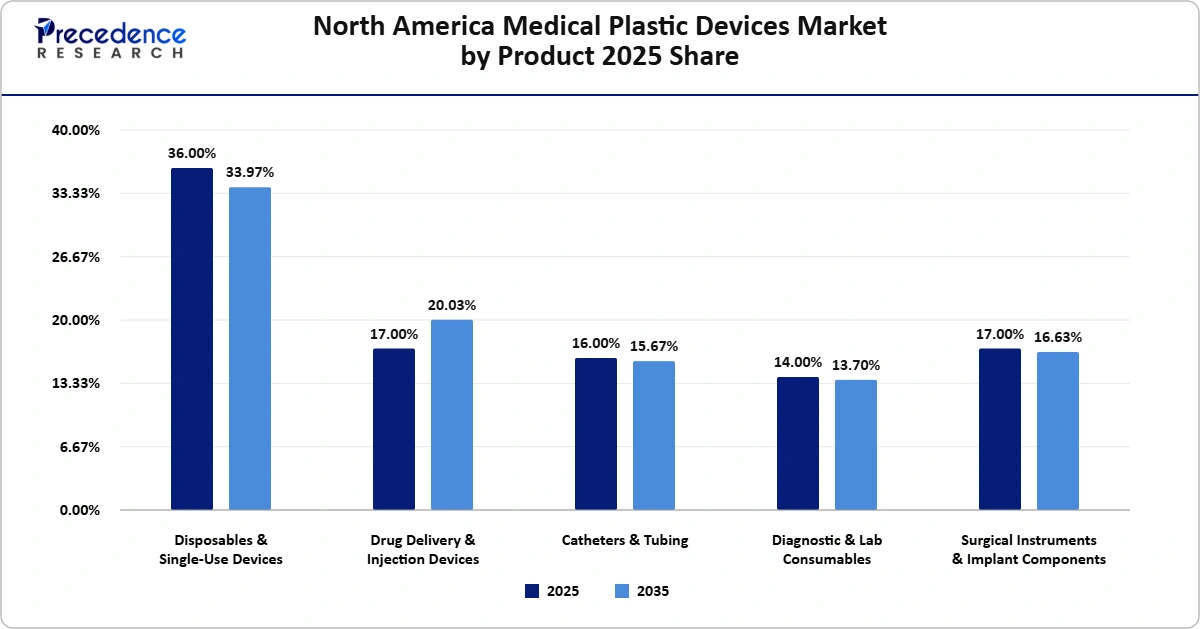
Note: 2025 is the base year; 2035 shares and CAGRs are forecasts.
Sources: Expert interviews, secondary sources, Precedence Research database, and Precedence Research analysts.
Disposables & Single-Use Devices accounted for 36.00% in 2025, Drug Delivery & Injection Devices for 17.00%, Catheters & Tubing for 16.00%, Diagnostic & Lab Consumables for 14.00%, and Surgical Instruments & Implant Components for 17.00%. Disposables & Single-Use Devices lead, while Drug Delivery & Injection Devices is growing fastest.
Disposables & Single-Use Devices: This segment dominates with 36.00% of the North America medical plastic devices market in 2025 and is projected to expand at a CAGR of 6.47% from 2026 to 2035. Disposables & single-use devices lead because syringes, IV sets, gloves, drapes, and kits are used once and bought in very high volumes. The disposables & single-use devices segment is expected to grow slower than the overall market over the forecast period.
Drug Delivery & Injection Devices: The segment captured 17.00% of the total market in 2025 and is anticipated to register a CAGR of 8.87% between 2026 and 2035. Drug delivery & injection devices grow fastest, with autoinjectors and pens for GLP-1 and biologic drugs. The drug delivery & injection devices segment is expected to grow faster than the overall market over the forecast period.
Catheters & Tubing: Representing 16.00% of the market in 2025, this segment is forecast to maintain steady growth at a CAGR of 6.87% over the forecast period. Catheters & tubing use PVC, polyurethane, and silicone for vascular, urinary, and respiratory care. The catheters & tubing segment is expected to expand broadly in line with the overall market during the forecast period.
Diagnostic & Lab Consumables: With a market contribution of 14.00% in 2025, the segment is expected to witness sustained expansion at a CAGR of 6.87% from 2026 to 2035. Diagnostic & lab consumables include tubes, cartridges, pipette tips, and plates. The diagnostic & lab consumables segment is projected to grow broadly in line with the overall market between 2026 and 2035.
Surgical Instruments & Implant Components: The segment held a substantial 17.00% share in 2025, with its growth projected at a CAGR of 6.87% during the forecast period. Surgical instruments & implant components use high-performance polymers such as PEEK. The surgical instruments & implant components segment is expected to grow broadly in line with the overall market over the forecast period.
Segment Outlook: Disposables & Single-Use Devices remain the largest product segment through 2035, holding about 33.97% of the market in 2035, while Drug Delivery & Injection Devices record the highest CAGR of 8.87% from 2026 to 2035. Diagnostic & Lab Consumables hold the smallest share and serve more specialized needs within the North America medical plastic devices market.
North America Medical Plastic Devices Market by Material 2025 Share
| Segments | 2025 Share | 2035 Share | CAGR 2026-2035 |
| Polypropylene & Polyethylene | 34.00% | 32.62% | 6.64% |
| PVC | 18.00% | 17.89% | 7.04% |
| Polycarbonate & Engineering Plastics | 20.00% | 19.88% | 7.04% |
| High-Performance Polymers | 12.00% | 13.70% | 8.54% |
| Others | 16.00% | 15.90% | 7.04% |
Note: 2025 is the base year; 2035 shares and CAGRs are forecasts.
Sources: Expert interviews, secondary sources, Precedence Research database, and Precedence Research analysts.
Polypropylene & Polyethylene captured 34.00% in 2025, PVC at 18.00%, Polycarbonate & Engineering Plastics at 20.00%, High-Performance Polymers at 12.00%, and Others at 16.00%. Polypropylene & Polyethylene lead, while High-Performance Polymers are growing fastest.
Polypropylene & Polyethylene: In 2025, the segment represented 34.00% of the overall market and is expected to achieve a CAGR of 6.64% over the 2026-2035 period. Polypropylene & polyethylene lead because they are low-cost, sterilizable, and easy to mold. The polypropylene & polyethylene segment is expected to grow slower than the overall market over the forecast period.
PVC: The segment's market share stood at 18.00% in 2025, while its growth trajectory is expected to reflect a CAGR of 7.04% during 2026-2035. PVC segment remains common in bags and tubing. The PVC segment is projected to expand broadly in line with the overall market over the forecast period.
Polycarbonate & Engineering Plastics: This segment accounted for 20.00% of the North American medical plastic devices market in 2025 and is projected to grow at a CAGR of 7.04% through 2035. Polycarbonate & engineering plastics serve housings and fluid connectors. The polycarbonate & engineering plastics segment is estimated to grow broadly in line with the overall market from 2026 to 2035.
High-Performance Polymers: Holding a 12.00% market share in 2025, this segment is expected to expand at a CAGR of 8.54% during the forecast period. High-performance polymers such as PEEK grow fastest for implants and reusable instruments. The high-performance polymers segment is expected to grow faster than the overall market over the forecast period.
Others: The segment captured 16.00% of the total market in 2025 and is anticipated to register a CAGR of 7.04% between 2026 and 2035. Others include silicone, polyurethane, COC, and bioresorbable polymers. The other segments are projected to grow broadly in line with the overall market during the forecast period.
Segment Outlook: Polypropylene & Polyethylene remain the largest material segment through 2035, holding about 32.62% of the market in 2035, while High-Performance Polymers record the highest CAGR of 8.54% from 2026 to 2035. Although High-Performance Polymers start from the smallest base, their faster growth shows how demand is shifting within the North America medical plastic devices market.
North America Medical Plastic Devices Market by End User 2025 Share
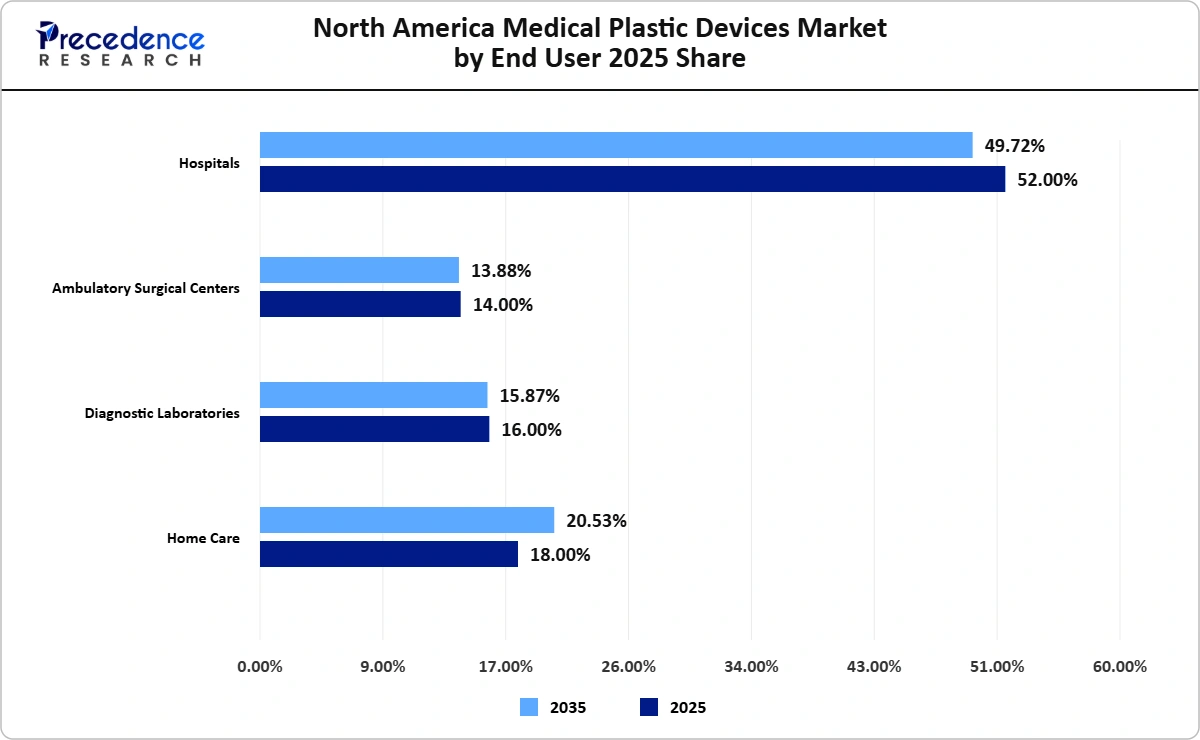
Note: 2025 is the base year; 2035 shares and CAGRs are forecasts.
Sources: Expert interviews, secondary sources, Precedence Research database, and Precedence Research analysts.
Hospitals contributed 52.00% in 2025, Ambulatory Surgical Centers at 14.00%, Diagnostic Laboratories at 16.00%, and Home Care at 18.00%. Hospitals lead, while Home Care is growing fastest.
Hospitals: Representing 52.00% of the market in 2025, this segment is forecast to maintain steady growth at a CAGR of 6.62% over the forecast period. Hospitals lead because they use the most disposables, catheters, and surgical devices. The hospitals segment is estimated to grow slower than the overall market between 2026 and 2035.
Ambulatory Surgical Centers: This segment accounted for 14.00% of the North America medical plastic devices market in 2025 and is projected to expand at a CAGR of 7.02% from 2026 to 2035. Ambulatory surgical centers grow as procedures move out of hospitals. The ambulatory surgical centers segment is expected to grow broadly in line with the overall market over the forecast period.
Diagnostic Laboratories: With a market contribution of 16.00% in 2025, the segment is expected to witness sustained expansion at a CAGR of 7.02% from 2026 to 2035. Diagnostic laboratories use plastic consumables at scale. The diagnostic laboratories segment is projected to expand broadly in line with the overall market over the forecast period.
Home Care: In 2025, the segment represented 18.00% of the market share and is expected to achieve a CAGR of 8.52% over the 2026-2035 period. Home care grows fastest with self-injection, infusion, and monitoring devices. The home care segment is estimated to grow faster than the overall market during the forecast period.
Segment Outlook: Hospitals remain the largest end user segment through 2035, holding about 49.72% of the market in 2035, while Home Care records the highest CAGR of 8.52% from 2026 to 2035. Ambulatory Surgical Centers hold the smallest share and serve more specialized needs within the North America medical plastic devices market.
Analyst View: The market is dominated by disposables & single-use devices, supported by high-volume hospital consumption and routine medical procedures. Polypropylene & polyethylene remain the leading materials due to their cost-effectiveness and ease of processing, while hospitals account for the largest end-user share. However, due to increased demand for self-injection, GLP-1 therapies, improved implants, and home-based therapy, growth is turning toward drug delivery devices, high-performance polymers, and home care applications.
Country Analysis
North America Medical Plastic Devices Market by Country 2025 Share
| Country | 2025 Share | 2035 Share | CAGR 2026-2035 |
| U.S. | 83.00% | 81.38% | 6.89% |
| Mexico | 11.00% | 12.50% | 8.49% |
| Canada | 6.00% | 6.12% | 7.29% |
Note: 2025 is the base year; 2035 shares and CAGRs are forecasts.
Sources: Expert interviews, secondary sources, Precedence Research database, and Precedence Research analysts.
U.S. accounted for 83.00% in 2025, Mexico for 11.00%, and Canada for 6.00%. U.S. leads, while Mexico is growing the fastest.
U.S.: This country accounted for 83.00% of the North America medical plastic devices market in 2025 and is expected to expand at a CAGR of 6.89% from 2026 to 2035. The U.S. leads because it has the largest healthcare spending, procedure volumes, and medical device manufacturing base, with molders in Minnesota, Massachusetts, California, and the Southeast. U.S. is projected to grow broadly in line with the overall market between 2026 and 2035.
Mexico: The country's market share stood at 11.00% in 2025, while its growth trajectory is expected to reflect a CAGR of 8.49% during 2026-2035. Mexico grows fastest as nearshoring brings device assembly and molding to Tijuana, Juárez, and other clusters. Mexico is expected to expand faster than the overall market over the forecast period.
Canada: Holding a 6.00% market share in 2025, this country is expected to expand at a CAGR of 7.29% during the forecast period. Canada is supported by public hospital demand and device manufacturers in Ontario and Quebec. Canada is projected to grow broadly in line with the overall market from 2026 to 2035.
Analyst View: The U.S. dominates the market, supported by strong healthcare spending, high procedure volumes, and an established medical device manufacturing base. Due to nearshoring and rising medical device manufacturing operations, Mexico is becoming the market with the quickest growth rate. Canada continues to grow steadily due to existing manufacturing clusters in Ontario and Quebec as well as the demand for public healthcare.
Competitive Landscape
Top 10 Players in the North America Medical Plastic Devices Market, 2025
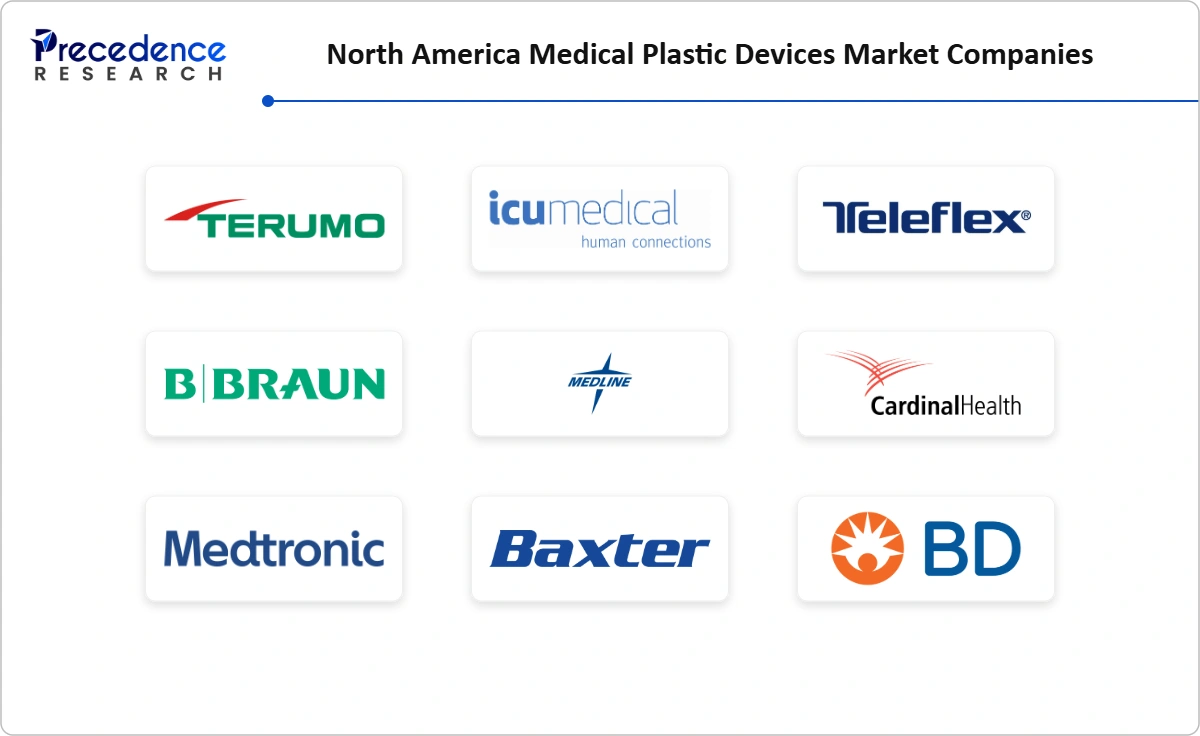
| Rank | Company Name | Key Products / Business | Headquarters |
| 1 | Becton, Dickinson and Company | Syringes, catheters, IV sets and specimen collection devices | United States |
| 2 | Baxter International | IV solutions, sets and infusion systems | United States |
| 3 | Medtronic | Catheters, tubing and device components | Ireland |
| 4 | Cardinal Health | Medical-surgical disposables | United States |
| 5 | Medline Industries | Medical-surgical disposables and kits | United States |
| 6 | B. Braun | Infusion sets, catheters and disposables | Germany |
| 7 | Teleflex | Vascular and urology catheters | United States |
| 8 | ICU Medical | Infusion consumables and connectors | United States |
| 9 | Terumo | Syringes, catheters and blood management disposables | Japan |
| 10 | West Pharmaceutical Services | Drug containment and delivery components | United States |
Note: Company shares are 2025 estimates.
Sources: Company press releases, expert interviews, secondary sources, Precedence Research database, and Precedence Research analysts.
Becton, Dickinson and Company led the North America medical plastic devices market, followed by Baxter International and Medtronic. Becton, Dickinson and Company leads with syringes, catheters, IV sets, and specimen collection devices; Baxter International competes with IV solutions, sets, and infusion systems, and Medtronic offers catheters, tubing, and device components. Cardinal Health, Medline Industries, B. Braun, Teleflex, ICU Medical, Terumo, and West Pharmaceutical Services compete through medical-surgical disposables and kits, infusion sets, catheters and disposables, vascular and urology catheters, infusion consumables and connectors, syringes, catheters and blood management disposables, and drug containment and delivery components.
The North America medical plastic devices market is fragmented, and competition centers on regulatory compliance, material biocompatibility, sterilization compatibility, molding precision, supply reliability, nearshoring, and price.
Company Snapshots
Becton, Dickinson and Company: This company is headquartered in the United States. Its offerings center on syringes, catheters, IV sets, and specimen collection devices. In the Precedence Research Companies Quadrant, it is positioned as a Leader.
Baxter International: Headquartered in the U.S., Baxter International focuses on IV solutions, infusion sets, and infusion systems. The company is classified as a Leader in the Precedence Research Companies Quadrant.
Medtronic: Headquartered in Ireland. Its offering centers on Catheters, tubing, and device components. It is positioned as a Leader in the Precedence Research Companies Quadrant.
Cardinal Health: Based in the U.S., Cardinal Health specializes in medical-surgical disposables. It is recognized as a Leader in the Precedence Research Companies Quadrant.
Medline Industries: Medline Industries is headquartered in the United States. Its offering centers on medical-surgical disposables and kits. In the Precedence Research Companies Quadrant, it is positioned as a Leader.
B. Braun is headquartered in Germany. Its offering centers on Infusion sets, catheters, and disposables. The company holds a Leader position in the Precedence Research Companies Quadrant.
Teleflex: Headquartered in the United States. Its offerings center on Vascular and urology catheters. The company is placed in the Innovators quadrant by Precedence Research.
ICU Medical, headquartered in the United States, specializes in infusion consumables and connectors, and is classified as an Innovator in the Precedence Research Companies Quadrant.
Terumo: This Japan-based company specializes in Syringes, catheters, and blood management disposables. In the Precedence Research Companies Quadrant, it is positioned as an Innovator.
West Pharmaceutical Services: This company is headquartered in the U.S. Its offering centers on Drug containment and delivery components. It secures an Innovator classification in Precedence Research's competitive positioning framework.
Companies Ecosystem
The North America medical plastic devices ecosystem links resin suppliers, contract molders & component makers, device makers, distributors, and users & regulators, with each stage adding value before products reach end users. Recycled plastic and bio-based resins are being tested for non-patient-contact device parts.
| Ecosystem Stage | Role in the Market | Key Companies |
| Resin Suppliers | Supply medical-grade polymers | LyondellBasell, SABIC, Covestro, Celanese, Victrex |
| Contract Molders & Component Makers | Mold and assemble parts | Contract manufacturers in the U.S. and Mexico |
| Device Makers | Design, assemble, and sterilize devices | BD, Baxter, Medtronic, Teleflex |
| Distributors | Supply hospitals and clinics | Cardinal Health, Medline, McKesson, Owens & Minor |
| Users & Regulators | Use and approve devices | Hospitals, ASCs, labs, FDA, Health Canada, COFEPRIS |
Sources: Company press releases, expert interviews, secondary sources, Precedence Research database, and Precedence Research analysts.
Resin Suppliers: Supply medical-grade polymers. Key participants include LyondellBasell, SABIC, Covestro, Celanese, and Victrex.
Contract Molders & Component Makers: Mold and assemble parts. Key participants include Contract manufacturers in the U.S. and Mexico.
Device Makers: Design, assemble, and sterilize devices. Key participants include BD, Baxter, Medtronic, and Teleflex.
Distributors: Supply hospitals and clinics. Key participants include Cardinal Health, Medline, McKesson, and Owens & Minor.
Users & Regulators: Use and approve devices. Key participants include Hospitals, ASCs, labs, FDA, Health Canada, and COFEPRIS.
Value in the North America medical plastic devices market flows from upstream material and technology suppliers to manufacturers and service providers, then through distribution partners to end users. Companies that integrate several stages or build long-term relationships with end users capture a larger share of this value.
Precedence Research Companies Quadrant
The Precedence Research Companies Quadrant positions key participants in the North America medical plastic devices market by market strength, reflecting revenue scale, market share and geographic reach, and by innovation and growth strategy, reflecting product portfolio breadth, R&D intensity and partnerships. Positions reflect each company's estimated 2025 share of the North America medical plastic devices market and our assessment of its product innovation, portfolio breadth and partnerships.
Sources: Company press releases, expert interviews, secondary sources, Precedence Research database, and Precedence Research analysts.
Leaders: Becton, Dickinson and Company, Baxter International, Medtronic, Cardinal Health, Medline Industries, and B. Braun combine high market share with broad portfolios and strong innovation.
Innovators: Teleflex, ICU Medical, Terumo, and West Pharmaceutical Services bring newer technologies and specialized products.
Recent Development
- October 2025: Ypsomed announced a USD 195.4 million investment in its first North American manufacturing facility in Holly Springs, North Carolina. The facility will expand local production capacity for self-injection devices, including autoinjectors and injection pens.
North America Medical Plastic Devices Market Segments
By Product
- Disposables & Single-Use Devices
- Drug Delivery & Injection Devices
- Catheters & Tubing
- Diagnostic & Lab Consumables
- Surgical Instruments & Implant Components
By Material
- Polypropylene & Polyethylene
- PVC
- Polycarbonate & Engineering Plastics
- High-Performance Polymers
- Others
By End User
- Hospitals
- Ambulatory Surgical Centers
- Diagnostic Laboratories
- Home Care
By Country
- U.S.
- Canada
- Mexico
Research Methodology: The North America medical plastic devices market was defined as medical devices and device components made mainly from medical-grade plastics in the U.S., Canada, and Mexico, including disposable and single-use devices, drug delivery and injection devices, catheters and tubing, diagnostic and laboratory consumables, surgical instruments and implant components, made from polypropylene, polyethylene, PVC, polycarbonate, high-performance polymers, and other plastics, and used by hospitals, ambulatory surgical centers, diagnostic laboratories, and home care users. The 2025 base year was built bottom-up from demand volumes and average prices by product, material, end user, and region, and checked top-down against the market-specific revenues of leading companies and published estimates. Segment, country and company values were allocated from product, material and end user and country demand. Key estimates were verified by cross-checking company disclosures, regulatory and industry data, and published third-party estimates, and inputs that could not be reconciled were excluded. All segment, regional, and company figures were reconciled to the same 2025 base year, and the 2026-2035 forecast, which applies a constant CAGR from the 2025 base, was recalculated and validated.
Analyst View: The North America medical plastic devices market is poised for steady growth, driven by rising surgical procedure volumes, increasing demand for single-use medical products, and the growing adoption of drug delivery and injection devices. The development of medical-grade polymers, the growing use of home healthcare, and the nearshoring of manufacturing activities to Mexico all contribute to market expansion. However, market expansion may be hampered by shifting resin costs, strict regulations, and growing worries about medical plastic waste.
Sources and References
- Plastics News. "Ypsomed to invest USD 195.4 million in first North American injection device plant in North Carolina". October 2025. (Source: plasticsnews.com)
For inquiries regarding discounts, bulk purchases, or customization requests, please contact us at sales@precedenceresearch.com
Frequently Asked Questions





Ask For Sample
No cookie-cutter, only authentic analysis – take the 1st step to become a Precedence Research client
 Get a Sample




 sales@precedenceresearch.com
 Schedule a Meeting