



Para-aminophenol Market Size, Companies, Share, Production Capacity, Raw Material Pricing, Export & Import Analysis, Manufacturing Cost, Competitive Positioning, and Demand Forecast
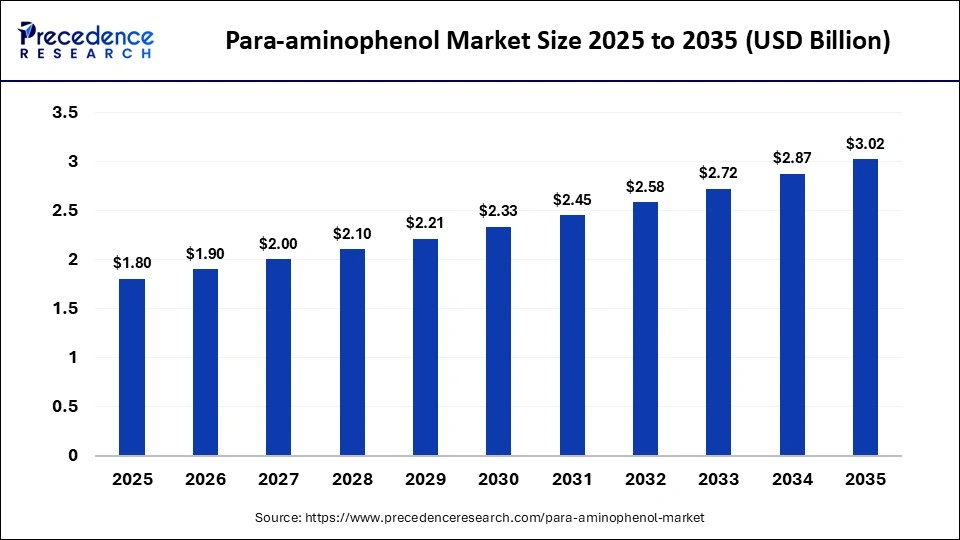
Yogesh Kulkarni, a Chemical and Materials Industry Expert, estimates the para-aminophenol market at USD 1.90 billion in 2026, with the market projected to reach USD 3.02 billion by 2035 at a CAGR of 5.30%. Major para-aminophenol market companies such as Amino Chemicals (India) Pvt. Ltd., Jiangsu Zhongtian Pharmaceutical Co., Ltd., Eastman Chemical Company, Guangdong Zhongtian Biotechnology Co., Ltd., Sumitomo Chemical Co., Ltd are competing across key material and application segments, including By Application, By End-Use Industry.
Source: https://www.precedenceresearch.com/para-aminophenol-market
 Get a Sample
 Table Of Content


What is the Para-aminophenol Market Size in 2026?
The global para-aminophenol market size was calculated at USD 1.80 billion in 2025 and is predicted to increase from USD 1.90 billion in 2026 to approximately USD 3.02 billion by 2035, expanding at a CAGR of 5.30% from 2026 to 2035. The para-aminophenol market is experiencing unprecedented growth, driven by rising demand in pharmaceutical applications, especially for paracetamol production, along with expanding use in dyes, cosmetics, and industrial chemicals.
Key Takeaways
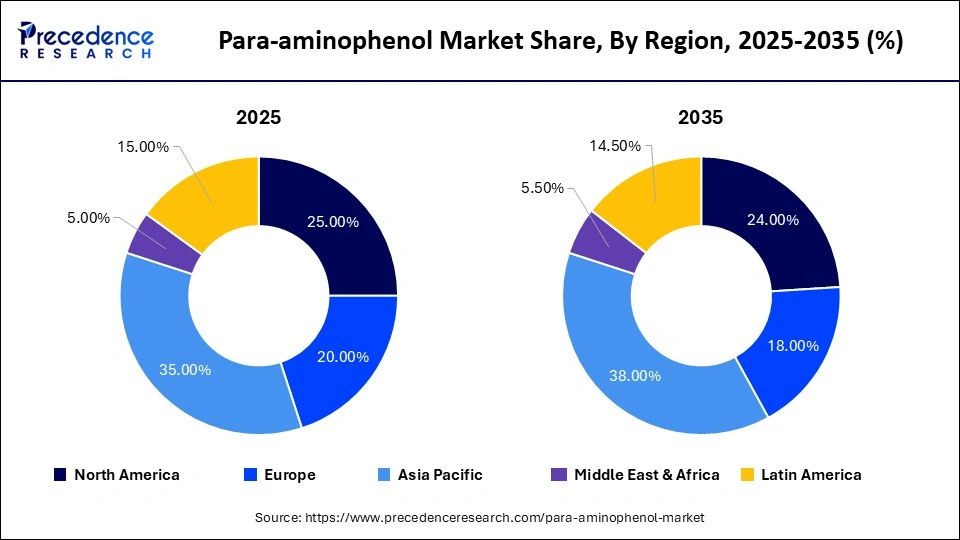
- Asia Pacific dominated the para-aminophenol market with a 35% share in 2025.
- North America is expected to expand at a robust CAGR of 5% between 2026 and 2035.
- By application, the pharmaceuticals segment held the largest market share of 45% in 2025.
- By application, the dyes & intermediates segment is expected to grow at the fastest CAGR of 6% from 2026 to 2035.
- By end-use industry, the pharmaceutical industry segment held a dominant share of 50% in 2025.
- By end-use industry, the textile industry segment is expected to expand at the fastest CAGR of 6% between 2026 and 2035.
Market Overview
Para-aminophenol (p-aminophenol or 4-aminophenol) is an organic compound with the chemical formula C6H7NO. Para-aminophenol is a key industrial chemical and pharmaceutical intermediate. It appears as a white crystalline solid that is most widely used in numerous applications, including the production of dyes, pharmaceuticals, and hair dyes. Para-aminophenol is typically unstable under normal atmospheric conditions, owing to its sensitivity to humidity, air, and light. It serves as a strong reducing agent that reacts quickly when exposed to oxygen in an alkaline or basic environment.
What are the Emerging Trends in the Para-aminophenol Market?
- The growing adoption of hair dyes and personal care products is spurring the demand for PAP as an intermediate, which is bolstering the growth of the market.
- Innovation in continuous flow synthesis is enhancing efficiency and significantly reducing the ecological footprint of production, which is expected to contribute to the overall growth of the market.
- The rising consumption of over-the-counter (OTC) medication globally creates consistent demand for raw materials like PAP, which is anticipated to drive the market's growth during the forecast period.
- The rapid expansion of the textile industry is increasing the need for sulfur red-brown coloration dyes, which is anticipated to accelerate the demand for para-aminophenol in the coming years.
Market Scope
| Report Coverage | Details |
| Market Size in 2025 | USD 1.80 Billion |
| Market Size in 2026 | USD 1.90 Billion |
| Market Size by 2035 | USD 3.02 Billion |
| Market Growth Rate from 2026 to 2035 | CAGR of 5.30% |
| Dominating Region | Asia-Pacific |
| Fastest Growing Region | North America |
| Base Year | 2025 |
| Forecast Period | 2026 to 2035 |
| Segments Covered | Application, End-Use Industry, and Region |
| Regions Covered | North America, Europe, Asia-Pacific, Latin America, and Middle East & Africa |
Market Dynamics
Drivers
Rising Demand for Paracetamol (Acetaminophen)
The growing need for paracetamol and other paracetamol-based pharmaceutical formulations worldwide is expected to drive the growth of the para-aminophenol market during the forecast period. Para-aminophenol (PAP) is the crucial raw material for manufacturing acetaminophen. Therefore, a surge in global paracetamol consumption directly raises the need for PAP.
Restraint
Volatility in Raw Material Prices
Fluctuations in the price of raw materials hamper the market's growth. The production of para-aminophenol relies heavily on raw materials such as nitrobenzene and phenol, which are highly subject to price fluctuations. These fluctuations, along with geopolitical tensions affecting supply chains.
In the first half of July 2025, prices for Para-aminophenol (PAP) in the Asian market recorded a significant increase. This rise was increased due to limited inventories, higher feedstock costs, and strong demand from the pharmaceutical and healthcare sectors.
Opportunities
Rising Shift Toward Green Chemistry
The increasing adoption of green chemistry to reduce environmental impact is projected to create lucrative opportunities in the para-aminophenol market during the forecast period. The market is transitioning from traditional iron-reduction techniques to cleaner methods such as catalytic hydrogenation and bio-based production to comply with stringent regulations.
Segment Insights
Application Insights
Para-aminophenol Market Share, By Application, 2025-2035 (%)
| Application | 2025 | 2035 | CAGR (%) |
| Pharmaceuticals | 45.00% | 47.50% | 5.0% |
| Cosmetics | 25.00% | 23.00% | 4.5% |
| Dyes & Intermediates | 15.00% | 16.00% | 6.0% |
| Photographic Chemicals | 10.00% | 9.50% | 3.5% |
| Others | 5.00% | 4.00% | 2.0% |
The Pharmaceuticals Segment Led the Market With a 45% Share in 2025
In 2025, the pharmaceuticals segment dominated the para-aminophenol market with the largest share of 45%. This dominance is driven by the high use of para aminophenol in pharmaceutical formulations for analgesic and antipyretic drugs. In addition, the rising demand for over-the-counter (OTC) medications has significantly increased the demand for raw materials such as para-aminophenol (PAP).
The cosmetics segment was the second-largest shareholder, holding a share of 25% in 2025, and is expected to grow at a robust CAGR of 4.5% in the coming years, primarily driven by the increasing demand for skin-lightening products and hair coloring agents. PAP is a crucial intermediate in permanent hair dye formulations, specifically used to create deep, long-lasting shades of sulfur red-brown, brown, and black. Moreover, the consumer spending on personal grooming and cosmetics is anticipated to drive the segment's growth.
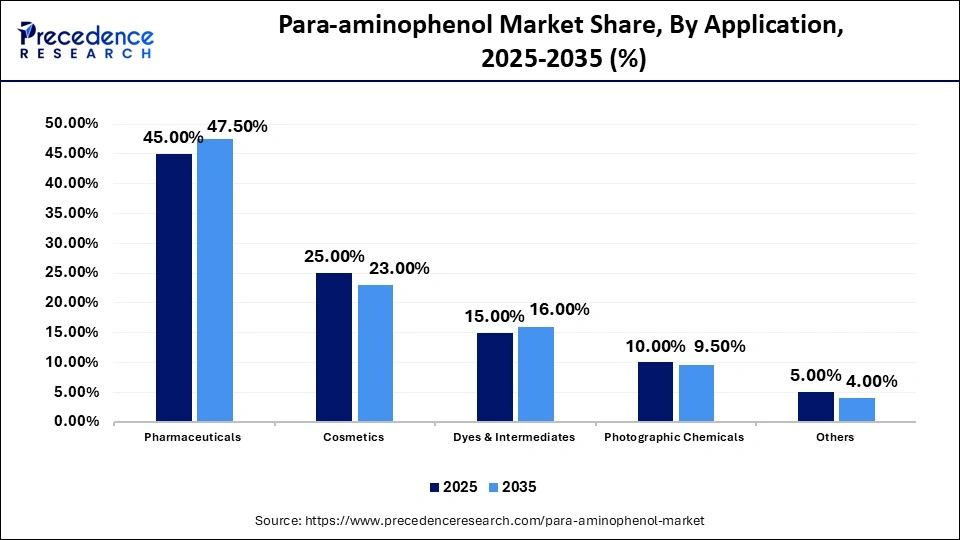
The dyes & intermediates segment held a remarkable share of 15% in the market in 2025 and is expected to grow at a 6% CAGR during the forecast period. This is because of the rising demand for vibrant and durable colorants in the textile and leather industries, which has created high demand for PAP-based dyes. PAP gained immense traction in these applications for its excellent color stability. It acts as a source of diazonium ions for coupling reactions, which is crucial for producing azo dyes. These dyes are widely utilized in the textile and leather industries.
The photographic chemicals segment held a remarkable share of 10% in the market in 2025 and is expected to expand at a 3.5% CAGR over the studied period. The rising use of para-aminophenol in photographic developers and other specialty chemicals drives the segment's growth during the forecast period. Para-aminophenol is vital in the production of photographic developers, particularly for black-and-white films. PAP serves as a key reducing agent that transforms latent silver halides into visible metallic silver, facilitating high-quality image development.
End-Use Industry Insights
Para-aminophenol Market Share, By End-Use Industry , 2025-2035 (%)
| End-Use Industry | 2025 | 2035 | CAGR (%) |
| Pharmaceutical Industry | 50.00% | 52.50% | 5.5% |
| Cosmetics Industry | 20.00% | 19.00% | 4.5% |
| Textile Industry | 15.00% | 14.50% | 6.0% |
| Food & Beverage Industry | 5.00% | 5.50% | 3.0% |
| Other Industries | 10.00% | 9.00% | 2.5% |
The Pharmaceutical Industry Segment Contributed the Largest Market Share in 2025
The pharmaceutical industry segment led the para-aminophenol market with the largest share of 50% in 2025. The pharmaceutical industry remains the largest consumer of para-aminophenol, supported by the increasing use in drug formulations and over-the-counter medicines. Paracetamol is the most widely used analgesic and antipyretic drug worldwide, and para-aminophenol is its primary raw material. Moreover, the growing awareness, expanding pharmaceutical sectors, and increased access to healthcare in developing economies are expected to drive strong demand for pain relief medication.
The cosmetics industry segment was the second-largest shareholder, holding a share of 20% in 2025, and is expected to expand at a robust CAGR of 4.5% between 2026 and 2035. The growth of the segment is driven by the rising consumer demand for hair care products and cosmetic formulations that utilize PAP as an intermediate for dyes and colorants. PAP is commonly used in skin care products as a skin brightening agent for depigmentation.
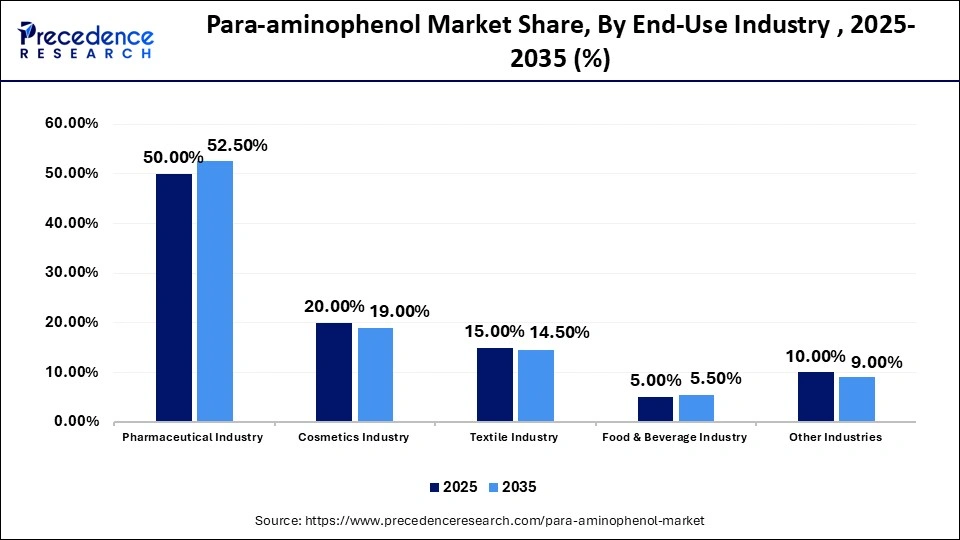
The textile industry segment held a 15% share of the market in 2025 and is expected to grow at a 6% CAGR in the upcoming period. This is because of the increased use of PAP in the textile sector, particularly in dyeing. PAP is a crucial intermediate in the production of sulfur red-brown dyes, azo dyes, acid dyes, and several pigments widely used in textile fiber processing. Moreover, the rising production of textile fibers such as wool, cotton, and rayon propels the demand for para-aminophenol to create high-performance colorants.
The food & beverages industry segment held a market share of 5% in 2025 and is expected to grow at a 3% CAGR over the projection period, driven by the rising use of para-aminophenol as a food additive. Para-aminophenol derivatives are commonly used as specialized intermediates in the manufacturing of food-related colorants and specific additives, contributing to their growth in the food and beverage sector.
Regional Insights
Asia Pacific Para-aminophenol Market Size and Growth 2026 to 2035
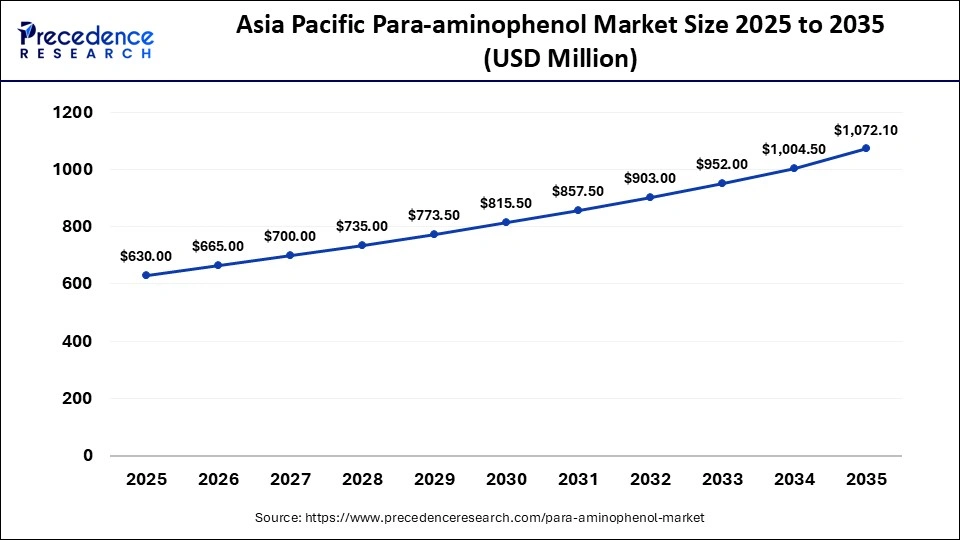
The Asia Pacific para-aminophenol market size is expected to be worth USD 1,072.10 million by 2035, increasing from USD 630.00 million by 2025, growing at a CAGR of 5.46% from 2026 to 2035.
What Made Asia Pacific the Dominant Region in the Para-aminophenol Market?
Asia Pacific dominated the para-aminophenol market with a 35% share in 2025 and is expected to grow at the fastest CAGR of 7% during the forecast period. This is because of the significant increases in demand from the pharmaceuticals, textile, and cosmetics industries. India and China are major exporters and consumers of these pain-relief medications. Several pharmaceutical producers, particularly in countries like Japan, India, and China, are rapidly expanding production capacity to meet growing healthcare demands, ensuring a strong demand for pharmaceutical-grade PAP. The rapid expansion of the textile and leather industry requires sulfur red-brown coloration dyes, which contribute to the demand for PAP as a key intermediate. The favorable government policies and initiatives are expected to boost the regional pharmaceutical manufacturing.
India Para-aminophenol Market Analysis
India holds a significant share of the Asia Pacific market. India is one of the major manufacturers of analgesic and antipyretic drugs, creating strong demand for PAP as a key intermediate. The country has easy access to raw materials and established supply chains for precursor chemicals, which enhance production efficiency. To combat reliance, the government has implemented several attractive policies to boost domestic production, including setting up specialized Bulk Drug Parks. The surge in the aging demographic in the country contributes to the increasing need for pharmaceutical treatments, boosting the consumption of PAP-based medicines. The growth of textile manufacturing in the country, such as cotton, wool, and synthetics, requires large quantities of para-aminophenol as a key intermediate in the synthesis of azo dyes. Additionally, the expenditure on personal care and beauty products is significantly driving the growth of the cosmetic sector.
North America: The Second Largest Market
North America is the second-largest market for para-aminophenol, holding a 35% share in 2025, and is expected to grow at a 5% CAGR from 2026 to 2035. This is because of its well-established pharmaceutical industry and high consumption of acetaminophen-based analgesic drugs. The region is highly focused on high-purity standards for pharmaceutical ingredients that favor regional producers, strengthening the regional market growth. The region's position is characterized by the advanced healthcare infrastructure, significant investment in R&D, rise in disposable income, surge in aging population, and growing demand for industrial, cosmetic, and dye applications.
U.S. Para-Aminophenol Market Analysis
The U.S. is the major contributor to the market within North America. The country has a robust pharmaceutical manufacturing sector, combined with rapid research and development (R&D) activities, which allows for rapid innovation in drug formulations. The region is home to dominant market players such as Wego Chemical Group, Parachem Fine & Specialty Chemicals, Eastman Chemical Company, Sigma-Aldrich Corporation, and others. The U.S. market is significantly influenced by the import demand for pharmaceutical-grade PAP, which supports the production of paracetamol (acetaminophen). Additionally, the growing demand for para-aminophenol in the dye formulations and other chemical synthesis applications is expected to drive the country's market growth during the forecast period.
How is the Opportunistic Rise of Europe in the Para-Aminophenol Market?
Europe held a 20% market share in 2025 and is expected to grow at a 4.5% CAGR over the studied period. The region has a robust demand for paracetamol (acetaminophen) for pain relief and fever reduction, increased the para-aminophenol consumption. The growth of the region is attributed to the expansion of pharmaceutical manufacturing, stringent quality standards, rising investment in R&D, increasing adoption of processed textiles, rising disposable income, and growing demand for hair care & cosmetics products. Additionally, the rising shift toward greener and more cost-effective production methods, such as catalytic hydrogenation, is significantly lowering production costs and improving yields.
Germany Market Analysis
Germany is experiencing significant growth. Germany's robust pharmaceutical infrastructure drives demand for high-purity PAP, which plays a crucial role in manufacturing paracetamol and other drugs. The country's growth is also largely driven by the rapid expansion of the chemical manufacturing sector, increasing adoption of food colorants and additives, strong regulatory focus on sustainable chemical manufacturing, and surging demand for hair colorants and cosmetics. German companies are increasingly utilizing advanced chemical synthesis methods, such as catalytic hydrogenation and eco-friendly practices, to improve product quality and efficiency. Additionally, the increasing self-medication trends have significantly increased consumer reliance on over-the-counter (OTC) pain relievers and anti-fever medications (paracetamol), accelerating the demand for para-aminophenol.
Para-aminophenol Market Companies
- Amino Chemicals (India) Pvt. Ltd.
- Jiangsu Zhongtian Pharmaceutical Co., Ltd.
- Eastman Chemical Company
- Guangdong Zhongtian Biotechnology Co., Ltd.
- Sumitomo Chemical Co., Ltd.
- BASF SE
- Hunan Lihua Pharmaceutical Co., Ltd.
- Hubei Hongyuan Pharmaceutical Co., Ltd.
- Sigma-Aldrich (Merck Group)
- Shanghai Aladdin Biochemical Technology Co., Ltd.
- Anhui Huateng Pharmaceutical Co., Ltd.
- Shijiazhuang Lanhua Sci-Tech Co., Ltd.
- Nantong Acetic Acid Chemical Co., Ltd.
- Tianjin Zhongtai Chemical Co., Ltd.
- Dongying Jinan Pharmaceutical Co., Ltd.
Recent Developments
- In September 2025, Novopor Advanced Science Private Limited inaugurated a state-of-the-art Pilot Plant Facility in Vizag, marking a significant step in strengthening its innovation and scale-up capabilities. With advanced process systems and stringent safety and environmental safeguards, it provides a critical platform for accelerating the commercialization of new technologies in agrochemicals, performance materials, and specialty chemicals.(Source: https://resources.novopor.com)
- In March 2024, the Union Minister for Chemicals & Fertilizers and Health & Family Welfare, Dr. Mansukh Mandaviya, virtually inaugurated Sadhana Nitro Chem Ltd.'s Para Amino Phenol (pAP) bulk drug plant, amongst 26 other greenfield bulk drug park projects and 13 greenfield manufacturing plants for medical devices. Expressing his elation at the inauguration of these greenfield projects under the PLI scheme, Dr. Mansukh Mandaviya stated that, “it is noteworthy that today India has not only reduced its dependence on medicines, API and medical devices, but the country is also emerging as a major exporter of these products, due to the success of the PLI scheme.(Source: https://www.indianpharmapost.com)
- In October 2023, Sadhana Nitro Chem received MPCB approval for Para Aminophenol (pAP) production and commenced continuous commercial operations at its plant.(Source: https://www.cnbctv18.com)
Segments Covered in the Report
By Application
- Pharmaceuticals
- Cosmetics
- Dyes & Intermediates
- Photographic Chemicals
- Others
By End-Use Industry
- Pharmaceutical Industry
- Cosmetics Industry
- Textile Industry
- Food & Beverage Industry
- Other End-Use Industries
By Region
- North America
- Latin America
- Europe
- Asia-pacific
- Middle and East Africa
For inquiries regarding discounts, bulk purchases, or customization requests, please contact us at sales@precedenceresearch.com
Frequently Asked Questions
Tags





Ask For Sample
No cookie-cutter, only authentic analysis – take the 1st step to become a Precedence Research client
 Get a Sample




 sales@precedenceresearch.com
 Schedule a Meeting
