



PCB Design Software Market Size, Share and Trends 2026 to 2035
PCB Design Software Market (By Deployment Type: On-premise, Cloud/Web-based/SaaS; By End-User Industry: Consumer Electronics, Automotive & Transportation, Telecommunications & Networking, Aerospace & Defense, Healthcare & Medical Devices, Industrial & Automation, Other End-Users; By User Type: Design Engineers/PCB Layout Teams, R&D/Innovation Centers, Educational/Academic Users, Service & Consulting Providers) - Global Industry Analysis, Size, Trends, Leading Companies, Regional Outlook, and Forecast 2026 to 2035zzz () - Global Industry Analysis, Size, Trends, Leading Companies, Regional Outlook, and Forecast 2026 to 2035
Source: https://www.precedenceresearch.com/pcb-design-software-market
 Get a Sample
 Table Of Content


What is PCB Design Software Market Size?
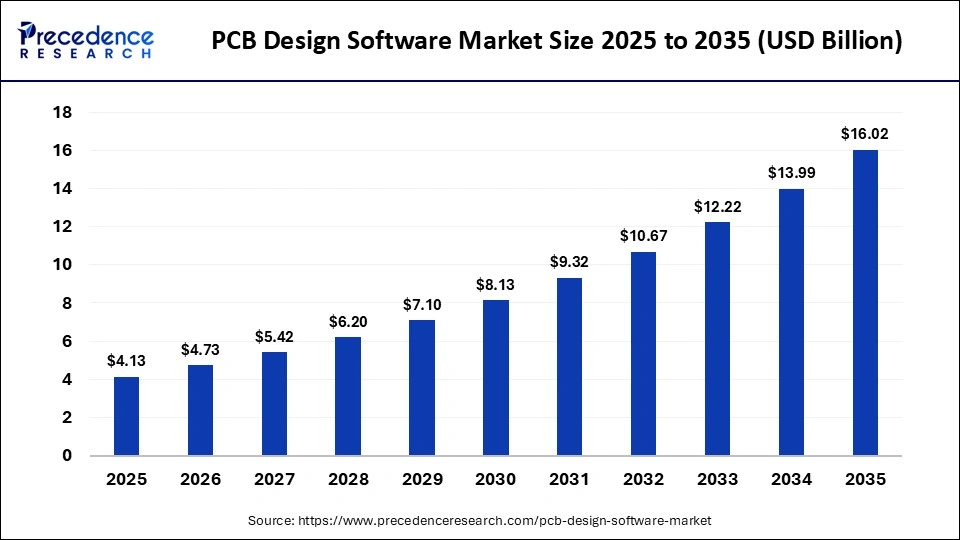
The global PCB design software market size was calculated at USD 4.13 billion in 2025 and is predicted to increase from USD 4.73 billion in 2026 to approximately USD 16.02 billion by 2035, expanding at a CAGR of 14.52% from 2026 to 2035. The PCB design software market is rapidly expanding due to the increase in the need for compact and complex designs of electronic devices, the expansion of the automotive & IoT industry, and advancements in AI-driven and cloud-based design tools.
Market Highlights
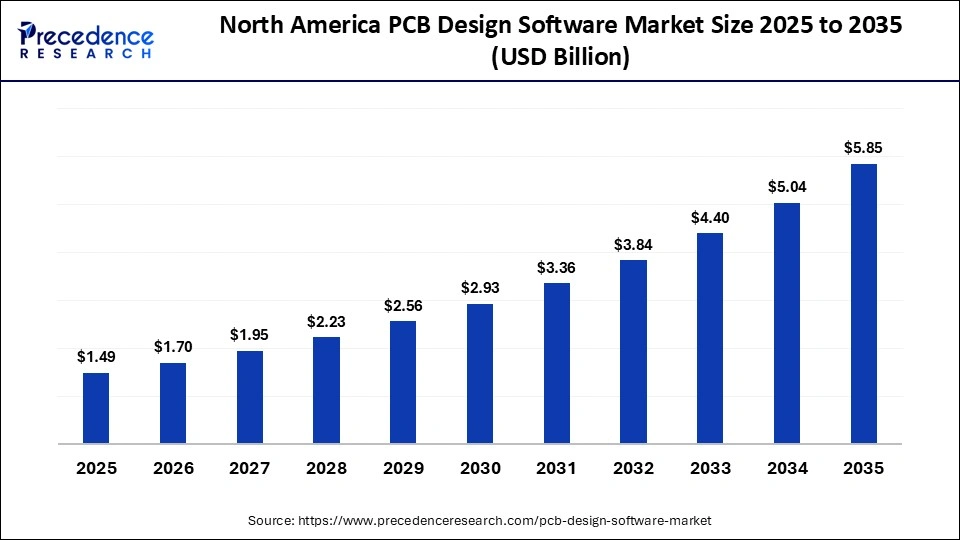
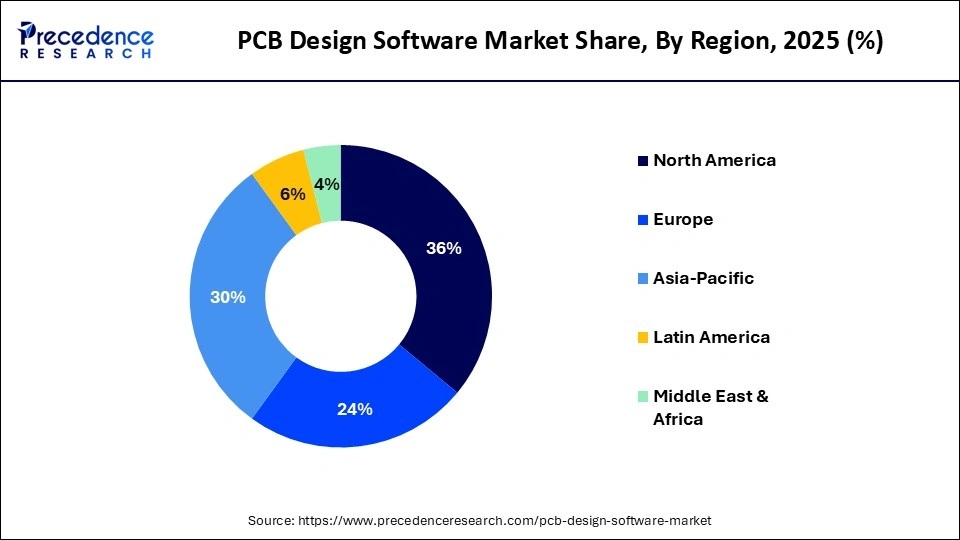
- North America dominated the PCB design software market, holding a share of approximately 36% in 2025.
- Asia-Pacific is expected to expand with the highest CAGR during the forecast period.
- By deployment type, the on-premise segment held the largest market share of approximately 51% in 2025.
- By deployment type, the cloud/web-based/SaaS segment is expected to grow swiftly between 2026 and 2035.
- By end-user industry, the consumer electronics segment dominated the market with a share of approximately 26% in 2025.
- By end-user industry, the automotive & transportation segment is expected to rise at the fastest CAGR during the forecast period.
- By user type, the design engineers/PCB layout team segment held the largest revenue share of approximately 64% in the market in 2025.
- By user type, the R&D/innovation centers segment is expected to show the fastest growth in the forecast period.
What is the PCB Design Software?
The PCB design software market comprises computer-aided design (CAD) tools and platforms used for planning, schematic capture, layout, simulation, validation, and verification of PCB designs across electronics, automotive, telecom, consumer devices, aerospace, medical devices, and industrial equipment industries. Printed circuit board (PCB) design software enables engineers to optimize signal integrity, thermal performance, manufacturability, and design for testability, with features including multi-layer routing, library/data management, 3D visualization, and AI-assisted automation.
The key driving forces of this market include the growing demand for AI-driven automation, 3D modelling, cloud-based collaboration, and integration with mechanical CAD for high-performance and compact-sized electronic devices. This market is experiencing significant growth due to the increasing need for advanced and high-performing electronic circuits. Various companies are adopting this software to minimize errors, improve performance, and reduce overall time-to-market, further expanding the market.
How is AI Utilized Within the PCB Design Software Market?
Artificial Intelligence is transforming the market by automating complex tasks like component placement, routing & design rule checks, significantly minimizing design time, reducing human errors & improving manufacturing efficiency. It enables predictive analytics for thermal and electric performance, accelerating time-to-market. It provides a shared database & automated update, enabling better communication between the design team & producer. AI boosts human expertise rather than replacing it by streamlining circuit board development, making it faster, more reliable, and cost-effective.
- In May 2025, Siemens Digital Industries Software announced the development of its AI-enhanced electronic systems design technology with PADS Pro Essentials software and Xpedition Standard software, enhancing accessibility to small and mid-sized businesses (SMBs).
Government Initiatives
- China: The region's is being supported by export-oriented production and technology-intensive manufacturing capacity. Sustained procurement volumes are also being generated by various government investment programs that also help to boost domestic industrial modernization efforts.
- U.S: The country's growth is driven by regulatory compliance cycles, aftermarket replacement volumes and institutional procurement from large-scale end-user markets. The region also has robust distribution networks and strong procurement relationships across the market. Regulatory compliance requirements help drive upgrade and replacement cycles.
- Germany: Regulatory compliance, sustainability requirements and advanced manufacturing infrastructure are shaping market demand in the region. The market also focuses on product certification, environmental standards, and standardization of performance in procurement processes. Sustainability mandates are helping in pushing the procurement of compliant products. Regulatory standardization drives compliance-driven upgrade cycles.
- UK: Compliance-driven procurement, institutional demand and post-regulatory transition requirements are helping to sustain momentum in the market. Quality standardization and performance certification requirements help drive the market decisions across various end-use segments. Post-regulatory transition results in incremental procurement needs.
- Japan: Technology leadership is sustained through advanced manufacturing capabilities and quality-driven procurement standards in the country. Demand is driven by institutional purchasing that appreciates product reliability, performance consistency and long-term supplier relationships. Regulatory compliance and certification mandates are further helping in driving the structured demand for PCB design software products across key end-use segments.
PCB Design Software Market Trends
- AI-Enabled Design Automation: Artificial intelligence (AI) is revolutionizing the electronics industry by automating routine, complex tasks like component placement, routing, and thermal analysis. It has an improved design leading to smart routing, predictive error detection, and automating layout, accelerating efficiency and reducing time to market.
- Cloud-enabled Teamwork: A shift toward SaaS models and cloud-native platforms enables real-time, remote teamwork, browser-based & instant data access, reducing design cycles and project timelines.
- 3D Visualization & Simulation: The demand for 3D visualization is expanding rapidly due to early error detection, improved AI-powered 3D modelling, and ECAD-MCAD collaboration. It has reduced physical prototyping failures by focusing on thermal analysis & signal integrity testing during the design phase.
- PLM/ERP Integration: The integration of PCB software & PLM system is essential for optimizing design to manufacturing efficiency, improving cost management, and enhancing traceability. This collaboration provides a digital thread for data products, which is important for minimizing errors in increasingly advanced electronic development.
Market Scope
| Report Coverage | Details |
| Market Size in 2025 | USD 4.13 Billion |
| Market Size in 2026 | USD 4.73 Billion |
| Market Size by 2035 | USD 16.02 Billion |
| Market Growth Rate from 2026 to 2035 | CAGR of 14.52% |
| Dominating Region | Europe |
| Fastest Growing Region | Asia Pacific |
| Base Year | 2025 |
| Forecast Period | 2026 to 2035 |
| Segments Covered | By Deployment Type, User Type, and region |
| Regions Covered | North America, Europe, Asia-Pacific, Latin America, and Middle East & Africa |
Segmental Insights
Deployment Type Insights
Why Did the On-Premise Segment Dominate the PCB Design Software Market?
The on-premise segment dominated the market by holding approximately 51% of market share, due to the need for strict data security, IP protection, and infrastructure control in the aerospace, defense, and automotive industries. On-premise tools provide a strong, advanced, and highly customizable solution that functions without depending on the internet. Many industries require stringent regulatory compliance, making on-premise a standard solution. Recently, due to technological advances, various deployment types have been introduced, but on-premise continues to be the benchmark for safe, complex, and high-performing systems.
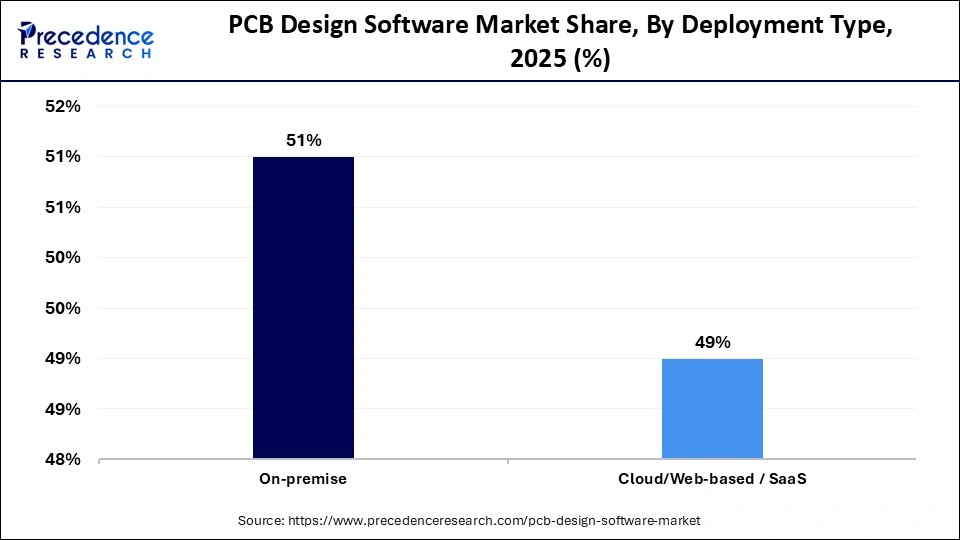
The cloud/web-based/SaaS segment is expected to grow at the fastest CAGR in the market between 2026 and 2035, due to the rise in demand for improved productivity, cost efficiency, and smoother joint efforts. The surge of sophisticated, well-connected devices requires complex PCB designs that benefit from high performance and on-demand compute resources provided by the cloud. Web-based tools eliminate the need for a specialized infrastructure to install their hardware components, reducing upfront costs.
End-User Industry Insights
What Made the Consumer Electronics Segment Lead the PCB Design Software Market?
The consumer electronics segment contributed the biggest revenue share of approximately 26% in the market in 2025, due to the growing demand for miniature, faster & complex devices like smartphones & wearables that require advanced high-density and multilayer board designing.
Accelerated innovation cycles, rapid prototyping, and high-volume production are driving the widespread adoption of PCB software. The need for miniature devices like VR headsets and smartphones has necessitated the use of specialized advanced PCB software. The booming market of smart home and IoT devices requires PCB design solutions, further enhancing its dominance in consumer electronics.
The automotive & transportation segment is expected to rise at the highest CAGR between 2026 and 2035 due to the shift in industry from fuel-consuming vehicles to electric vehicles, autonomous driving, & connected car technology. This shift requires advanced, high-performance, and complicated thermally efficient PCB design, surging the demand for PCB design software. The surge in vehicle electrification is fueling market growth in the automotive industry.
User Type Insights
Which User Type Segment Led the PCB Design Software Market?
The design engineers/PCB layout teams segment led the market with a share of approximately 64% in the market in 2025, as they are tasked with turning complex electronic concepts into reliable hardware. Their role is crucial due to the surge of IoT, 5G, & advanced high-speed electronic devices. The market is rapidly adopting AI-driven cloud-based platforms to handle high-density, interconnected multilayer board design, with high-end tools, augmenting the segment's growth.
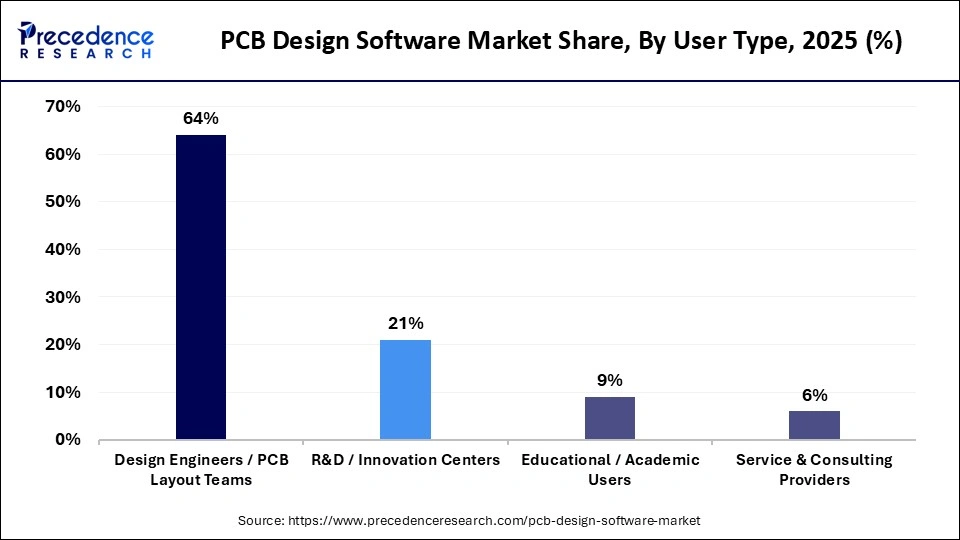
The R&D/innovation centers segment is expected to expand rapidly in the market in the coming years due to a surge in the need for high-speed, compact, and intelligent electronic devices. This expansion is propelled by the demand for faster time-to-market and increased design complexity in the AI, 5G, and automotive sectors.
R&D sectors are embedding PCB design in larger enterprise ecosystems to improve traceability and cost efficiency, which ensures a smooth transition from design to manufacturing. The market is also witnessing an increase in investments in R&D, leading to innovation-led applications, which further boost the market expansion.
Significant growth is also seen in educational/academic users due to diverse factors, primarily driven by the need to bridge the gap between theoretical electronics engineering and practical application, enhanced low-cost prototyping, and strategic initiatives by major software vendors to cultivate future industry professionals.
Regional Insights
How Big is the North America PCB Design Software Market Size?
Why Did North America Dominate the PCB Design Software Market?
North America dominated the market with a share of approximately 36% in 2025. This market is propelled by a well-established ecosystem of industry leaders and massive R&D investments, and it has huge demand in the aerospace, automotive, and defense sectors. This region's dominance is driven by the need for advanced, high-speed, and complicated multilayer PCB designs for AI, IoT, and 5G technologies. The region, like the U.S., holds the crown for major EDA software providers & electronics manufacturers.
Government initiatives in North America, mainly in the U.S. and Canada, are boosting the market. These initiatives include the CHIPS and Science Act, the Defense Production Act, and the Canadian Quantum Champions Program, focusing on developing highly advanced and complex design tools.
What is the Size of the U.S. PCB Design Software Market?
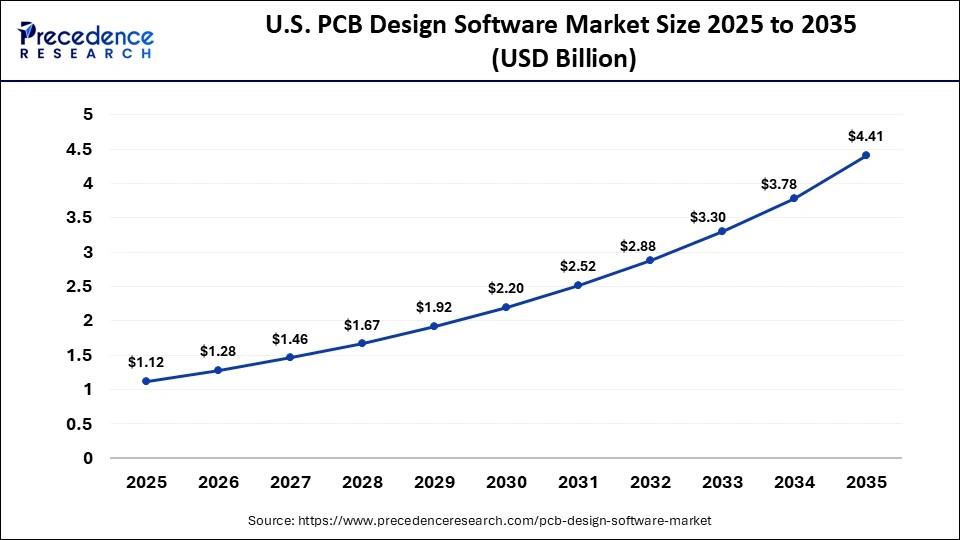
The U.S. PCB design software market size is calculated at USD 1.12 billion in 2025 and is expected to reach nearly USD 4.41 billion in 2035, accelerating at a strong CAGR of 14.69% between 2026 to 2035.
U.S. Market Trends
The U.S. dominates the market in the North American region due to its advanced electronics ecosystem, robust R&D, & the burgeoning aerospace & defense sectors. The increasing adoption of cloud-based and AI-driven tools and massive investments in technology foster market growth.
Major tech companies are heavily investing in R&D to improve software features such as 3D modeling and simulation of thermal & signal integrity, which further augments market growth. Various government initiatives, like the CHIPS and Science Act and the Supporting American Printed Circuit Boards Act, to secure the manufacturing pipeline for aerospace and defense applications.
How Will Asia-Pacific Grow in the PCB Design Software Market?
Asia-Pacific is expected to be the fastest-growing region in the foreseeable period due to its dominance in electronic manufacturing, propelled by huge demand for consumer electronics, industrial automation, & IoT devices. There are also other various key factors for its rapid growth, like significant R&D investments, along with rapid adoption of advanced design technology like 3D visualization & cloud-based EDA tools.
This region provides a favorable environment for tech startups & affordable manufacturing abilities that encourage software adoption. Governments in countries like India & China are focused on improving local electronic manufacturing, which further boosts the market. Inter-governmental collaborations with different nations strengthen domestic infrastructure and propel market growth.
China Market Trends
China is leading the market in the Asia-Pacific region primarily because it is an electronics manufacturing powerhouse. It is propelled by massive production capacity and initiative, like Made in China, making it a leader in the market. Shenzhen is known as the Silicon Valley of hardware due to its rapid manufacturing turnarounds with a strong localised supply chain supported by advanced AI design tools. Local manufacturers are rapidly capturing market share by focusing on user-friendly, AI-driven, specialized design tools that meet the demand of the growing electronics sector, further boosting China's dominance.
Will Europe Grow in the PCB Design Software Market?
Europe is expected to grow at a notable CAGR in the foreseeable future, due to investments in AI-driven design and advanced manufacturing & semiconductor research. The European market is driven by the need for a localized supply chain, automotive electrification & strict Industry 4.0 automation standards. European regulation encourages digitalization, clean energy, and environmental compliance, leading manufacturers to adopt advanced software. Hefty investments in specialized high-end prototyping in the industries of medicine & aerospace are further boosting the market.
Germany Market Trends
Germany currently holds the largest share in the European region. Its dominance in this region is due to its robust, well-established automotive, industrial automation, & high-frequency 5G sector. It is driven by strong R&D, AI for design automation, & government backing for technological innovation. With focus, precision, reliability, and strict standards, German software is an ideal choice for global applications.
What Drives the PCB Design Software Market in Latin America?
Latin America is growing at a significant CAGR in the market. The well-established manufacturing base for electronics and the burgeoning smart manufacturing increase demand for PCB design software. Strong government support for technology utilization and the rise of vehicle electronics increase the adoption of PCB design software. The surging digital talent drives the market growth.
Brazil Market Trends
Brazil held the highest share in the market in the Latin American region. The growing capacity of electronics manufacturing and the demand for high-performance electronics increase the adoption of PCB design software. The expansion of local design firms and the utilization of simulation tools help with expansion. Initiatives like Lei de TICs and Nova Industria Brasileira support the market growth.
Which Factors are Responsible for the Growth of the PCB Design Software Market in the Middle East and Africa?
The Middle East and Africa region is expected to grow at a substantial CAGR in the market. The utilization of smart technologies and the growing local electronics development increases demand for PCB design software. The rise in AI-powered automation and the development of medical equipment increase the adoption of PCB design software. The expansion of rigid-flex PCBs drives the market growth.
Saudi Arabia Market Trends
Saudi Arabia is growing in the market. The growing smart automation and the heavy investment in EV manufacturing increase demand for PCB design software. The increased development of defense equipment and the increased use of smart gadgets increase the adoption of PCB design software. The expansion of SMT supports the market growth.
Competitive Landscape
The Global PCB Design Software Market is currently characterized by a dynamic competitive landscape, driven by rapid technological advancements and increasing demand for efficient design solutions. Major players such as Altium, Cadence Design Systems, and Autodesk are strategically positioning themselves through innovation and partnerships.
The market structure appears to be moderately fragmented, with several key players exerting their influence over various segments. This fragmentation allows for niche players to thrive, while larger companies are able to leverage their resources in order to capture high market share. The collective influence of these key players shapes the competitive dynamics, as they continuously adapt to emerging trends and customer preferences.
Top Companies in the PCB Design Software Market
- Altium Limited:- The software company offers products like Altium 365, CircuitStudio, Altium Designer, Octopart, and CircuitMaker for industries like aerospace, electronics, automotive, and defense.
- Cadence Design Systems:- The California-based company offers platforms like OrCAD X Platform and Allegro X Design Platform.
- Siemens EDA:- The company offers diverse technologies like system-level design, EDA software, digital twin technology, and EDA hardware.
- Autodesk Inc.:- The San Francisco-based company offers PCB design software like Autodesk EAGLE and Autodesk Fusion for mechanical design, manufacturing, electronics design, and simulation.
- Zuken Inc.:- The Japan-based company offers products like E3.series, CR-8000, and eCADSTAR for diverse industrial applications like automotive, machinery, electronics, defense, and aerospace.
Recent Developments
- In October 2025, SiCarrier, a China-based company, launched two electronic design automation (EDA) software programs, one for schematic capture and another for PCB design, at the three-day WeSemiBay Semiconductor Ecosystem Expo 2025. The development of new domestic EDA products enhances self-sufficiency in chip design software.
- In June 2025, Siemens Digital Industries Software launched its new EDA AI system, which allows engineers to use generative and agentic AI within EDA workflows, providing secure access and interoperability. The system offers unparalleled customization capabilities and seamless integration across the entire EDA workflows. (Source: https://news.siemens.com)
- In May 2025, Zuken launched eCADSTAR 2025, the latest version of its PCB design software. The software streamlines design workflows, improving high-speed and signal integrity performance, and supporting collaboration between engineering and manufacturing teams. (Source: https://www.engineering.com)
- In May 2025, Cadence launched its Millennium M2000 Supercomputer that integrated NVIDIA accelerated computing hardware and software for semiconductor design, digital twin simulations, drug discovery, and more. The supercomputer leverages NVIDIA HGX B200 systems and NVIDIA RTX PRO 6000 Blackwell Server Edition GPUs.
Segments Covered in the Report
By Deployment Type
- On-premise
- Cloud/Web-based/SaaS
By End-User Industry
- Consumer Electronics
- Automotive & Transportation
- Telecommunications & Networking
- Aerospace & Defense
- Healthcare & Medical Devices
- Industrial & Automation
- Other End-Users
By User Type
- Design Engineers/PCB Layout Teams
- R&D/Innovation Centers
- Educational/Academic Users
- Service & Consulting Providers
By Region
- North America
- Europe
- Asia-Pacific
- Latin America
- Middle East & Africa
For inquiries regarding discounts, bulk purchases, or customization requests, please contact us at sales@precedenceresearch.com
Frequently Asked Questions
Tags





Ask For Sample
No cookie-cutter, only authentic analysis – take the 1st step to become a Precedence Research client
 Get a Sample




 sales@precedenceresearch.com
 Schedule a Meeting
