


Cell and Gene Therapy Solutions Market Trends, Leading Companies, Company Revenue / Sales Performance, Procedure Volume, Healthcare Spending, Technology Adoption, Reimbursement Analysis, Competitive Landscape, and Growth Outlook
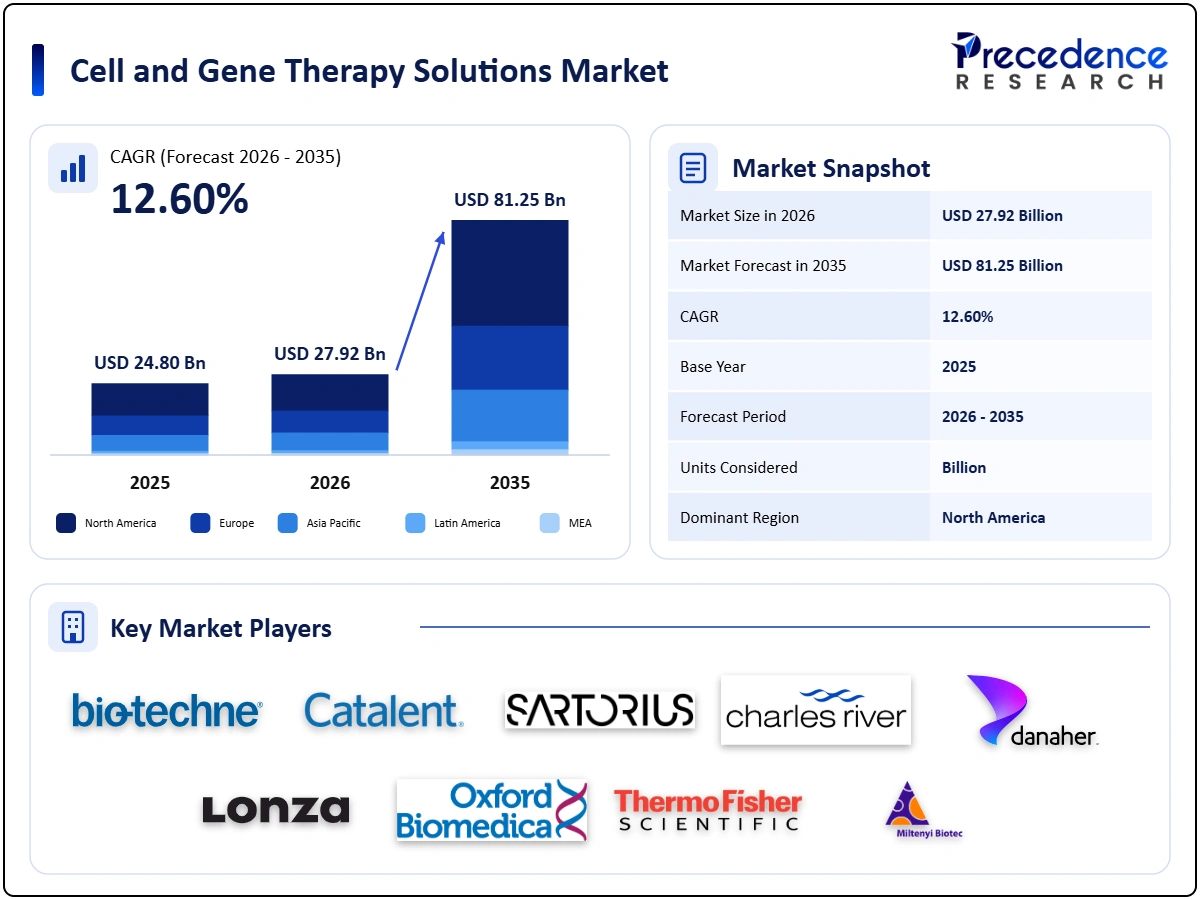
Payal Rabde, a Healthcare Industry Expert, highlights that the cell and gene therapy solutions market has reached USD 27.92 billion in 2026 and is on track to reach USD 81.25 billion by 2035, advancing at a CAGR of 12.60%. Key cell and gene therapy solutions market companies shaping the market include Thermo Fisher Scientific, Charles River Laboratories, Miltenyi Biotec, while major growth segments span therapy type, offering, application, end user and region.
Source: https://www.precedenceresearch.com/precedence-cell-and-gene-therapy-solutions-market
 Get a Sample
 Report Description
Key Takeaways
Market Size & Growth Outlook
- Market size in 2025: USD 24.80 billion
- Estimated market size in 2026: USD 27.92 billion
- Projected market size by 2035: USD 81.25 billion
- CAGR (2026-2035): 12.60%
Regional Market Spotlight
- North America led the market with a 45.00% (USD 11.16 billion) share in 2025.
- Europe accounted for 27.20% (USD 6.75 billion) of the market in 2025.
- Asia Pacific accounted for 22.00% (USD 5.46 billion) of the market in 2025 and is projected to be the fastest-growing region, at a CAGR of 14.30% from 2025 to 2035.
Segmental Spotlight
- By therapy type, Cell Therapy Solutions accounted for 55.20% (USD 13.69 billion) in 2025.
- By offering, Process Development & Manufacturing Services accounted for 40.20% (USD 9.97 billion) in 2025.
- By application, Oncology accounted for 50.20% (USD 12.45 billion) in 2025.
- By end user, Biotech Startups & Clinical-Stage Developers accounted for 45.00% (USD 11.16 billion) in 2025.
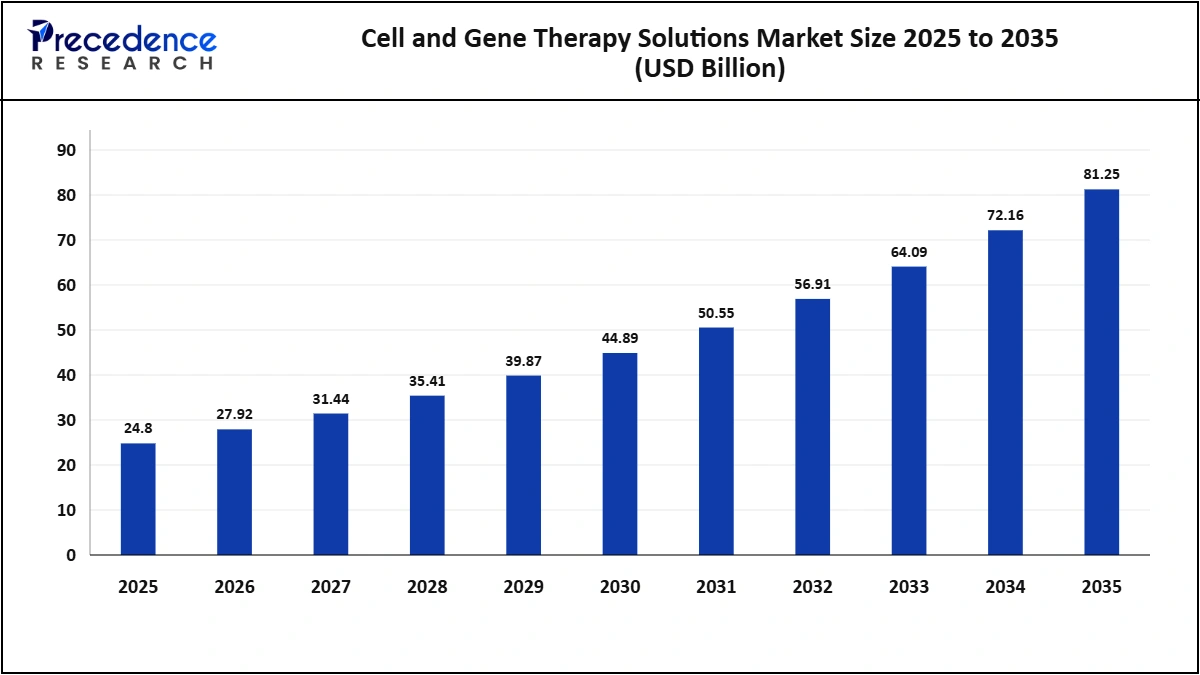
Cell and Gene Therapy Solutions Market Size and Forecast, 2025-2035 (USD Billion)
Note: 2025 is the base year; 2026–2035 values are forecasts.
Sources: Expert interviews, secondary sources, Precedence Research database, and Precedence Research analysts.
The cell and gene therapy solutions market is projected to grow from USD 24.80 billion in 2025 to USD 81.25 billion by 2035 due to the increasing number of approved CGTs and late-stage programs. The majority of companies require external tools, reagents, and manufacturing services as they lack specific infrastructure for development and manufacturing of CGTs. Driven by automation of manufacturing processes, increasing outsourcing of viral vectors, and the need for quality control, the market is expected to grow and reach USD 44.89 billion by 2030, growing at a CAGR of 12.60% between 2026 and 2035.
- Analyst View: We built the estimate from spending by CGT developers on manufacturing services, tools and reagents, instruments, testing and logistics, based on the number of clinical and commercial programs, manufacturing batches, and cost per batch. The expenditure will depend on the number of programs, stage, number of patients, outsourcing, and the cost of goods and services. No single published estimate covers this full scope, so the total was set on an evidence basis by combining published estimates for tools and reagents and manufacturing services and cross-checking against supplier revenues. The growth rate reflects significant pipeline growth, but also the funding cycles in biotech and the need to reduce treatment costs.
Market Trends
- Automated closed manufacturing.
- Faster release testing.
- Viral vector capacity consolidation.
- Non-viral gene delivery tools.
- Allogeneic and in vivo approaches.
- Long-term vector supply agreements.
Drivers, Restraints and Opportunities
Driver
Approvals of new therapies grow. Pipelines expand into new diseases. Developers outsource manufacturing. Rigorous testing is a regulatory requirement. Automation helps scalability.
Restraint
Therapies are very expensive. Biotech funding is cyclical. Manufacturing is complex. The excess capacity in CDMOs reduces pricing pressure. Skilled staff is scarce.
Opportunity
There is an increase in demand for autoimmune cell therapies. In vivo editing needs new tools. Asian pipelines grow. Point-of-care manufacturing emerges. Advanced analytics and digital tools are used to make development easier.
Market Segmentation: 2025 Share and Size
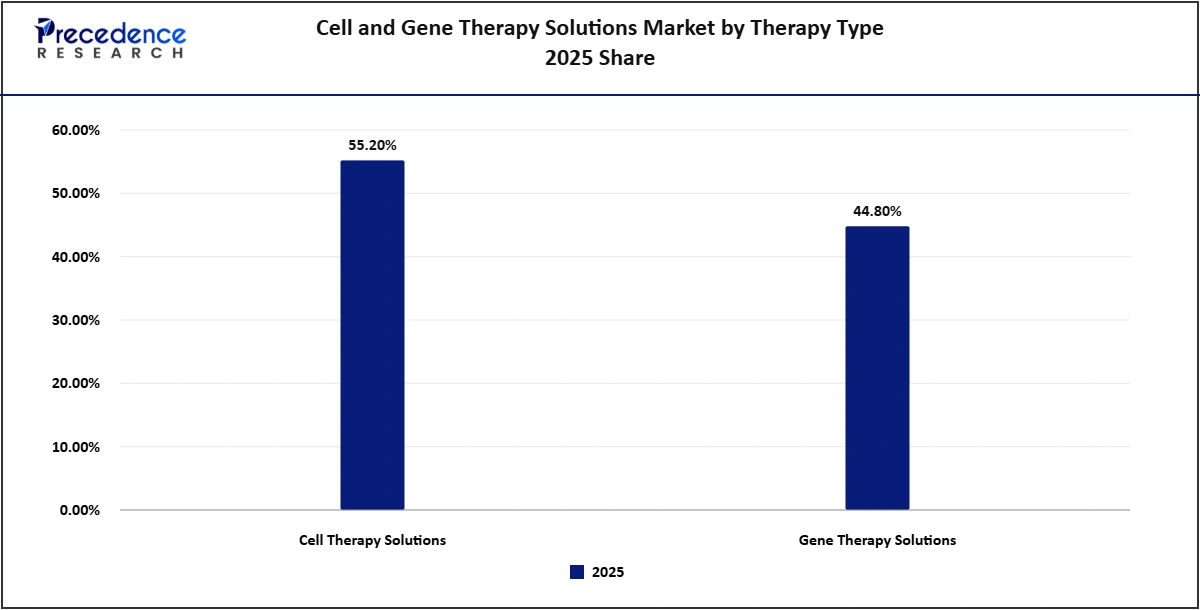
Cell and Gene Therapy Solutions Market by Therapy Type 2025 Share
Note: 2025 is the base year; 2035 values are forecasts.
Sources: Expert interviews, secondary sources, Precedence Research database, and Precedence Research analysts.
Cell therapy solutions accounted for 55.20% (USD 13.69 billion) in 2025, and gene therapy solutions accounted for 44.80% (USD 11.11 billion). Cell therapy dominates, and gene therapy is the fastest-growing.
Cell Therapy Solutions: This segment accounted for 55.20% (USD 13.69 billion) of the cell and gene therapy solutions market in 2025 and is projected to reach USD 42.34 billion by 2035, expanding at a CAGR of 11.95% from 2026 to 2035. Cell therapy solutions include CAR-T, TCR-T, NK cell, stem cell, and other cell therapies, covering cell isolation, activation, gene modification, expansion, formulation, cryopreservation, and release testing. They lead because approved CAR-T therapies and a large pipeline of cell therapies require patient-specific or allogeneic manufacturing with many reagents and services.
Gene Therapy Solutions: This segment accounted for 44.80% (USD 11.11 billion) of the cell and gene therapy solutions market in 2025 and is projected to reach USD 38.91 billion by 2035, expanding at a CAGR of 13.35% from 2026 to 2035. Gene therapy solutions support AAV, lentiviral, and non-viral gene therapies and gene editing, covering plasmid production, viral vector manufacturing, purification, analytics, and fill-finish. The market is growing faster as gene therapies and in vivo gene editing expand into broader indications and demand for viral vectors rises.
Cell and Gene Therapy Solutions Market by Offering 2025 Share & Size
| Segments | 2025 Share | 2025 Value (USD Billion) | 2035 Value (USD Billion) | CAGR 2026–2035 |
| Process Development & Manufacturing Services | 40.20% | 9.97 | 31.30 | 12.12% |
| Tools, Reagents & Consumables | 36.40% | 9.03 | 29.37 | 12.52% |
| Instruments & Equipment | 9.80% | 2.43 | 7.91 | 12.52% |
| Analytical Testing & QC | 8.60% | 2.13 | 8.64 | 15.02% |
| Logistics & Commercialization Services | 5.00% | 1.24 | 4.03 | 12.52% |
Note: 2025 is the base year; 2035 values are forecasts.
Sources: Expert interviews, secondary sources, Precedence Research database, and Precedence Research analysts.
Process development and manufacturing services accounted for 40.20% (USD 9.97 billion) in 2025; tools, reagents and consumables for 36.40% (USD 9.03 billion); instruments and equipment for 9.80% (USD 2.43 billion); analytical testing and QC for 8.60% (USD 2.13 billion); and logistics and commercialization services for 5.00% (USD 1.24 billion).
Process Development & Manufacturing Services: This segment accounted for 40.20% (USD 9.97 billion) of the cell and gene therapy solutions market in 2025 and is projected to reach USD 31.30 billion by 2035, expanding at a CAGR of 12.12% from 2026 to 2035. Process development and manufacturing services are provided by CDMOs such as Lonza, Thermo Fisher, Catalent, Charles River, and Oxford Biomedica, covering viral vectors, plasmids, and cell therapy production. They are the largest offering because most developers outsource complex GMP manufacturing.
Tools, Reagents & Consumables: This segment accounted for 36.40% (USD 9.03 billion) of the cell and gene therapy solutions market in 2025 and is projected to reach USD 29.37 billion by 2035, expanding at a CAGR of 12.52% from 2026 to 2035. Tools, reagents and consumables include cell culture media, cytokines, activation beads, transfection reagents, gene editing tools, single-use bags and cell separation kits, supplied by Thermo Fisher, Danaher, Merck KGaA, Miltenyi Biotec, Bio-Techne, and others.
Instruments & Equipment: This segment accounted for 9.80% (USD 2.43 billion) of the cell and gene therapy solutions market in 2025 and is projected to reach USD 7.91 billion by 2035, expanding at a CAGR of 12.52% from 2026 to 2035. Instruments and equipment include closed automated cell processing systems, bioreactors, cell sorters, and cryogenic freezers, with growing demand for automation platforms that reduce labor and contamination.
Analytical Testing & QC: This segment accounted for 8.60% (USD 2.13 billion) of the cell and gene therapy solutions market in 2025 and is projected to reach USD 8.64 billion by 2035, expanding at a CAGR of 15.02% from 2026 to 2035. Analytical testing and quality control include potency, identity, purity, sterility, vector titre, and safety testing. This is the fastest-growing offering because regulators require rigorous characterization, and faster release testing is critical for patient-specific therapies.
Logistics & Commercialization Services: This segment accounted for 5.00% (USD 1.24 billion) of the cell and gene therapy solutions market in 2025 and is projected to reach USD 4.03 billion by 2035, expanding at a CAGR of 12.52% from 2026 to 2035. Logistics and commercialization services include cryogenic shipping, chain-of-identity tracking, specialty distribution, and patient support for commercial therapies.
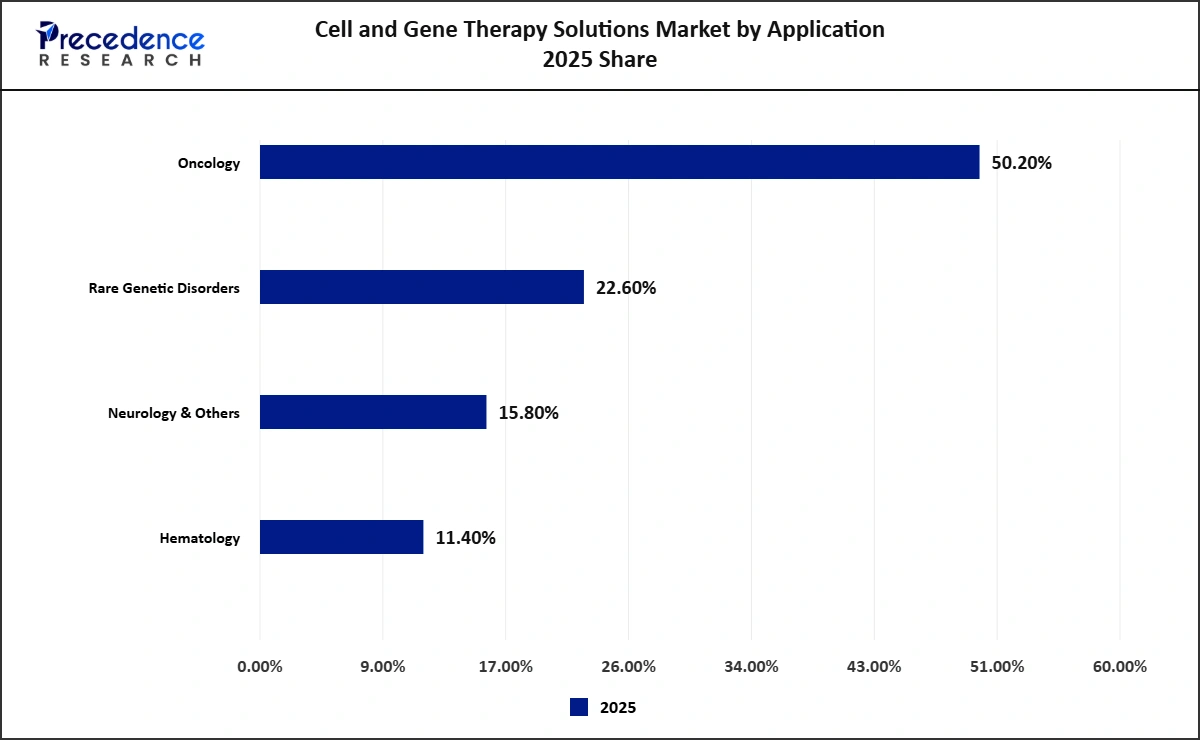
Cell and Gene Therapy Solutions Market by Application 2025 Share
Note: 2025 is the base year; 2035 values are forecasts.
Sources: Expert interviews, secondary sources, Precedence Research database, and Precedence Research analysts.
Oncology accounted for 50.20% (USD 12.45 billion) in 2025; rare genetic disorders for 22.60% (USD 5.60 billion); neurology and others for 15.80% (USD 3.92 billion); and hematology for 11.40% (USD 2.83 billion).
Oncology: This segment accounted for 50.20% (USD 12.45 billion) of the cell and gene therapy solutions market in 2025 and is projected to reach USD 38.80 billion by 2035, expanding at a CAGR of 12.04% from 2026 to 2035. Cancer is the most prominent field, with CAR-T treatments leading the way in treating blood cancers and solid tumors.
Rare Genetic Disorders: This segment accounted for 22.60% (USD 5.60 billion) of the cell and gene therapy solutions market in 2025 and is projected to reach USD 20.67 billion by 2035, expanding at a CAGR of 13.94% from 2026 to 2035. Rare genetic disorders, such as spinal muscular atrophy, hemophilia, sickle cell disease, and muscular dystrophies, are the fastest-growing application as more gene therapies and gene editing treatments are approved.
Neurology & Others: This segment accounted for 15.80% (USD 3.92 billion) of the cell and gene therapy solutions market in 2025 and is projected to reach USD 12.65 billion by 2035, expanding at a CAGR of 12.44% from 2026 to 2035. Neurology and others include gene therapies for neurological and eye diseases and cell therapies for autoimmune and cardiovascular diseases.
Hematology: This segment accounted for 11.40% (USD 2.83 billion) of the cell and gene therapy solutions market in 2025 and is projected to reach USD 9.13 billion by 2035, expanding at a CAGR of 12.44% from 2026 to 2035. Hematology includes gene therapies and edited cell therapies for blood disorders such as sickle cell disease and beta-thalassemia.
Cell and Gene Therapy Solutions Market by End User 2025 Share & Size
| Segments | 2025 Share | 2025 Value (USD Billion) | 2035 Value (USD Billion) | CAGR 2026–2035 |
| Biotech Startups & Clinical-Stage Developers | 45.00% | 11.16 | 34.75 | 12.03% |
| Large Biopharma | 33.60% | 8.33 | 29.38 | 13.43% |
| Academic & Research Institutes | 13.20% | 3.27 | 10.56 | 12.43% |
| Hospitals & Others | 8.20% | 2.03 | 6.56 | 12.43% |
Note: 2025 is the base year; 2035 values are forecasts.
Sources: Expert interviews, secondary sources, Precedence Research database, and Precedence Research analysts.
Biotech startups and clinical-stage developers accounted for 45.00% (USD 11.16 billion) in 2025; large biopharma for 33.60% (USD 8.33 billion); academic and research institutes for 13.20% (USD 3.27 billion); and hospitals and others for 8.20% (USD 2.03 billion).
Biotech Startups & Clinical-Stage Developers: This segment accounted for 45.00% (USD 11.16 billion) of the cell and gene therapy solutions market in 2025 and is projected to reach USD 34.75 billion by 2035, expanding at a CAGR of 12.03% from 2026 to 2035. Biotech startups and clinical-stage developers are the largest end users because most CGT programs are run by smaller companies that rely heavily on external tools and manufacturing.
Large Biopharma: This segment accounted for 33.60% (USD 8.33 billion) of the cell and gene therapy solutions market in 2025 and is projected to reach USD 29.38 billion by 2035, expanding at a CAGR of 13.43% from 2026 to 2035. Large biopharma companies are the fastest-growing end users as they acquire and commercialize CGTs and sign long-term supply agreements, such as Bristol Myers Squibb's lentiviral vector agreement with Oxford Biomedica.
Academic & Research Institutes: This segment accounted for 13.20% (USD 3.27 billion) of the cell and gene therapy solutions market in 2025 and is projected to reach USD 10.56 billion by 2035, expanding at a CAGR of 12.43% from 2026 to 2035. Academic and research institutes develop early-stage therapies and run academic manufacturing facilities.
Hospitals & Others: This segment accounted for 8.20% (USD 2.03 billion) of the cell and gene therapy solutions market in 2025 and is projected to reach USD 6.56 billion by 2035, expanding at a CAGR of 12.43% from 2026 to 2035. Hospitals and others include treatment centers performing point-of-care manufacturing and handling.
Analyst View: Segment value was assigned by associating expenditure incurred on development by developers with the therapies, products, indications, and recipients using supplier revenue profiles and pipeline data. Cell therapy manufacturing services, oncology, and biotech developers lead. We expect gene therapy, analytical testing, rare diseases, and large biopharma to gain share.
Regional Analysis
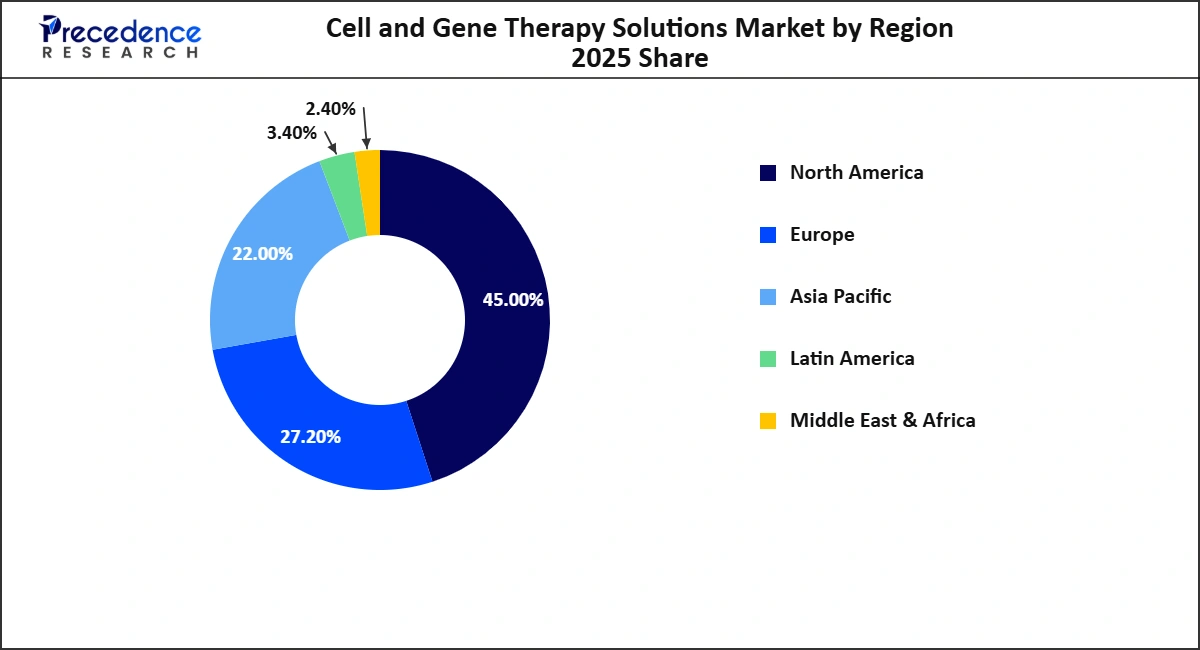
Cell and Gene Therapy Solutions Market by Region 2025 Share
Note: 2025 is the base year; 2035 values are forecasts.
Sources: Expert interviews, secondary sources, Precedence Research database, and Precedence Research analysts.
North America accounted for 45.00% (USD 11.16 billion) in 2025; Europe for 27.20% (USD 6.75 billion); Asia Pacific for 22.00% (USD 5.46 billion); Latin America for 3.40% (USD 0.84 billion); and the Middle East and Africa for 2.40% (USD 0.60 billion). North America dominates, while Asia Pacific is growing rapidly.
North America: This region accounted for 45.00% (USD 11.16 billion) of the cell and gene therapy solutions market in 2025 and is projected to reach USD 34.36 billion by 2035, expanding at a CAGR of 11.90% from 2026 to 2035. The United States has the largest number of CGT developers, approved products, and clinical trials, strong FDA engagement through its advanced therapy programs, and many CDMOs and tool suppliers in Boston, Philadelphia, North Carolina, and California.
Europe: This region accounted for 27.20% (USD 6.75 billion) of the cell and gene therapy solutions market in 2025 and is projected to reach USD 21.53 billion by 2035, expanding at a CAGR of 12.30% from 2026 to 2035. Europe has strong advanced therapy research, the UK's Cell and Gene Therapy Catapult, major CDMOs such as Lonza and Oxford Biomedica, and tool suppliers such as Miltenyi Biotec, Merck KGaA, and Sartorius.
Asia Pacific: This region accounted for 22.00% (USD 5.46 billion) of the cell and gene therapy solutions market in 2025 and is projected to reach USD 20.77 billion by 2035, expanding at a CAGR of 14.30% from 2026 to 2035. Asia Pacific is the fastest-growing region, driven by China's large CAR-T pipeline and approvals, Japan's conditional approval pathway for regenerative medicine, South Korea's biotech sector, and growing CDMO capacity.
Latin America: This region accounted for 3.40% (USD 0.84 billion) of the cell and gene therapy solutions market in 2025 and is projected to reach USD 2.69 billion by 2035, expanding at a CAGR of 12.30% from 2026 to 2035. Latin America is supported by early cell therapy programs and academic manufacturing in Brazil and Argentina.
Middle East & Africa: This region accounted for 2.40% (USD 0.60 billion) of the cell and gene therapy solutions market in 2025 and is projected to reach USD 1.90 billion by 2035, expanding at a CAGR of 12.30% from 2026 to 2035. The Middle East and Africa are supported by new cell therapy centers and investments in Saudi Arabia, the UAE, and Israel.
Analyst View: Regional shares were built from developer spending and manufacturing capacity in each region. North America leads because of its pipeline and approvals. The growth premium is attributed to Asia Pacific because pipeline and manufacturing capacity growth are highest in that region.
Competitive Landscape
Top 10 Companies in the Cell and Gene Therapy Solutions Market, 2025
| Rank | Company Name | Market-Specific Revenue (USD Billion) | 2025 Share | Key Products/Business | Headquarters |
| 1 | Thermo Fisher Scientific | 2.20 | 8.87% | CTS products, viral vector and cell therapy services | United States |
| 2 | Danaher (Cytiva, Pall, Aldevron) | 1.90 | 7.66% | Plasmids, reagents, bioprocessing and gene editing | United States |
| 3 | Lonza | 1.60 | 6.45% | Cell and gene CDMO and Cocoon platform | Switzerland |
| 4 | Merck KGaA (MilliporeSigma) | 1.20 | 4.84% | Viral vector CDMO and reagents | Germany |
| 5 | Miltenyi Biotec | 0.70 | 2.82% | CliniMACS Prodigy and reagents | Germany |
| 6 | Charles River Laboratories | 0.60 | 2.42% | Cell and gene CDMO and testing | United States |
| 7 | Catalent | 0.60 | 2.42% | Gene therapy manufacturing | United States |
| 8 | Sartorius | 0.50 | 2.02% | Bioprocessing for advanced therapies | Germany |
| 9 | Bio-Techne | 0.30 | 1.21% | GMP proteins and cell therapy reagents | United States |
| 10 | Oxford Biomedica | 0.22 | 0.89% | Lentiviral and AAV vector CDMO | United Kingdom |
Note: Company revenues and shares are 2025 estimates.
Sources: Company press releases, expert interviews, secondary sources, Precedence Research database and Precedence Research analysts.
Thermo Fisher Scientific led the cell and gene therapy solutions market with an estimated 8.87% (USD 2.20 billion) of 2025 revenue, followed by Danaher (Cytiva, Pall, Aldevron) at 7.66% (USD 1.90 billion) and Lonza at 6.45% (USD 1.60 billion). Thermo Fisher Scientific leads with CTS cell therapy reagents and instruments and viral vector and cell therapy manufacturing services. Danaher supplies plasmids through Aldevron, gene editing reagents through IDT and bioprocessing through Cytiva and Pall, and Lonza is a leading cell and gene therapy CDMO. Merck KGaA, Miltenyi Biotec, Charles River, Catalent, Sartorius, Bio-Techne and Oxford Biomedica compete through viral vector services, closed processing systems, CDMO and testing services, gene therapy manufacturing, bioprocessing, GMP reagents and lentiviral vectors.
The leading 10 firms derived 39.60% of revenue, which amounts to USD 9.82 billion in 2025, while the remaining 60.40% (USD 14.98 billion) was distributed amongst several smaller CDMOs, reagents, test labs, and logistics providers. The cell and gene therapy solutions market is fragmented across tools, services, and logistics, and competition centers on GMP quality, capacity and speed, technical expertise, regulatory track record, automation, cost per dose, and long-term supply reliability. CDMO capacity is consolidating after a period of overbuilding.
Companies Ecosystem
The cell and gene therapy solutions ecosystem links raw material and reagent suppliers with instrument makers, CDMOs, testing laboratories, logistics providers, developers, and treatment centres.
| Ecosystem Stage | Role in the Market | Key Companies |
| Reagents & Materials | Supply media, cytokines, plasmids, and editing tools | Thermo Fisher, Danaher, Bio-Techne, Merck KGaA |
| Instruments & Automation | Supply closed processing and bioreactors | Miltenyi Biotec, Lonza, Sartorius, Celltrio |
| CDMOs | Manufacture vectors and cell therapies | Lonza, Catalent, Charles River, Oxford Biomedica |
| Testing & Logistics | Test and ship therapies | Testing labs, Cryoport, specialty distributors |
| Developers & Providers | Develop and administer therapies | Biotech companies, large biopharma, treatment centres |
Sources: Company press releases, expert interviews, secondary sources, Precedence Research database and Precedence Research analysts.
Precedence Research Companies Quadrant
The Precedence Research Companies Quadrant positions key participants in the cell and gene therapy solutions market by market strength, reflecting revenue scale, market share and geographic reach, and by innovation and growth strategy, reflecting product portfolio breadth, R&D intensity, and partnerships. Positions reflect each company's estimated 2025 CGT solutions revenue and our assessment of its technology, capacity, and partnerships.
Sources: Company press releases, expert interviews, secondary sources, Precedence Research database and Precedence Research analysts.
Leaders: Thermo Fisher Scientific, Danaher (Cytiva, Pall, Aldevron), Lonza, Merck KGaA (MilliporeSigma), Miltenyi Biotec, and Charles River Laboratories combine large revenue with broad tools, reagents, and manufacturing services.
Challengers: Catalent is big in terms of volume, but has issues regarding restructuring/utilization.
Innovators: Sartorius, Bio-Techne, and Oxford Biomedica provide GMP reagents and know-how on viral vectors.
Recent Developments
- March 2026: Oxford Biomedica reported 2025 revenue of GBP 168.7 million, up 31%, acquired an FDA-approved viral vector facility in Durham, North Carolina, and signed a multi-year lentiviral vector supply agreement with Bristol Myers Squibb in February 2026.
- June 2025: Celltrio closed a USD 15 million funding round led by Premier Partners to scale its RoboCell automated cell culture and cell therapy manufacturing platform.
Cell and Gene Therapy Solutions Market Segments
By Therapy Type
- Cell Therapy Solutions
- Gene Therapy Solutions
By Offering
- Process Development & Manufacturing Services
- Tools, Reagents & Consumables
- Instruments & Equipment
- Analytical Testing & QC
- Logistics & Commercialization Services
By Application
- Oncology
- Rare Genetic Disorders
- Neurology & Others
- Hematology
By End User
- Biotech Startups & Clinical-Stage Developers
- Large Biopharma
- Academic & Research Institutes
- Hospitals & Others
By Region
- North America (U.S., Canada, Mexico)
- Europe (Germany, U.K., France, Italy, Spain, Rest of Europe)
- Asia Pacific (China, Japan, India, South Korea, Taiwan, Rest of Asia Pacific)
- Latin America (Brazil, Argentina, Rest of Latin America)
- Middle East & Africa (GCC, South Africa, Rest of MEA)
Research Methodology
The cell and gene therapy solutions market was defined as process development and manufacturing services, tools, reagents and consumables, instruments, analytical testing, and logistics services for CGTs, worldwide. The 2025 base year was built bottom-up from developer spending by therapy type, offering, application, end user, and region, based on program numbers and batch costs, and checked top-down against published tools and reagents and manufacturing services estimates and supplier revenues. Segment, regional, and company values were allocated from therapy types, offerings, applications, end users, and regional activity. Key estimates were verified by cross-checking company disclosures, regulatory and industry data, and published third-party estimates, and inputs that could not be reconciled were excluded. All segment, regional, and company figures were reconciled to the same 2025 base year, and the 2026-2035 forecast, which applies a constant CAGR from the 2025 base, was recalculated and validated.
Analyst View: Overall Market
The cell and gene therapy solutions market grows with the advanced therapy pipeline, and its value is shifting towards automation, testing, and long-term manufacturing partnerships. The estimate is based on demand, spend on development and programs, and batch costs. The market is therefore driven by approvals, funding, and outsourcing. Key drivers are new indications and automation, while key risks are funding cycles and pricing pressure.
Sources and References
- Oxford Biomedica. "Preliminary results for the year ended 31 December 2025". March 2026. Company results. https://oxb.com/news/preliminary-results-for-the-year-ended-31-december-2025/
- Medical Design & Development. "Celltrio Raises $15M to Expand Cell and Gene Therapy Automation". June 2025. News. https://www.medicaldesigndevelopment.com/topics/equipment/news/22943706/celltrio-raises-15m-to-expand-cell-and-gene-therapy-automation
For inquiries regarding discounts, bulk purchases, or customization requests, please contact us at sales@precedenceresearch.com
Frequently Asked Questions





Ask For Sample
No cookie-cutter, only authentic analysis – take the 1st step to become a Precedence Research client
 Get a Sample




 sales@precedenceresearch.com
 Schedule a Meeting