



5G Customer Premises Equipment Market Revenue to Attain USD 51.29 Bn by 2035
Published: 14 Apr 2026
Author: Precedence Research



5G Customer Premises Equipment Market Revenue and Trends 2026 to 2035
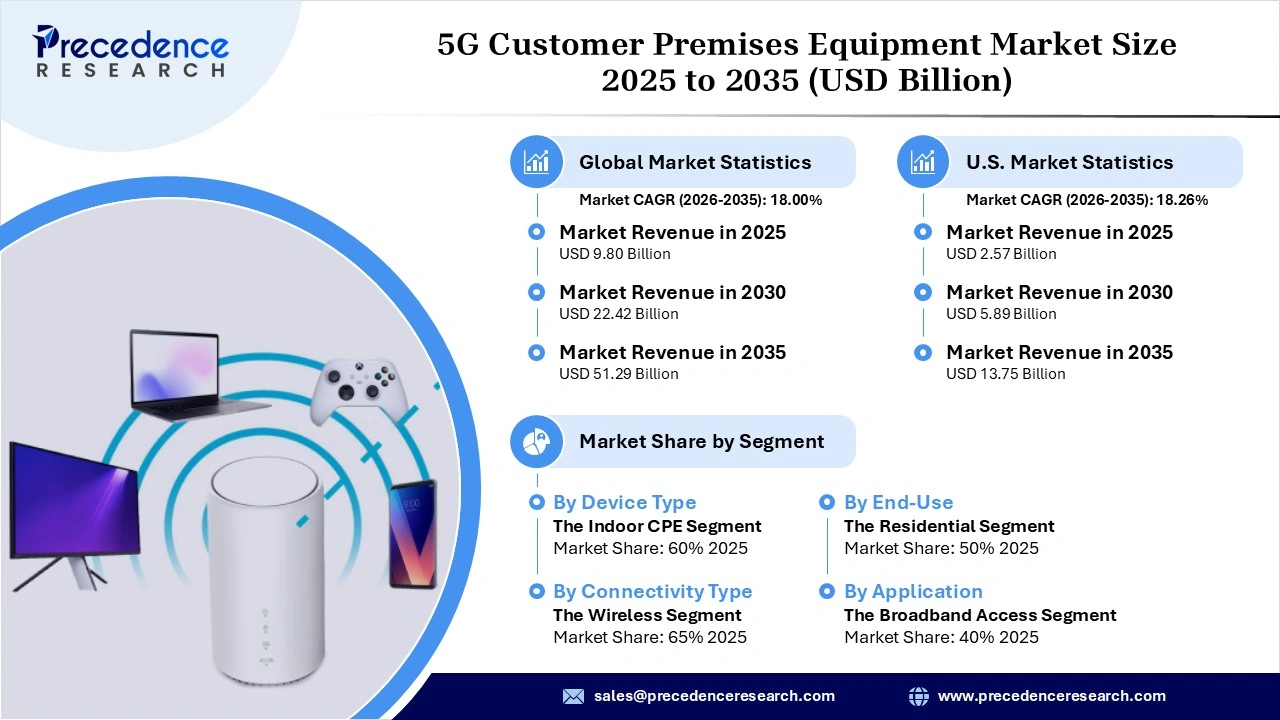
The global 5G customer premises equipment market revenue reached USD 9.80 billion in 2025 and is predicted to attain around USD 51.29 billion by 2035 with a CAGR of 18.00%. The market is driven by the increasing demand for fast connectivity services, deployment of 5G infrastructure, growing use of smart home applications, and the increasing requirement for low-latency broadband solutions.
Connecting the Future: Delivering Ultra-Fast Connectivity
The 5G customer premises equipment market comprises devices and infrastructure installed by consumers, such as routers, gateways, and modems, which facilitate 5G network connectivity. This market goes beyond the conventional broadband to include solutions that support ultra-fast internet, low latency, and connectivity solutions, including IoT, edge computing, and smart devices.
The deployment of 5G customer premises equipment spans both indoor and outdoor applications, catering to residential, business, and industrial environments. This market offers flexible connectivity solutions tailored to the diverse needs of users. As digital transformation accelerates across industries, the demand for these solutions grows, making them essential for delivering robust and scalable connectivity services.
What Drives the Market?
Innovation in Next-Gen Wireless Connectivity Technologies
Constant innovation in new wireless connectivity solutions like 5G Advanced(5G-A), Wi-Fi 7/8, and AI-based networking is rapidly improving the ability of devices to handle larger workloads. These technologies allow for faster data transfer rates, greater spectral efficiencies, and support for bandwidth-intensive applications such as video, gaming, industrial IoT, and cloud computing applications.
- In 2026, ZTE unveiled the first generation of AI-based 5G Advanced Wi-Fi 8 CPE products at MWE Barcelona 2026, with maximum speed reaching up to 10 Gbps.
Integration With Edge Computing and Intelligent Network Ecosystems
The integration of connectivity hardware with technologies like multi-access edge computing (MEC), AI, and cloud-based network architectures is transforming these solutions into intelligent platforms. These platforms can process data locally, optimizing services in real-time. This convergence reduces latency, improves bandwidth efficiency, and supports the seamless operation of complex applications such as industrial automation, immersive digital experiences, and enterprise communication.
- In 2025, Ericsson collaborated with GCI Communication Corporation to integrate a cloud-native dual-mode 5G core network in Alaska.
Government Initiatives to Expand Broadband Connectivity
Government-sponsored projects for developing digital infrastructure have become vital for improving broadband connectivity, especially in rural areas where the existing wired network is less developed. Projects involving investment in the backbone fiber network, last-mile connectivity, and other public broadband projects are helping to enhance digital inclusion while laying the groundwork for future technologies like 5G and IoT deployments.
In 2026, the Government of Andhra Pradesh collaborated with the Department of Telecommunications (India) as part of the amended BharatNet Project to improve broadband connectivity in almost 5 lakh rural households.
Quarter Trillion Dollar Network Upgrade to Transform Future Connectivity
In March 2026, AT&T revealed its intentions to make investments of more than USD 250 billion in the upcoming five years for improving fiber broadband, 5G home broadband, and satellite infrastructure in the U.S. This announcement comes after the firm’s previous network investment amounting to USD 145 billion from 2019 to 2023. The company gained around USD 1.06 billion from the USD 42.5 billion BEAD broadband initiative.
Market Segmentation Overview
- By Device Type: The indoor CPE segment led the 5G customer premises equipment market with 60% share in 2025. This is because it is extensively used in households and offices, where it offers reliability, ease of installation, and affordability without any complicated outdoor installations.
- By Device Type: The outdoor CPE segment is expected to expand at the highest CAGR during the forecast period, owing to its capabilities to offer better signal reception and wider coverage in places where indoor signal strength is low.
- By Connectivity Type: The wireless segment dominated the 5G customer premises equipment market with 65% share in 2025, owing to its high degree of flexibility and ability to be deployed faster since it depends less on physical cables. The increasing use of fixed wireless technologies and the need for affordable solutions for the last-mile connectivity are further driving the market growth of this segment.
- By Connectivity Type: The wired segment held the second largest market share of 35% in 2025, as it provides a highly stable and low-latency connection at constant speed, which made it popular in enterprise networks. The wired connectivity solutions are slowly fading out because wireless connections provide quicker installation and lower cost.
- By End-Use: The residential segment led the market with 50% share in 2025, due to the growing popularity of high-speed home internet connections, which are required for working, studying, and digital entertainment. The fast proliferation of smart devices in households has been accompanied by an increase in demand for in-house connectivity solutions.
- By End-Use: The commercial segment held the second largest market share of 30% in 2025, owing to high demand for connectivity in offices, retail stores, and hospitality establishments. The rising use of cloud computing and digital payment technologies has further fueled the adoption of 5G CPEs in this segment.
- By Application: The broadband access segment dominated the 5G customer premises equipment market with 40% share in 2025. This is due to the increasing requirement for high-speed internet connectivity within residential and business settings to facilitate applications requiring intensive data transfer.
- By Application: The smart home segment held the second largest market share of 20% in 2025, because of increasing adoption of smart devices like smart lights, security systems, and voice assistants that depend on reliable high-speed home connectivity.
Regional Analysis
North America led the 5G customer premises equipment market with 35% share in 2025, owing to the early implementation of the latest broadband technologies and significant expenditure on network infrastructures. This region has high broadband penetration levels and fixed wireless access service deployments. Massive launches of 5G-based home internet offerings by top telecommunication service providers in the U.S. led the market. Growing broadband initiatives in rural areas in Canada have ensured constant development of connectivity infrastructure.
Asia Pacific is expected to expand at the highest CAGR during the forecast period due to the rapid build-out of 5G networks and high demand for high-speed broadband in highly populated areas. This region is witnessing a growing trend of digital transformation and the adoption of fixed wireless access technology that provides an economical option to establish connectivity facilities. China led the market in Asia Pacific due to the widespread installation of 5G base stations and indigenous equipment production. In India, initiatives taken by the government for broadband rollout and greater residential internet usage are helping drive market growth.
5G Customer Premises Equipment Market Coverage
| Report Attribute | Key Statistics |
| Market Revenue in 2025 | USD 9.80 Billion |
| Market Revenue by 2035 | USD 51.29 Billion |
| CAGR from 2026 to 2035 | 18.00% |
| Quantitative Units | Revenue in USD million/billion, Volume in units |
| Largest Market | North America |
| Base Year | 2025 |
| Regions Covered | North America, Europe, Asia-Pacific, Latin America, and the Middle East & Africa |
Top Companies in the 5G Customer Premises Equipment Market
Key players operating in the market, including Huawei Technologies Co. Ltd., ZTE Corporation, Nokia Corporation, and Ericsson AB, focus on delivering end-to-end 5G solutions to ensure seamless interoperability between CPEs and telecom infrastructures. Companies like Qualcomm Technologies Inc. and Samsung Electronics Co., Ltd. enhance performance through innovative 5G modem solutions. Meanwhile, Netgear Inc., Inseego Corp., Sierra Wireless Inc., Fibocom Wireless Inc., Wistron NeWeb Corporation, and CommScope Holding Company Inc. are driving CPE adoption by developing high-speed routers and fixed wireless access devices.
Segments Covered in This Report
By Device Type
- Indoor CPE
- Outdoor CPE
By Connectivity Type
- Wired
- Wireless
By End-Use
- Residential
- Commercial
- Industrial
By Application
- Broadband Access
- Smart Home
- Enterprise Networking
- Industrial IoT
- Others
By Region
- North America
- Latin America
- Europe
- Asia-pacific
- Middle and East Africa
Get this report to explore global market size, share, CAGR, and trends, featuring detailed segmental analysis and an insightful competitive landscape overview @ https://www.precedenceresearch.com/sample/8297
You can place an order or ask any questions, please feel free to contact us at sales@precedenceresearch.com |+1 804 441 9344