



Agentic AI in Digital Engineering Market Revenue to Attain USD 655.48 Bn by 2035
Published: 16 Mar 2026
Author: Precedence Research



Agentic AI in Digital Engineering Market Revenue and Trends 2026 to 2035
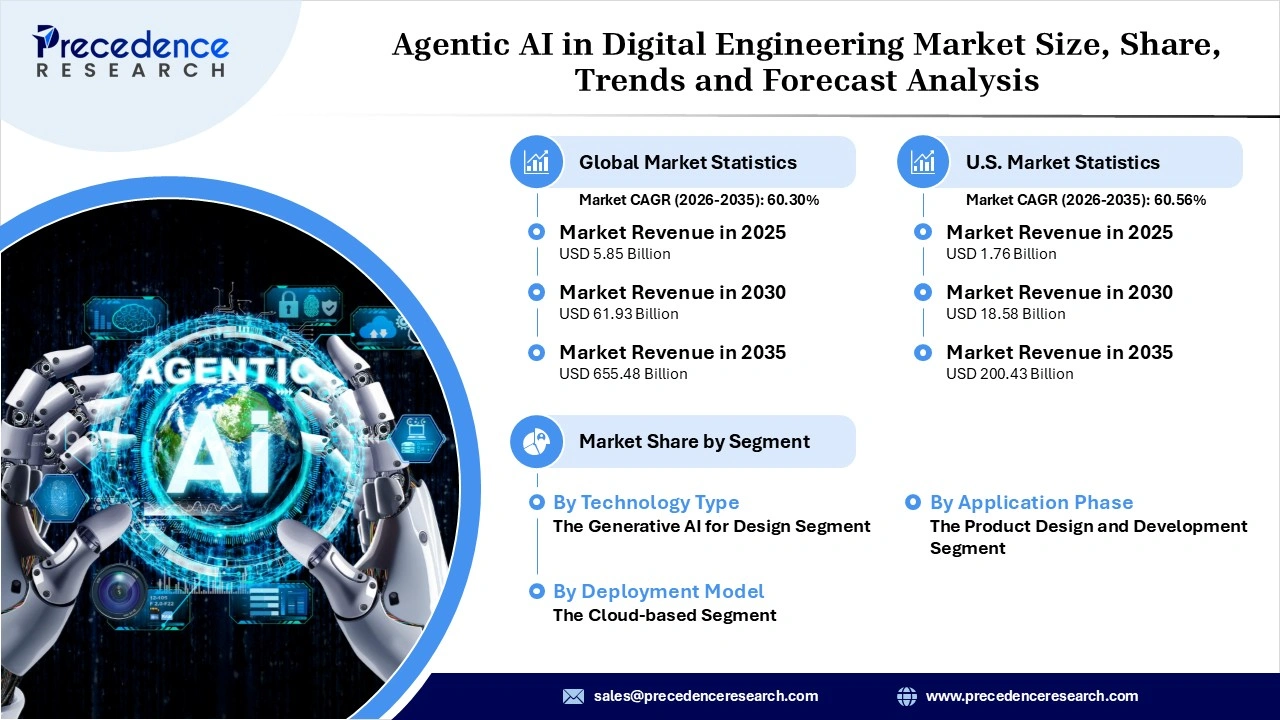
The global agentic AI in digital engineering market revenue reached USD 5.85 billion in 2025 and is predicted to attain around USD 655.48 billion by 2035 with a CAGR of 60.30%. The growth of the market is driven by increasing demand for autonomous decision-making systems, rising adoption of AI-driven automation in engineering workflows, and the need for improved efficiency, faster product development, and intelligent process optimization.
What Drives the Growth of the Agentic AI in Digital Engineering Market?
Agentic artificial intelligence represents a shift from passive automation to goal-driven autonomous systems capable of planning and executing complex workflows. These systems act as proactive digital coworkers, integrating with digital twins and simulation platforms to create adaptive, self-optimizing engineering ecosystems. In digital engineering, Agentic AI enables the management of high-fidelity design processes and rapid prototyping, significantly shortening development cycles and reducing operational downtime. Consequently, market players are increasingly focusing on strategic innovation and the development of advanced digital architectures to strengthen their competitive positioning.
Segment Insights
- By technology type, the generative AI for design segment dominated the market in 2025, driven by its ability to navigate the entire computational design process autonomously. Generative AI enables autonomous performance validation, inserted within multidisciplinary workflows. These systems estimate trade-offs in material chemistry, structural reliability, and aerodynamics through digital twins. It produces hyper-optimized, manufacturable geometries by using a self-correcting feedback loop in highly automated design ecosystems
- By deployment model, the cloud-based segment maintains its leadership in the market in 2025. Its ability to provide the adaptable processing power and data infrastructure essential for autonomous agents to perform complex navigation tasks, such as real- time computational simulations and extensive telemetry analysis. Cloud deployment supports scalable, continuous product development and predictive maintenance. Overall, the segment fosters a hyper- connected innovation environment.
- By application phase, the product design and development segment dominated the market in 2025, driven by the growing adoption of autonomous systems capable of managing the entire product lifecycle. These systems leverage high-reliability simulations to balance structural integrity, weight optimization, and thermal performance. Additionally, self-correcting AI agents can anticipate design trade-offs and optimize geometries in real time. As a result, this segment enables human experts to focus more on innovation while supporting the development of highly intelligent and efficient engineering workflows.
Regional Insights
North America dominated the agentic AI in digital engineering market in 2025, driven by the growing adoption of industrial hyper-automation across sectors such as aerospace and semiconductors. The region benefits from the strong presence of technology innovators and advanced cloud-computing infrastructure that support the deployment of autonomous AI agents. These systems manage complex product lifecycles, from generative design to real-time supply chain optimization. Additionally, the region is increasingly focused on building resilient, self-correcting digital pipelines that accelerate the transition from concept to intelligent production.
Asia Pacific is anticipated to grow at the fastest CAGR during the forecast period, driven by the rapid adoption of industrial intelligence across the region’s extensive manufacturing sector and supportive digital transformation initiatives. Autonomous frameworks are increasingly integrating with large industrial datasets to enable self-correcting supply chains and autonomous shop-floor operations. Additionally, the combination of strong AI capabilities and robust manufacturing infrastructure is fostering a collaborative environment for the development of resilient, self-evolving engineering systems.
Agentic AI in Digital Engineering Market Coverage
| Report Attribute | Key Statistics |
| Market Revenue in 2025 | USD 5.85 Billion |
| Market Revenue by 2035 | USD 655.48 Billion |
| CAGR from 2026 to 2035 | 60.30% |
| Quantitative Units | Revenue in USD million/billion, Volume in units |
| Largest Market | North America |
| Base Year | 2025 |
| Regions Covered | North America, Europe, Asia-Pacific, Latin America, and the Middle East & Africa |
Recent Development
- In March 2026, Tech Mahindra announced a major strategic partnership to launch an ontology-driven Agentic platform built on Microsoft Fabric and Azure AI Foundry. The collaboration focuses on accelerating telecom and enterprise data modernization through real-time multi-agent orchestration. (Source: https://www.techmahindra.com)
Get this report to explore global market size, share, CAGR, and trends, featuring detailed segmental analysis and an insightful competitive landscape overview @ https://www.precedenceresearch.com/sample/8036
You can place an order or ask any questions, please feel free to contact us at sales@precedenceresearch.com |+1 804 441 9344