



AI Data Center and Power Consumption Market Revenue to Attain USD 70.59 Bn by 2035
Published: 21 Apr 2026
Author: Precedence Research



AI Data Center and Power Consumption Market Revenue and Trends 2026 to 2035
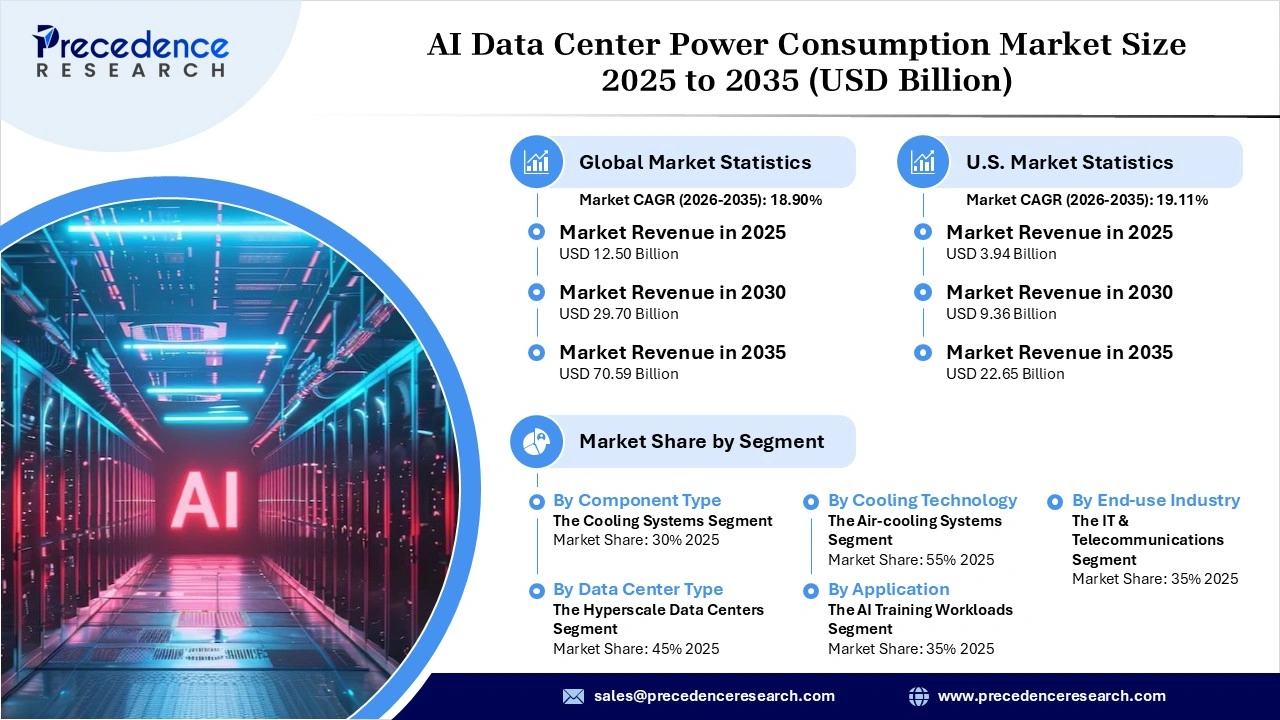
The global AI data center and power consumption market revenue surpassed USD 12.50 billion in 2025 and is predicted to attain around USD 70.59 billion by 2035, growing at a CAGR of 18.90%. The market is driven by the growing need for high-performance computing and the expanding use of AI applications with significant energy needs.
Market Overview
The AI data center and power consumption market involves organizations that provide, manage, and optimize the power necessary to operate data centers specialized in AI applications. It includes various types of power equipment such as power distribution units, energy storage systems, cooling systems, and other energy management tools.
The scope of this market ranges from conventional data centers to hyperscale data centers and cloud service providers using AI-based services. It also encompasses initiatives to enhance power efficiency and introduce renewable energy sources for powering AI operations.
What are the Major Trends Driving the Market?
Development of Advanced Liquid Cooling and Efficient Power Delivery
The emerging technologies in the AI data center and power consumption market include liquid cooling systems for direct chip cooling, which can help to curb the excess heat produced by AI processors. As opposed to conventional air cooling, liquid cooling offers efficient thermal management, denser architectural design of servers, and optimal usage of energy. The move toward high-voltage power systems helps to enhance the efficiency of power delivery, ensuring stable performance of high-performance AI applications in data centers.
- In 2025, in collaboration with NVIDIA, Delta Electronics unveiled an innovative 800 VDC system to increase the power efficiency in high-density AI data centers.
Adoption of Smart Energy Optimization and Sustainable Computing
There is a growing trend towards the adoption of energy optimization systems using AI, carbon-aware computing workload scheduling, and grid-aware data center management. These technologies allow data centers to allocate computing resources according to changes in electrical demand and energy availability, which leads to optimal usage of energy. This development will help companies optimize energy usage bills and improve their sustainability performance through the adoption of renewable energy.
- In 2025, Amazon Web Services (AWS) adopted carbon-aware computing and energy optimization methods that allow workloads to be allocated to regions with cleaner energy sources.
Sustainable Energy Policies to Improve Digital Infrastructure
Governments are promoting sustainable development in data centers using renewable energy, increasing grid capacity, and regulating energy consumption. The intention behind such policies is to secure power supplies that are necessary for AI operations in a sustainable way. The governments are helping companies to adopt renewable energy sources for their computing centers by investing in the installation of production-scale battery systems and energy storage systems.
- In 2026, India achieved 50% non-fossil fuel-based capacity of electricity production, indicating an ongoing shift towards renewable energy systems to sustain energy-intensive digital and computing technology infrastructure.
Global Data Centers Electricity Consumption
As illustrated in the figure, total data center power consumption is projected to rise from 448 TWh in 2025 to 980 TWh in 2030, representing a 119% increase. The additional 532 TWh of demand will be driven primarily by AI servers, accounting for 64% of the growth, while traditional servers contribute 9%. The remaining 21% of the increase will be consumed by supporting data center infrastructure.
Market Segmentation Overview
- By Component: The cooling systems segment led the AI data center and power consumption market with a 30% share in 2025, since AI computing centers have GPUs and CPUs, which are energy-intensive and produce a lot of heat constantly, thus requiring sophisticated cooling solutions to avoid overheating and ensure efficient energy consumption.
- By Component: The uninterruptible power supply (UPS) systems segment held the second-largest market share of 25% in 2025 because AI data centers need a constant power supply to ensure that there is no failure, loss of data, and hardware damage when there is an unpredictable electricity supply.
- By Cooling Technology: The air cooling systems segment dominated the market with a 55% share in 2025, owing to its extensive adoption, cost-effectiveness, and ease of implementation in medium-density data centers.
- By Cooling Technology: The liquid cooling systems segment is expected to expand at the highest CAGR during the forecast period, as there has been a rapid rise in AI workload density, thus putting air cooling techniques under strain, and hence, liquid cooling becomes more effective in extracting high heat loads.
- By Application: The AI training workloads segment led the AI data center and power consumption market with a 35% share in 2025, since it needs the most advanced computing capabilities and sustained processing operations in the data farms, hence demanding maximum infrastructure and power consumption.
- By Application: The generative AI & LLMs segment is expected to grow at the fastest rate from 2026 to 2035, due to its widespread use across various sectors, leading to a rapid surge in the demand for computational resources for training and inference, along with significant data processing requirements.
- By End-Use Industry: The IT & telecommunications segment dominated the market with 35% share in 2025, because it comprises data centers and network infrastructure that facilitate cloud computing and deal with data traffic, generating a significant need for AI-based processing techniques.
- By End-Use Industry: The healthcare segment is expected to expand at the highest CAGR during the forecast period, owing to the fast-paced integration of AI in hospitals and life science institutions, which boosts the need for powerful computing technologies.
Regional Analysis
North America led the AI data center and power consumption market with a 42% share in 2025, owing to its well-developed hyperscale data center infrastructure and early adoption of AI-driven technologies. The United States dominated the region due to the strong presence of major cloud and AI companies that continue to expand large-scale data center capacity. Canada also contributed significantly, driven by the growing number of computing facilities and increasing adoption of AI and cloud-based services.
Asia Pacific is expected to grow at the fastest rate from 2026 to 2035, fueled by rapid digitalization, rising cloud adoption, and increasing demand for AI-driven computing infrastructure. China leads the region due to its strong cloud and AI infrastructure and continuous expansion of large-scale computing facilities, while India is witnessing significant growth driven by rising IT service demand, data localization policies, and increasing adoption of cloud and AI-powered solutions.
AI Data Center and Power Consumption Market Coverage
| Report Attribute | Key Statistics |
| Market Revenue in 2025 | USD 12.50 Billion |
| Market Revenue by 2035 | USD 70.59 Billion |
| CAGR from 2026 to 2035 | 18.90% |
| Quantitative Units | Revenue in USD million/billion, Volume in units |
| Largest Market | North America |
| Base Year | 2025 |
| Regions Covered | North America, Europe, Asia-Pacific, Latin America, and the Middle East & Africa |
Top Companies in the AI Data Center and Power Consumption Market
Key players such as Schneider Electric SE, Vertiv Holdings Co., ABB Ltd., Siemens AG, and Eaton Corporation focus on developing critical power infrastructure for data centers. Delta Electronics Inc., Legrand SA, and Rittal GmbH & Co. KG specialize in power distribution, busway systems, and enclosure solutions. Huawei Technologies Co. Ltd. and Johnson Controls International plc provide advanced power and thermal management solutions. Meanwhile, NVIDIA Corporation, Intel Corporation, Microsoft Corporation, Amazon Web Services, and Google LLC are heavily investing in AI data center infrastructure, including high-performance AI clusters and advanced cooling technologies such as liquid cooling and direct-to-chip cooling.
Segments Covered in the Report
By Component
- Power Distribution Units (PDUs)
- Uninterruptible Power Supply (UPS) Systems
- Cooling Systems (Liquid Cooling, Air Cooling)
- Power Monitoring & Management Software
- Backup Generators & Energy Storage Systems
By Data Center Type
- Hyperscale Data Centers
- Colocation Data Centers
- Enterprise Data Centers
- Edge Data Centers
By Cooling Technology
- Air Cooling Systems
- Liquid Cooling Systems (Direct-to-Chip, Immersion Cooling)
- Hybrid Cooling Solutions
By Application
- AI Training Workloads (High-performance Computing)
- AI Inference Workloads
- Generative AI & Large Language Models
- High-density GPU Clusters
- Edge AI Processing
By End-Use Industry
- IT & Telecommunications
- BFSI
- Healthcare
- Retail & E-commerce
- Government & Defense
- Manufacturing
- Others
By Region
- North America
- Latin America
- Europe
- Asia-pacific
- Middle and East Africa
Get this report to explore global market size, share, CAGR, and trends, featuring detailed segmental analysis and an insightful competitive landscape overview @ https://www.precedenceresearch.com/sample/8318
You can place an order or ask any questions, please feel free to contact us at sales@precedenceresearch.com |+1 804 441 9344