



AI Explainability And Transparency Market Revenue to Attain USD 26.51 Bn by 2035
Published: 14 May 2026
Author: Precedence Research



AI Explainability And Transparency Market Revenue and Trends 2026 to 2035
The global AI explainability and transparency market revenue reached USD 3.40 billion in 2025 and is predicted to attain around USD 26.51 billion by 2035 with a CAGR of 22.80%. The market is expanding quickly to understand algorithmic decisions and be conscious about biases in algorithms. This transition turns trust, regulatory compliance, and responsible use of AI into key growth engines.
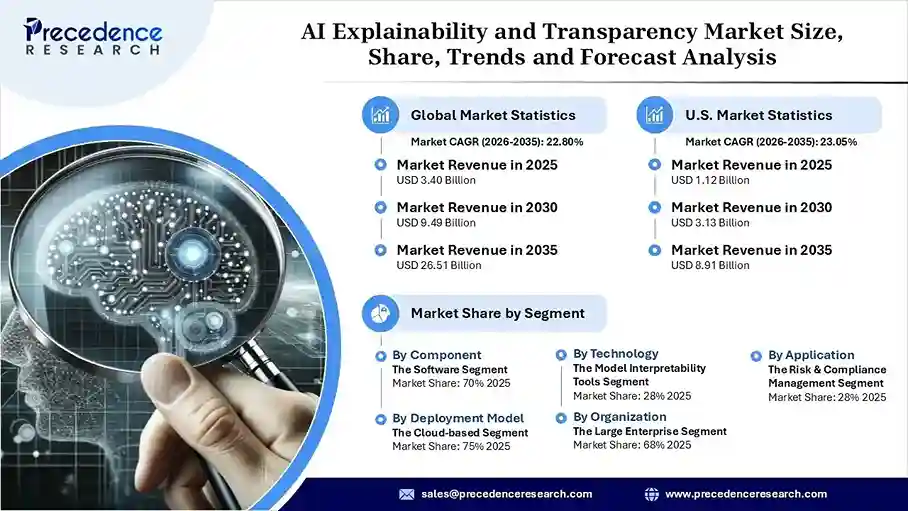
Market at a Glance
The AI explainability and transparency market includes software products and services that help improve the understanding, monitoring, and reliability of AI applications. These tools provide explanations of how models reach their decisions, identify bias in algorithms, trace data lineage effectively, and enable governance accountability. These changes will facilitate organizations to move from an opaque culture to an objective, accountable one, and operational assurance as artificial intelligence is integrated into financial, healthcare, retail, and public administration sectors.
This involves market segments on model interpretation applications, bias detection technologies, audit trails, compliance solutions, and governance services as part of cloud-based and on-premises environments. In industries like banking, healthcare, retail, manufacturing, and government, where comprehending automated decisions is just as important as implementing them, this is all the more important.
Market Forecast for the AI Explainability and Transparency Market
Increasing Demand for Transparency and Explainability
As governments move from discussion to enforcement, companies are being pushed to document how AI systems make decisions. The U.S. NIST AI Risk Management Framework was created to help organizations manage trustworthy AI risks through transparent and accountable practices. That framework is now being used as a practical benchmark across industries. This creates long-term demand for audit tools, model documentation software, and governance platforms.
Rising Use of Explainability in Core AI Services
Microsoft Azure now markets responsible AI capabilities that help organizations manage risk, improve accuracy, reinforce transparency, and simplify compliance. This is significant because once explainability becomes native inside cloud AI stacks, adoption can scale rapidly across thousands of enterprise customers.
Rising Healthcare AI Adoption and Growing Need for Transparency
- The U.S. FDA has approved at least 1,357 AI-enhanced medical devices, approximately twice the number of devices that passed muster until 2022. Such a meteoric rise indicates the growth of healthcare AI technology and underscores the growing push for transparency, explainability, and validation in decision-making systems as additional devices are deployed.
- Between 2021 and October 2025, Reuters identified 1,401 adverse-event reports tied to devices on the FDA’s AI list. Growth in deployment alongside rising incident reports often pushes hospitals and regulators toward stronger AI oversight tools.
- There are 60 FDA-approved AI devices cited in the report from Reuters, who cite 182 recalls in total; estimates show that about 43 percent of the recalls took place within a year of being cleared. Early-stage recalls like these bring increased costs for governance models and software that tracks the process and monitors its results.
Market Segmentation Overview
- By component, the software segment dominated the market with a 70% market share in 2025 and is expected to maintain its leading position with a CAGR of 24.5% in the coming years, as core XAI platforms became the preferred route for enterprises seeking scalable interpretation, monitoring, and governance capabilities. Buyers favored repeatable tools over fragmented manual methods, allowing organizations to embed transparency directly into model development and production workflows.
- By deployment model, the cloud-based segment dominated the market with a 75% market share in 2025 and is expected to maintain its leading position with a CAGR of 26.5% in the coming years, because scalable AI deployment has already become central to enterprise technology strategy. Organizations prefer cloud environments, which are simpler to deploy across multiple locations.
- By technology, the model interpretability tools segment accounted for a considerable revenue share of 28% in the AI explainability and transparency market in 2025, because of core explainability. Enterprises needed clear reasoning behind predictions, approvals, or alerts, making feature importance, decision tracing, and local explanations the earliest and most widely purchased capabilities.
- By technology, the bias detection and fairness tools segment is expected to grow at the fastest CAGR of 25.5% in the market between 2026 and 2035, due to a shift from theoretical discussions about ethical AI to practical implementations. For organizations, the development of risk assessments that predict risks of discrimination, unequal outcomes, and policy violations before delivering models to consumers is predicted to take off, and investments will massively outpace those of model delivery to consumers.
- By organization size, the large enterprises segment held a major revenue share of 68% in the market in 2025, as regulatory compliance pressures were strongest for firms operating at scale. Many firms witnessed increased scrutiny, which compelled them early on to implement explainability systems aimed at minimizing risk, documenting decisions, and safeguarding their reputations.
- By organization size, the small and medium enterprises (SMEs) segment is expected to grow steadily with a CAGR of 27.5% in the market between 2026 and 2035, due to growing accessibility. Subscription-based models and cloud-based systems will allow smaller businesses to leverage explainability solutions offered only to larger companies.
- By application, the risk and compliance management segment accounted for a considerable revenue share of 28% in the AI explainability and transparency market in 2025, because of regulatory requirements that necessitated the use of transparent AI. Businesses wanted thorough records of decisions being made by automated systems, audit trails, and justifiable reasoning, especially in markets where a model output that wasn’t fully explained to an audience may result in penalties or conflicts.
- By application, the healthcare diagnostics segment is expected to expand rapidly in the market with a CAGR of 26.5% in the coming years, as explainable medical AI is established in the clinical arena. Health professionals and health institutions probably want systems that are based on evidence, confidence, and justification before machine suggestions guide the treatment determination.
- By end-use industry, the BFSI segment held the largest market share of 30% in 2025, because compliance and risk controls were deeply tied to lending, fraud detection, underwriting, and customer screening. Financial institutions had stronger incentives to justify algorithmic decisions, making explainability spending both urgent and sustained.
- By end-use industry, the healthcare segment is expected to grow at the fastest CAGR of 26.5% in the market between 2026 and 2035, as diagnostic AI gains wider use across imaging, triage, and patient monitoring. Demand is likely to rise because providers increasingly require transparent outputs before trusting software in high-stakes medical decisions.
Regional Analysis
North America dominated the global AI explainability and transparency market with a market share of 44% in 2025, due to a deep AI ecosystem that includes cloud service providers, enterprise software vendors, startups, and research institutions. Some key sectors, such as finance, healthcare, and retail, were swiftly deploying governance tools to tackle model risk and compliance challenges. Big investments in enterprise AI and a renewed interest in ethical practices for AI were fueling regional demand in the United States.
Asia-Pacific held a market share of 18% in 2025 and is expected to grow at the fastest CAGR of 26.5% in the market during the forecast period, as AI deployment is widening rapidly across consumer platforms, manufacturing, telecom, and public services, while governance frameworks are beginning to take clearer shape. Enterprises increasingly need transparency tools once AI moves from pilot projects into real operations. China is expected to remain a key growth driver owing to advancements in industrial-scale AI plus strong digital ecosystems. Furthermore, India’s demand is expected to rise owing to digitization initiatives in the BFSI and healthcare sectors, and growing policy interest centered around trustworthy AI developments.
AI Explainability and Transparency Market Coverage
| Report Attribute | Key Statistics |
| Market Revenue in 2025 | USD 3.40 Billion |
| Market Revenue by 2035 | USD 26.51 Billion |
| CAGR from 2026 to 2035 | 22.80% |
| Quantitative Units | Revenue in USD million/billion, Volume in units |
| Largest Market | North America |
| Base Year | 2025 |
| Regions Covered | North America, Europe, Asia-Pacific, Latin America, and the Middle East & Africa |
Top Companies in the AI Explainability and Transparency Market
In terms of organizational governance, IBM remains at the forefront with WatsonX governance solutions, and Microsoft has also brought responsible AI tools to Azure and enterprise environments. Google Cloud and Amazon Web Services have built explainability capabilities into their massive machine learning systems for scalable access to governance. Oracle and Salesforce have bolstered their roles by integrating transparent AI functions with enterprise processes, customer data systems, and automation frameworks. DataRobot has expanded its focus from running automated machine learning to governance and lifecycle management as well, while H2O.ai highlights solutions for trustworthy AI at both the open-source and enterprise levels.
Segments Covered in the Report
By Component
- Software
- Services
By Deployment Model
- Cloud-based
- On-premise
By Technology
- Model Interpretability Tools
- Bias Detection & Fairness Tools
- Model Monitoring & Auditing
- Explainable AI (XAI) Frameworks
By Organization Size
- Large Enterprises
- Small & Medium Enterprises (SMEs)
By Application
- Fraud Detection
- Risk & Compliance Management
- Customer Analytics
- Healthcare Diagnostics
- Autonomous Systems
By End-Use Industry
- BFSI
- IT & Telecom
- Healthcare
- Government
- Retail & E-commerce
- Automotive
By Region
- North America
- Europe
- Asia Pacific
- Middle East & Africa
- Latin America
Get this report to explore global market size, share, CAGR, and trends, featuring detailed segmental analysis and an insightful competitive landscape overview @ https://www.precedenceresearch.com/sample/8405
You can place an order or ask any questions. Please feel free to contact us at sales@precedenceresearch.com |+1 804 441 9344