



AI-Powered Embryo Selection Market Revenue to Attain USD 1,747.16 Mn by 2035
Published: 14 Apr 2026
Author: Precedence Research



AI-Powered Embryo Selection Market Revenue and Trends 2026 to 2035
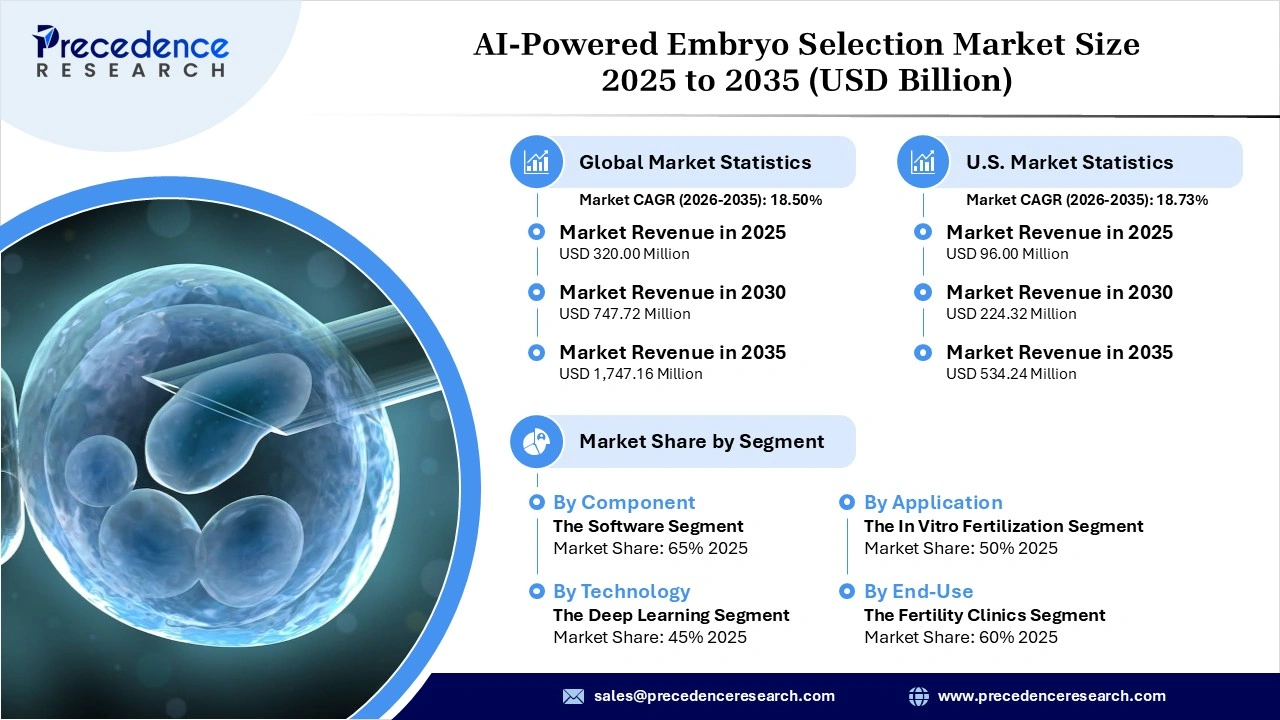
The global AI-powered embryo selection market revenue was valued at USD 320.00 million in 2025 and is expected to attain around USD 1,747.16 million by 2035, growing at a CAGR of 18.50% during forecast period. The growth of the market is driven by high rates of infertility and the need for greater accuracy in embryo selection.
Market Overview
The AI embryo-selection market represents a segment of the advanced reproductive technology field, which involves the use of machine learning techniques to analyze time-lapse microscopy, morphokinetic patterns, and clinical datasets to assess embryo viability. By moving beyond subjective judgments, these AI-driven approaches interpret subtle developmental data, providing more objective and probabilistic predictions on the likelihood of successful implantation. This technological shift enhances the accuracy and efficiency of embryo selection, ultimately improving IVF outcomes and offering a more personalized approach to fertility treatments.
The AI-powered embryo selection market comprises software and imaging technologies designed to optimize embryo selection, reduce cycle failures, and offer predictability in what is traditionally a chaotic process. Beyond just image analysis, the market also focuses on integrated workflow optimization throughout the entire IVF process. Its impact is expanding from fertility clinics to research laboratories, providing valuable insights at every stage of embryo assessment and playing a crucial role in increasing the chances of successful IVF outcomes.
What Drives the Market?
Growing Adoption of AI-powered IVF Tools
The growing adoption of AI-powered IVF tools is driving the market. Nova IVF Fertility, for instance, implemented an AI-based embryo assessment tool across 120 clinics, which resulted in improved pregnancy rates, reduced IVF cycle duration, and enhanced decision transparency. Clinical data suggests that AI can be approximately 12% more accurate in embryo selection, positioning AI as a performance multiplier rather than just a marginal improvement to traditional IVF processes.
Increase Assurance in AI-Powered Models
Startups like Gaia are leveraging AI models that predict IVF success with up to 90% accuracy, which enables innovative financial models where patients only pay for successful birth outcomes. This creates a new opportunity for AI to not only enhance clinical decision-making but also revolutionize the financing and delivery of fertility care, aligning patient costs with treatment success.
IVF Success Rates on the Rise: Key Findings from 2023 SART Report
During National Infertility Awareness Week, the Society for Assisted Reproductive Technology (SART) released its latest data on assisted reproductive technology, highlighting notable trends in IVF success.
- Increased IVF Births: The number of IVF babies born rose from 91,771 in 2022 to 95,860 in 2023, accounting for 2.6% of all U.S. births.
- Higher IVF Cycles: IVF cycles at 371 SART member clinics grew from 389,993 in 2022 to 432,641 in 2023.
- Singleton Births Consistent: The percentage of singleton births from IVF cycles remained high at 96.74%, similar to the previous year.
These findings continue a decades-long trend of growing IVF usage and success, offering hope for those facing infertility challenges.
Market Segmentation Overview
- By component, the software segment held the largest share of 65% in the AI-powered embryo selection market in 2025, as AI algorithms contribute greatly to embryo grading. By leveraging time-lapse image analysis and predictive modeling, software solutions improve assessment methods by consistently decreasing manual bias and improving IVF success rates through accuracy driven by data.
- By component, the service segment held the second-largest share of 35% in 2025, driven by the growing demand for AI integration, system training, data management, and continuous technical support in fertility clinics. Service providers have become key enablers of smooth and uninterrupted clinical adoption of digital solutions in IVF processes.
- By technology, the deep learning segment held a major revenue share of 45% in the AI-powered embryo selection market in 2025, owing to its exceptional capability in interpreting complex embryo images. Its strength in image recognition enabled automated, highly accurate grading systems, reducing reliance on visual approximation and providing consistently reproducible insights.
- By technology, the machine learning segment was the second-largest shareholder, holding a 30% share in 2025, and is expected to grow at a significant rate in the coming years. By utilizing historical and clinical data, machine learning supports the assessment of embryo quality based on known patterns, complementing advanced neural network-based techniques for more effective decision-making.
- By application, the in-vitro fertilization segment accounted for a major market share of 50% in 2025, as AI significantly improved embryo selection accuracy. This advancement led to higher success rates in implantation and fewer repeated cycles, making IVF a more predictable procedure with better outcomes.
- By application, the genetic screening segment was the second-largest shareholder in 2025, driven by AI integration with genomic testing. This has made detecting chromosomal abnormalities easier and more accurate, leading to better embryo selection decisions and enhanced clinical confidence, ultimately improving reproductive outcomes.
- By end-use, the fertility clinics segment led the AI-powered embryo selection market with a 60% share in 2025, driven by high procedural volumes and the need for more efficient methods. By integrating AI, these clinics were able to enhance clinical outcomes and streamline processes, ensuring accuracy and timely results in embryo selection.
- By end-use, the hospitals segment held the second-largest market share of 25% in 2025 and is growing at a significant rate. As hospitals gradually incorporate AI into their reproductive medicine departments, this adoption has steadily improved treatment precision and patient outcomes, marking a broader shift toward data-driven fertility care in medical institutions.
Regional Analysis
North America dominated the global AI- powered embryo selection market with a major share of 40% in 2025, driven by its well-established IVF infrastructure, which is highly systematized and tech-ready. The U.S. plays a key role in the market, with clinics adopting AI-based embryo grading systems to navigate high treatment costs and meet patient demands for better outcomes. Clinics in Canada are gradually incorporating AI in line with established clinical traditions. Additionally, the presence of leading fertility technology providers made the adoption of AI more seamless, transforming it from an innovative concept into an integral part of routine embryology practices.
Asia Pacific is expected to grow at the fastest CAGR during the forecast period, driven by rising infertility rates, the expansion of IVF networks, and an increasing demand for AI solutions. China and India are major contributors to the market, as they face large-scale needs for advanced reproductive technology. Meanwhile, Japan and South Korea contribute with technological sophistication and precision improvements. Across the region, AI is not only improving IVF processes but is also emerging as a key solution to address the growing reproductive challenges.
AI-Powered Embryo Selection Market Coverage
| Report Attribute | Key Statistics |
| Market Revenue in 2025 | USD 320.00 Million |
| Market Revenue by 2035 | USD 1,747.16 Million |
| CAGR from 2026 to 2035 | 18.50% |
| Quantitative Units | Revenue in USD million/billion, Volume in units |
| Largest Market | North America |
| Base Year | 2025 |
| Regions Covered | North America, Europe, Asia-Pacific, Latin America, and the Middle East & Africa |
Top Companies in the AI-Powered Embryo Selection Market
Vitrolife AB and iGenomix have established a strong presence by combining genetics with AI-driven embryo assessment. CooperSurgical Inc. and Genea Biomedx both provide proven IVF solutions to promote general clinical adoption. Emerging companies, including Fairtility Ltd., Alife Health Inc., Overture Life, and AIVF, are breaking away from traditional models by focusing on explainable AI technologies and data-based embryo ranking systems. In the broader life sciences sector, Merck KGaA and Fujifilm Irvine Scientific are enhancing their involvement in AI-augmented fertility treatments, while Nikon Corporation, ZEISS Group, and Hamilton Thorne Ltd. emphasize the use of imaging technologies alongside laboratory expertise to improve IVF outcomes.
Segments Covered in the Report
By Component
- Software
- Services
By Technology
- Machine Learning
- Deep Learning
- Computer Vision
By Application
- In Vitro Fertilization (IVF)
- Genetic Screening
- Embryo Viability Assessment
- Others
By End-Use
- Fertility Clinics
- Hospitals
- Research Institutes
By Region
- North America
- Latin America
- Europe
- Asia-pacific
- Middle and East Africa
Get this report to explore global market size, share, CAGR, and trends, featuring detailed segmental analysis and an insightful competitive landscape overview @ https://www.precedenceresearch.com/sample/8295
You can place an order or ask any questions, please feel free to contact us at sales@precedenceresearch.com |+1 804 441 9344