



Air Cargo Security Screening Systems Market Revenue to Attain USD 2.47 Bn by 2035
Published: 13 Apr 2026
Author: Precedence Research



Air Cargo Security Screening Systems Market Revenue and Trends 2026 to 2035
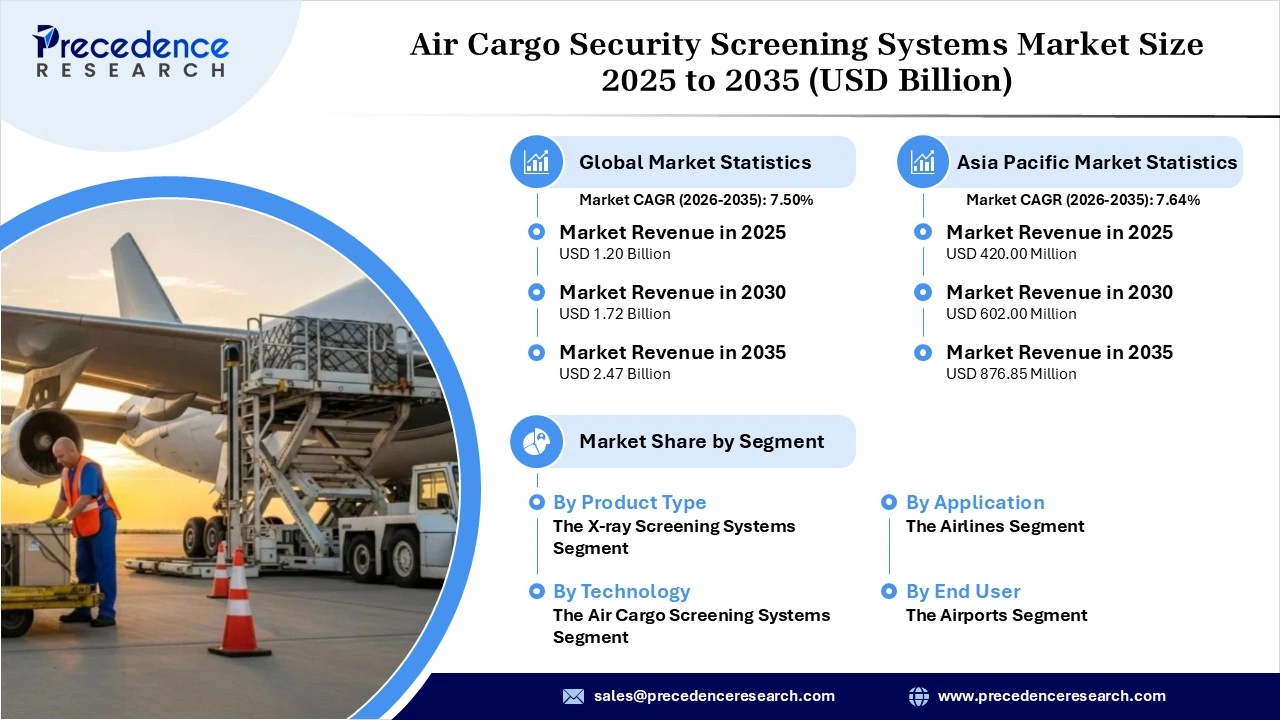
The global air cargo security screening system market revenue reached USD 1.20 billion in 2025 and is predicted to attain around USD 2.47 billion by 2035 with a CAGR of 7.50%. The air cargo security screening systems market is driven by the increasing demand for advanced technologies, such as AI and X-ray imaging, to ensure the safety and efficiency of global trade and aviation.
Market at a Glance
The air cargo security screening systems market encompasses technologies and processes used to inspect, scan, and verify cargo before it departs. From X-ray imaging and explosive detection to AI-powered analytics that quickly identify anomalies, air cargo security screening ensures that security keeps pace with the growing demands of global trade, balancing speed and safety in a shipment-driven world. At the intersection of aviation safety and international trade, the air cargo security screening systems market ensures that security keeps pace with the growing demand for efficiency in global shipments. Found in airports, freight terminals, and logistics hubs, this market incorporates hardware, software, and integrated services to detect threats across various cargo types. As global trade expands and new risks emerge, the industry evolves toward automation, data intelligence, and enhanced compliance, ensuring secure yet fast cargo management worldwide.
What are the Major Factors Driving the Market?
- Rising Security Concerns: Increasing global security threats, such as terrorism and smuggling, are pushing for more stringent screening measures to protect air travel and cargo.
- Technological Advancements: Innovations in AI, machine learning, and automation are improving the accuracy, speed, and efficiency of cargo screening processes, reducing human error and enabling faster processing times. AI-powered predictive systems, autonomous imaging, and advanced analytics are transforming cargo screening from reactive to proactive, improving detection accuracy and minimizing delays, enhancing both safety and operational efficiency.
- Increased Global Trade: With the rise in e-commerce and global supply chains, the volume of air cargo is growing, necessitating more sophisticated and faster security systems to maintain operational efficiency.
- Government Investments: Governments are heavily investing in modern security infrastructure, including screening technologies, to enhance safety and support the growing volume of global air freight. In 2025, the U.S. allocated $500 million annually for explosive detection systems and $250 million for upgrading checkpoint technology, demonstrating a strong commitment to advancing screening infrastructure.
How Regulatory Compliance Shapes the Air Cargo Security Screening System Market?
The air cargo security screening system market is primarily driven by regulatory requirements rather than organic demand. A federal mandate to screen all cargo on passenger planes catalyzed a rapid scale transformation. Compliance analysis shows discrepancies, with 84% compliance across 5,000 flight inspections versus only 75% adherence to international standards. Additionally, over 720 accredited screening facilities handle more than 40% of total cargo volume, signaling a trend towards decentralization. Consequently, market growth is shaped more by regulatory enforcement, incomplete verification processes, and the proliferation of multiple testing companies rather than organic demand.
National and international regulations, such as those from the TSA and ICAO, require advanced screening technologies to ensure compliance and secure global trade. International and national efforts to tighten cargo screening regulations are driving global compliance, with expanded frameworks and standardization accelerating the deployment of certified systems.
Market Segmentation Overview
- By product type, the X-ray screening systems segment accounted for a major market share of 50% in 2025, primarily due to their status as the industry standard for security checkpoints. These systems are especially crucial at busy airports, where efficient and reliable processing is essential for maintaining smooth operations.
- By product type, the explosive detection systems segment held the second-largest market share of 25% in 2025 and is expected to grow at a significant rate in the coming years. This growth is driven by rising global security concerns and increasingly stringent regulations. These systems are not only effective in accurately detecting threats but are also essential for compliance with evolving security standards, making them a vital addition to many cargo operations.
- By technology, the air cargo screening systems (ACS) segment held a major revenue share of 45% in the market in 2025, driven by the surge in global trade activity. The widespread adoption of these systems highlights the growing need for organized and reliable screening technologies that can efficiently handle increasing cargo volumes while ensuring consistent detection accuracy.
- By technology, the automated screening system segment is expected to grow at the fastest rate during the projection period, driven by the industry's shift toward greater efficiency. As airports sought faster, less labor-intensive solutions, automation emerged as a key driver, reducing manual tasks and significantly improving throughput, accuracy, and overall operational efficiency in cargo handling.
- By application, the airlines segment accounted for a 39.50% share of the market in 2025, driven by the rapid expansion of international routes and cargo activities. As passenger volumes grow, the demand for secure installations and reliable inspection processes also rises, making advanced screening systems a necessity for ensuring smooth and safe operations.
- By application, the freight forwarders segment was the second-largest shareholder, holding a 25% market share in 2025. With increasing investments in screening systems to meet global standards, freight forwarders are ensuring compliance with regulations and enhancing reliability. This not only fosters trust in logistics networks but also minimizes delays and security risks, which can have significant cross-border impacts.
Regional Analysis
Asia Pacific dominated the air cargo security screening systems market with a 35% share in 2025 and is expected to grow at the fastest CAGR during the forecast period. This is mainly due to the rapid development of air cargo routes, rising regulatory pressures in emerging markets, and the surge in e-commerce trade. China is expected to spearhead large-scale airport expansion, while India continues to grow cargo terminals as part of aviation upgrades. Additionally, Southeast Asian nations like Singapore and Indonesia are focusing on advanced screening technologies to manage the increasing cargo volumes.
North America held the second-largest market share of 30% in 2025 and is expected to grow at a significant rate over the projection period. This is largely due to its robust security framework and the presence of high-volume international airports. The region’s early adoption of advanced screening technologies, supported by federal security initiatives and national regulatory compliance, has driven strong demand. Additionally, Canada has played a key role in harmonizing laws and modernizing airports, ensuring outdated systems are replaced, and reducing vulnerabilities within the security ecosystem.
Air Cargo Security Screening Systems Market Coverage
| Report Attribute | Key Statistics |
| Market Revenue in 2025 | USD 1.20 Billion |
| Market Revenue by 2035 | USD 2.47 Billion |
| CAGR from 2026 to 2035 | 7.50% |
| Quantitative Units | Revenue in USD million/billion, Volume in units |
| Largest Market | North America |
| Base Year | 2025 |
| Regions Covered | North America, Europe, Asia-Pacific, Latin America, and the Middle East & Africa |
Top Companies in the Air Cargo Security Screening System Market
Industry leaders such as L3Harris Technologies (formerly L3 Technologies), Smiths Detection, and Rapiscan Systems dominate the air cargo security screening market with their cutting-edge X-ray imaging, CT scanning, and explosive detection technologies used globally. These companies hold a significant share of the market revenue. Additionally, Nuctech Company Limited plays a crucial role, particularly in Asia and emerging markets, offering cost-effective and scalable screening solutions.
Segments Covered in the Report
By Product Type
- X-ray Screening Systems
- 2D X-ray Systems
- 3D X-ray Systems
- Explosive Detection Systems
- Trace Detection Systems
- Explosive Detection Liquid
- Computed Tomography (CT) Systems
- Single-view CT Systems
- Multi-view CT Systems
- Other Screening Systems
- Passive Millimeter Wave Imaging Systems
- Automated Explosive Detection Systems
By Technology
- Air Cargo Screening Systems (ACS)
- Manual Screening
- Automated Screening
- Automated Screening Systems (ASS)
- Inline Systems
- Stand-alone Systems
- Manual Screening Systems
- Traditional Methods
- Hybrid Manual Systems
By Application
- Airlines
- Passenger Air Cargo
- Freight Air Cargo
- Freight Forwarders
- Logistics Companies
- Express Delivery Providers
- Ground Handling
- Cargo Terminal Operators
- Airport Cargo Handlers
- Logistics Providers
- Third-party Logistics
- Warehousing
- Other Applications
- Customs and Border Protection
- Military Applications
By End-Use
- Airports
- International Airports
- Regional Airports
- Cargo Terminals
- Freight Cargo Terminals
- Express Cargo Terminals
- Customs and Border Protection
- Others
By Region
- North America
- Latin America
- Europe
- Asia-pacific
- Middle and East Africa
Get this report to explore global market size, share, CAGR, and trends, featuring detailed segmental analysis and an insightful competitive landscape overview @ https://www.precedenceresearch.com/sample/8292
You can place an order or ask any questions, please feel free to contact us at sales@precedenceresearch.com |+1 804 441 9344