



Alzheimers Disease Diagnostics Market Revenue to Attain USD 26.21 Bn by 2035
Published: 25 May 2026
Author: Precedence Research



Alzheimers Disease Diagnostics Market Revenue and Trends 2026 to 2035
The global Alzheimers disease diagnostics market revenue surpassed USD 9.40 billion in 2025 and is predicted to attain around USD 26.21 billion by 2035, growing at a CAGR of 10.80%. The overall market is currently booming, driven by an explosion of elderly patients, the development of blood-based biomarker testing for rapid diagnosis, and the necessity for more urgent, accurate diagnosis as new therapeutic interventions surface before symptom progression.
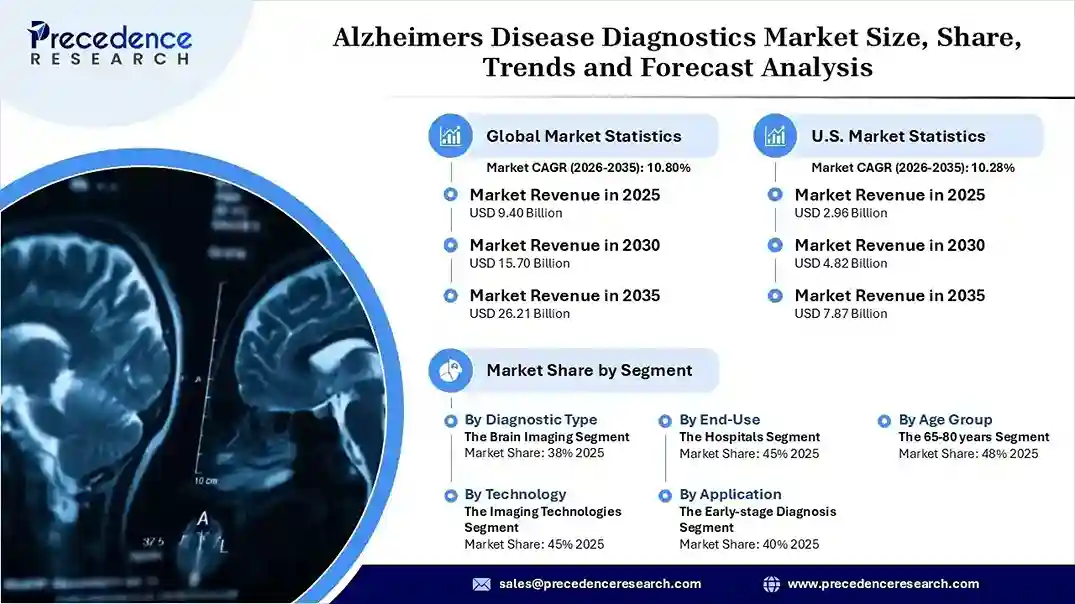
Market at a Glance
The diagnostic sector for Alzheimer’s disease encompasses many products, technologies, and clinical services intended to diagnose, confirm, and monitor the course and progress of Alzheimer’s disease in one form or another across different phases of cognitive decline. It includes blood biomarker assays, brain imaging tools such as PET and MRI, cerebrospinal fluid testing, genetic screening, digital cognitive assessments, and laboratory analysis platforms. Growth in this market reflects the rising need for earlier diagnosis, treatment selection, and long-term disease management worldwide.
The scope of the Alzheimer’s disease diagnostic market extends from hospital-based imaging and laboratory testing to emerging point-of-care blood diagnostics, AI-enabled screening tools, and remote cognitive monitoring platforms. It covers research, early-risk detection, treatment eligibility testing, disease progression tracking, and expanding access across developed and emerging healthcare systems.
Market Forecast for the Alzheimer’s Disease Diagnostics Market
- Blood Tests Are Driving the Market: The U.S. FDA cleared the first blood test for Alzheimer’s diagnosis in May 2025, Lumipulse G pTau217/β-Amyloid 1-42 Plasma Ratio. In a 499-patient study, 91.7% of positive results aligned with confirmed amyloid pathology, while 97.3% of negative results ruled it out. This opens the door for mass adoption in clinics that previously lacked PET scan access.
- Demand for New Therapies for Alzheimer’s Disease Diagnostics : Disease-modifying drugs such as Leqembi and Kisunla often require biomarker confirmation before treatment begins. This makes diagnostics the front gate to therapy access, boosting demand for blood assays, PET imaging, and CSF testing.
Increasing Alzheimer’s Cases Supporting Diagnostic Demand
- More than 7 million Americans were living with Alzheimer’s in 2026, creating a steadily expanding pool of people who may require cognitive screening, biomarker tests, and imaging services.
- By 2050, an anticipated 13 million individuals are forecast to be impacted, indicating a growing market for diagnostics on Alzheimer’s disease.
- Today, almost 1 in 9 people aged 65 and older receives a diagnosis of Alzheimer’s, indicating that an aging population has a growing demand for testing services.
- A large majority, 74% of patients, are aged 75 or older, indicating rising diagnostic needs in later life care domains such as memory clinics and hospitals.
- Potential health and long-term care costs of dementia are expected to reach $409 billion by 2026, making it more important now than ever before for early diagnosis or intervention strategies.
- These costs could rise into the $1 trillion range by 2050 and thus indirectly call forth a necessity in health-care systems worldwide for diagnostics that are efficient and scalable.
- Nearly 13 million unpaid caregivers help those living with dementia, demonstrating a comprehensive system that benefits from timely and accurate diagnoses.
Market Segmentation Overview
- By diagnostic type, the brain imaging segment held a major revenue share of 38% in the Alzheimer’s disease diagnostics market in 2025, due to the extensive use of PET and MRI scans for Alzheimer’s detection and increasing clinical adoption of amyloid imaging. Strong clinical preference for early-stage disease diagnosis, combined with rising availability of advanced neuroimaging systems, has reinforced the segment’s leadership across hospitals and specialty neurological centers.
- By diagnostic type, the biomarker testing segment is expected to grow at the fastest CAGR of 16% in the market between 2026 and 2035, due to the rising development of minimally invasive blood-based biomarker tests. Increasing demand for earlier and more accurate diagnosis, coupled with government investments in biomarker research and commercialization, is expected to accelerate the adoption of precision diagnostics in neurology practice.
- By technology, the imaging technologies segment accounted for a considerable revenue share of 45% in the market in 2025, because of their strong diagnostic accuracy in detecting amyloid plaque accumulation. Wider adoption in advanced Alzheimer’s diagnosis, along with growing access to PET and MRI systems and higher investments in neuroimaging infrastructure, has sustained segment dominance.
- By technology, the AI and diagnostics segment is expected to expand rapidly in the market with a CAGR of 18% in the coming years, due to the expansion of digital healthcare infrastructure and the rising adoption of AI-assisted imaging analysis. Rising integration of predictive analytics in neurology and growing demand for automated diagnostic workflows are expected to reshape diagnostic efficiency worldwide.
- By end-use, the hospitals segment held a major revenue share of 45% in the Alzheimer’s disease diagnostics market in 2025, due to high patient inflow for neurological assessments and memory-related disorders, and strong availability of advanced imaging technologies. Strong availability of advanced imaging technologies and increasing demand for integrated Alzheimer’s diagnostic services have positioned hospitals as the primary care setting.
- By end-use, the diagnostic laboratories segment is steadily growing with a CAGR of 13% in the market between 2026 and 2035, as demand rises for biomarker and blood-based testing. Increasing automation, improved laboratory efficiency, and broader adoption of molecular diagnostic technologies are expected to make labs a key growth engine in the coming years.
- By application, the early-stage diagnosis segment dominated the market with a 40% market share in 2025 and is expected to maintain its leading position with a CAGR of 13.5% in the coming years, as healthcare systems increasingly focus on detecting Alzheimer’s before symptoms progress significantly. Demand for preventive neurological care and a stronger emphasis on early biomarker testing technologies have driven widespread use of diagnostic tools in early patient evaluation.
- By age group, the 65-80 years segment accounted for a considerable revenue share of 48% in the market in 2025, due to the high prevalence of Alzheimer’s disease in aging populations. Rising demand for advanced diagnostic imaging, biomarker testing, and growing healthcare spending on elderly care have supported this segment’s large share.
- By age group, the above-80-year segment is expected to grow at the fastest CAGR of 12.5% in the market between 2026 and 2035, as the global geriatric population expands sharply. Higher risk of dementia and cognitive impairment, along with increasing need for continuous disease monitoring and diagnosis, is expected to lift demand steadily.
Regional Analysis
North America dominated the global Alzheimer’s disease diagnostics market with a market share of 42% in 2025, due to strong adoption of advanced neuroimaging technologies such as PET and MRI. High healthcare spending and favorable reimbursement support have improved patient access to costly diagnostic procedures. The region also benefited from rising Alzheimer’s prevalence within its aging population and robust clinical research on early biomarkers. At the same time, Canada’s publicly funded health system made diagnostics more widely available, and the U.S., with its extensive screening-related programs, greatly helped encourage these services.
Asia-Pacific held a market share of 18% in 2025 and is expected to grow at the fastest CAGR of 14% in the market during the forecast period, due to a rapidly aging population in China, Japan, and South Korea. Increasing healthcare investments in neurological diagnostics and broader awareness of dementia are expected to expand patient testing volumes. The growing presence of advanced imaging centers is also likely to improve early detection rates. Japan is expected to lead through a strong geriatric care infrastructure, while China is anticipated to surge through hospital modernization and urban diagnostic expansion.
Alzheimers Disease Diagnostics Market Coverage
| Report Attribute | Key Statistics |
| Market Revenue in 2025 | USD 9.40 Billion |
| Market Revenue by 2035 | USD 26.21 Billion |
| CAGR from 2026 to 2035 | 10.80% |
| Quantitative Units | Revenue in USD million/billion, Volume in units |
| Largest Market | North America |
| Base Year | 2025 |
| Regions Covered | North America, Europe, Asia-Pacific, Latin America, and the Middle East & Africa |
Top Companies in the Alzheimer’s Disease Diagnostics Market
F. Hoffmann-La Roche Ltd. has emerged as a front-runner through its Elecsys blood-based Alzheimer’s assays and broad installed diagnostics network, while Fujirebio gained industry attention with the first FDA-cleared blood test for Alzheimer’s diagnosis, Lumipulse. Imaging remains a cornerstone of diagnosis, giving Siemens Healthineers, GE HealthCare, Canon Medical Systems, and Philips Healthcare strong market positions through PET, MRI, and CT systems widely used for cognitive disorder assessment. Bio-Rad Laboratories, Quanterix, Abbott Laboratories, Sysmex Corporation, and PerkinElmer contribute through immunoassays, ultrasensitive detection platforms, automation systems, and research tools that power biomarker development.
Segments Covered in the Report
By Diagnostic Type
- Brain Imaging
- PET Scan
- MRI
- CT Scan
- Biomarker Testing
- Cerebrospinal Fluid (CSF) Testing
- Blood-based Biomarkers
- Genetic Testing
- APOE Testing
- Next-generation Sequencing (NGS)
- Cognitive Assessment Tests
- MMSE
- MoCA
- Neuropsychological Testing
By Technology
- Imaging Technologies
- PET
- MRI
- CT
- Molecular Diagnostics
- PCR-based Diagnostics
- Sequencing Technologies
- Immunoassays
- ELISA
- Chemiluminescence Immunoassays
- AI & Digital Diagnostics
- AI-assisted Imaging Analysis
- Predictive Analytics Platforms
By End-use
- Hospitals
- Diagnostic Laboratories
- Specialty Neurology Clinics
- Academic & Research Institutes
By Application
- Early-stage Diagnosis
- Mild Cognitive Impairment Detection
- Disease Monitoring
- Clinical Research & Drug Development
By Age Group
- Below 65 Years
- 65-80 Years
- Above 80 Years
By Region
- North America
- Latin America
- Europe
- Asia-pacific
- Middle and East Africa
Get this report to explore global market size, share, CAGR, and trends, featuring detailed segmental analysis and an insightful competitive landscape overview @ https://www.precedenceresearch.com/sample/8427
You can place an order or ask any questions. Please feel free to contact us at sales@precedenceresearch.com |+1 804 441 9344