



CAR-T Therapies for Blood Cancers Market Revenue to Attain USD 38.40 Bn by 2035
Published: 06 May 2026
Author: Precedence Research



CAR-T Therapies for Blood Cancers Market Revenue and Trends 2026 to 2035
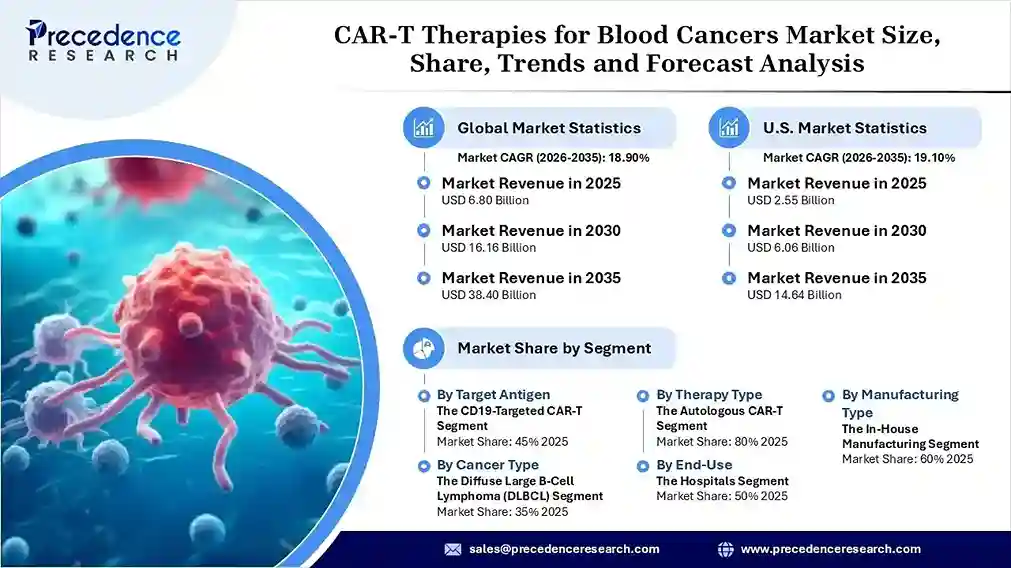
The global CAR-T therapies for blood cancers market revenue reached USD 6.80 billion in 2025 and is predicted to attain around USD 38.40 billion by 2035 with a CAGR of 18.90%. The CAR-T therapies for blood cancers market is growing rapidly due to the growing number of leukemia, lymphoma, and myeloma cases. Moreover, the rising demand for personalized treatments drives the market.
Market at a Glance
CAR-T therapies targeted against blood cancers are part of the clinical and commercial realm around genetically modified T-cell therapies that target malignant cells, which are associated with diseases such as leukemia, lymphoma, and multiple myeloma. This is the market for approved therapies, products, and services, manufacturing and development platforms, treatment facilities, logistics systems, and monitoring. Factors that have played a big role in this market include the rise in relapse rates, better survival rates, approvals by government and regulators for new therapies, and more investment in personalized treatments available in oncology.
The CAR-T therapy for blood cancers market encompasses autologous and allogeneic cell therapies. Its application spans major hematologic cancers and is expanding into emerging targets and advanced therapeutic indications, strengthening the overall capacity and reach of cell-based therapies.
What are the Major Trends Influencing the CAR-T Therapies for Blood Cancers Market?
- Expansion of Approvals and Earlier-Line Use: Regulatory agencies are increasingly approving CAR-T therapies for broader indications and earlier lines of treatment in blood cancers. This is expanding patient access and driving faster adoption across hospitals and cancer care centers globally.
- Advances in Next-Generation CAR-T Technologies: Innovation in gene editing, dual-target CAR-T, and allogeneic “off-the-shelf” therapies is improving safety, efficacy, and scalability. These advancements are also helping reduce relapse rates and shorten treatment manufacturing timelines.
- Growing Shift Toward Outpatient and Decentralized Care Models: Hospitals are focusing on managing toxicities such as cytokine release syndrome, enabling safer and more efficient treatment delivery. This is encouraging the expansion of CAR-T treatment centers beyond major academic hospitals into specialized and regional care facilities.
Market Segmentation Overview
- By target antigen, the CD19-targeted CAR-T therapies segment accounted for a revenue share of 45% in 2025, driven by multiple approved therapies for leukemia and lymphoma. Early clinical success, strong physician familiarity, and widespread treatment center adoption have established CD19 as the primary commercial backbone of CAR-T therapies.
- By target antigen, the dual-target & multi-antigen CAR-T segment is expected to grow at the fastest CAGR of 22% in the market between 2026 and 2035, as developers focus on improving efficacy and reducing relapse caused by antigen escape. Broader tumor recognition strategies are expected to enhance long-term remission outcomes in difficult-to-treat blood cancers.
- By cancer type, the diffuse large B-cell lymphoma segment dominated the CAR-T therapies for blood cancers market with a major revenue share of 35% in 2025, supported by its high prevalence and multiple CAR-T therapy approvals. Strong referral rates and urgent treatment needs in relapsed patients further reinforced its leading position.
- By cancer type, the multiple myeloma segment is expected to grow at a CAGR of 22% between 2026 and 2035, driven by a strong pipeline of BCMA-targeted therapies. Increasing approvals and improved response durability are encouraging broader adoption in later-line treatment settings.
- By therapy type, the autologous CAR-T therapies segment accounted for the highest share of 80% in 2025 because of established manufacturing processes and multiple approved therapies. Strong regulatory frameworks and clinical experience have reinforced its dominance in commercial oncology applications.
- By therapy type, the allogeneic CAR-T therapies segment is expected to grow at the fastest CAGR of 25% in the upcoming period, driven by scalability, lower production costs, and immediate availability. Off-the-shelf therapy models significantly reduce treatment wait times, offering a major advantage for rapidly progressing cancers.
- By end-use, the hospitals segment led the market with a share of 50% in 2025, as they serve as the primary centers for CAR-T administration and toxicity management. Their multidisciplinary expertise and critical care infrastructure make them essential for safe and effective treatment delivery.
- By end-use, the specialty cancer treatment centers segment is expected to expand rapidly in the market with a CAGR of 20.5%, driven by advanced infrastructure and specialized expertise in cell therapy. Their focused treatment models and expanding accreditation are improving patient access and regional adoption.
- By manufacturing type, the in-house manufacturing segment held a 60% share of the CAR-T therapies for blood cancers market in 2025, due to greater control over quality, intellectual property, and supply chain processes. Integrated production systems ensure consistency, scheduling efficiency, and compliance with chain-of-identity requirements.
- By manufacturing type, the CDMO segment is expected to grow at the fastest CAGR of 21.5% in the market between 2026 and 2035, driven by increasing outsourcing trends to improve scalability and reduce capital burden. Partnerships with specialized manufacturers are helping companies accelerate development timelines and expand production capacity.
Regional Analysis
North America dominated the global CAR-T therapies for blood cancers market with a 50% share in 2025, supported by rapid regulatory approvals, strong reimbursement systems, and the presence of leading players such as Gilead Sciences, Bristol Myers Squibb, and Johnson & Johnson. The U.S. leads regional demand due to advanced treatment centers, faster patient access, and well-established oncology infrastructure. Moreover, Canada contributes to the market due to rising investments in academic research and expanding hematology programs.
Asia Pacific held a 15% share in 2025 and is expected to grow at the fastest CAGR of 22.5% in the coming years, driven by rising clinical trials, supportive government policies, and increasing blood cancer incidence. China is expected to lead regional growth due to strong biotech investments and domestic CAR-T development. Japan benefits from regenerative medicine support, and India and South Korea continue improving access through healthcare infrastructure expansion.
CAR-T Therapies for Blood Cancers Market Coverage
| Report Attribute | Key Statistics |
| Market Revenue in 2025 | USD 6.80 Billion |
| Market Revenue by 2035 | USD 38.40 Billion |
| CAGR from 2026 to 2035 | 18.90% |
| Quantitative Units | Revenue in USD million/billion, Volume in units |
| Largest Market | North America |
| Base Year | 2025 |
| Regions Covered | North America, Europe, Asia-Pacific, Latin America, and the Middle East & Africa |
Top Companies in the CAR-T Therapies for Blood Cancers Market
The CAR-T therapies for blood cancers market is led by established players such as Novartis, which pioneered early commercial CAR-T approvals. Other major contributors include Gilead Sciences (via Kite Pharma), Bristol Myers Squibb, and Johnson & Johnson (via Legend Biotech), which have expanded therapies in lymphoma and multiple myeloma. Emerging companies such as Fate Therapeutics, Allogene Therapeutics, and Cellectis are advancing next-generation allogeneic platforms focused on scalability and faster patient access.
Segments Covered in the Report
By Target Antigen
- CD19-targeted CAR-T Therapies
- BCMA-targeted CAR-T Therapies
- CD20-targeted CAR-T Therapies
- Dual-target & Multi-antigen CAR-T Therapies
By Cancer Type
- Acute Lymphoblastic Leukemia (ALL)
- Diffuse Large B-Cell Lymphoma (DLBCL)
- Multiple Myeloma
- Chronic Lymphocytic Leukemia (CLL)
- Other Hematologic Malignancies
By Therapy Type
- Autologous CAR-T Therapies
- Allogeneic (Off-the-shelf) CAR-T Therapies
By End-Use
- Hospitals
- Specialty Cancer Treatment Centers
- Academic & Research Institutes
By Manufacturing Type
- In-house Manufacturing
- Contract Manufacturing (CDMO-based)
By Region
- North America
- Latin America
- Europe
- Asia-pacific
- Middle and East Africa
Get this report to explore global market size, share, CAGR, and trends, featuring detailed segmental analysis and an insightful competitive landscape overview @ https://www.precedenceresearch.com/sample/8377
You can place an order or ask any questions, please feel free to contact us at sales@precedenceresearch.com |+1 804 441 9344